
Poultry farming involves raising not only domesticated varieties of birds but also some exotic wild species, such as the White Eared Pheasant. These birds captivate with their beauty, grace, and elegance. Pheasants are easily recognized by their bright, snow-white plumage, which, when kept in good conditions, retains its whiteness.
Description
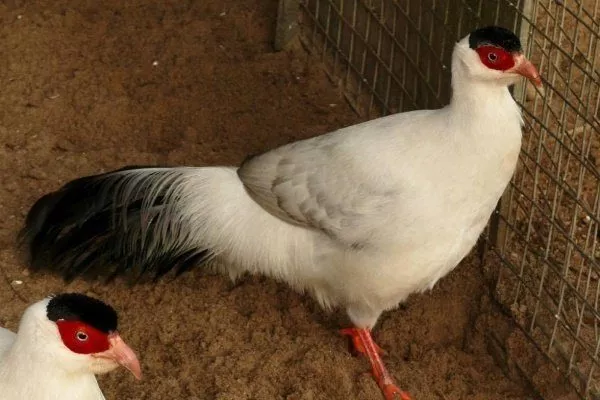
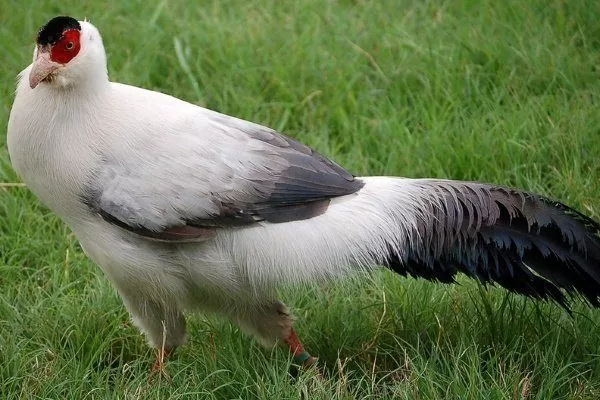
It has a small head that appears disproportionate to the rest of its body. It has a black velvet cap. The bare skin around the eyes is a rich red. The eyes are small, orange or dark yellow. The bill is curved and powerful, with a pinkish tint. The legs are bare, short, and strong, with spurs. The tail has 20 feathers, which are black with a blue tint. It is less fluffy than that of other species.
Despite the name "long-eared," this species' ears are virtually invisible. The wings are held tightly against the body, blending in well. The feathers at the tips are brownish.
Males and females cannot be distinguished by coloration, meaning they lack sexual dimorphism. This is considered unique among this family. However, distinguishing them by size is not difficult.
Males are larger, reaching a body length of up to 96 cm, with a tail no longer than 58 cm, an average wingspan of 33-35 cm, and a weight of up to 2.75 kg. Females are no more than 92 cm long, with a tail of 52 cm, a wingspan of up to 33 cm, and a weight of just under 2 kg. Furthermore, females have darker feathers and lack spurs on their legs. Larger specimens and larger bodies are also possible in the wild.
Varieties
| Name | Habitat | Plumage color | Size |
|---|---|---|---|
| Sichuan pheasant | Northeastern India, southeastern Tibet, northwestern China | Snow-white chin, gray spots in the wings, brownish or dark gray tail | Body length up to 96 cm, tail up to 58 cm |
| Crossoptilon crossoptilon lichiangense | Central China | Ash Wings | Body length up to 96 cm, tail up to 58 cm |
| Tibetan pheasant | Tibet | Snow-white or greyish, white wings | Body length up to 96 cm, tail up to 58 cm |
| Dolan's eared pheasant | Qinghai (Chinese province) | Ash-gray body, white belly, light gray wings | Body length up to 96 cm, tail up to 58 cm |
| Crossoptilon crossoptilon harmani | Northern India, central Tibet | Not specified | Body length up to 96 cm, tail up to 58 cm |
The species includes several subspecies of long-eared pheasants. They all differ from each other in plumage coloration and natural habitat:
- Sichuan Pheasant (Crossoptilon crossoptilon crossoptilon) This specimen has a snow-white chin. The rest of the plumage has some tint. The wings have gray speckles, and the tail feathers are primarily brownish or dark gray. They inhabit northeastern India, southeastern Tibet, and northwestern China.
- Crossoptilon crossoptilon lichiangense — This subspecies is very similar to the previous variety, but these pheasants are found only in central China. Their wings are ash-colored.
- Tibetan Pheasant (Crossoptilon crossoptilon drouynii) — as its name suggests, it lives in Tibet. It is either snow-white or grayish, but its wings are always covered with white feathers. In appearance, the Tibetan specimen is similar to the Sichuan specimen, but differs from the latter in its narrower and darker tail.
- Dolan's eared pheasant (Crossoptilon crossoptilon dolani) — recorded in Qinghai (a province in China) and characterized by an ash-gray body, but with only white feathers on the belly. The wings are light gray.
- Crossoptilon crossoptilon harmani Some ornithologists classify these birds as a subspecies of the white eared pheasant, while others consider them a separate species. They live in northern India or central Tibet.
Habitat
The white pheasant is found in the wild in Tibet, western China, and some parts of India. It prefers to inhabit mountain forests, at altitudes up to 4,600 meters, but does not rise above the snow line. In China, they can be found on the rocky, steep banks of the Yangtze River, in thickets of rose hips, barberries, rhododendrons, junipers, and other shrubs.
Number of people
In the wild, their population ranges from 10,000 to 50,000, with fewer mature individuals—approximately 6,700 to 33,000. However, in recent decades, experts have noted a downward trend in the white eared pheasant population, as their habitat is shrinking due to deforestation, making them a desirable trophy for hunters.
This sacred bird is protected by Buddhists; they are often found in monastery courtyards. Protected areas have also been established where they can be found.
Behavior
Pheasants of this species are distinguished by their sedentary lifestyle. They dislike flying, and even in times of danger, they prefer to flee from a hunter's dog or predator, covering long distances. However, this is not to say that they are poor flyers. On the contrary, the bird is noted for its rapid flight, capable of covering large distances in a short period of time.
These birds enjoy the company of their own kind, so they live in large groups. They spend almost all their time searching for food, digging through rocky soil with their strong legs and equally powerful beak. They prefer to inhabit alpine meadows, where they find abundant food, specifically the underground parts of plants. During the day, the birds rest near streams or water sources. The availability of water is also a fundamental factor in their distribution.
In winter, experts believe their white plumage serves as camouflage; the bird blends in well with the snow. Deep snow cover is no obstacle for them. They can move across it using their wings and tail. Pheasants rely on their wings spread across the snow and their wide, open tail. They leave very intricate, interesting tracks in the snow.
When the thermometer drops below freezing, the birds remain active and spend all their time searching for food. In winter, the "community" numbers up to 250 birds; in warmer months, it usually numbers no more than 30, and in spring, during mating season, they live exclusively in pairs.
Are they kept in captivity?
Only two subspecies are raised in aviaries: Crossoptilon crossoptilon crossoptilon and Crossoptilon crossoptilon drouynii. These are hardy birds that can withstand severe frosts, but they do not tolerate heat, sun, and indoor humidity very well.
One of the most trusting birds, they are easily trained in captivity and have a calm disposition. They spend the entire day doing the same thing—digging for worms in the garden. They are not prone to flying from one place to another, so they are safely kept free in large areas.
Mating season and reproduction
In May, early in the morning or late in the evening, cries begin to ring out in the forest. If you follow them, you'll see the following scene: a male circling the females, screaming. To impress, he puffs out the brightly colored parts of his head, lowers his wings, and raises his tail. Most ornithologists believe pheasants are monogamous, as they lack sexual dimorphism, and their mating "dances" are limited to a simple display of beauty.
Their nests are located under a tree or rock directly on the ground. The female typically lays 6-9 eggs, laid every 2-3 days. After approximately 24 days, the chicks hatch, weighing about 40 grams, but by ten days of age, this weight has increased to 85 grams. The young grow very quickly, with those at 50 days weighing up to 600 grams. Females are on average 50 grams lighter than males.
At 3.5 months, individuals can be distinguished by sex. Male cockerels have legs covered with short, thick fur, no more than 5 mm long. Chicks leave the nest as soon as they can walk.
The white eared pheasant is best bred in regions with a temperate climate. This bird does not thrive in hot and arid areas.
In captivity, birds' behavior is less peaceful. Some males often display aggression toward their fellows. Therefore, it is recommended to provide them with larger enclosures and more hiding places for females to escape from a boisterous male. Clipping one of the male's wings can help moderate his ardor.
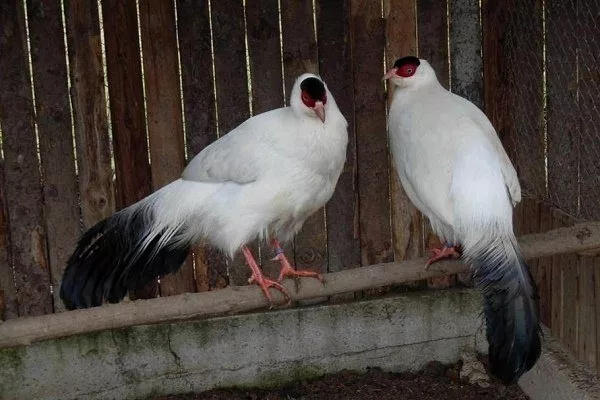
Only healthy birds that can be identified by the following characteristics are selected for breeding:
- good weight and developed muscles;
- dry nostrils;
- bright eyes;
- shiny, clean, odorless feathers;
- straight fingers.
Females lose their maternal instincts when kept at home, so it's necessary to find a broody hen—a common domestic hen or turkey hen would work well for this role.
Another option is to use an incubator for hatching. Incubation requires low humidity (45-50%) and a temperature of 35°C. Eggs are collected daily while in storage (the storage temperature should not exceed 10°C) and should be turned twice daily to prevent the birth of weak chicks. Eggs no older than 11 days are used for incubation. The older the egg, the less likely it is to hatch.
- ✓ The temperature in the incubator must be strictly maintained at 35 °C with a deviation of no more than ±0.5 °C.
- ✓ Humidity in the incubator must be kept within 45-50% to prevent the eggs from drying out.
All varieties of these birds can interbreed and produce offspring. Birds are ready to mate in their second year of life.
Conditions of detention
If you're considering keeping several birds of this beautiful pheasant variety, be prepared to spare no expense on the outdoor area. It should be very spacious; 18 square meters is recommended (for 4-5 birds). Place a dry tree or plant some shrubs inside.
The floor of the bird house is covered with an 8-cm-thick layer of bedding—fine-grained river sand, finely chopped straw, hay, or aspen sawdust. Pine or cedar wood shavings release aromatic hydrocarbons (phenols) and toxic acids. This can cause various dermatitis, gastrointestinal irritation, or allergic reactions in pheasants.
Aviaries must have a roof to provide shelter from the rain and keep the flooring dry. Pheasants quickly become ill and die in damp conditions. A 4-square-meter aviary is typically designed for one pair. Otherwise, in cramped quarters, birds develop the very harmful habit of eating each other's feathers and pecking at each other's feet. However, this behavior can also be caused by a vitamin and mineral deficiency. Therefore, bunches of fresh herbs and root vegetables (turnips, carrots, and beets) are hung year-round at a height of 40 cm.
What do eared pheasants eat?
In the wild, white-eared pheasants are omnivorous. They prefer plant foods—bulbs, tubers, roots, seeds, grains, and leaves. In summer, their diet expands to include berries. They enjoy strawberries and cranberries.
Although they are vegetarians, they require protein during the egg-laying period. Animal food, such as various insects, grasshoppers, snails, slugs, and small lizards, appears on their menu.
In autumn, juniper berries form the basis of their diet. In winter, they feed on pine needles, wolfberries, juniper berries, and dried flower seeds. In unfavorable conditions, such as prolonged snowstorms, they survive on pine needles and the dung balls of animals such as deer and rabbits.
In captivity, such a diet is difficult to find. Therefore, experts recommend a diet consisting of 25% greens and 75% special food made from a mixture of grains. Alternatively, they use corn-based mixtures with the addition of soybean meal and beans, protein, and vitamins.
| Type of feed | Protein percentage | Recommended period |
|---|---|---|
| Standard mixture | 18% | Winter |
| Propagation mixture | 25% | Breeding period |
Canadian breeders introduced feed containing 18% protein into their charges' diets in winter, and also gave them apples, grapes, and hard-boiled eggs.
During the breeding season, the protein content is increased by 25%. Birds must have free access to clean water, which must be changed regularly.
When their diet lacks protein, pheasants are prone to cannibalism. To reduce the risk of bacterial diseases, waterers are cleaned and washed daily.
Diseases
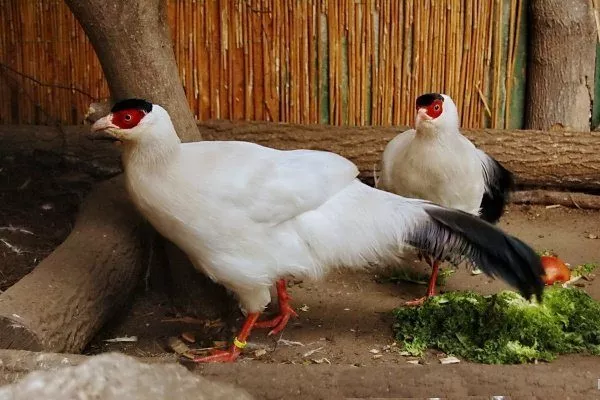
Pheasants are hardy birds with a lifespan of 15-25 years. They are resistant to various diseases. However, they can contract diseases that affect domestic birds:
- botulism;
- Newcastle disease;
- avian tuberculosis;
- pasteurellosis or cholera.
The most common infectious disease in domestic pheasants is coccidiosis. It is caused by protozoa that enter the birds' bodies through contaminated feed. The disease is epidemic in nature, meaning that virtually the entire flock living in the same area is infected within a short period of time. Young birds, whose immune systems are weaker, are more susceptible.
The main symptoms of the disease are:
- liquid and foamy stools in which blood clots are found;
- mucus is secreted from the beak;
- The bird exhibits lethargy, thirst and lack of appetite.
Pheasants are also often infected with parasitic worms, so breeders recommend regular preventative measures and parasite control. If parasites have settled on the birds, they must be treated with special products. Ash baths are used for bathing as a preventative measure.
The white eared pheasant is a curious and friendly bird. It is undemanding in terms of care and is completely unpretentious. When breeding it in captivity, it is important to remember that this is a representative of the wild, and to ensure its comfortable maintenance, it is necessary to create conditions similar to their natural habitat. Then they will produce offspring and delight you with their beauty.
Hello, could you please tell me how to distinguish young white-eared bats?