
Keeping pheasants is only possible if you have an aviary. These birds are demanding when it comes to housing, so determine the area and plan the enclosure right away. Building one yourself is possible with some effort and the knowledge contained in this article.
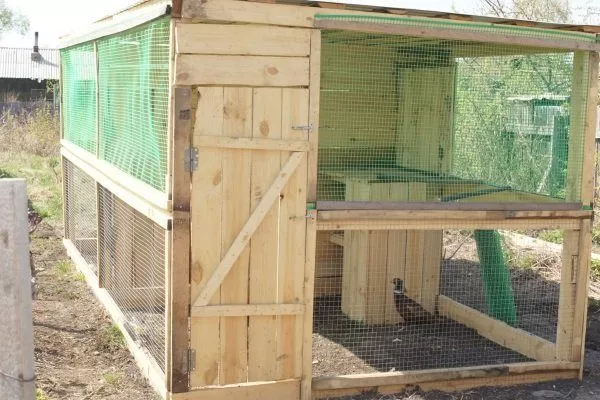
Requirements for a pheasant enclosure
When kept captive, pheasants require a fairly large living area. They can't simply be released into the open air for exercise. These birds must be kept within an enclosed area at all times.
To ensure pheasants' comfort, their living conditions should be as close to natural as possible. To achieve this, consider the following requirements when constructing the enclosure:
- Choose a dry, flat location for your poultry house. Avoid lowlands due to their dampness or hills due to their exposure to winds.
- Sandy soil is preferred. If the soil composition is different, the enclosure floor should be covered with 30 cm of fine gravel and sand.
- Be sure to cover the aviary ceiling with mesh. It's best to choose a mesh made of soft materials (rope, nylon, or plastic) to prevent birds from injuring themselves.
- For the Diamond and Golden pheasant breeds, a house is required in the enclosure. Other breeds do without one.
- The enclosure should contain snags, trees, bushes, ladders and other types of perches.
- The size of the enclosure for the wards must have sufficient area.
Types of enclosures
| Name | Size | Material | Peculiarities |
|---|---|---|---|
| Made of metal | 3x3x2.5 m | Metal mesh | One wall is made of boards |
| Made of metal with the use of wooden materials | 3x3x2.5 m | Wood and metal mesh | Depends on the quality of the wood |
| Made of polycarbonate | 3x3x2.5 m | Polycarbonate and mesh | Weather protection |
Pheasant enclosures come in a wide variety of designs and constructions, including wood, metal, or a combination of both. They can be built above ground or suspended.
Types of poultry houses:
- Made of metal. The most common and simplest type of enclosure is one constructed entirely of a frame covered with wire mesh. An improved version of this type of enclosure is a single-walled enclosure made of solid boards. Birds are more comfortable in such enclosures, as they can find shelter from the wind along the solid wall.
- Made of metal with the use of wooden materials.Construction using wood for the base and metal mesh for the fencing. This option is less expensive to construct, but the enclosure's lifespan depends on the quality of the wood and its treatment with special compounds.
- Made of polycarbonate.An example of a poultry house is a polycarbonate greenhouse with mesh on the front and back walls. This type of enclosure always provides ample light and shelters the birds from the elements.
Enclosures can have a roof made of any roofing material, or a mesh roof can be used instead. Slate or tile roofing is preferred. If the structure is roofless, a canopy should be built to provide shelter for the birds during precipitation and to provide protection from the sun.
Whether or not to build a birdhouse is a personal decision for each breeder. Remember that not all pheasant breeds require one. Such a structure can serve as a decorative element.
Selecting materials for the enclosure
The choice of materials for building an enclosure is determined by the breeder's vision and financial situation. You can purchase the necessary equipment at a higher quality and more expensive price, or save money on building the enclosure yourself. The design is simple, so even a novice can handle the tasks.
Galvanized fencing mesh
The enclosure must be enclosed, meaning it must be fenced on all sides. It's important to note that mesh with a mesh size larger than 20 mm is not suitable. Chicks can easily slip through it to freedom. Furthermore, a fine-mesh fence deters rodents and predators.
Give preference to a mesh covered with a layer of varnish, which prevents the spread of rust on the metal and maintains its aesthetic appearance.
Nylon mesh for a canopy
When threatened or frightened, pheasants instantly fly vertically. Therefore, when creating a ceiling canopy, use a soft mesh to prevent injury to the birds. Nylon or rope mesh with a mesh size of 2.5-2.7 cm and a thread thickness of approximately 2 mm works well.
If the enclosure is fairly tall, this isn't a concern. Even a wire mesh roof will do. The only drawback of such a roof is the potential difficulty clearing snow in the winter.
Building materials
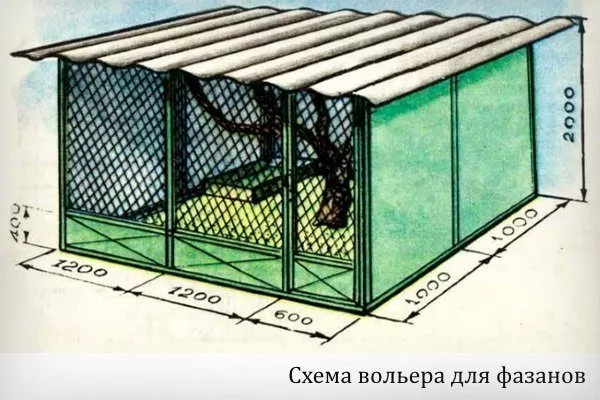
To avoid mistakes in choosing building materials, their size, and quantity, it's a good idea to draw a diagram of the proposed enclosure. Make it as close to the planned structure as possible. A diagram makes it easier to see and account for all the details. It's also very convenient to immediately list the necessary supplies and tools.
The standard set of building materials for constructing an aviary for pheasants includes:
- wooden beams for the construction of the main frame and roof;
- a board to sew up the back wall of the enclosure;
- cement and sand, or screenings to form the foundation;
- fencing mesh;
- roofing materials when planning a roof;
- fasteners;
- paint and varnish coating and antiseptic compounds;
- river sand or fine gravel for flooring.
Building a house inside the enclosure will require an additional list of materials.
Tools
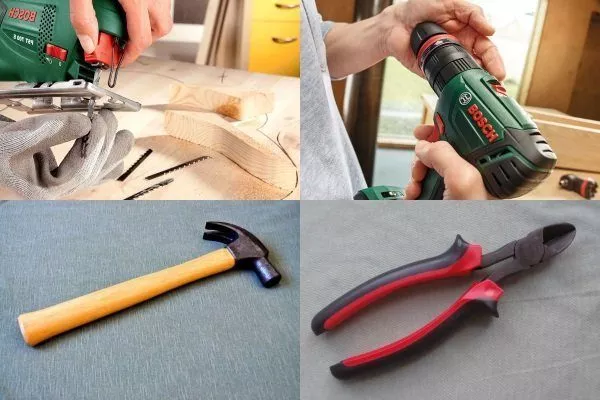
To avoid being distracted by searching for the necessary tools when building a bird fence, prepare them in advance:
- jigsaw or hand saw;
- screwdriver or screwdrivers;
- hammer;
- side cutters or pliers.
Calculating the required size
Calculate the enclosure size based on the knowledge that a single individual requires at least 2 square meters of space, while a pair requires 9-10 square meters. When breeding 300 young animals, the enclosure should be at least 200 square meters in area.
Construction of an enclosure
There are two approaches to building a pheasant enclosure:
- hire professionals to build and develop the area;
- build it yourself.
In both cases, you shouldn't expect low costs, as these birds are quite demanding in terms of living conditions. However, building the nest yourself will help reduce the construction costs.
Planning and preparatory work
The first stage of construction involves preparatory work. Determine the site for the building, level, and clear the area. Consider the interior design right away; perhaps a tree or shrub growing on the site could become a finished part of the enclosure's interior. Purchase all building materials according to the drawings and prepare a tool list.
It is recommended to create a small vestibule at the entrance so that the pheasants do not have the opportunity to jump out when the breeder opens the front door.
If the enclosure will be a suspended structure or a pheasant house is planned, a foundation must be constructed. This is accomplished by pouring concrete foundation columns or laying them out of concrete blocks. The composition of the concrete foundation mix includes:
- cement - 1 part;
- sand - 4 parts;
- water.
To form the foundation, mark the perimeter of the enclosure and dig a trench half a meter deep and at least 25 cm wide. Dig foundation holes at least 50 cm deep every 1.3-1.5 meters around the interior. Install the formwork and fill it with concrete so that it rises at least 25-30 cm above the ground surface.
It is recommended to lay a reinforced layer of rebar with a diameter of 9 mm inside the foundation when pouring concrete, to strengthen it and improve the binding properties of the mixture.
An above-ground enclosure only requires a strip foundation. However, in this case, it's advisable to remove the turf layer and sprinkle it with a 2-cm layer of slaked lime when preparing the floor mound.
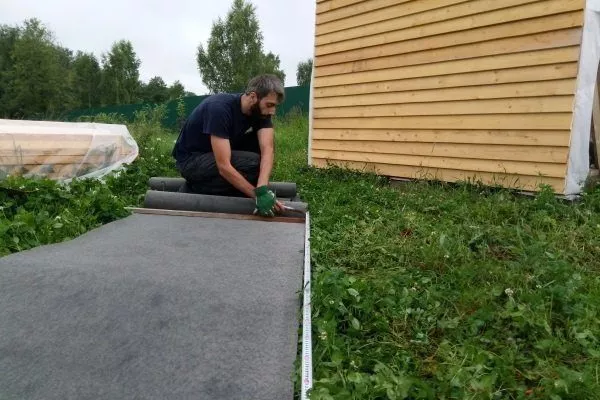
Once the foundation has hardened, lay a layer of waterproofing material on it - roofing felt.
Installation of the frame
A metal frame offers excellent performance. However, this design is only suitable for housing a large number of pheasants. If you're a beginner breeder, it's easier and more cost-effective to build a wooden aviary.
Install support posts on the foundation. To adjust the roof pitch, if one is planned, the front supports should be higher than those on the rear wall. Connect the vertical beam with a cross beam in the middle plane and under the roof. The middle cross beam is necessary for structural stability and to prevent the metal mesh from sagging.
Cover the frame with mesh, securing it with a special bracket mechanism. Provide doors.
After completing the work, check that the interior of the enclosure is free of protruding or sharp wire or fastener ends, as these could injure the pheasants. If any such hazards are discovered, eliminate them.
Lathing
If you plan to have a slate roof for the enclosure, install a batten for its installation. This is made from timber laid lengthwise at 0.75 m intervals, and then crossbars are formed at the same interval.
Another lathing method is to lay a lattice of timber opposite the main vertical supports, as if continuing them horizontally. Cover them with boards on top, maintaining a spacing of 0.5-0.75 m between them.
Place the slate on the lathing, using slate nails for fastening.
Protecting wooden parts from rotting
Wood as a building material has many undeniable advantages, but it does have one significant drawback: it's susceptible to rot. The service life of such a structure does not exceed 3-5 years, depending on the location. Therefore, prepare the wood before construction by impregnating it with a mixture of heated bitumen and diesel fuel.
To prepare this preservative, place a container of bitumen on the stove, and when it begins to boil, add enough diesel fuel to liquefy the mixture. For preservative work, use this mixture while it's hot to ensure deep penetration into the wood.
After treatment, leave the wood to dry for a couple of days, then prime and paint with oil paint. The only exceptions to preservative treatment are perches, decorative trees, and driftwood—wood with which pheasants have direct contact.
Arrangement of the enclosure
The layout of the aviary depends directly on the species and breed of pheasants. Common and game birds require food, food and water containers, and an ash box. Ornamental pheasants are very demanding, so approach their aviary's interior carefully and thoughtfully.
Greening the aviary is a natural incentive for birds to breed.
Place perches and snags inside, plant shrubs, and sow part of the enclosure with grass and cereals. All of this is necessary for the birds' comfortable living. For females, a green enclosure should be constructed where they can hide from males and lay eggs. This allows the eggs to be concentrated in nests rather than scattered throughout the enclosure.
The video's author shows and explains how he built a three-section pheasant enclosure (using wild stone, timber beams and planks, mesh, and slate):
Experienced breeders advise against using mesh for the roof, so the bird can't see the sky and try to fly. And avoid using concrete for the floor, as it's too cold for winter.
Poultry house hygiene
Sanitizing the enclosure and cleaning the interior are essential for the comfortable living of pheasants. The birds are under constant threat of contracting various diseases, which can originate from seemingly harmless objects.
Thus, if hygiene is not observed, pathogenic microflora accumulates in drinking bowls and feeders, sandy floor coverings from bird droppings, and rodents can become carriers of diseases when they penetrate the enclosure.
Therefore, do not neglect the work associated with maintaining the health of your charges. After all, violations of hygiene and sanitation can lead to the complete death of birds.
Rules for caring for an aviary
Keeping your pheasant enclosure clean is crucial for the birds' comfortable and healthy lives. Therefore, be sure to maintain your pheasant enclosure and follow these guidelines:
- Remove any remaining food from feeders daily, as rotting food can cause poisoning and intoxication in pheasants. Wash and disinfect feeding containers weekly.
- Once a quarter, disinfect the inside of the enclosure with lime or caustic soda to prevent the emergence and spread of infection among birds.
- Replace the sand flooring every 8-10 weeks. Otherwise, pathogens from pheasant feces can cause serious harm to your pets.
- Make sure rodents don't get into bird enclosures. Chemical treatments are not recommended, so it's recommended to simply trap and destroy them manually.
- Completely sterilize the enclosure annually, or at most every 2 years.
Calculation of financial costs
If you build a pheasant enclosure yourself, you'll only need to spend money on building materials. Let's calculate the cost of building a 3x3x2.5 m poultry house with a pitched slate roof:
- 8-wave slate - 10 sheets × 230 rubles = 2300 rubles;
- beam with a square section of 50 mm - 24 pcs. × 75 rubles = 1800 rubles;
- board 6 m long, 100 mm wide - 20 pcs. x 450 rubles = 9000 rubles;
- cement grade M-500 - 4-5 bags × 300 rubles = 1,500 rubles;
- sand - 4 bags x 900 rubles = 3200 rubles;
- chain-link fencing 20*20 mm — 30 sq. m x 47 rubles = 1410 rubles;
- fasteners - 700 rubles.
Thus, the cost of building a pheasant enclosure is approximately 19,910 rubles, taking into account the average prices for materials.
Open enclosures
Open-air aviaries are widely used by British and Dutch pheasant breeders. This type of aviary enclosure involves fencing the area with a 1.2-1.5 m high net, buried 20 cm into the ground, and placing open houses for the birds within the perimeter. A prerequisite for this type of pheasant breeding and housing is their safety, i.e., the absence of nocturnal and diurnal predators.
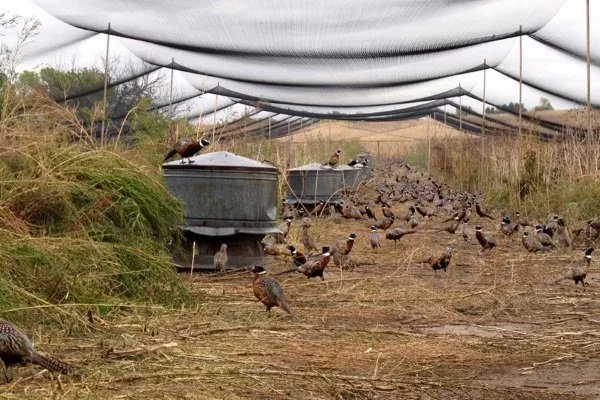
In such conditions, the pheasants' wings should be periodically clipped or tied to prevent them from flying. It's best to locate the aviary in a quiet area, sheltered from the outside world by shrubs. To encourage the hens to lay eggs, make holes in the ground in a convenient part of the aviary and line them with pine needles, hay, or straw. Place an artificial egg inside the nest.
To set up an open enclosure for your charges, keep in mind that 20 individuals require approximately 100 square meters of space.
There are many options for building, placing, and furnishing pheasant enclosures. The key is to ensure the enclosure meets their needs and provides comfortable conditions. Therefore, only those who know these birds can build an enclosure that is optimally suited to their needs. And the birds, in turn, will repay their owner with a peaceful life and active reproduction.