
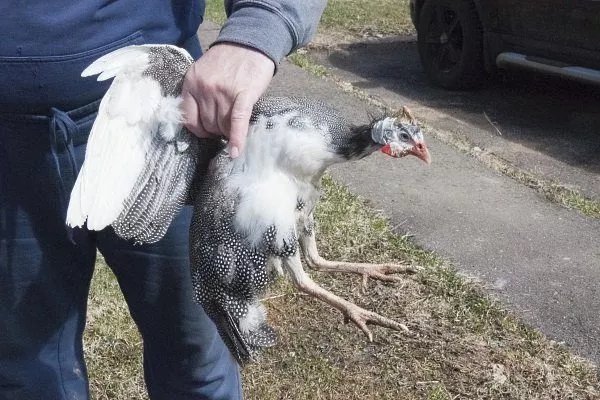
Every farmer who is involved in the maintenance and breeding guinea fowl, is faced with the task of slaughtering poultry. The correct execution of this procedure, as well as subsequent processing of the carcass, determines the meat's taste and shelf life. Understanding these important nuances will help you avoid mistakes and ensure a high-quality product.
Preparation for slaughter
Pay attention to proper preparation before slaughter:
- Place the guinea fowl selected for slaughter in a separate pen, which must be kept clean. Make sure the pen is free of bird droppings and dirt that the poultry might peck at.
- Before slaughtering a guinea fowl, clean out its gastrointestinal tract. To do this, place it on a fasting ration for 20 hours, but ensure its access to clean drinking water is unrestricted.
- Experienced poultry farmers recommend using a mild laxative to speed up the process. Mirabilite, also known as Glauber's salt, is most often used for this purpose.
- If you don't have a laxative, you can resort to a little trick. Keeping the light on in the aviary at night will disorient the bird, which will subsequently accelerate all internal processes, including digestion.
How long do guinea fowl grow before slaughter?
The main criterion for slaughtering a guinea fowl is its muscle mass. Guinea fowl gain weight much faster than chickens.
- ✓ Optimal weight for slaughter: females – 1.5 kg, males – 2 kg.
- ✓ Age for maximum weight gain: 5 months.
To successfully gain weight, birds require at least 4.5 kg of high-quality supplementary feed. A three-month-old guinea fowl typically reaches a weight of up to 1.5 kg. After this point, the poultry is ready for slaughter.
Guinea fowl reach their peak muscle mass by five months of age. By this time, the female weighs 1.5 kg, and the male up to 2 kg.
Guinea fowl are slaughtered at three months of age because the meat at this age is particularly soft and tender. It also has a low fat content and a higher content of essential amino acids.
What tools will you need?
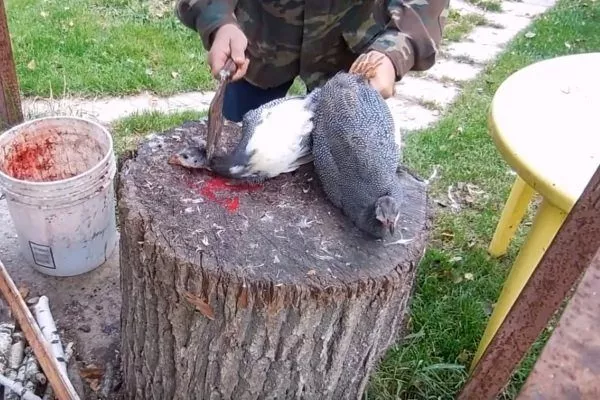
To slaughter guinea fowl at home, use large cleaverWith its help, the procedure will not require much time and effort.
A sharp cleaver easily cuts through the bird's throat and blood vessels, allowing it to die instantly and without suffering pain. However, using a large cleaver is only advisable if the meat will be consumed immediately.
It can be stored for a minimal amount of time. This is because open slaughtering promotes contamination and damage to the integrity of the product, causing the meat to spoil fairly quickly.
When slaughtering large numbers of guinea fowl, use a sharp knife inserted into the bird's beak, damaging the jugular vein. This method of slaughter allows the meat to remain fresh for a longer period of time.
Step by step process
Depending on your experience slaughtering poultry and the size of the birds, it's important to choose a convenient and easy-to-perform method. Keep the tools and clothing you use clean.
- Rinse the instruments under running water.
- Soak in a 2% bleach solution for 40 minutes.
- Boil for 10 minutes to completely sterilize.
Instruments can be disinfected using a 2% bleach solution, leaving them in the solution for 40 minutes. If disinfectant is not available, it is advisable to boil the instruments for at least ten minutes.
Slaughter is recommended to be carried out early in the morning.
Slaughter
Decapitating a guinea fowl involves using a sharp axe or cleaver. The procedure consists of three simple steps:
- For convenience, first tie the bird's legs and place it in a special bag that allows the head to be fixed in one position.
- Place the bird on a flat surface.
- Take aim and strike the bird's neck with an axe (or cleaver). Try to decapitate it on the first try. This will help put the bird out of its misery.
It's crucial to bleed the carcass after decapitation. To do this, hang it by the feet to allow the blood to drain. Neglecting this process is absolutely not recommended, as any remaining blood clots can promote bacterial growth and reduce the shelf life of the meat.
As with chicken, you can use the beak-killing or split-killing technique:
- Take the guinea fowl's head in your left hand so that the beak is facing you.
- Then insert a sharp knife directly into the guinea fowl's beak. Damaging the jugular vein will kill the bird, while preserving the integrity of the meat.
In the video below, the breeder demonstrates the process of slaughtering a guinea fowl:
Plucking and singeing
Before plucking, place the bled guinea fowl carcass in a deep container of hot water for a while. The temperature should not exceed 60 degrees Celsius (140 degrees Fahrenheit). Only then can you begin removing the feathers.
First, remove the large feathers, then move on to the smaller ones. The down is removed last.
Singing is done using a standard alcohol or gas torch. It's crucial that there are no folds on the carcass. Therefore, it's important to stretch the area being singed each time.
If the carcass is damp, it's recommended to rub it with wheat or rye flour before singeing. This will absorb any moisture on the surface of the carcass, and any remaining fuzz will be easily removed during singeing.
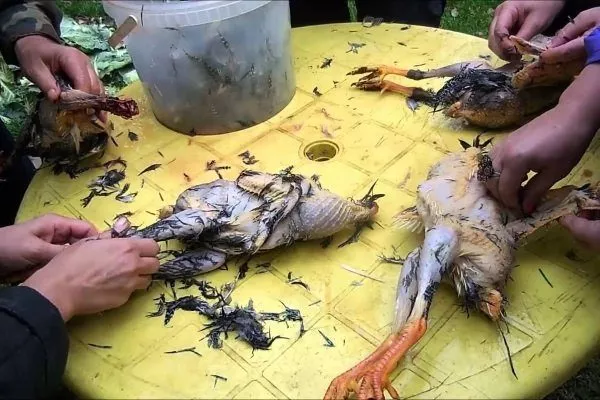
The soot that forms during scorching can be easily washed off with clean water.
Gutting
Before eviscerating a guinea fowl, the legs, wings, and neck are removed down to the second vertebra. When removing the neck, the skin is removed first, and only then is the vertebra cut. The legs are removed 15 mm below the heel joints, and the wings are removed up to the first joint.
Then you can begin gutting the bird. This will require removing all of the bird's internal organs, including the crop and esophagus.
Particular care must be taken when removing the spleen. If the organ is damaged, fluid leaks out, which imparts a bitter taste to the meat.
Once the process is complete, rinse the carcass thoroughly in ice water three times. Change the water for each rinse. Leaving the gutted carcass in water for long periods of time is not recommended, as this will deplete the meat of its nutrients.
Watch another video of guinea fowl slaughter and processing in the following video:
Carcass aging
Once the guinea fowl has been cleaned and washed, let it cool for a while. This is best done in a clean, moderately humid room at room temperature. Typically, guinea fowl does not require more than 6 hours to cool. After this time, you can begin preparing the meat.
If you want to preserve the meat for a longer period, freezing is recommended. Long-term storage of frozen guinea fowl reduces the product's nutritional value.
Cutting
There are several options for cutting up a guinea fowl carcass. Whole guinea fowl can only be cooked by grilling, baking, or boiling. Otherwise, you'll need to use one of the following methods:
- Boneless cutting.This involves completely removing the meat from the bone. This method is used to obtain the tenderloin, which is used for making meatloaf or various types of ground meat.
- Portion cutting of the carcass.This involves cutting the bird into symmetrical pieces. This method is used for baking and roasting.
- Waste-free cutting of guinea fowl carcasses. It is often used by housewives. Thanks to it guinea fowl meat It can be used extremely sparingly. You can prepare a wide variety of dishes, from broth to meat casseroles.
To carry out waste-free cutting of a guinea fowl carcass:
- Make a small cut near the thigh. Pull it back and rotate it slightly with your other hand, continuing to cut with the knife.
- A similar procedure is performed with the wing. When separating the humeral cartilage, the wing is severed.
- The guinea fowl breast is cut down the middle. The fillet is removed from the bones using a blade. This should leave two fillets and the back section, connected to the ribs.
- Cut the spine lengthwise, removing the ribs. If desired, you can chop the resulting pieces into smaller pieces.
- Although guinea fowl is a lean meat, a small amount of fat may occasionally be found. This can be discarded or stored in the refrigerator.
Slaughtering a guinea fowl is not at all difficult if you follow our recommendations. Prepare the bird properly and follow the step-by-step butchering instructions.