
A spacious enclosure for guinea fowl is the most important part of their care. Keeping birds in open areas is not recommended; it is recommended to use special cages for guinea fowlThey're easy to build yourself, but it's difficult to take into account all the details to ensure the guinea fowl's comfort.
Types of enclosures for guinea fowl
Keeping birds in cages is the most convenient method. There are two types of enclosures for guinea fowl: open and closed. Both types are quite compact, as even an adult bird doesn't require much space. An ideal size is 1.5 m high, 0.5 m long, and the same width.
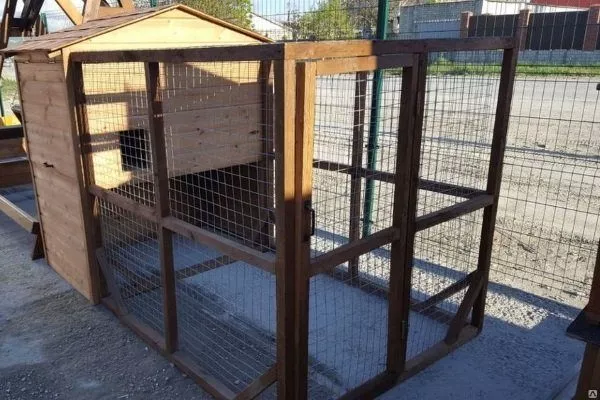
Open enclosure for guinea fowl
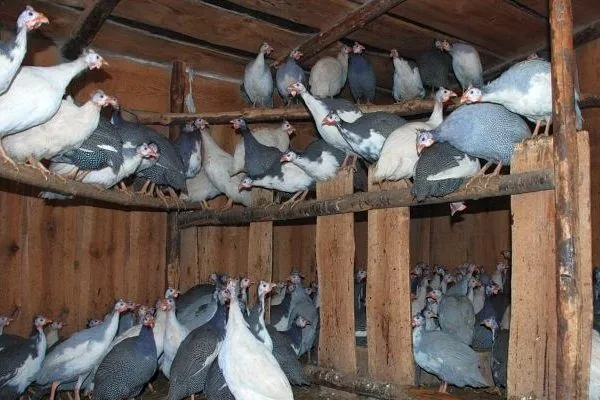
Closed enclosure for guinea fowl
| Name | Type of enclosure | Dimensions | Peculiarities |
|---|---|---|---|
| Open | Open | 1.5 m high, 0.5 m long, 0.5 m wide | Metal mesh, insulated bedding |
| Closed | Closed | 1.5 m high, 0.5 m long, 0.5 m wide | Polycarbonate roof, perches |
Open
An open-air enclosure is a small, separate area, with sides covered with wire mesh. Unlike closed-air enclosures, the guinea fowl are not kept in the enclosure all the time, which is the main difference. The enclosure may have a grassy area for feeding. The ground is covered with insulated bedding, which is changed periodically. Enclosures are typically built near the farmhouse.
There should be no roadway or bodies of water near the enclosure.
There are several features associated with the installation of an aviary:
- Do not use plastic instead of metal beams or mesh, as it can be damaged by insects and rodents.
- Choose beams made of durable material; metal pipes are best, and wooden posts make an excellent substitute.
- Enclose the enclosure with a strong mesh; a wooden fence is not suitable, as it is also a flimsy material against rodents.
- Do not dig holes for beams with a shovel, use a drill for this.
- Cover part of the aviary with a roof; this will protect the birds from precipitation.
Closed
Guinea fowl spend the entire season in an enclosed enclosure. As winter approaches, they are moved to a poultry house. This is usually a simple fenced path with access to the enclosure and the poultry house. This allows the birds to decide for themselves whether to go to a warmer place or remain outdoors, which is their preferred option.
So, they can spend the winter in an aviary. Sometimes, there's no need for a coop; according to poultry farmers, guinea fowl thrive in temperatures down to -30 degrees Celsius. The birds spend most of their time on perches, from where they move to bedding during feeding.
Frosted or solid polycarbonate, an inexpensive material, is used for the roof. It's best to reinforce it with tinted rivets to prevent the hot sun's rays from reaching the guinea fowl. This type of installation is long-lasting and is not damaged by heat, cold, or other environmental factors.
The ceiling is no higher than 4 meters. The hay bedding is changed every 1-2 months. One of the advantages of this material is that dirt always remains under the hay, keeping the enclosure clean for a long time.
The enclosure should have water bowls and feeders, but that's all it takes. The guinea fowl will build a nest on its own if needed during egg-laying season.
Step-by-step instructions for making a cage-type enclosure
Below is a step-by-step guide to making a cage-type enclosure for guinea fowl:
- Before starting work, mark out the area of the future enclosure.
- Use a ground auger to create holes for the metal or wooden posts. The holes should be deep enough to securely anchor the pipe. The surface length of the post should be at least 4 meters. Only one post should be raised 20-30 cm above the others to facilitate rainfall runoff.
- For the walls, cover the posts with wire mesh; plastic is not suitable. Instead of the bottom of the mesh on the north side, use sturdy plywood to protect the birds from the wind. You can install panels on other sides if necessary. Leave an opening on one side of the enclosure for a gate.
- Strengthen the mesh with strapping and screws.
- Another roofing option is plastic mesh. This roof consists of two layers with polyethylene stretched between them and on the surface. The roof should completely cover the perimeter of the enclosure walls, preventing precipitation from penetrating.
- Install rain pipes around the perimeter of the enclosure. Two pipes will be needed for this, the first of which should be placed on the roof.
- Cover the base of the net near the ground with sand or soil, preventing contact with wastewater.
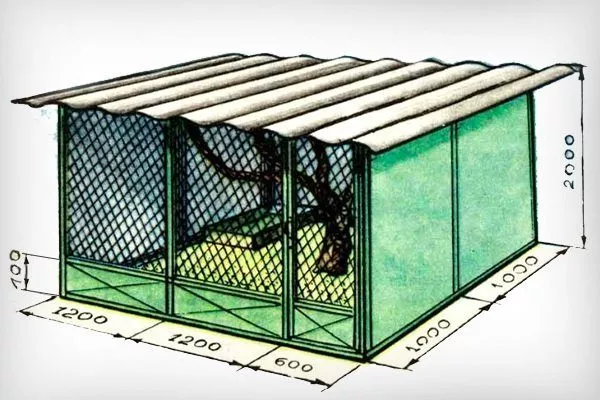
Standard cage size diagram for guinea fowl
Arrangement of a place for keeping guinea fowl
Guinea fowl are almost unpretentious in terms of keeping conditions.
To set up the aviary, you'll need to place waterers and feeders around it. The first type of perch, with the first step 50 cm above the ground, is intended for sleeping. The second type is used for play. The bedding layer consists of peat or hay, 15 to 25 cm thick (birds love to dig in it).
There are several subtleties in setting up an enclosure:
- the bedding must contain slaked lime;
- Basically, guinea fowl need shade for better egg production, this is taken into account when choosing the area for building the enclosure;
- The drinking bowls should be installed so that the guinea fowl cannot knock them over (there should be exactly as much water as the guinea fowl consumes; excess moisture is not needed in the enclosure; and it is best to install several drinking bowls so that the bird does not look for them);
- ventilation is essential;
- For perches, it is best to use real tree branches;
- It is better to level the bedding layer from time to time.
- ✓ The bedding thickness should be at least 15 cm for effective thermal insulation.
- ✓ Slaked lime is added at a rate of 0.5 kg per 1 sq.m. for disinfection.
Lighting
The enclosure should be illuminated almost all day. Sometimes, sunlight can be substituted. LED or incandescent lamps are an alternative. However, sunlight won't always be the dominant light in the cage, as shaded areas are preferred (guinea fowl thrive in these areas, as this promotes egg laying).
Temperature
Guinea fowl do not require additional insulated walls if they are protected from external drafts and precipitation. They are frost-hardy, withstanding temperatures down to -30 to -35 degrees Celsius. A floor and wall litter made of cotton wool or foam can be used. In this case, it will be necessary to monitor their condition and prevent moisture-induced rotting. The standard enclosure temperature is +16 degrees Celsius.
Failure to comply with maintenance rules often leads to poultry morbidity.
Keeping guinea fowl in enclosures and cages
Guinea fowl are kept in three ways:
- walking;
- floor;
- cellular.
Walking method
The free-range method involves letting the guinea fowl spend the day in a pasture within a confined area. They return to the enclosure at nightfall. In this case, the enclosure height will be 2-3 meters, as when the guinea fowl spent the entire day in the cage, they required more space to move around.
Some tips for following this method:
- In one part of the pasture area, a roof is also installed to protect from precipitation. Perches are also located there;
- 1 square meter of land is allocated for two guinea fowl;
- To prevent the guinea fowl from attempting to escape, you will have to cut off the flight part of the wings.
Floor method
This is the most common method of keeping guinea fowl. In this case, they spend almost all their time in an enclosure, occasionally being let outside. Here, 1 square meter of land is sufficient for 5 birds.
The bedding will not exceed 15 cm, as it will be replenished gradually during the season, once a week. Therefore, by the end of the season, the bedding layer can reach 40 cm. For floor-based housing, an internal climate control system is essential.
This includes:
- temperature from 12 to 18 degrees;
- high humidity, up to 70%.
The aviary must be equipped with a ventilation system. Otherwise, the aviary will become too airy due to the large number of birds being kept close together, with little access to the outdoors.
Cellular method
The cage method is not the most popular, but it has many advantages. Here, the guinea fowl spend almost all their time in their own small cages. Occasionally, they are allowed to walk outside. The cage size is equal to the volume of the guinea fowl plus a few dozen centimeters.
The cells are arranged in several rows next to the wall on which they will rest.
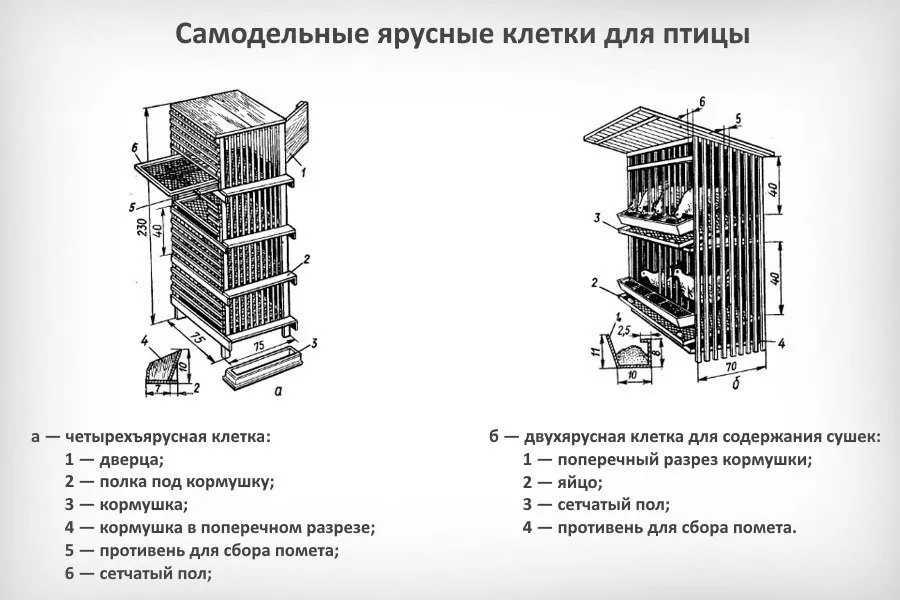
Among the advantages of this method:
- feed consumption is significantly reduced;
- the area of the territory occupied by the enclosure is reduced;
- Guinea fowl will not require daily monitoring;
- Caring for and keeping birds is greatly simplified.
Read more about rules for the care and maintenance of guinea fowl.
Among the productive advantages of this method:
- the productivity of guinea fowl during egg laying increases to 200 eggs;
- egg-laying periods occur earlier, as does maturity for egg production;
- Guinea fowl gain live weight faster without fattening; with the cage method they will remain motionless almost all the time;
- it becomes easier to carry out your work near the livestock;
- the birth rate of young animals increases significantly;
Each of the two enclosures has its advantages and disadvantages. Assembling them is not difficult, provided you have some experience. It's important to consider all the details of the structure's construction. If you lack the necessary skills, you can consult a professional poultry farmer.