
One option for keeping guinea fowl is to build cages yourself. This method has certain advantages. Caring for and keeping guinea fowl in cages has its own unique features.
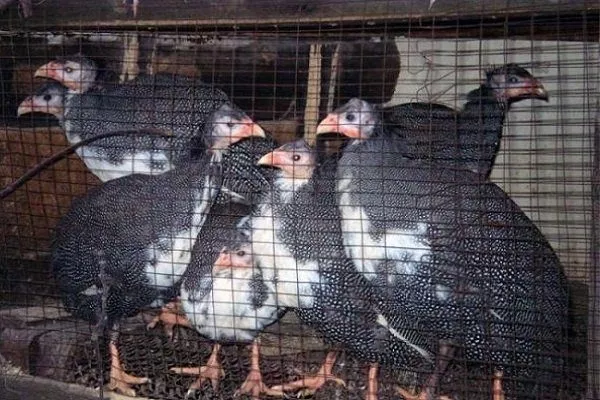
Benefits of keeping guinea fowl in cages
Cage housing for guinea fowl is a common choice among breeders. This method has several advantages:
- the insemination process is simplified;
- egg production increases - if the average guinea fowl produces 110 eggs per year, then when kept in a cage, this figure can increase to 150 eggs;
- feed consumption is reduced by approximately 15%;
- sexual maturity is reached earlier;
- the bird gains weight faster;
- the hatchability of young animals increases – this figure can rise to 85%;
- easy to care for and maintain;
- no need to control the bird during daytime hours.
A significant advantage of raising guinea fowl in cages is the space savings. This allows for expansion of the farm or the addition of these birds to other farming activities without compromising them.
The list of advantages increases when building your own guinea fowl cages. You can create custom-sized structures yourself, including any necessary modifications and additions. The main advantage is cost savings.
DIY Guinea Fowl Cages
If you buy a ready-made cage for guinea fowl, it's usually designed for 20 birds. The design consists of block cages with dividing partitions, typically with four compartments. The cages are made of wire mesh.
You can build your own cage of any size. The optimal ratio is 1.5 x 0.45 x 0.5 m (L x W x H). A design of this size is designed for 5-10 birds.
- ✓ The distance between the bars of the front wall should not exceed 50 mm to prevent the escape of young animals.
- ✓ The height of the cage should be at least 50 cm to ensure comfortable movement of the bird.
The following materials and tools will be required:
- wooden blocks with a cross-section of 3-4 cm - the frame will be made from these, a length of 10 m is sufficient;
- galvanized mesh floor grid 1.5x0.6 m (cells 75x12.5 mm);
- galvanized mesh for walls (side, rear) and roof 3x4 m (cells 25x25 mm);
- galvanized mesh for the front wall 1.5x0.5 m (cells 50x50 mm);
- galvanized sheet iron to fit the floor size – used as a pallet;
- door hinges;
- metal corners - you need two corners, the length corresponds to the depth of the cage;
- PVC pipe for making a feeder, diameter – 10 cm, height – 1.5 m;
- PVC pipe for drinking bowl, diameter – 7 cm, height – 1.5 m;
- hacksaw;
- metal shears;
- hammer, screwdriver or drill;
- nails or screws;
- wire for attaching the feeder;
- construction stapler.
Once you've gathered all the necessary materials, you can begin building the guinea fowl cage. Follow these steps:
- Build a timber frame. Fasten the pieces together with nails or screws. The frame will be supported by legs 15 cm high.
- Prepare pieces of galvanized mesh of the required size. Use metal shears for this.
- Attach the front, back, and side panels to the frame. It's easiest to do this with a stapler.
- Secure the floor.
- Fold over part of the front mesh wall to create an egg collector. It should be the right size for the guinea fowl eggs.
- Bend the sides of the galvanized sheet metal flooring to create 2 cm high sides.
- Attach metal brackets to the frame legs. These will serve as mounts and runners for the tray. It is installed 10 cm below the cage floor. This is why the legs are included on the frame.
- Install the tray. It should slide out easily when pulled toward you.
- Build a frame for the top of the cage. Its dimensions are 1.5 x 0.45 cm. The top of the cage will also serve as the door.
- Attach a mesh of suitable size to the frame.
- The top of the cage is secured with door hinges.
- Cut the plastic pipe for the feeder. The recess for the food should be made closer to the edge to ensure a comfortable fit. Secure the feeder to the front using wire. The feeder should be 5 cm above the floor.
The floor of guinea fowl cages should be slightly sloped, no more than 10 degrees. This won't disturb the birds, and the eggs they lay will roll into the egg collector.
Cages are usually placed along the walls. To save space, it's recommended to create tiers. This requires a frame with 3-4 cages. The load will be higher, so larger cross-section beams will be needed.
A version of how to make a bird cage is shown in the video below:
Features of cage keeping of guinea fowl, cage care
The cage option of keeping birds implies certain rules:
- maintaining the temperature at 16-18 degrees;
- daylight hours are 15 hours, lighting can be provided by LED or incandescent lamps;
- Maintaining cleanliness – wipe the cage daily with a damp cloth;
- regular disinfections – you can use Virocid, Ecocide C, Glutex;
- timely replacement of bedding - focus on the degree of contamination, change at least once every 2-4 weeks;
- regular removal of droppings;
- daily cleaning and rinsing of food and water containers, do not allow sediment in liquids or mold in food;
- maintaining dryness in the cages and the room where they are located – 60-70% humidity;
- Regular ventilation of the cages – if this point is ignored, ammonia and hydrogen sulfide accumulate, which negatively affects the health of the bird.
Guinea fowl are quite frost-hardy. The cage room does not require additional heating if it is well insulated. The walls and floor are well insulated with foam or basalt wool.
If you want to organize cage housing for guinea fowl, you need to select them carefully. They should be late-hatching pullets and fairly plump females that have no breeding value.
Before transferring birds to cage housing, deworming is necessary. Guinea fowl should be housed in groups of 5 birds each.
During the first few days of cage housing, the birds are restless and noisy, and their appetite decreases due to intense agitation. Adaptation occurs gradually. The success of the process is indicated by the guinea fowl's increased appetite and a sharp increase in body weight.
When birds are transferred to cage housing, egg-laying begins by the end of the first month. An increase in daylight hours is essential.
Guinea fowl kept in cages are fed the same diet as laying hens in similar conditions. Read more about feeding. Here.
Guinea fowl are very shy when kept in cages. Transferring them to other cages or grading them is not recommended.
For information on cage housing for guinea fowl, watch this video:
One option for housing guinea fowl is cages. They offer many advantages, and these structures are easy to make yourself. Keeping birds in cages requires several rules, including regular maintenance.