
Nests for guinea fowl are one of the possible options for keeping these birds. They are designed according to certain requirements, the adherence to which largely determines the guinea fowl's egg production. It's important to properly design not only the nests for the birds, but also the care they receive within them. Certain requirements also apply to the poultry house.
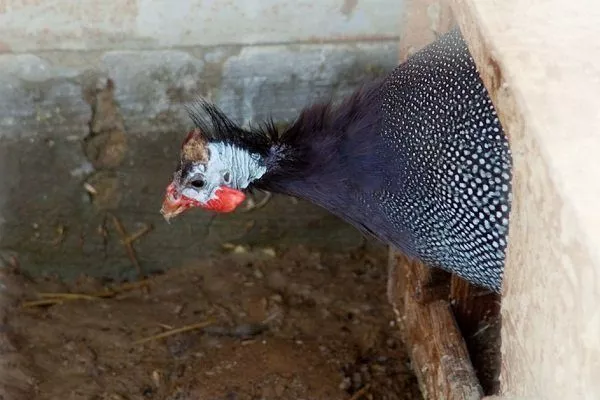
Nest requirements
Guinea fowl are wary of nests, preferring to lay eggs in a secluded corner of their own choosing. This complicates the poultry farmer's work, especially when collecting eggs.
In order for a bird to lay eggs in a nest, it must meet the following requirements:
- the right place - quite secluded and dark, guinea fowls like to be alone not only from people, but also from their own relatives;
- reliable protection – presence of walls on all sides, shelter from above;
- no noise around the nest – otherwise the bird will be frightened, which will negatively affect its egg production;
- protection from drafts, but at the same time good ventilation;
- space: minimum length – 40 cm, width and height – 30 cm each;
- absence of overcrowding – there should be no more than 6-8 guinea fowl in one nest;
- high-quality bedding – it should be warm, dry and soft, you can use straw and hay;
- regular eard – cleaning, disinfection, drying;
- ensuring optimal temperature conditions and humidity in the room.
It's best to build nests for several birds, as they begin laying eggs at the same time. The main thing is not to frighten the birds, otherwise they may abandon the nest permanently.
DIY Guinea Fowl Nests
Making nests for guinea fowl yourself isn't difficult. To do so, you'll need to stock up on certain materials and tools:
- a wooden box of suitable size;
- plywood sheets;
- hacksaw;
- self-tapping screws;
- screwdriver or drill;
- ruler and pencil.
- ✓ Use only dry and treated wood to avoid fungi and pests.
- ✓ Plywood must be moisture-resistant, at least 10 mm thick, for the durability of the structure.
The wooden nest box must be thoroughly washed, disinfected, and dried. If a suitable box is not available, you can make your own wooden frame using appropriately sized slats.
Further actions should be carried out according to the following algorithm:
- Cover the walls of the box or wooden frame with plywood sheets.
- Create a round hole in one wall. It should be large enough for one bird. The hole's dimensions vary depending on the breed and size of the guinea fowl. The average size is 17 x 17 cm.
- Make the ceiling. Also use plywood for this.
- Arrange bedding at the bottom of the nest.
For easy maintenance, the nest should be made with a removable or opening top. This can be achieved by using hinges or nailing two slats with notches so the door can slide to the side.
Additionally, you can install an egg collector in the nest. In this case, the floor of the structure should be inclined—a slope of 5-7 cm is sufficient. A slit should be made in the wall where the slope is located for the egg to roll into. The egg collector can be a wooden tray or trough, or fine-mesh netting can also be used.
Rules for nesting guinea fowl, requirements for the poultry house
When raising guinea fowl in a nest, it's important to follow certain rules. The nest must meet the required standards. It's important to keep it clean and change the bedding daily.
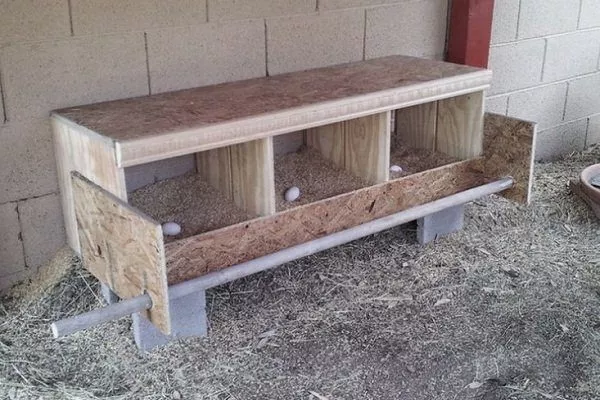
The general rules and requirements for a poultry house are as follows:
- The poultry house must be of sufficient size. Each bird should have at least 1 square meter of space.
- Heating in the poultry house isn't necessary, as guinea fowl are frost-hardy. However, it's still advisable to ensure high egg production. Adults need a temperature of 17-20 degrees Celsius. If winters are frosty in your region, you can install underfloor heating or use a stove to heat the room. Warmth is essential for young chicks; the optimal temperature for them is 32-34 degrees Celsius, so incubators are preferred.
- The poultry house should be provided with bedding. Straw, sawdust, or peat can be used. A layer of 10-20 cm is sufficient.
- Provide feeders and waterers. Feeders should be positioned close to the wall. They should be fitted with wooden sides to prevent feed from scattering. Feeders and waterers should be installed not only in the poultry house but also in the run.
- Keep feeders and waterers clean. Clean and rinse them daily.
- Provide clean water. Change it regularly. As a preventative measure, it's recommended to administer a solution of potassium permanganate. It should be weak and slightly pinkish. Use only freshly prepared solutions and administer them every 3-4 days.
- One of the most important conditions keeping guinea fowl The key factor is daylight hours. They should be at least 8 hours long. Artificial lighting should be used if necessary. Light sources should not be placed near nests or resting areas. The best location is above feeders and waterers. To accelerate sexual maturation of guinea fowl, daylight hours should be increased to 16 hours using artificial lighting.
- Provide good ventilation, but there should be no drafts in the poultry house.
- Provide perches in the poultry house. The optimal height is 0.6-0.7 m.
- Guinea fowl need a sand bath. They bathe in it to clean their feathers of dirt. The bath doesn't need to be installed permanently; placing it in the coop once a week is sufficient.
- Collect eggs correctly. This should be done at the end of the day, preferably at night. It's best to collect the eggs out of the bird's sight. Don't leave the eggs in the nest overnight, as this may trigger brooding behavior.
- ✓ Maintain humidity in the poultry house at 60-70% for the comfort of the guinea fowl.
- ✓ Provide natural light throughout the day, supplementing it with artificial light in the morning and evening.
When keeping a nest, do not remove all the eggs from a guinea fowl. Otherwise, there is a risk that the bird will stop laying eggs in the nest, believing it to be destroyed.
Guinea fowl shouldn't be confined to a single coop. They are free-spirited birds, so they need access to an outdoor run. This area should be fenced in. The fence should be at least 2 meters high. A weather shelter should be installed. Feeders and waterers should be placed underneath it.
Guinea fowl can be given access to the outdoors year-round. Even snow is no obstacle. Guinea fowl are not only frost-resistant but also heat-tolerant, thriving even at 40 degrees Celsius. Allowing them to roam freely allows for a significant reduction in feed consumption, as their diet includes grass, insects, worms, slugs, and frogs.
Guinea fowl should be provided with access to a range after lunch, once the eggs have been laid. Failure to do so will result in the birds laying eggs on the ground, in grass, or in various hidden corners. This will significantly complicate the poultry farmer's work and result in a loss of production.
Guinea fowl nests are easy to make yourself. They require minimal materials, tools, and time. Nesting requires following certain rules, which also apply to the organization and maintenance of the poultry house.