
Good afternoon
I already talked about how we chose chickens, trying to select as many hens as possible when buying.
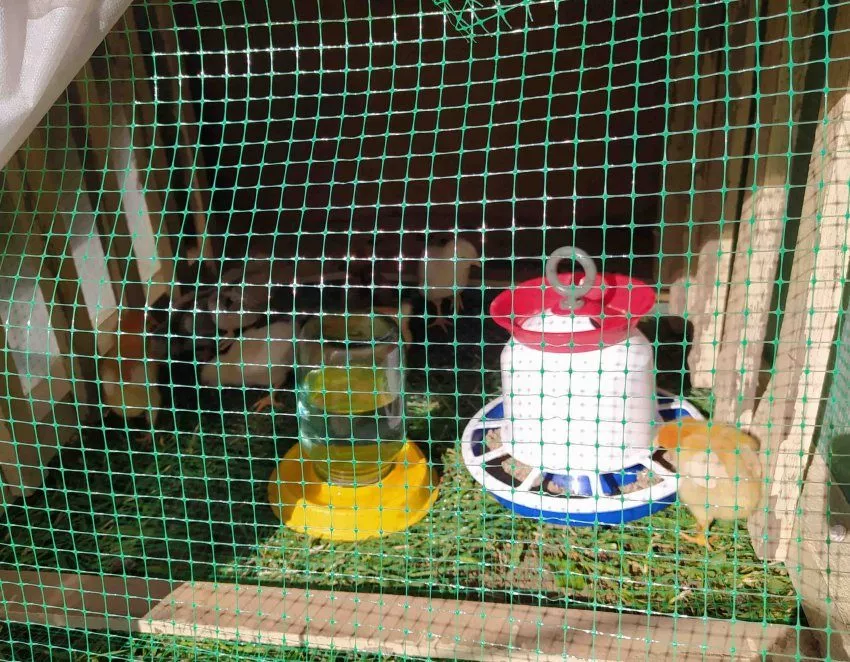
Today I'll show you how they've settled in with us and tell you the mysterious backstory behind the chickens' mysterious disappearance.
We decided to keep chickens, mainly for eggs, because we didn't want to slaughter them. We only did it out of necessity, and we didn't want to bother with slaughtering them, and fresh eggs wouldn't hurt. So we decided to buy about ten chickens, then remove some of the cockerels and unproductive hens, leaving the best ones for the winter. But as they say, if you want to make God laugh, tell him your plans. So it was with us: we chose and bought our first chicks, they grew well, and at 1.5 months old, we built them a temporary run out of plastic mesh and moved them into it.
Everything was fine for a week, but one morning I had to leave for an hour and a half to run some errands. When I returned, I found the pen empty. What happened remains a mystery to this day. Our dog was tethered in another part of the yard during the trip. She's a quiet dog, too: she doesn't bother the chickens, the chicks, or the cats. The cat and kitten were peacefully basking in the sun, and their hungry faces made it clear they weren't to blame, as they were greedily devouring the scraps of meat.
But the enclosure is empty... The wire mesh is intact, there are no holes, no feathers or anything else that would indicate a predator had gotten in and there was panic – also, no feathers. Everything is clean, intact, as if the birds had simply vanished. No feathers, no signs of commotion. They checked their yard, their garden, and the neighbors' – they found nothing.
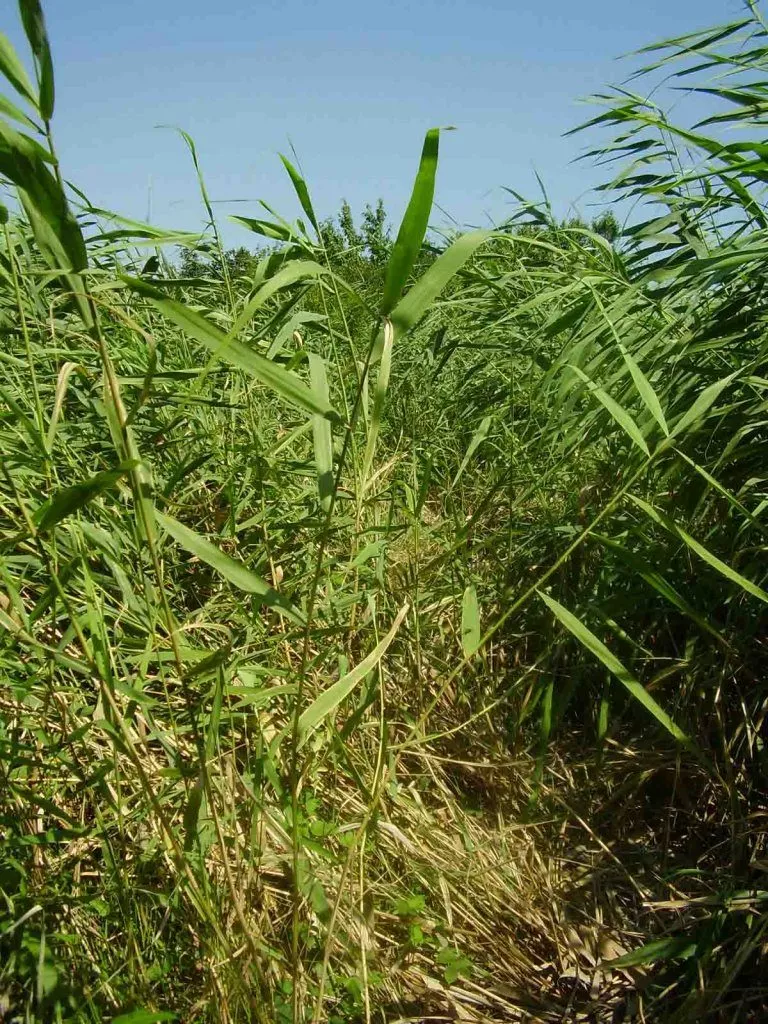
The neighbors assumed a rat was at work, but surprisingly, it happened on a sunny day around 11 or 12 o'clock. For some reason, I thought rats were mostly nocturnal, especially since the enclosure was quite far from other buildings. Recently, some relatives came to visit, and one of them told me he saw some kind of animal, "long as a sausage" and fast, run across the yard that morning. They rushed to look for it, but it was already gone. We decided it might have been a weasel, as our garden borders on one side of a wild reed bed, which is home to snakes, wild ducks, hedgehogs, turtles, and other creatures.
We mourned the loss, but since we were already determined to get a bird, we bought more hens and an older rooster, 3 months old, so that if an animal or rat attacked, we could fight off the predator. When we saw that no one was bothering them, we bought more chicks. A month later, we were offered 8 more babies, hatched by a broody hen. These chicks are interesting because five of them are Ameraucanas. These hens lay blue and green eggs. And three of the chicks are dominants; the breed is still a mystery to me; we'll see who grows up. I believe they are praised for their productivity.
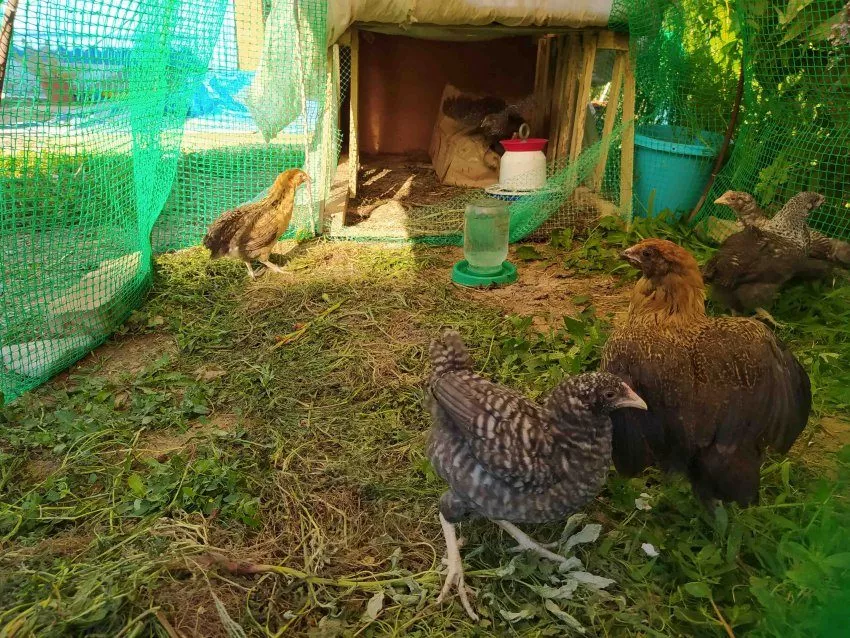
So it was necessary to build a second enclosure.
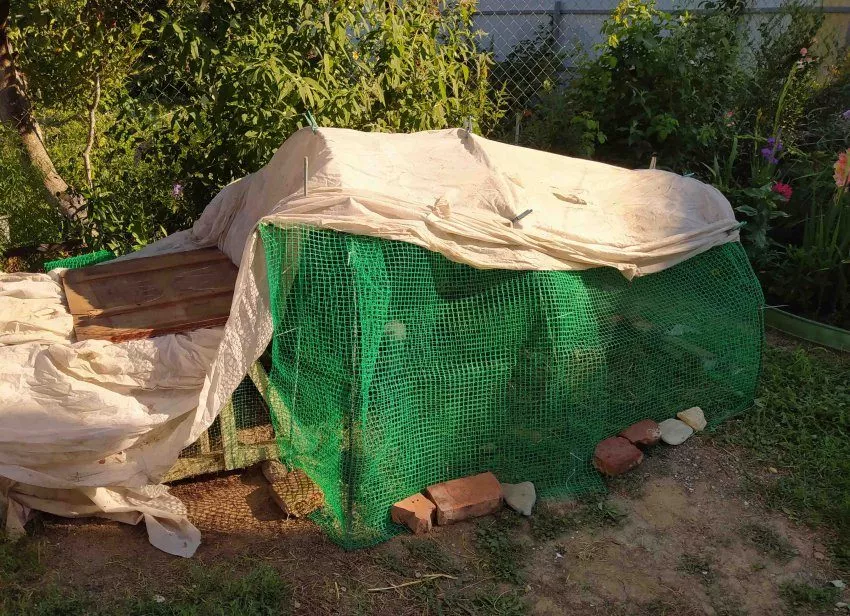
A temporary enclosure, folded and covered with spunbond to protect from the sun.
The babies are a little older now, they're already two months old. We'll figure out how to get them to live with the older hens.
At first they lived in a small enclosure like this:
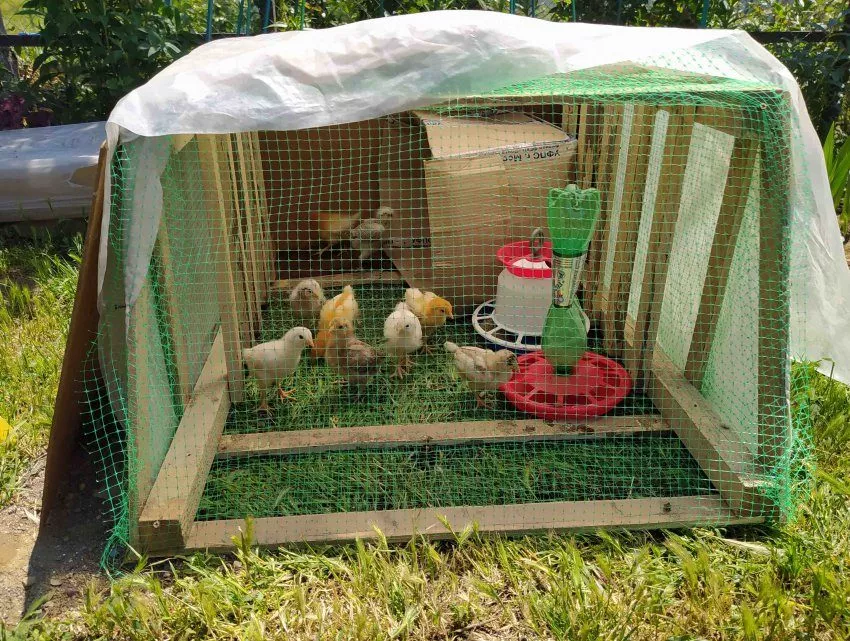
The walk for the kids was organized by:
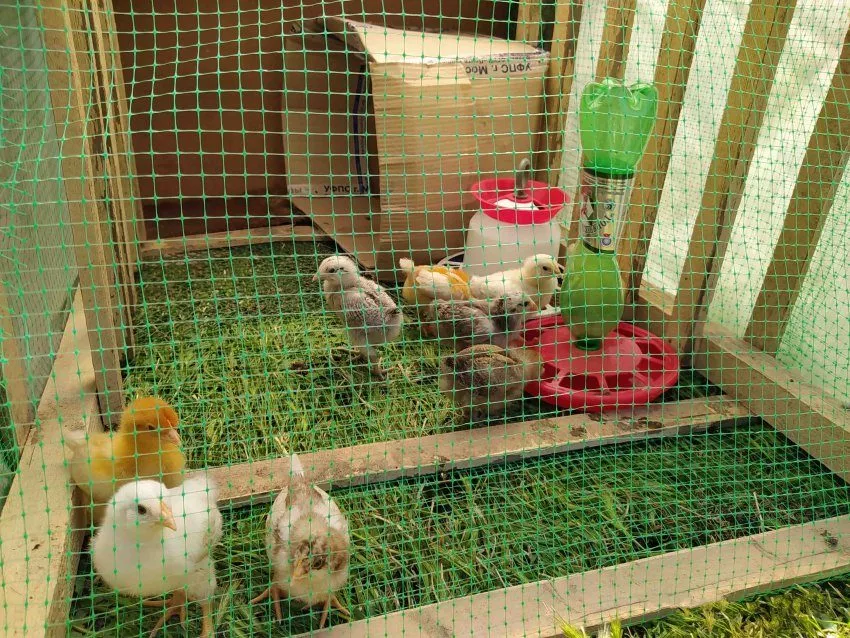
The box was made of slats covered with mesh, one side beveled, the other straight. The area where the heated overnight box was located was tightly covered with spunbond and covered with film to protect from rain and drafts.
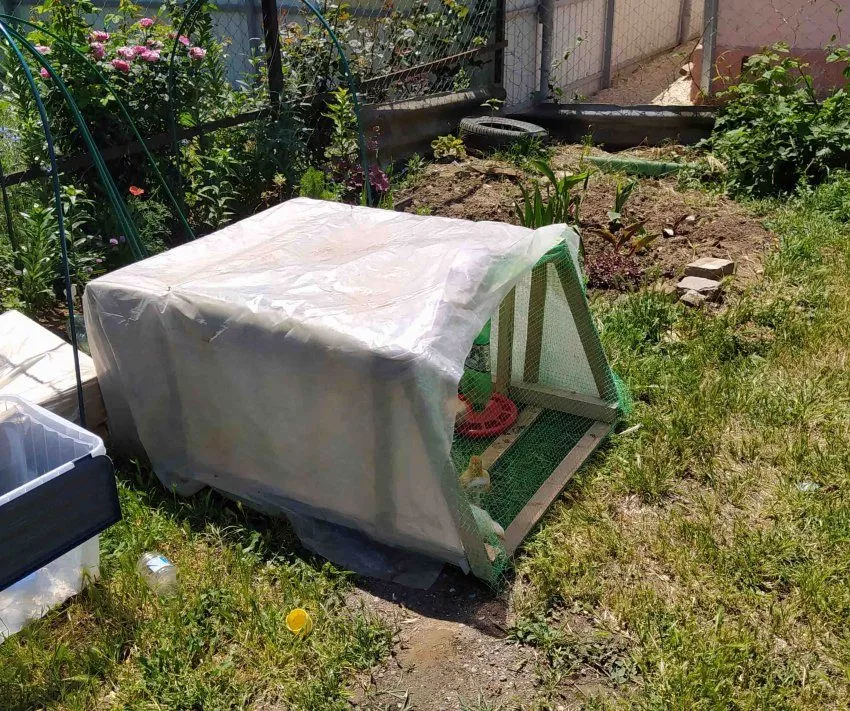
The remaining section is secured with non-woven fabric at one edge, and the other edge can be secured to protruding screws for sun protection. A hood made of thick film is placed on top, which can be pulled up during rain.
We also built a chicken coop for the adult birds – we laid old wire mesh on the ground. For the frame of the run, we used a welded metal structure previously used for an outdoor shower. We painted it pink (to save money, we used whatever paint we had on hand, plus my daughter had some color suggestions for the future chicken coop).
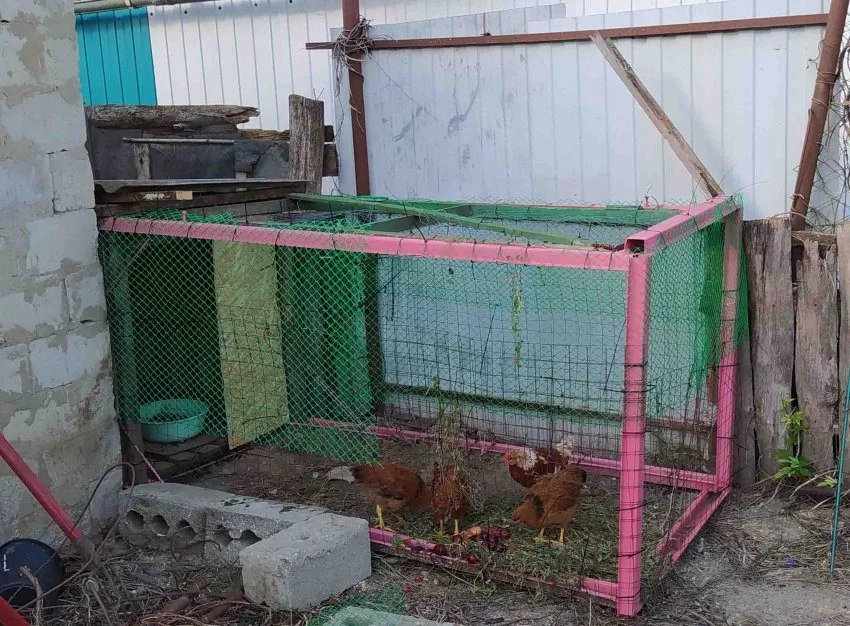
This enclosure was covered with mesh, also made of metal, and connected to the one lying on the ground to create a mesh run that was as seamless as possible.
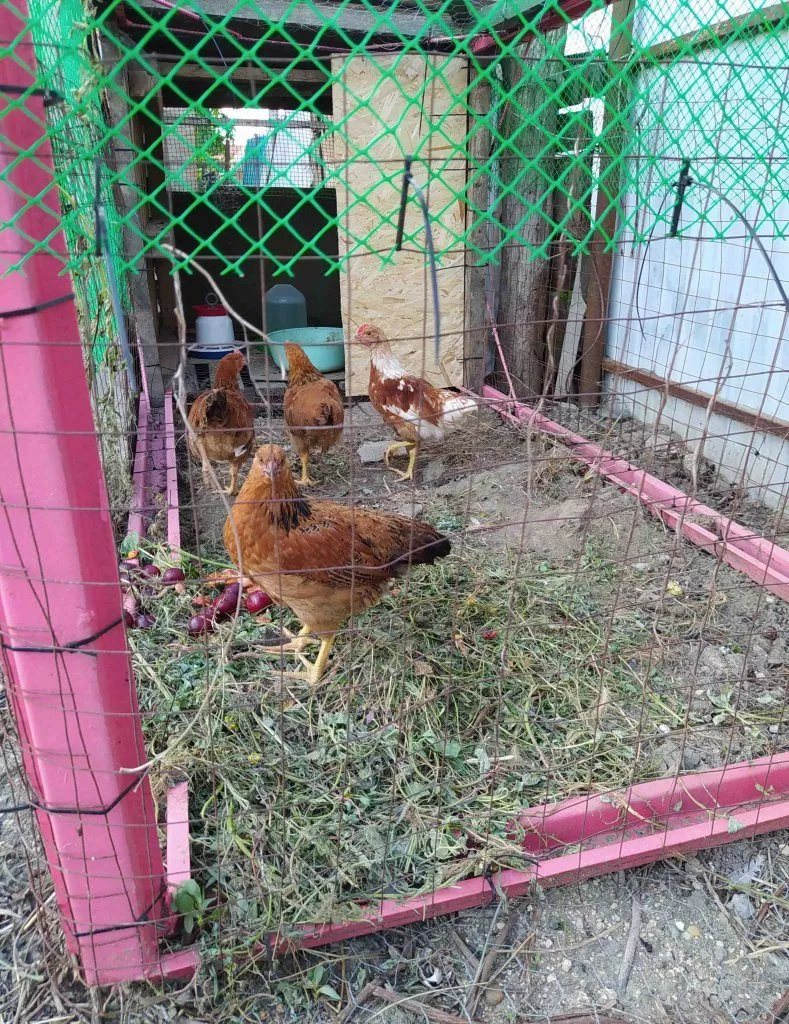
The coop itself was constructed from pallets, and the roof was covered with old slate. Basically, "I cobbled it together from whatever I had." The young ones (I wrote about them in a previous post) were added to the older ones. They were already well-fed and quickly became friends with their older brothers and sisters.
In the enclosure:
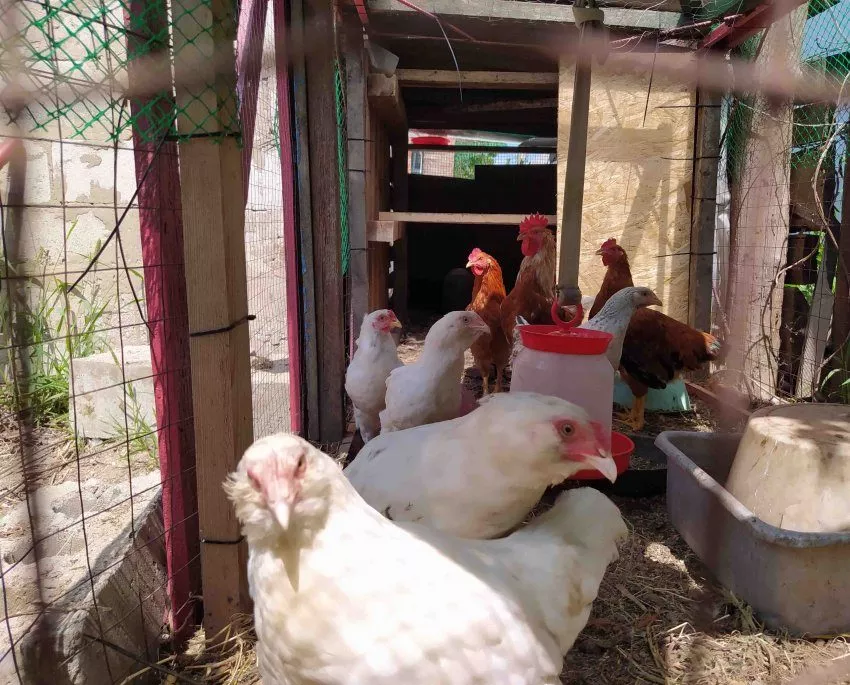
View from inside the chicken coop:
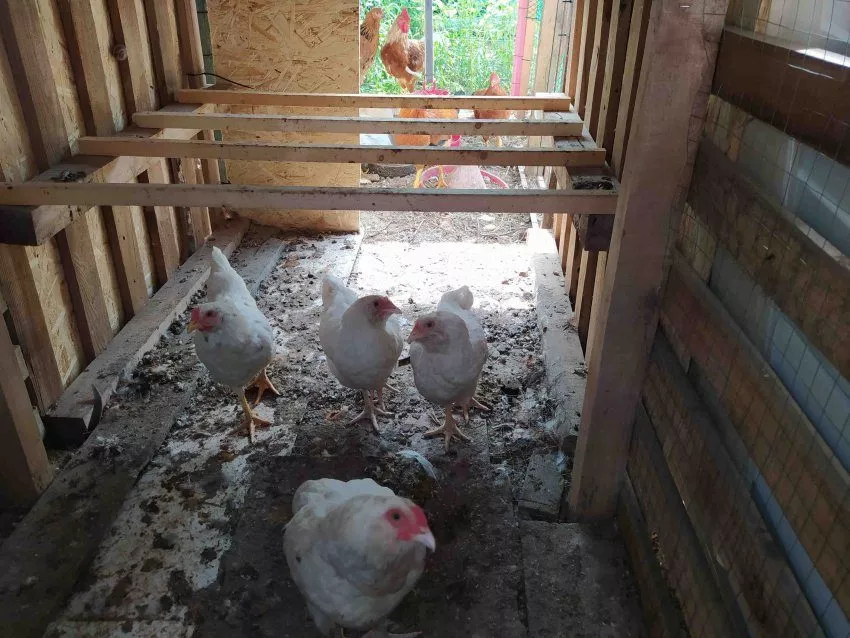
Since the sun is very hot here in the summer, we hide the chicken coop itself in the shade, and cover the run with netting on sunny, hot days.
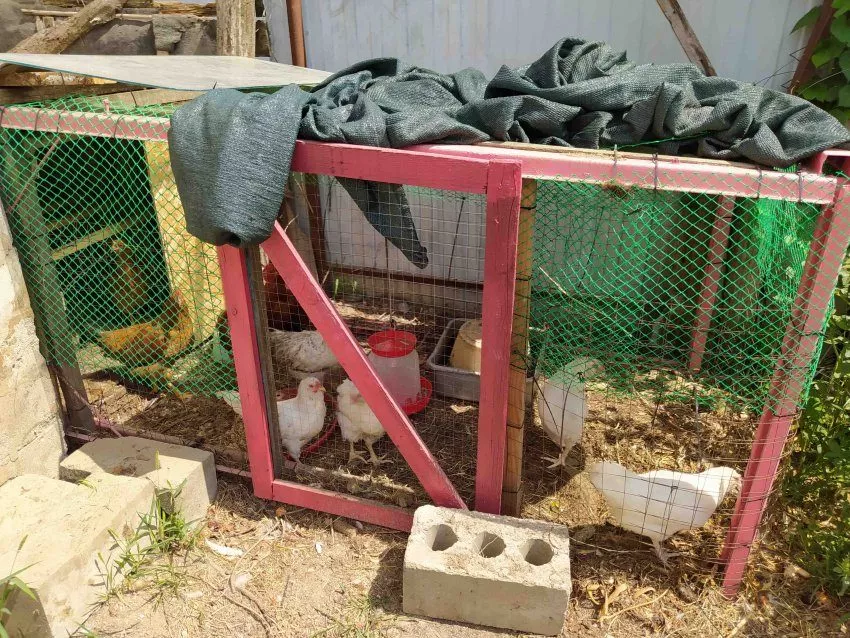
Finally, we equipped the enclosure with a door, and poured greenery into a hole in the roof covered with a net.
The chickens have already settled into their new home, but construction is still underway. Plans include adding a door to the front of the coop and converting the old windows into an additional run.
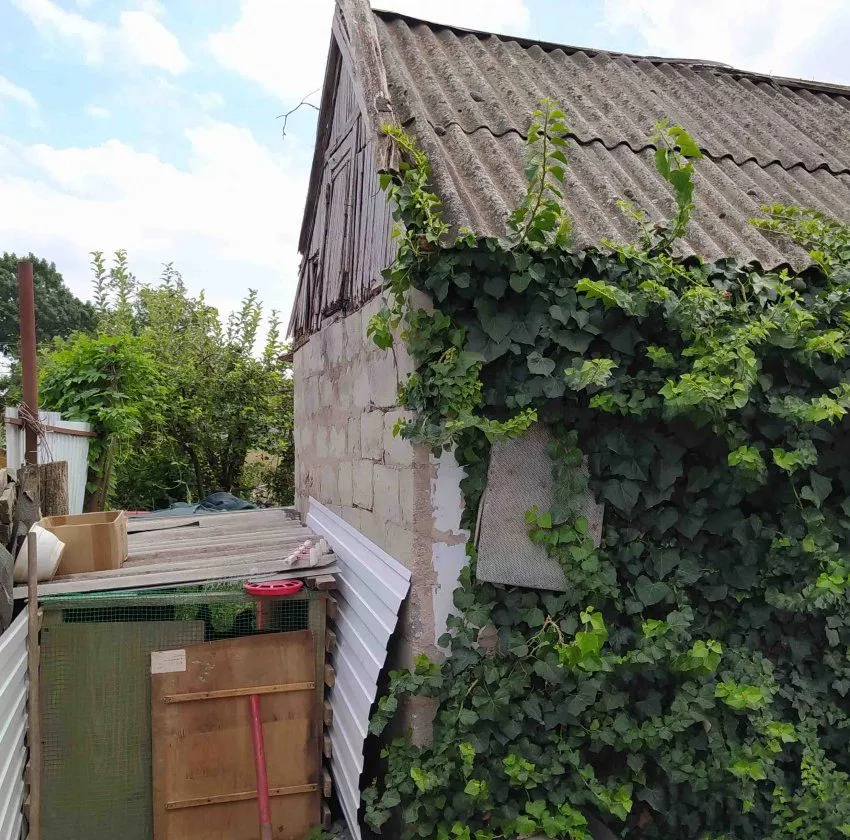
But that's a summer option. For the winter, we decided to give our birds the old barn. It was already leaning and cracking. We considered tearing it down, but decided it would be worthwhile to repurpose it as a winter chicken coop.
We're also currently looking for a convenient option with feeders and waterers. The regular one, the one in the photo, if placed on the ground, the chickens tip it over. So far, I've figured out how to hang it on a hook. But they still manage to scrape everything onto the ground. I want to try installing a hanging feeder with a trench running along the length of the run. For now, we've adapted a basin for water so the chickens don't trample in it—we've placed a second basin on top, turning it upside down. But it's not very convenient for cleaning and changing the water.
It's the same story with the basin of ash for bathing – it gets knocked over very quickly. I'll need to improve it somehow.
But now the hens are settling into their nest, the rooster has started crowing – hoarsely for now, developing his voice.
Once we've got all the hens and their grown chicks together, we'll convert that small slatted pen into a nesting area for the hens and attach it to the main coop. When it's all finished, I'll show you the finished product.
We also once kept chickens and Muscovy ducks. Our chicks would disappear, rats would steal them, it was obvious, feathers would be scattered everywhere, and sometimes they would disappear without a trace. Magpies and kites readily stole our chicks.
My grandmother's chickens somehow escaped from their enclosure and apparently scattered across the property while we were working in the distant field. The fence around the dacha is so weak, it's practically nonexistent. At the time, we also thought someone had eaten them, but it turned out the neighbors had quickly taken them for themselves and kept quiet about it. Everything came to light eventually, but it was difficult to prove anything.
I was a child then, and I had a favorite chick with a curious spot on its head. Another chick had a broken beak, and the number was the same. They showed up at the neighbors' place around the same time ours disappeared. The neighbors told their grandson not to bring anyone over, but how could a boy not bring the girl he liked to play with those fluffy balls? That's how our chicks disappeared. As a child, I thought it was my fault, because I'd trained them to give the little ones treats (worms and something from the table, I can't remember now), and they'd run in single file to everyone, one after another, expecting to be fed.
How can I make the water bowl in the second enclosure? It's missing the bottom part: I need to make it myself (we can't buy one).