

Good afternoon. Today I'd like to share my experience planting fruit trees and warn others not to repeat my planning mistakes.
So, just five years ago, the plot was practically an open field. Our plot was about as far as the mounds of earth. The neighbor had already brought it in, but there was no fence between us yet.
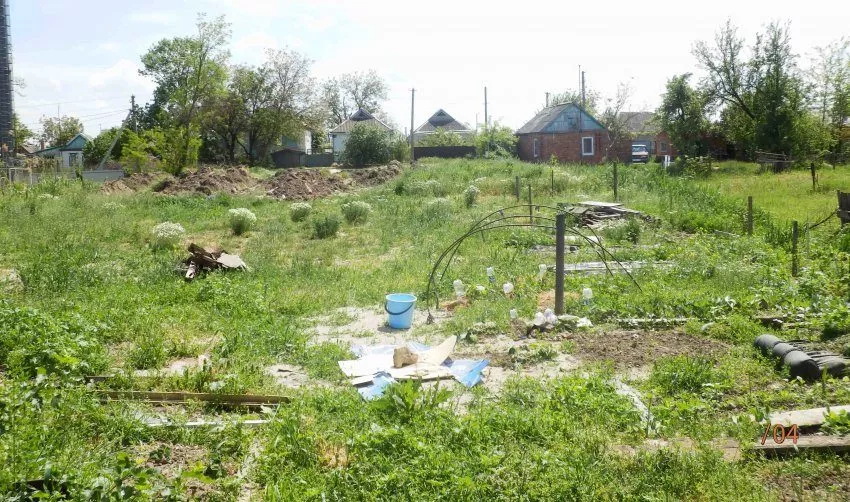
I just planted my first trees. Of course, I had a lot of plans; I wanted to have everything. Especially since I moved south from Siberia, there's an abundance of fruit, and the very fact that you can grow a full-bodied, real, large apple right here in your own garden, rather than buying it from the Chinese, was a delight.
And, of course, I got busy. I planted cherry, peach, apricot, pear, several apple trees, plums, dogwood, gooseberries, and so on. You can see the stakes in the photo as markers. At the time, it seemed like there was plenty of space in the plot, plenty of room to spread out with a garden, and plenty of space between the plants. But time flies. And the trees grow even faster.
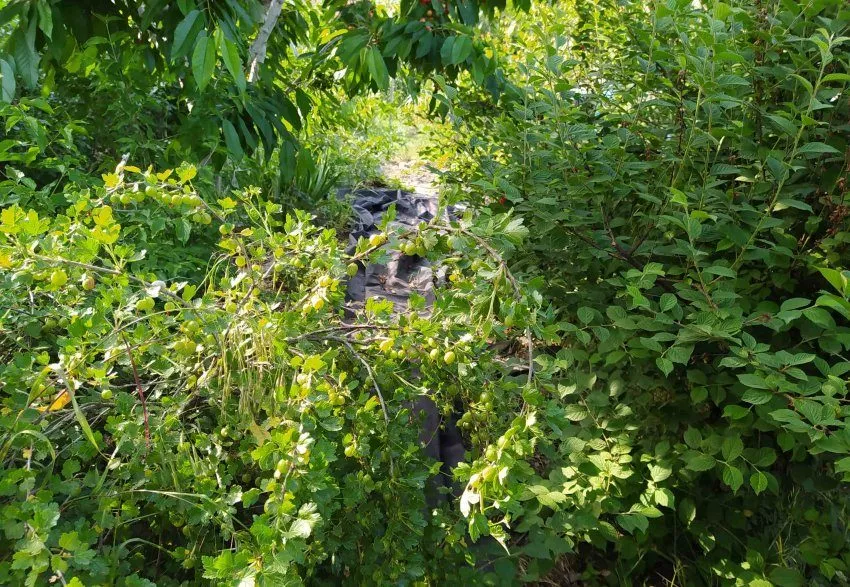
Despite attempts at shaping and pruning, this is the current picture in this corner of the plot.
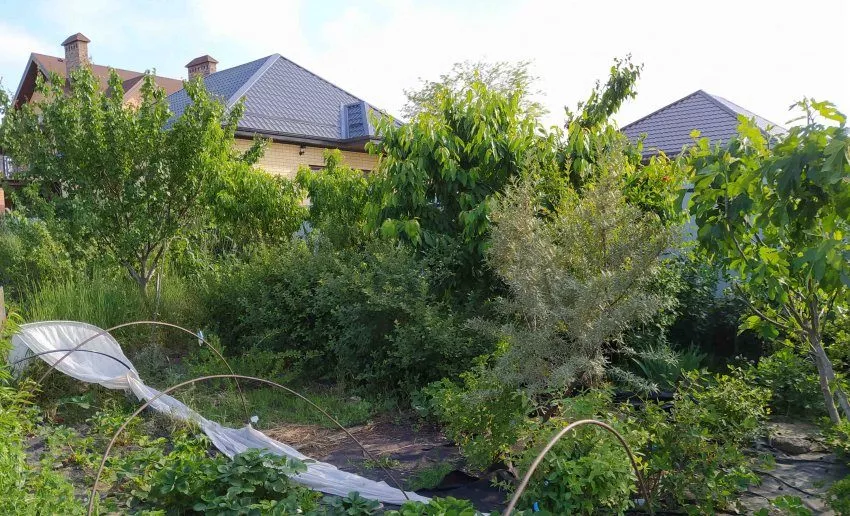
The tree canopies have closed in. The cherry tree is vying with the peach tree for light, and the dogwood is in the shade, beneath the canopy.
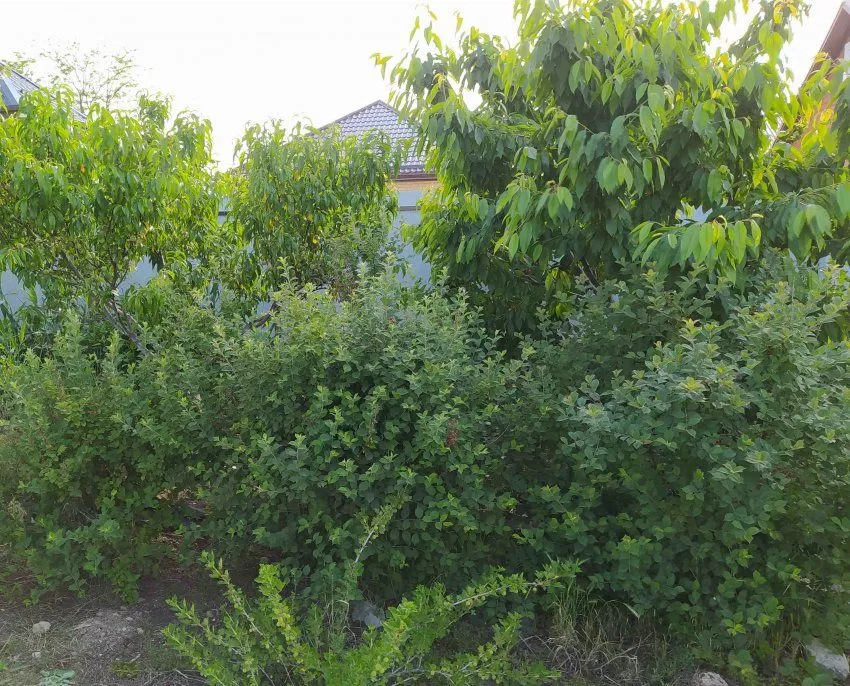
Three tiny felt cherry bushes have grown into huge bushes, and now, by sending out shoots, they are trying to take over the space under the tree canopies.
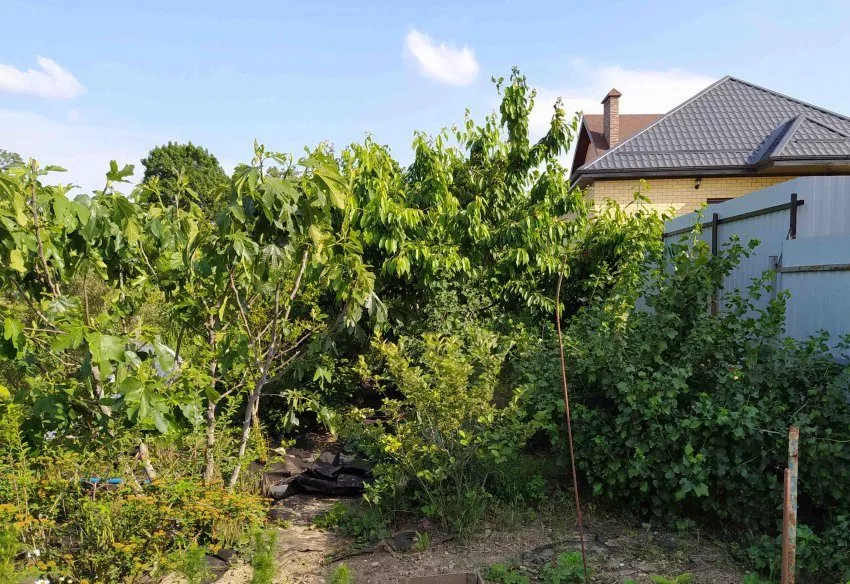
As a result, my interval of 3-4 meters between seedlings turned out to be very small.
But there are some positives, too. When I got tired of fighting the grass, I covered the entire area with thick mulch. And over the years, I've had no problems with grass, fallen leaves, or pruned branches. All of this is easily removed from the agrospam.
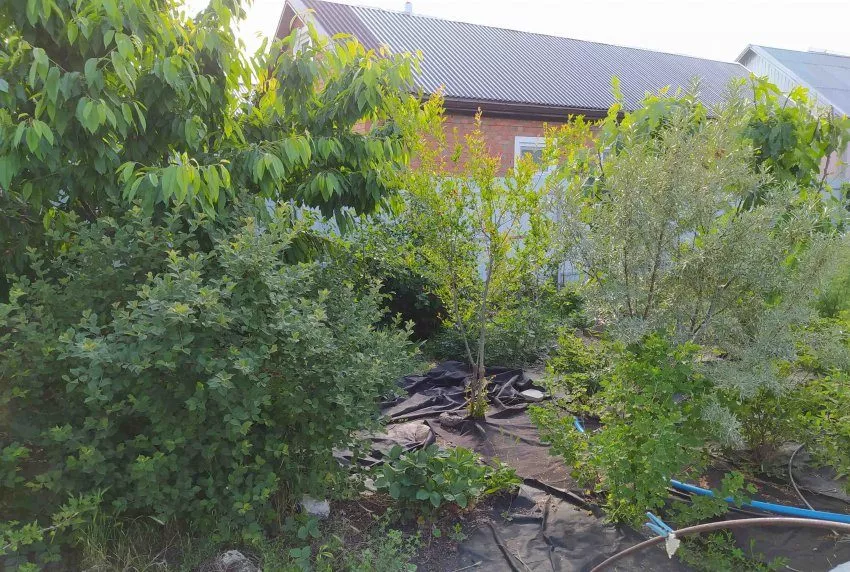
Another mistake was rushing. Wanting to harvest as quickly as possible, I went to the nearest market to buy planting material, relying on the advice of the vendors, and chose the varieties based on their recommendations.
Now I understand that it's not enough to just know your preferred varieties in advance. You need to find a trusted seedling supplier to avoid buying the wrong variety or even being scammed.
So, having bought seedlings from a beautiful market stall with a sign proclaiming "Such-and-Such Garden" and an attractive advertisement, a season later I discovered that the white currants I'd bought there were actually ordinary black ones, and small ones at that. The honeysuckle, instead of blue, turned out to be red, though at least it was edible. And the mulberry, in fact, had grown into a wild cherry plum. How I didn't notice this before the fruit appeared, I don't know; for some reason, I didn't pay close attention to the leaves, and they're completely different on these plants. I simply trusted the seller's promises.
I had better luck with the apricot tree—I was recommended the "Triumph Severny" variety. After purchasing it, I read the description—it has good characteristics. Last year, it bore fruit for the first time, and I liked them. Now, the main task is to properly shape its crown and tame its vigorous growth. Although the seller claims it's grafted onto a dwarf rootstock, given that it was purchased commercially, the reliability of its characteristics is questionable.
I'll have to correct my mistakes. I plan to remove the middle-sized felt cherry bush. Although this cherry ripens earlier than the average cherry, one or two bushes are enough for a tasty treat. I'll transplant the dogwood from the shade to another spot. I'll remove one jostaberry bush. It's also interesting because it ripens very late, but it's not very suitable for canning.
Well, more attention should be paid to the formation of the crown of peach, apricot and cherry trees.
Now I try to stick to the rules:
- Don't rush into buyingUntil I'm sure it's the right variety on the right rootstock. Read information about the varieties, reviews, look at photos, see what the fruit looks like, and what size the mature plant will be.
- Find a good seller. It's advisable to purchase seedlings from a certified nursery rather than at the market. Many nurseries now sell their products online. However, there's an important point here: the variety must be zoned. A plant bred and grown in Siberia will have a very difficult time adapting to the hot southern climate. Conversely, a southern plant may not survive the freezing winter or may grow but not produce a harvest or fail to ripen.
- Keep your distance, sufficient for the size of the mature tree's crown, since the roots are usually equal in area to the crown. Therefore, if the trees are too close together, they will compete not only for sunlight but also for underground resources such as water and minerals.
- Take into account the characteristics of each plant. Therefore, it's not advisable to place mulberries near areas where you frequently walk or rest. This is because their sweet berries fall onto the grass as they ripen, attracting numerous insects and creating a sweet and sticky carpet.
Ideally, you could lay a cloth under the tree and regularly pick ripe berries from it. But more often than not, this isn't done.
The walnut tree isn't just a giant. Its foliage is also rich in tannins, which weigh down the soil. Therefore, nothing usually grows under walnut trees. And the tree's foliage is unsuitable for mulch or compost. - Learn the specifics of proper pruning of fruit trees. This knowledge will allow you to create the best conditions for a good harvest and space your plants more compactly within your plot.
- Give preference to seedlings on dwarf rootstock.
- Take into account the peculiarities of some types of fruit (For example, plum and cherry trees) can produce shoots from the roots, which will regularly appear in the most unexpected places. To remove these shoots, dig up the soil around them and cut them as close as possible to the horizontal root from which they originated. By cutting them at ground level, in a couple of weeks you'll have not just one branch, but a whole bunch of them in that spot.
- Take into account the “pairing” of some cultures. Many varieties require a pollinator, which must be located within a certain distance. Therefore, when choosing a seedling, check whether it requires a mate. Another option is to plant just one plant if a nearby neighbor already has a pollinator.
- From the moment of planting the seedlings, you have another 2-3 years to analyze – whether you've positioned it correctly. While the plant is young, up to three years old, it can still be replanted. Of course, fruiting will be a little delayed, and for the first two weeks, it will need ample watering to help the tree establish roots in its new location.
I'm currently trying to adhere to these guidelines. But due to the small plot and the desire to plant a variety of crops, planting density remains a challenge. My only hope is for the saplings to thrive. Because not all seedlings take root, or I have to remove a tree that doesn't live up to expectations.
Another thing I'm focusing on right now is multi-trees. I'm trying to learn how to graft several varieties onto a single tree. Then, instead of five pear or apple trees, you can just plant one and graft other varieties onto it.
Please share your experience of planting fruit trees, your thoughts, your mistakes (and don’t make the same mistakes as me).
I have a Siberian Triumph apricot tree. It's a great tree. This is the second year it's bearing fruit. The tree is five years old; I planted it when it was two years old. I don't remember when, but on someone's advice, I didn't prune it. Now I regret it. Last year, the tree reached a height of four meters; this year, it's six meters. It has many long, almost vertical branches. It looks beautiful. But it's a fruit tree, so beauty comes second. I'll prune it in the fall.