

I'd like to tell you about this simple yet unusual flower. It has the exotic name of coleus. But the common people also call it by another name.
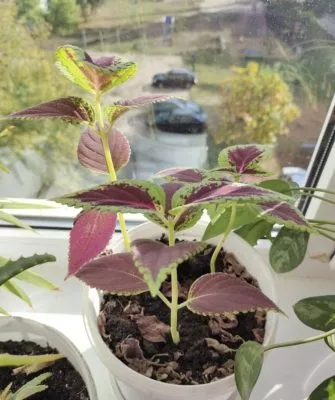
I'll tell you how and why:
- Indoor nettle. The reason is that the leaves resemble nettles in shape and size. Indeed, one of my guests asked, "What kind of nettle is that in your pot?"
- Poor man's croton. Croton is a noble flower and very expensive, and our coleus is similar. Only a thousand times cheaper. So it turns out it's a poor thing.
I've never repotted or propagated my plant before, but I've mastered the art of caring for it. I'm happy to share it with the reader:
- When I planted the seedling, I used 2 parts leaf mold and 1 part each of sand, peat, and humus. But you can buy a universal soil mix, too. I baked the soil in the oven for 20 minutes to kill any bacteria.
- The windowsill is the sunniest spot because the more light, the brighter the leaf color. However, direct sunlight should be avoided, as this will burn the leaves.
- The temperature depends on the time of year, but for coleus there is a temperature range of +16 to +26 degrees.
- I water it about 2 or 3 times a week in spring and summer, and once a week in autumn and winter, but if the room is hot, I water it twice a week.
- I fertilize during the growing season (starting in March-April and ending in mid-October) once a week; in winter, I don’t fertilize at all.
You can buy universal mixtures for fertilizing, but on the advice of a friend, I occasionally use the following:
- wood ash powder – I sprinkle it on the soil surface to a depth of 0.7-0.9 mm, loosen it and water it generously;
- glucose - 0.5 tablets per 0.5 liters of water - I do this once a month;
- Sometimes I add peat to the surface of the soil, but only a little.
Keep in mind that if the plant is too cold, it will shed its leaves, and if it's too hot, it will wilt. I solve this problem by regulating the air humidity—increasing it in the summer and decreasing it in the winter.