

Gardeners often encounter viral and other diseases. I had the same problem for a couple of years in a row. Either I did something wrong, or I bought planting material that was already infected. This prompted me to study the topic carefully. potato diseasesI consulted with an agronomist and learned many fascinating facts. I want to share this knowledge with you today.
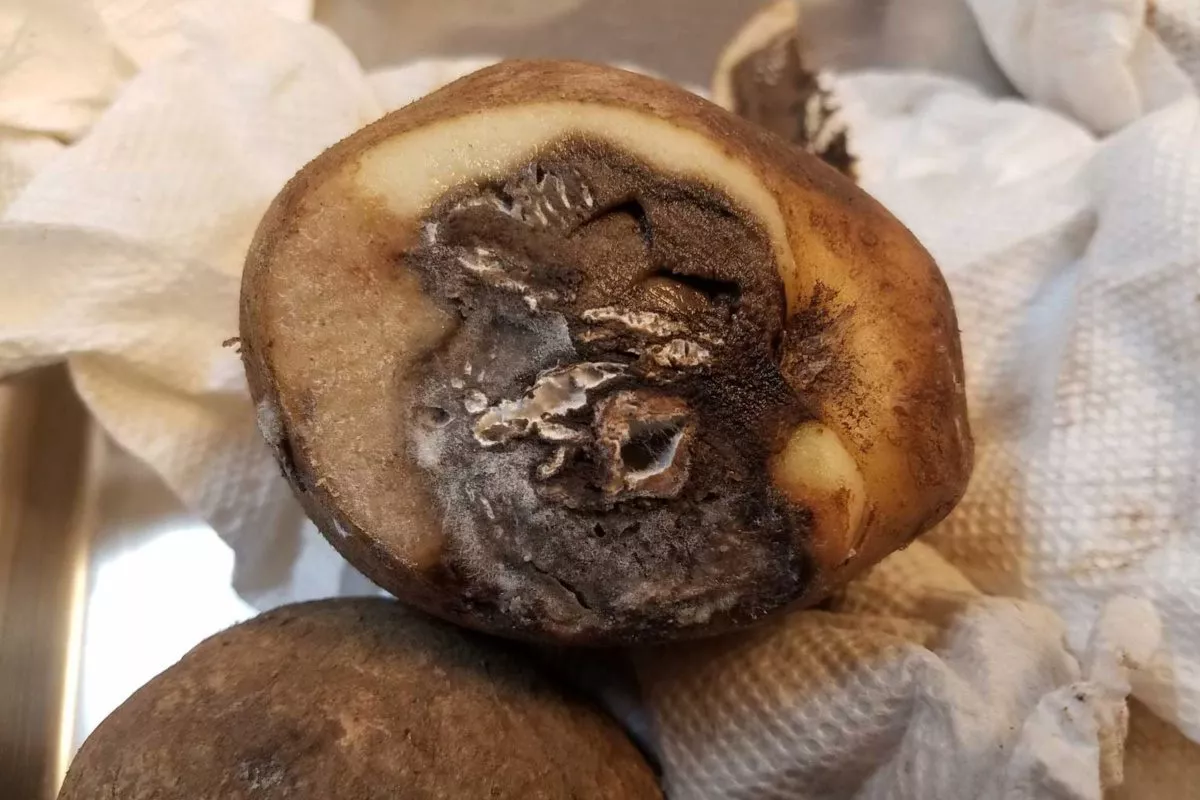
For example, this is fusarium dry rot on potatoes.
Viruses and other bacteria are dangerous—they're difficult to get rid of because they live in the plant's structure, often in a latent state. First, let me tell you what to do for prevention:
- Disinfection of storage facilities, garden tools, and containers is required.
- Create protective conditions against insects that carry the pathogen.
- The affected tops are burned.
- To clean the soil, green manure from cereals (oats, rye) is added to the soil during crop rotation.
- It is important to separate affected root crops from healthy ones.
- If you plan to use the peels of virus-carrying vegetables, boil the scraps first. This will prevent infection.
- Follow agricultural practices.
- Be sure to feed your potatoes with microelements and other useful substances.
- Apply manure before sowing and dig the soil more frequently.
- Prepare seed and soil properly.
- Take care of the crops throughout the entire period.
- Use protective equipment.
- Maintain rotation of planting each year.
Fusarium wilt
The infection is caused by spore-forming fungi. The mycelium resembles spider webs, containing canodia. The localization is soil. Symptoms:
- discoloration of the upper leaves;
- twisting of leaves along the vein;
- yellowing of the tops followed by falling off;
- coloring of the stem in a brown shade;
- stem and tuber rot;
- formation of a putrid odor on the tubers.
Verticillium wilt
The fungus penetrates the root system through insects and mechanical damage. Signs:
- growth retardation;
- root death;
- formation of brown strokes of a slightly depressed elongated shape;
- the presence of a pink or gray coating on the stems and leaves;
- the cut has a brown tint.
Powdery mildew
Infection is caused by various types of fungi, typically found on foliage and young shoots. Initially, the coating is white, but as the spores (which have a brown tint) spread, the plant darkens. Characteristic symptoms include:
- the formation of a powdery coating that is sticky to the touch;
- deformation of root crops;
- growth retardation;
- death of affected areas.
Macrosporiosis
Another name for this disease is spotted dryness. It is caused by Macrosporium solani Ellis et Martin. Infection occurs during harvest through mechanical damage. It can also be transmitted through foliage. It is most commonly found on nightshade crops. Tubers and stems can also be affected.
Early stage symptoms:
- formation of spots up to 1.5 cm in size;
- color of spots – gray, brown, dark brown;
- formation of a weak plaque with a black tint;
- clearly defined boundaries of defects;
- dryness of the tops.
Signs of late stage infection:
- rounded rashes along the edges of the leaves;
- the color of the spots is dark brown with an olive tint of a velvety type;
- rolling leaves into a tube.
Stem form of the disease:
- spots on stems of an oblong shape;
- at a late stage, the rashes merge together;
- stem ringing with spots;
- stem death.
Tuberous form:
- formation of brown, gray spots on the tubers;
- presence of plaque deposits
- hardening of the affected tuber.
I've only described a few of the potato damages, but they're the most common. So try to detect them promptly to prevent the "infection" from spreading further.