

It's hard to imagine gardening without tools like saws, pruning shears, hedge trimmers, and so on. With proper care and gentle use, any tool will last its full lifespan. Today, I'll tell you how to maintain a chainsaw so it keeps working smoothly for years to come.
Rules for operating a chainsaw
- Before starting work and each time you refuel check the chain tension is correct, otherwise:
a) the chain, bar and sprocket will wear out quickly (if the chain is too tight);
b) the chain will fly off and may injure you (if it was not tensioned properly).
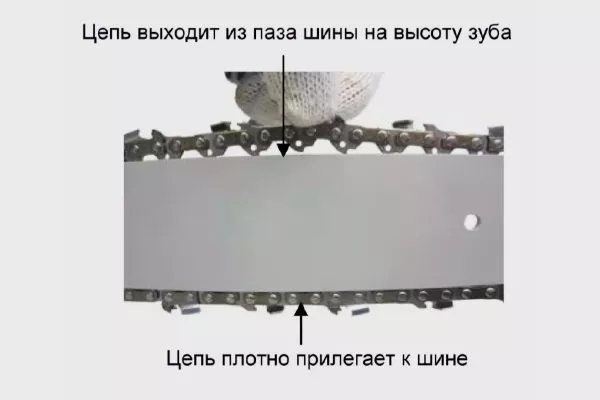
Normally, the chainsaw chain should fit snugly against the bottom of the bar, and if you lift the chain at the top of the bar (grab the chain and pull it up a little), the chain comes out of the bar groove to the height of the tooth (see the picture below), and the chain can easily be pulled along the bar by hand. Remember that the chain stretches during operation, so it will need to be tightened periodicallyTo do this, slightly loosen the bar mounting nuts, turn the bar tension screws (counterclockwise if necessary to tighten the chain), grab the end of the bar and pull it up, while tightening the bar mounting nuts with your other hand.
 - Don't fuel your chainsaw with gasoline alone! Make a mixture of AI 92 gasoline and two-stroke oil For air-cooled engines. Do not use other gasoline and/or oil, as this may damage the engine.
Refer to the oil packaging for fuel mixture ratios (for example, it may say 1:50, which is equivalent to 100 ml of oil per 5 liters of gasoline... or other ratios may be specified). For engine break-in, prepare a fuel mixture at a ratio of 1:25 (200 ml of oil per 5 liters of gasoline).
Mix gasoline and oil in a separate container., and don't do it in the tank itself! Take a can of gasoline and pour the required amount of oil into it, stir it, and only then pour it into the chainsaw's fuel tank.Don't prepare too much fuel mixture at once. It can be stored without losing its properties for no more than a month!
- Do not operate a chainsaw without chain oil. Use only pure oil (Specially for chain lubrication). Do not lubricate with used oil!
- Use bars and chains recommended for this chainsaw model.And replace it with a new one on time. If the chain becomes dull and you continue working, you risk severe wear on the bar and engine components.
- The bar and chain must be constantly lubricated. Use special chainsaw oil, otherwise they will fail. By the way, if you run the saw dry and it breaks, it's not covered by the warranty, and you'll have to pay for the repairs yourself. So make it a rule to top up the oil every time you refuel the saw.
- Periodically lubricate the tire sprocket, manually, using a syringe or oiler.
- Don't try to cut with the tip of the bar. This is dangerous and can cause damage.
- Try your best Turn the tire over every 8 hours of operationto ensure even wear. You can also check the tire grooves right away.
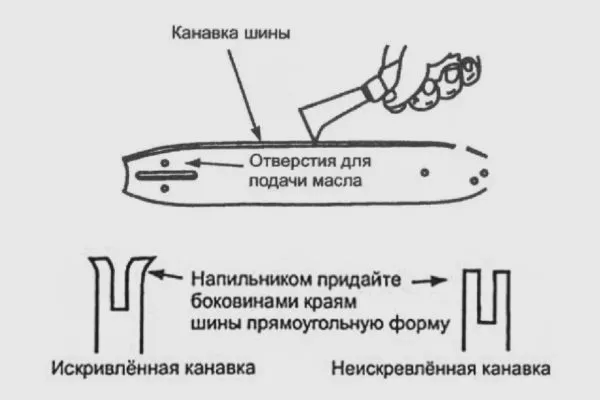
Clean the tire grooves of dust and dirt, for example, using a putty knife. If there are burrs along the edges of the grooves, remove them with a flat file.
If you don't have the experience or understanding, look online, read, and ask around. Once they show and explain, you'll understand—and then you'll be able to do it yourself without any problems. If the tire grooves are worn out or the tire is deformed, replace it with a new one. - Replace the chain with a new one if necessary or sharpen it yourself. For proper chainsaw operation and to avoid breakage, the chain teeth must be sharp.
How do you know when it's time to change/sharpen your chain? Here's the answer... Look at the sawdust: if it's fine and dust-like, it's time. The cutting teeth need to be sharpened at a specific angle—that's important! If you don't have the experience or the right tools, learn from the experts, take them to a service center, or just buy a new chain. - Check and maintain your air filter regularly, otherwise engine power will be reduced and fuel consumption will increase (a dirty filter prevents proper air flow to the chainsaw carburetor). Don't be lazy. check the air filter for cleanliness Before each job, and well in advance, it's best to do this so it has time to dry. Cleaning the filter is easy: remove it, rinse it in soapy water, dry it, and reinstall it. If it wears out, replace it with a new one. Don't be stingy, because as the saying goes, a miser pays twice.
 It's strictly forbidden to operate the engine without an air filter, otherwise the engine will quickly fail! And it won't be repaired under warranty: if you broke it yourself, you'll have to fix it yourself.
 - Also periodically check the fuel filterIf it's too dirty, the chainsaw will have trouble starting and the engine will perform poorly. Clean the fuel filter as it gets dirty. It's easy: drain all the fuel from the tank, lower a homemade wire hook into the tank, pry and pull out the fuel filter, rinse it with warm water and detergent, dry it, and reinstall it. If the filter is heavily dirty or damaged, replace it with a new one.
- Periodically check the spark plugIf the engine no longer starts easily, it's time to inspect the spark plug. If the spark plug electrode is dirty, clean it with a wire brush.
Normally, the gap between the electrodes should be about 0.5 mm (0.6-0.7 mm is acceptable).
If the saw doesn't work or works intermittently after cleaning, replace the spark plug with a new one. It's generally recommended to replace the spark plug with a new one every year. - Do not pour any carburetor or engine cleaning agents into the fuel tank, otherwise you will damage the engine.
- If the log is lying on the ground, do not saw the ground. To do this, cut 1/3 of the log, flip it over, and continue cutting on the other side, being careful not to apply pressure to the saw at the end of the cut. In general, it's important to understand how tensile and compressive forces are distributed within the log... where the main weight falls and how the support points are distributed determines whether the wood will pinch the saw guide.
If you misjudge the situation and the bar gets pinched, don't jerk the saw or increase the speed, otherwise the clutch will burn out! Simply shut off the saw and drive a wedge into the cut before removing it from the wood.
- The chainsaw is not designed for continuous operation.You need to take breaks to allow the tool to cool. Chainsaw work should be done intermittently and for short periods. In general, first read up on how to properly cut trees (familiarize yourself with logging techniques); otherwise, if the log is large, you could injure yourself or others, damage nearby small structures, and ruin the saw.
- Well, store your chainsaw properly. First of all drain the fuel completely, start the engine and let it run until it stops (even if you haven't used the saw for just a month, still drain and store it). Keep the tool in a dry place out of direct sunlight.
 It's strictly forbidden to operate the engine without an air filter, otherwise the engine will quickly fail! And it won't be repaired under warranty: if you broke it yourself, you'll have to fix it yourself.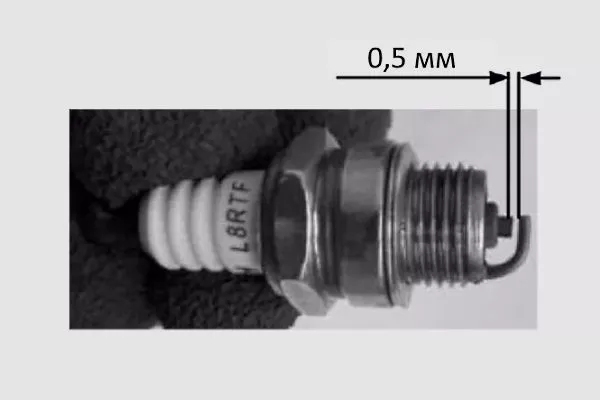
Failure to follow these rules may result in damage to the saw!
Engine running-in (first start)
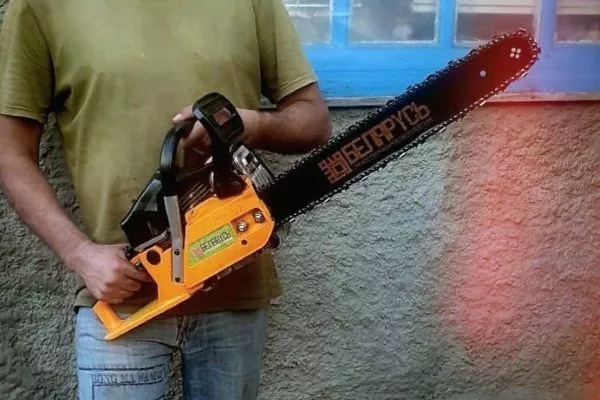 Running-in is necessary to allow the moving and rotating parts to adjust to each other. This will extend the engine's lifespan. Running-in is performed the first time the saw is fully started.
It's done like this:
- Prepare a fuel mixture by increasing the amount of oil. Use 200 ml of oil per 5 liters of gasoline or 100 ml of oil per 2.5 liters of gasoline (i.e., a ratio of 1:25).
- Fill the fuel tank full with the freshly prepared mixture.
- Fill the oil tank with clean chain oil (clean, not used!).
- Check the chain tension. Adjust it if necessary.
- Close the choke (since the engine is cold, and if it were hot, there would be no need to close it).
- Check that the chain brake is disengaged.
- Turn the chainsaw ignition switch to the “ON” position.
- Pull the starter handle sharply until a spark enters the engine. The key here is the sharpness of the pull, not the force… the goal isn't to pull the rope all the way out, so pull sharply, but not too hard.
- When the engine starts, open the choke.
- Run a full tank of fuel at medium engine speeds. This is sufficient for cutting small branches and bushes. Avoid pushing the saw too hard during the break-in period, and be careful not to let the engine overheat.
- Once the fuel tank is empty, the break-in period is complete. Next, mix the fuel at a ratio of 1:50 (100 ml of oil to 5 liters of gasoline or 50 ml of oil to 2.5 liters of gasoline).
Don't run an air-cooled engine at idle. Apply minimal load, such as light throttle, at partial throttle.
Chainsaw malfunctions and their solutions
The most common problem is that the chainsaw won't start or stalls, but there are other malfunctions too...
- If after 10 pulls of the starter the engine didn't start: 1) It is possible that the carburetor is flooded with fuel, therefore: unscrew the spark plug, pull the starter handle 5 times, screw the spark plug back in, try to start the engine again; 2) the spark plug is dirty or faulty (clean it or replace it with a new one).
- If the engine starts, but The saw operates unstably at idle or the saw power is weak, then check the air and fuel filters and clean them if necessary. Also, check the chain tension (to make sure it's not too tight).
Still haven't resolved the problem? Then it's most likely a carburetor issue. Take your saw to a service center to have it adjusted or cleaned. But be careful! If you mixed the fuel incorrectly or used low-quality or stale fuel, no one will repair your chainsaw for free, and it's your fault the saw is malfunctioning. - If the engine stalls at idle, most likely, the chainsaw engine speed is not adjusted.
- If the chain rotates at idle, then you need to take the saw to a service center for adjustment, or turn the idle speed screw counterclockwise until the chain stops.
- If the chain does not rotate under load, most likely the chain lock/brake is engaged. You need to press the locking lever.

All this information should help a newbie save money on repairs. May your unit always be on the road!