
The leafcutter bee's habits are quite unlike those of a typical hive worker. It doesn't produce honey and doesn't live in large colonies. Leafcutters live alone. They leave round or oval cutouts on leaves, often ruining the appearance of garden flowers. Nevertheless, the leafcutter bee is an important element of the ecosystem.
Subspecies, description
| A subspecies of leafcutter bee | Preferred plants | Body size (cm) | Abdominal coloration | Features of the hair |
|---|---|---|---|---|
| lagopods | lilac, acacia, cherry, quince | 1.1-1.2 | yellow-brown | thick light villi |
| silvery | dogwood, rose, pomegranate | 1.1-1.2 | silvery-white | sparse long hairs |
| white-bordered | reed, cistus, grapes | 1.1-1.2 | white with black stripes | short thick hairs |
| silky | oak, hawthorn, grapes, cistus | 1.1-1.2 | brown with a golden tint | silky long hairs |
| apical | hawthorn, rose hips | 1.1-1.2 | black with a blue tint | thick short hairs |
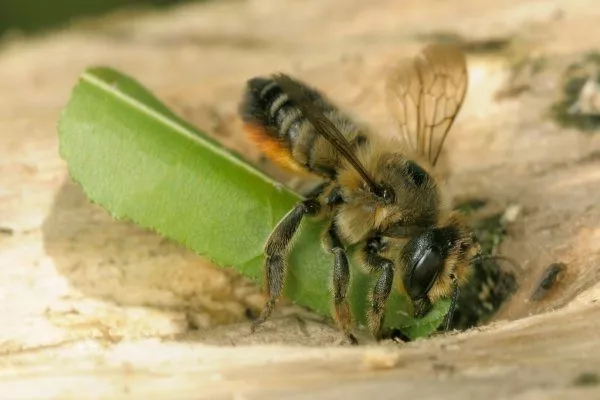
The leafcutter bee is an insect belonging to the Megachilidae family. It resembles a common honeybee in appearance.
Main differences:
- more vibrant contrasting coloration - the light abdomen can be colored from yellow to brown, and the upper part is black with a blue, purple or green tint;
- long, densely arranged light hairs on the abdomen, with which the bee pollinates plants;
- powerful and strong jaws;
- large head and abdomen;
- the sting is not supplied with poison.
Females and males have a few differences:
- females reach 1.2 centimeters in length, and males – 1.1 centimeters;
- Females have more hair on their abdomen, while males have more hair on their head.
Leafcutter bees have several subspecies, which differ in the leaves they prefer:
- Lagopods love lilac, acacia, cherry, quince;
- silver ones choose the foliage of dogwood, rose, pomegranate;
- white-bordered plants are suitable for reed, rockrose, and grapes;
- Silkies can choose from oak leaf, hawthorn, vine and sage leaf cistus;
- The apical ones cut out circles on the leaves of hawthorn and rose hips.
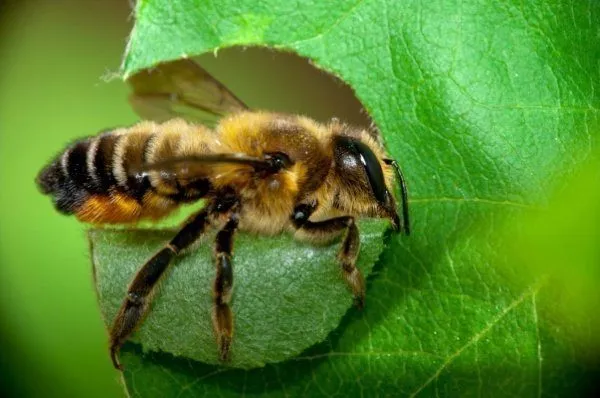
Bees cut ovals and circles on leaves with their jaws, and the correct shape is given to them by rotating their bodies during the cutting process.
Features of life activity
Leafcutter bees are found in Central and Eastern Europe, Africa, Asia, North America, and Australia. They dislike cold regions with long, frosty winters, such as northern Russia or high mountains. Despite their widespread distribution, their population is small, and scientists are calling for their conservation and protection.
Leaf cutters are already listed in the Red Book of a number of regions of the Russian Federation: Lipetsk, Saratov, Kursk and Belgorod regions.
Males and females live separately. They meet only for fertilization, after which the drone dies fairly quickly. Its maximum lifespan is one month. The female lives for two months. During this short period, she manages to build a nest, lay 20-40 larvae (fertilized ones produce females, unfertilized ones produce males), and gather food for them.
Nesting sites can be:
- earthworm burrows;
- hollows of reeds or rushes;
- rotten trees;
- holes from nails and screws in wooden boards;
- special "houses".
Essentially, any cylindrical hole near food sources (gardens, meadows, fields) will do for a leafcutter bee. It settles alone in its chosen location; very rarely, two females share a single hole.
Because this species cuts holes in leaves, many believe that these insects feed on them. In fact, leafcutter bees feed on nectar and pollen, and the leaf-cut circles are used to create nests. The base and entrance are formed from dense foliage (oak, holly), while thinner materials (alfalfa, lilac, rose) are chosen for the walls. The bees bind the materials together with their own saliva, which hardens upon exposure to air. This process usually occurs in July.
Having created a nest, the female leafcutter begins to form cells for the larvae, twisting leaf scraps into miniature cylinders. She then fills them with pollen and nectar, deposits the larva, and seals the cell.
In the fall, the larva will begin to feed on prepared food; in the spring, it will fly out to create its nest, live until August, and die.
The drones emerge first, and for some time before the females emerge, they fight among themselves so that only the strongest individuals with a healthy gene pool can mate.
In the natural environment, the greatest danger to the leafcutter bee is posed by cuckoo bumblebees, which lay their larvae in its nests.
You can see what a leafcutter bee looks like, how it builds a nest in the soil of a flowerpot, and the benefits it provides in this video:
How to determine the appearance in the garden?
The presence of a leafcutter bee in a garden plot is difficult to confuse with anything else or the activity of another insect. Only this species leaves such neat and precise holes in leaves.
They especially love rose gardens—the soft leaves of roses are perfect for cells, and the flowers themselves contain essential nectar and pollen. They also appreciate other plants:
- lilac;
- acacia;
- grape;
- quince;
- alfalfa;
- clover;
- cherries.
Sometimes you might see an insect flying into a hole in a fence, a hole in a tree bark, or a hole in the ground. But leafcutter bees aren't the only ones living in such holes. So, you'll need to take a closer look at the appearance and occupation of the unexpected inhabitant.
Benefit or harm?
The only harm that a leafcutter bee can cause is to deprive ornamental flowers grown for sale of their aesthetic appeal.
But the damage this insect causes is only superficial and does not harm the plant itself. The bee compresses the blood vessels of the leaf it's using, so the flow of sap through the tissues continues. The damaged foliage won't dry out, turn black, or yellow, but will simply continue to grow, acquiring a distinctive "design."
But leaf cutters have many uses. That's why they're even used in agriculture. They drill holes in wooden boards and beams, make special hives, and stock them with bees.
This is done, for example, when growing alfalfa. This medicinal legume is extremely difficult to pollinate, and the only ones that can handle it are leafcutter bees. They increase alfalfa yields to up to 800 kilograms per hectare.
These workers are also introduced to other legume crops, and they are also useful in melon fields. Gardeners attract leafcutters to their plots to increase the number of fruit and vegetable ovaries.
Benefits of leafcutter bee pollination:
- In 1 minute, one bee is able to visit, collect food for itself and simultaneously pollinate 20-25 buds.
- A female makes about 700 foraging flights per day and is capable of creating conditions for the formation of 2,000 flowers.
- One individual flies around an area with a radius of 2 kilometers in search of food.
- It takes a bee about 5 hours to prepare food for one larva. This means, theoretically, it visits and pollinates about 18,000 flowers.
Leafcutter bees pollinate plants twice as efficiently and quickly as honey bees.
Should we fight?
Before attempting to remove leafcutter bees from your property, it's worth considering whether it's really necessary:
- the species is small in number and brings much more benefit than harm;
- leaf damage lasts only 2-3 weeks while the insect builds its nest;
- If the plant was being prepared for sale, damaged leaves can be carefully torn off;
- The insect's peacefulness deserves special mention: the leafcutter never attacks humans and is not capable of poisoning them or causing allergic reactions, unlike honeybees.
Plant protection methods
If a gardener wants to keep the leaves of their plants looking attractive, there are several ways to do so without damaging the leaf cutter.
For this purpose, the leaves can be:
- cover with a fine mesh (17 mesh) or gauze;
- dust with sifted wood ash, finely ground hot pepper, tobacco dust;
- treat with soapy water.
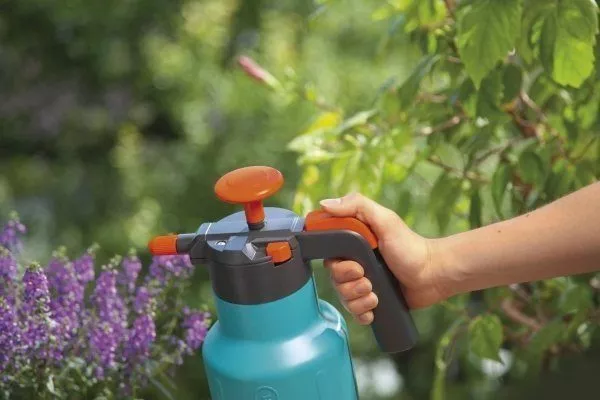
The last two methods have their pros and cons. They will repel insects, and the ash and tobacco will act as fertilizer. However, the effect of these treatments will be lost after the first rain.
You can save the rose if you feed it with potassium fertilizers, – they will make the leaves tough and unattractive to bees. Nitrogen fertilizers, on the other hand, increase the number of vegetative parts of the plant and make them more tender, which is necessary for the formation of leaf-cutter cells.
- ✓ Plants should be more attractive to leafcutter bees than roses, such as lilacs or acacias.
- ✓ Plants should bloom during the same period as roses to provide an alternative source of food and nesting material.
You can distract leaf cutters from roses by planting other types of flowers or trees that are beneficial to bees nearby.
The use of chemical insecticides is not recommended for a number of reasons:
- the number of pollinated plants will decrease;
- In addition to leaf cutters, honey plants may also die;
- you can deprive the area of defenders from aphids - ladybugs and lacewings;
- The deliberate killing of leafcutter bees may be punishable by law.
To remove leafcutter bees from your garden you need to:
- Remove dead reeds, rushes, sow thistles, and thistles. Leafcutter bees love to nest near them or in the hollows of dead stems. Dead or fallen trees also pose a danger.
- If you manage to find a nest and it is quite accessible, then it must be carefully removed and taken away, or left alone, and the next spring, when the young bees fly out, seal the hole.
The leafcutter bee is a beneficial and rare insect. It can treat a huge variety of plants, including those difficult to pollinate. The damage this species causes to flower beds is minimal. If you spot this bee in your garden, it's best not to get rid of it. It can increase crop yields, especially when growing legumes.