
Osmia is a genus of bees belonging to the Megachilidae family, which includes over 350 species. About 150 are found in Europe. These insects are unique – they do not produce honey or other by-products. However, for many years, humans have actively used them for pollination.
Who are the Osmiums?
These are wild insects that are one of the largest species of bees. Various species are found throughout the world. Bees have fluffy bodies, are peaceful, beautiful, and very beneficial. They pollinate not only fruit but also ornamental crops.
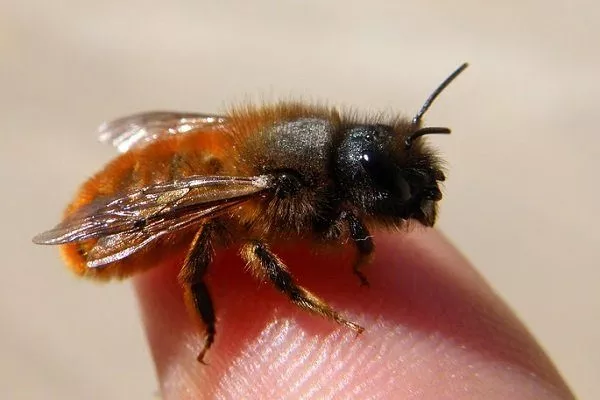
Bees store bee bread for the next generation, which always pupates before spring. As soon as the temperature reaches +8°C, they leave their nests. Osmia are considered the most productive pollinators and contribute to increased crop yields.
Bees are capable of pollinating plants over long distances in a short period of time. Even bad weather is no obstacle. Recently, greenhouse farms have begun breeding these bees, which has led to a dramatic increase in crop yields.
Geographic distribution
Osmia are found almost everywhere on the planet. Most of them live in Europe. Depending on the specific species, their preferred climate conditions vary slightly.
Bees are extremely rare in the far south. It is believed that osmia bees do not like extremely hot tropical climates.
Appearance
Osmia bees don't differ much from their honey-producing relatives. However, there are some distinctive features of their appearance:
- the body size is within 8-11 mm (the figure depends on the specific type of bee);
- brown tint and very thick downy cover, there is a slight metallic sheen;
- females are much larger than males;
- there is a sting;
- The female has a white triangle on her forehead and long antennae;
- egg production of queens – from 20 to 45 eggs;
- Females have an apparatus located at the bottom of their abdomen that is used to collect pollen.
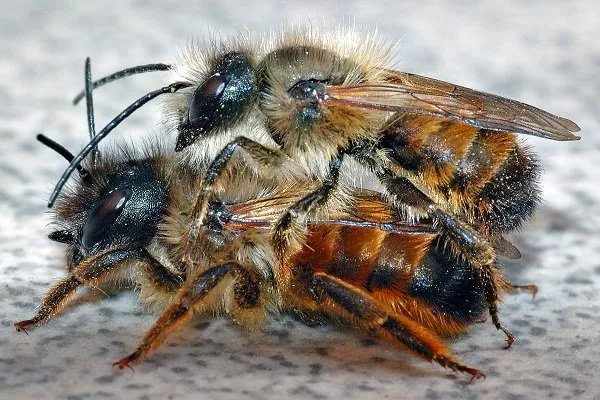
Housing characteristics
Osmia insects are unable to build their own homes; they search for existing ones. They use old wood and hollows in plant stems to construct their nests. The average diameter of a nest is approximately 5-11 mm.
The female takes special care of her nest, cleaning it, removing dust, and creating walled cells from dirt or earth. A plug of earth is used to seal the entrance to the nest.
Almost all of the time is spent cleaning and preparing bee bread for the brood. There is only one female per nest. The nesting period lasts until late June or early July.
Lifestyle
Wild bees are completely harmless. Although they have a stinger, they almost never use it. For a bee to sting a person, it must be picked up and squeezed very hard. Increased aggression in this species of bee is observed only in the spring, when egg-laying season begins.
This peaceful behavior of osmia bees is due to their lack of concern for protecting their nest, which distinguishes them from honey bee species. After laying eggs, the bees completely lose interest in the nest. The life cycle consists only of:
- Mating.
- Searching for a place for a nest.
- Egg clutches.
Osmia bees don't require any special care and can survive under cover during the winter. Solitary bees perform a single function: reproduction, searching for and collecting pollen, and storing food.
Nutrition
The basis of the diet of osmia is pollen, which they collect from:
- flowering trees (fruit species);
- spring nectar bearers (early).
Osmia feed on small flies, caterpillar larvae, Colorado potato beetles, and spiders. They do not eat bees.
Common species
| Name | Body length | Hair color | Peculiarities |
|---|---|---|---|
| Blue | 8-10 mm | Brown with a dark blue sheen | Sparse hairs |
| Horned | 11-15 mm | Black and red | Females have a "horn" on their forehead. |
| Hooked | up to 1 cm | Yellow-brown | Stocky and broad body |
| Redhead | 12-15 mm | Red-brown | Females form small colonies |
| Wall | up to 10 mm | Almost black | Light bronze sheen on the abdomen |
Some of the most popular species of Osmia bees include:
- Blue. The body length is 8-10 mm, there are sparse brown hairs with a dark blue metallic sheen.
- Horned. The body length is 11-15 mm, and females have a "horn" on their forehead. Their head is covered with black hair, while their body is covered with red hair.
- Hooked. The body length is no more than 1 cm, almost black in color, and lacks shine. The sides and lower chest are covered with yellow-brown hair. The body is stocky and wide, densely covered with fur.
- Redhead. Body length: 12-15 mm, thick reddish-brown hair. Females are capable of forming small colonies.
- Wall. The body is no more than 10 mm long, sparsely pubescent, and narrow. The hair is almost black, with a slight bronze sheen on the abdomen.
- ✓ Blue Osmia: metallic sheen on sparse hairs.
- ✓ Horned osmia: the presence of a “horn” in females.
- ✓ Hooked Osmia: stocky and wide body.
- ✓ Red osmia: the ability of females to form small colonies.
- ✓ Wall osmia: slight bronze sheen on the abdomen.
Reproduction
Osmia bees are characterized by a short life cycle, lasting only one year (sometimes from two weeks to two months). Active reproduction begins in the spring. The main difference between wild bees and honey bees is their multiple mating cycles.
The female gives birth towards the end of August. The larvae feed on pollen and nectar collected in the spring. In September, they transform into pupae and spend the winter in this form.
In the spring, when the weather warms up, the adult bee chews through the cocoon itself to emerge and awakens the next bee. This is when the insect's active life cycle begins.
How to properly breed Osmium bees?
Insects are very beneficial. There are several reasons for actively cultivating osmia:
- The aesthetic side. Representatives of this species of bees are considered the most beautiful.
- Osmium cultivation. This is a type of beekeeping. Osmiums are currently poorly studied and are of great interest to researchers.
- The best pollinators. Osmia are very hardworking and more active than honey plants. Even in low temperatures and rain, they continue pollinating plants.
- Useful in greenhouses. Using honey bees for pollination is not cost-effective because they require special care and are expensive. Wild bees do not require special conditions.
To quickly increase the number of osmia, ensure favorable conditions for this:
- Place the houses in a cozy, quiet place where there are no constant drafts.
- Replace old reeds with new ones periodically, as they may harbor parasites.
- Make sure that mice or other rodents do not destroy the osmium's home.
- Provide the insects with a regular source of fresh dirt to build partitions and a watering bowl.
You can learn how to make osmium houses in the following video:
How to attract insects to your property?
Osmia flies to your site spontaneously if there are many early spring nectar-producing insects nearby. Be sure to provide a shelter in advance where they can build a home.
Simply hang an old box or metal can under a canopy and fill it with reeds or plant stems. You can also take bundles of reeds and close the tubes at one end. If you have a house and water in the area, the insects will soon arrive and begin actively pollinating the plants as early as April.
Osmia bees are the primary pollinators of various flowering plants. They nest in virtually any natural shelter. These large and resilient insects pollinate even plants that might ignore honey plants (such as legumes). They work in all weather conditions, which is especially important for crops whose flowering period lasts only a few days.