
Overwintering bees in colder conditions extends their lifespan by a couple of weeks and produces excellent honey without any impurities. This is because, in the wild, bees consume 3-4 kg more honey, and increased food consumption leads to increased fecal contamination and can lead to nest lining. However, for bees to successfully overwinter outdoors, certain conditions must be created for them, which you can learn more about below.
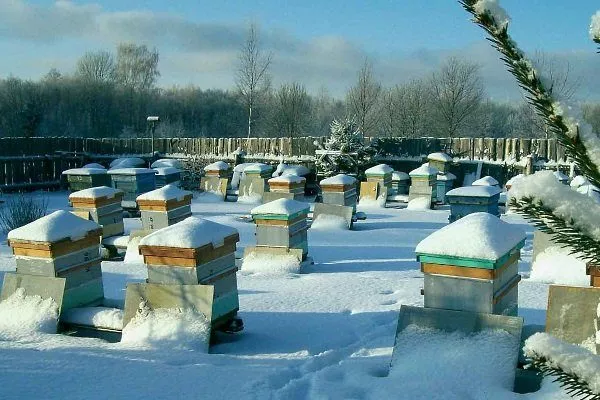
Is it possible for bees to overwinter in the wild?
Overwintering insects in natural conditions allows beekeepers to reduce labor costs and save money on wintering houses. However, to ensure the proper preservation of bee colonies, several factors must be considered:
- Quality of the hiveThey should be insulated, made double-walled, or constructed from 60 mm thick boards. Furthermore, the hives should be wrapped in paper or roofing felt and covered with snow to a depth of 0.5 m or more above the roof. Snow has low thermal conductivity, so it will ensure an optimal microclimate in the nest and prevent sudden temperature fluctuations.
- Access to feedThe overwintering insects' nest should be stocked with sufficient (up to 30 kg) high-quality food. To ensure their free movement, place 10x10 mm slats across the frames under the canvas in the fall.
- Snow removalIn early spring, snow should be pushed away from the front wall of the hive to allow it to be warmed by the sun's rays and allow the bees to make their first flight. Warmer temperatures and bright light will help them emerge from dormancy, which is necessary for their earlier development and the rapid replacement of overwintered bees. While snow is being removed, hay or straw should be spread in front of the hive to prevent the insects from perishing in the snow during their flight.
- ✓ The thickness of the insulating material must be at least 50 mm to ensure optimal thermal insulation.
- ✓ It is mandatory to have ventilation holes to prevent condensation from forming inside the hive.
If all necessary requirements are not met, the bee colonies will die or emerge from wintering weakened, requiring reinforcement in the summer, which may be ineffective. However, even if all conditions are met, significant waste and weakened bees may occur in the wild, but this is not a cause for concern. The fact is that colonies that successfully survive the winter will have exceptional energy, performance, and will regain strength faster than colonies that overwintered in a moss house.
It is believed that the mobilization of bees' defenses and their will to survive are crucial to their successful wintering. If bees overwinter outdoors every year, they undergo natural selection and subsequently become more resilient to adverse weather conditions. If bees overwinter indoors every year, they become accustomed to optimal conditions, and their genes develop different skills and a hope for help. The likelihood of their successful overwintering in natural conditions is low.
Overwintering in the open in steppe zones, where there is practically no snow until January, is undesirable, since strong winds will blow away the sparse cover, and the bee colonies will die, unable to survive such conditions.
Wintering conditions in the wild
Preparations for this should begin in the fall, before the cold weather sets in. Experienced beekeepers determine the hives' readiness for winter by the following steps:
- The queen is found and her age is determined. The future offspring and growth of the colony depend on her age.
- They check how much brood there is.
- They examine the honeycombs and use them to determine the suitability of the bees for wintering.
- They closely monitor the bees, identifying and removing sick insects.
At preparing bees for winter Pay attention to the following parameters:
- SternThe highest demands are placed on them, as the life of the entire colony depends on the quality of honey. Honey is taken from the main honey flow, as it rarely hardens. It's important to ensure there's an adequate supply of food, as bees should be neither starved nor overfed.
- Frames with bee bread. Don't forget about the content frames either. bee breadThey are placed near the club, preferably along the perimeter. The honey used is predominantly light-colored, as it's more suitable for winter—it crystallizes and thickens less frequently. The honey should be free of honeydew. To confirm this, it is sent to a laboratory.
- DisinfectionI. The hive is treated to eliminate all pests, as they spread various infectious diseases. This is done after the nest is fully formed and the hatching of the young has completed. All bees must undergo the treatment. Hives are disinfected with steam and smoke, as these will not harm the insects. Read about fumigating bees with a smoke cannon. Here.
This video explains how to prepare bees for wintering outdoors:
In general, to create favorable conditions for bees, adhere to the following recommendations:
- Each colony is given 3 kg more honey than those bees wintering in the moss house. It's important that the honey be of high quality, free of honeydew. Even a small amount of honeydew will kill the colony.
- Create a large underframe space. The insulation must be porous, and a top entrance is essential.
- By the end of September, the insulation (cotton pads) is removed from the hives to prevent the bees from forming clusters in the warmest corners of the hive. If the hive is poorly insulated, the bees will find the warmest spot, which is usually located in the middle of the frames, right where the brood is located.
- By the end of October, the canvas, which will be soaked in propolis, is replaced with a new one. The nest is insulated with a breathable, porous material. This could be:
- dry moss;
- finely chopped straw;
- hay.
- If the hive has several tiers housing two colonies, a mesh super is used rather than a closed-bottomed one. Even empty boxes filled with chopped straw can be used, as bees overwinter much better in them. In these boxes, the insects begin brood rearing much later, so there will be a large number of winter bees. Such supers are also an excellent preventative measure against varroatosis in the fall and spring. Read on to learn how to treat bees for varroatosis. here.
- The hive is built with up to five tiers. They are insulated on both the sides and the inside. The hives are separated by air-permeable ceilings. Bees in the second and fifth tiers are warmed by neighboring colonies. They consume less food, so their guts don't fill up as much, and the number of dead bees is almost two to three times lower.
- A board placed at a slight angle next to the hive protects it from cold, gusty winds that may blow into the entrance. This device also provides good protection from birds.
- For optimal wintering, the hive is covered with a special cellophane film jacket, which provides excellent protection from wind and snow. This insulation can be applied as early as late August and not removed until mid-May. For winter, the lower hive entrances are closed, while the upper ones are left open. The jackets provide excellent protection for the colonies, which can be seen in the summer, when the bees begin to collect more honey. However, it's important to ensure that moisture does not accumulate between the wall and the film, as it will gradually turn into ice.
Beginning beekeepers should be aware that hives should not be left in the winter near high-voltage wires. This is because the electric field affects bees' activity: the temperature in the nest rises, causing them to consume more food, which impacts their wintering performance.
How to arrange nests?
There are several ways to form bee nests for wintering:
- Double-sidedIt is used when the colony is quite strong. Two frames weighing 2 kg are placed in the central part of the hive. The fullest frames, weighing up to 4 kg, are placed around these frames. The total honey weight should be 30 kg.
- Installing frames using the corner methodIn this case, the frames are installed from the edge. The heaviest frame, completely filled with honey, is placed first. Next comes a smaller frame, and so on in descending order. The very last frame should weigh no less than 2.5 kg.
- The Beard MethodAn excellent option for young colonies. Heavy frames filled with honey are secured in the center. The lightest frames extend from these frames. The total honey content should not be less than 15 kg.
Methods for organizing wintering in the wild
When wintering bees outdoors, it's crucial to properly insulate the hives. There are several simple insulation methods developed by experienced beekeepers. We'll discuss them below.
In casings
To insulate their hives, some beekeepers use enclosures to protect the insects from gusty winds and frost. They make them as follows:
- Enclosures are made for 2-6 hives at a time. Wooden planks, straw, sedge, reeds, and tree branches are used for this purpose.
- Logs or wood are placed on the bottom, 10 cm above the ground, to prevent the hive casing from rotting due to moisture. Then, natural insulation is laid, and the hives are positioned so that the entrances face different directions. Small corridors are created to allow the bees to fly around. The entrances are protected with overhead boards.
- The side walls and floor are fastened together using nails and hooks. A gap is left, which is filled with insulating materials such as leaves, straw, or hay. Insulation is also provided on top. The roof is positioned so that atmospheric moisture cannot penetrate the hive. It is secured to the side walls of the enclosure. The entire structure is covered with a waterproof roofing material.
- When snow falls, the enclosures are covered with a layer of approximately 50-80 cm. This serves as additional insulation. With the arrival of spring, the snow is removed and the hive entrances are cleared of it so that the bees can begin their spring flights.
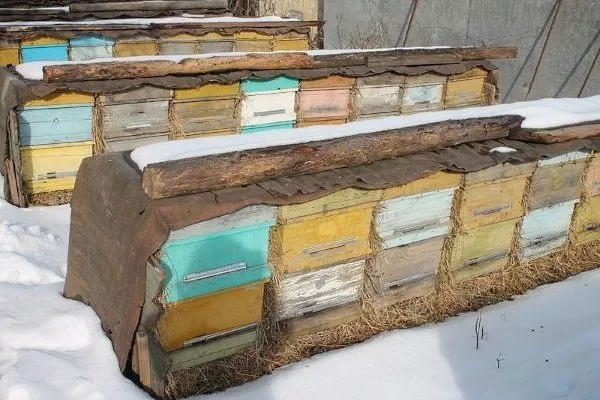
If the hives are covered with casings, bees still make flyovers in the fall, when others are no longer flying. In the spring, they are more active than their fellow bees.
After winter, the casings are thoroughly dried in the sun and put away for storage in a warehouse.
In the trenches
Bees will survive the winter better if the hives are placed in trenches. Choose a dry location away from groundwater. A south-facing slope, where the soil is looser, is a good option. Place the hives in the trenches as follows:
- Hives are installed in one or two rows. A trench is dug approximately 1 m deep. The width at the bottom should be approximately 80 cm, and at the top – 110 cm. For one colony, allow approximately 70 cm. No more than 20 hives should be installed in one trench; it's better to dig another one nearby.
- After the trench is dug, wait a while for the soil to dry completely. Then, add about 5 cm of sand to the bottom and lay the logs.
- The hives are placed on the stacked logs and aligned in the center. The walls should not touch the ground or adjacent hives.
- Logs are placed on the hives again, followed by boards and well-dried straw, which will serve as insulation. The optimal thickness of this layer is 30 cm. Then, about 50 cm of soil is added on top. It is lightly compacted and slightly sloped to allow water to drain into a ditch dug nearby. This ditch should be 25-30 cm deep and 40-50 cm wide.
- To supply air, ventilation pipes are installed into the trench at a distance of approximately 8 meters. Their diameter should be approximately 10 cm. The pipes should be positioned as deep as possible, but they should not touch the hives. The top should be raised. A canopy should be installed to protect from rain and snow. These pipes should always be open, but they can be partially covered in low temperatures.
- Select a dry location with loose soil to prevent moisture accumulation.
- Installation of ventilation pipes to provide fresh air and remove fumes.
- Laying an insulating layer of straw at least 30 cm thick to maintain an optimal temperature.
Some beekeepers believe that ventilation pipes in trenches are unnecessary because bees benefit from the carbon dioxide. However, water vapor is also released in trenches, so the insects still need fresh air, which is why the pipes are installed.
- The entrance holes are completely opened, and the side insulation is removed. A thin straw mat is sufficient on top.
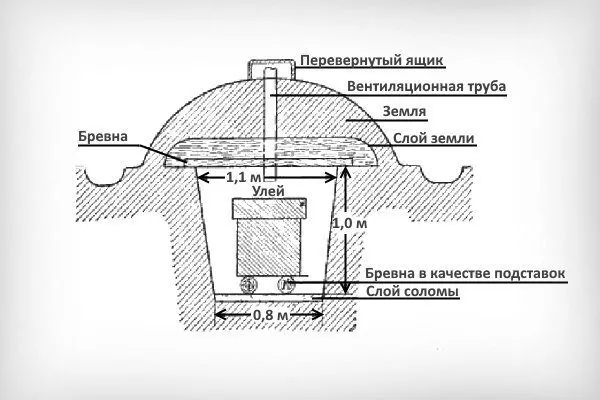
The trenches maintain approximately the same temperature, but the beekeeper cannot control the condition of the bees or regulate the air humidity, which is the disadvantage of this method.
Bees are dug out at the same time as when wintering in a moss house. This time is late March - early April. The trenches are dug in the evening so that by morning the bees are calmer and can be moved outdoors. The mortality rate during this type of wintering is small, and the feed consumption per colony is about 6 kg.
Under the snow
The most natural way to overwinter bees is to cover their hives with snow. There's no need to worry about the insects suffocating. Simply leave the hive entrances open and ensure they don't become clogged with snow.
Snow is an excellent temperature regulator, so bees will feel just as comfortable under it as in a moss house. Just cover the front wall with a sheet of plywood to create an air gap. The sides can be covered with tarpaulin to prevent wind from blowing through small cracks. A big advantage of this method is that tits will be unable to eat the bees under the snow.
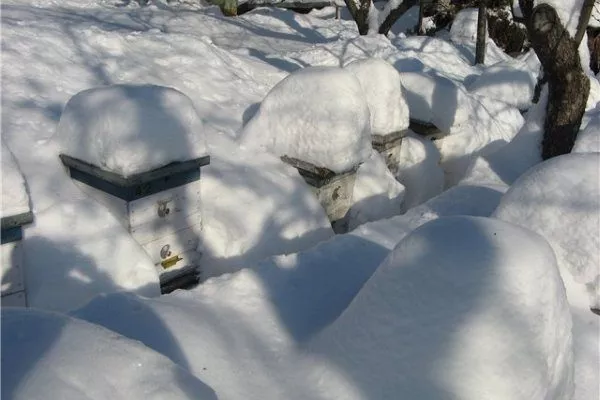
There is also a group method of wintering bees under the snow, which involves installing hives in a dense row in a protected place, with the entrances facing south.
Features of wintering in northern regions
Experienced beekeepers organize the wintering of bees outdoors in northern regions, taking into account several nuances:
- They use thin-walled hives, but of any size. Bees are kept in them year-round. The entrances are kept open.
- Hives are constructed from several boxes. Overwintering occurs in two of them, but sometimes only in one, which must be accompanied by a super. Nine frames are installed in each box, with the top bars being 12 mm thinner than usual. This allows the queen to move to a higher box.
- Only colonies occupying two hives are left to overwinter outdoors. All honey is collected, as it may contain honeydew. In the fall, the bees are given sugar syrup at a rate of up to 25 kg per colony. Three frames of bee bread are always left for the winter. In the spring, the bees are not given any additional food, as it is still quite cold in the north.
- To prevent moisture vapor from accumulating in the upper part of the hive, thin (3 cm) foam insulation is installed. Holes are made in the roof to allow moisture to escape.
- To prevent wind from blowing into the cracks, the hives are wrapped in moisture-proof paper, and the entrances are covered with inclined boards.
- They try to bury the hives as deep as possible in the snow.
In the harsh Siberian conditions, bees can survive in the wild only under a layer of snow.
Features of wintering in the southern regions
Bees overwinter most favorably in southern regions, where winter temperatures range from -5 to -3°C. In such conditions, it's best to overwinter bees outdoors. However, even in this case, a few nuances should be considered:
- In the south, winds often blow and damp weather persists for long periods, making it very difficult for bees to maintain a constant temperature inside the hive. Ice often forms on the walls. As the weather warms, the ice melts, leading to mold growth, which is detrimental to bees. To prevent this, it is recommended to insulate the hives with at least waterproof paper or roofing felt.
- When warm weather persists for a long time in autumn, bees are forced to fly and search for honey, weakening colonies. To survive such periods, they need more food.
- Bees need to be protected from strong, cold, and damp winds. To achieve this, the apiary can be placed inside bushes or a fence can be built. This step shouldn't be neglected, given that bees tolerate frost better than wind.
The disadvantage of overwintering bees outdoors in southern regions is that warm weather forces them to fly during the winter and early spring. This weakens the insects, and many don't survive until late spring.
Checking bee habitat in winter
If insect overwintering is managed according to all the rules, there's no need to check or disturb the bees. In practice, however, most beekeepers prefer to periodically check on their overwintering bees. This is done in accordance with certain rules:
- To peer inside the hive, remove the lid. This is done very carefully, without making any unnecessary noise.
- The weather during the inspection should be warm and windless. However, it can be cloudy to discourage bees from making a flyover.
This video shows how to inspect bees in winter:
To avoid opening the lid of the hive, you can listen to the sound coming from the hive. If it's quiet, everything is fine, so don't disturb the bees.
Pros and cons of wintering in the wild
There's still debate about how to overwinter bees. Some believe the insects thrive in natural conditions, while others prefer to keep them in a warmer moss house.
The main advantages of wintering bees in the open are as follows:
- It is much easier for a beekeeper to prepare for winter.
- When the outside temperature is above zero, the beekeeper can arrange for flights to empty the colonies of their full guts. This is much more difficult when housed in a moss house, as it requires transporting the hives back and forth. This is especially true in regions where temperatures fluctuate between below and above freezing.
- Bees in the wild make their first flight earlier, and the queen lays eggs sooner. They can clean the dead bees themselves.
As for the disadvantages, they are as follows:
- Not all beekeepers have the resources or ability to build a wintering house. Furthermore, the hives would have to be moved, and they are heavy, so a helper is essential. An alternative is to transport the hives, but this entails additional investment.
- You will need to find materials to protect the apiary from snow drifts and cover the wall that is located on the sunny side.
- It's important to consider protecting the hives from tits, as they disturb them by tapping the walls with their beaks. The bees then fly out, and the tits eat them.
- It is necessary to clear the snow around the hives, and also monitor the air temperature so that the bees do not fly away at the slightest warming.
- Weak colonies with only 4-6 frames need special attention. They likely won't survive the winter successfully, so it's best to rehouse them with another colony.
Organizing bee hives for winter in the wild is a challenging task, as it affects the health of bee colonies, their ability to produce honey, and their ability to produce more offspring. With the right conditions, the insects will be able to successfully overwinter in the wild and delight beekeepers with excellent honey.