
Using multi-hull hives offers beekeepers certain advantages, primarily due to their design. Relocating bees to new hives should be done in stages. It's important to consider the specifics of subsequent beekeeping.
Design Features
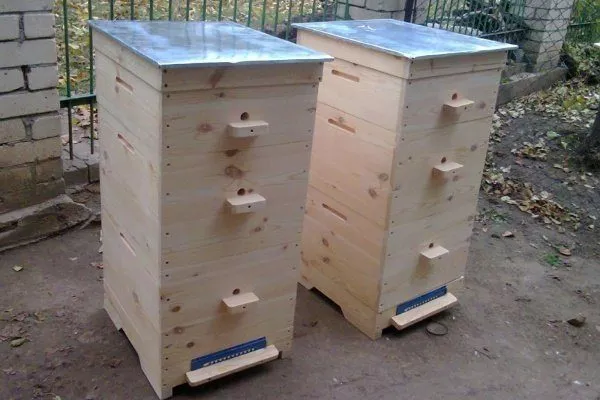
The design of a multi-body hive may vary, but according to GOST, it must include four identical bodies, a removable bottom, a lid, and a sub-lid. Interchangeability of all hive components is a mandatory requirement.
Each hive is equipped with a round entrance. The main entrance is slit-shaped and located at the bottom of the structure. Its length extends along the entire front wall, its width is 2.5 cm, and it is adjustable with a damper. These features improve ventilation and reduce the workload during intense bee flight.
The body and bottom are not secured, but they are necessary for transportation. The apiary should use identical frames of the same size and construction. These frames are 23 cm high and are designed for strong and medium-sized bee colonies, as well as for expansion of the hive by adding frames.
In a multi-body hive, a divider grid is essential to separate the brood nest from the rest of the hive. This grid is placed between the second and third bodies. 20 combs are sufficient for one fertile queen. Separating the brood with a grid will make honey harvesting much easier.
Additionally, a multi-body hive can be equipped with a landing board, although this is not required. Its width should match the front wall of the hive and its length should be approximately 50 cm. If the bees collide while approaching the entrance, they will fall onto the board. This is also convenient for honey collection – with a dividing board, bees can be shaken off onto the board without fear of losing the queen.
During the summer, the number of hives can reach 5-7. Each sector contains 10 frames.
Advantages of multi-body hives
There are several advantages to keeping bees in multi-hull hives:
- The main work is carried out with cases that are attractive due to their low weight - this eliminates the need for additional assistance and makes it possible to remove the case independently;
- the ability to move the hive freely and lead a nomadic lifestyle (you can read more about a mobile apiary)here);
- increasing the number of bee colonies without expanding the apiary;
- the possibility of stimulating active construction by bees by changing the locations of the bodies;
- making it easier to keep insects by replacing frames with housings;
- less time spent on inspection, placement, and selection;
- the opportunity to repopulate a strong bee colony with orphaned bees;
- comfortable conditions for insects to overwinter, resulting in increased productivity and subsequent honey collection.
Expanding the hive
Transferring bees to multi-hull hives should be done in stages. This process begins in the first half of spring, as the brood is still relatively small at this time. The transfer should be done during warm weather, otherwise the brood may become chilled.
- ✓ The air temperature during relocation should not be lower than 15°C to prevent the brood from getting cold.
- ✓ The best time of day for relocation is early morning or evening, when bee activity is minimal.
Preparing the first corps
Multi-frame constructions have a frame height that's shorter than standard, so it should be reduced. To shorten the nesting frames, trim the side bars to no more than 23 cm. After this, trim the bottom of the combs to a centimeter above the prepared bars, and nail the bottom bar to them.
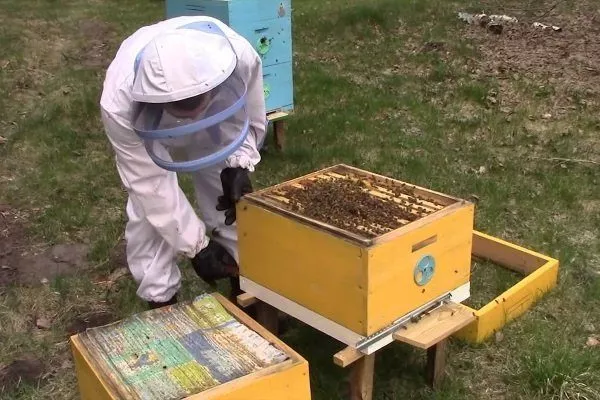
The multi-box hive must be installed in the same location as the hive being relocated. Shortened frames containing brood and food are installed according to the standard layout—there should be 10 of them in total. The queen should be temporarily covered with a queen cap. During this time, the bees should be moved from the old hive to the new box. The entrance should be shortened to an average of 2 cm.
Second building
Once a stable nectar flow is established, egg production will rapidly increase, leading to a corresponding increase in the number of brood frames. The number of young bees will rapidly increase, requiring expansion by adding a second hive. If this measure is not taken promptly, swarming may occur.
The installation of the second box should begin when the queen begins laying eggs on the second-to-last comb. For the second box, it's best to use low-honeycomb combs where brood has already been hatched. Be sure to add several frames of wax foundation.
A pair of combs with exposed brood should be placed in the center of the upper compartment. This will ensure a higher temperature in the enclosure and speed up the transition of the queen and her bees, who are attracted to the warmth. This ensures that brood of the same age is concentrated in one enclosure, which is important for subsequent rearrangements.
If the nights are cold and a cold snap is likely when introducing the second box, you can place it on the bottom and place the first box on top. This will protect the brood and fully stock the entire box at once. The bees will begin colonizing the nest naturally.
Rearrangement of buildings
Once all the frames in the second box are filled with brood and food, the bottom section becomes empty, but the queen is not attracted to this area due to the lower temperature, so egg production may decrease. This means it's time to move the boxes.
Two hive roofs are installed on either side of the hive, and the upper hive body is moved to one of them. The lower section is covered and placed on the second roof. Then the hive bodies are reinstalled, swapping their positions.
Third building
After rearranging the boxes, brood rearing occurs in the lower section, with the ovipositor passing through the top. To increase the colony's strength and prevent swarming, a third box should be installed.
Frames with wax foundation are installed—at least half mixed with light-colored comb. If the weather remains consistently warm, all frames can be installed with wax foundation.
At this stage, the boxes must be swapped again, as there are empty cells in the lower section again. The upper section is moved down, then a new box is installed, followed by the section that was the lowest. This creates a void in the nest, which the bees dislike, so they intensify their efforts to build. They do not, however, swarm.
When establishing queen cells, there's no need to install a third box. The bee colony won't build comb.
Fourth Corps
The third hive is built and fully occupied by the bees in approximately 2-3 weeks. After this, the final hive is installed. It is primarily composed of frames with wax foundation.
When adding the fourth enclosure, another rearrangement is required. The second sector is installed at the bottom, then the third compartment is placed, the new enclosure is installed on top, and the structure is completed with the sector that was the bottom.
After such a rearrangement, there is open brood and food supply at the bottom, and at the top sealed brood With empty combs, the bees will quickly rebuild them. The upper section will be used for pouring honey and preparing the combs for winter. The queen will begin laying eggs in the new section.
Such rearrangements provide the bees not only with work but also with good nutrition, as they regularly need to rebuild the nest and transport supplies upward. All this distracts the insects from swarming.
Honey extraction
This stage begins when the honeycomb cells are one-third sealed. It is important that the bees have food, as its quality is higher in the first half of the honey flowThe better the quality of the food, the lower the risk of insect death in winter.
- Make sure that at least one third of the honeycomb cells are sealed before you begin pumping.
- Make sure your bees have enough food to survive the winter successfully.
- Use a frame with a stretched canvas soaked in a weak solution of carbolic acid to quickly move the bees down.
There are no significant differences in extracting honey from multi-box hives. Once the first box is filled with honey, it should be emptied of bees and stored. This will become the main honey supply for the winter.
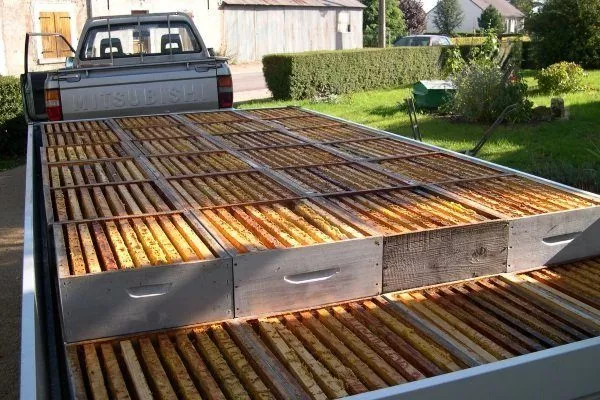
In a stationary apiary, honey extraction is performed once per season, so if the flow is good, an additional fifth box can be used. In a migratory apiary, extraction is performed before each move. Only the two upper feeding boxes are used for extraction. After the flow is complete, they are removed; the bee colonies will remain in the two lower sections.
To extract honey, it's convenient to use a frame with stretched canvas, which should be soaked in a weak solution of carbolic acid. The bees will move downwards within a few minutes.
Preparing food for the winter
This stage is essential for the successful wintering of the bee colony. Depending on the climate, each colony requires an average of 20-30 kg of feed.
Light-brown combs are used for storing the prepared bees. They are warmer and therefore preferable for laying queen bees. Light-colored combs are placed along the edges, and dark-colored combs are discarded.
The frames in the center of the nest should contain at least 2 kg of honey and empty cells for the cluster. Its density ensures good temperature control and reduced feed consumption. Uncapped honeycombs are left, while some of the capped honey is removed to prevent it from souring over the winter.
In addition to honey, you also need to prepare bee breadOtherwise, the bee colonies won't be able to develop in the spring. Each colony requires at least two frames of bee bread, filled with honey and sealed with wax—without this, the feed will mold.
Bee bread is placed along the edges of the combs after the light combs. The bees will initially feed on honey, and will switch to bee bread if necessary towards the end of winter.
Invert is also used for feeding. It should be prepared in a 4:100 ratio (honey to syrup ratio).
Reducing the size of the hive in autumn
For wintering in a multi-hull hive, all sectors are not needed—two are sufficient. Less commonly, three hives are used if the nest is small for the colony.
Excess compartments should be removed as honey flow declines. All honey boxes should be removed, leaving the lower section, where the brood is, and the upper section, which contains the food.
Wintering
In the fall, in addition to reducing the number of hives, standard maintenance work must be carried out. Inspection of the bees and hygiene checks are mandatory. Intensive feeding is carried out in early September.
During bee hive overwintering, ventilation is essential. To achieve this, the lower and upper entrances are left open. A moss cushion placed on the nest is an additional measure. The material should absorb moisture, which is a byproduct of the insects' metabolism. Proper ventilation helps prevent overheating, which is far more dangerous than frost.
Leaves and sawdust can be used to insulate the hive. This insulation is placed on the bottom of the structure.
Spring inspection
If the winter is well-survived, bee colonies will experience rapid growth in the spring, and expanding the nest will only facilitate this. Inspection is carried out when rearranging the nests—the boxes should be swapped. If colonies are weakened, they should be merged.
Spring rearrangement will stimulate the ovipositor and prevent swarming. When filling the upper hive, a third section must be installed – position it in the middle.
If a spring inspection reveals a food shortage, additional honey and bee bread frames should be added. One bee colony requires an average of 9 kg of honey and 2.5 kg of bee bread.
Swarming and layering
The risk of swarming in a multi-box hive is reduced by rearranging the boxes as they are added. Swarming can also be prevented by organizing colonies. This is possible if bee colony takes up at least 2 bodies and is quite strong.
The lower compartment containing the queen is separated by a solid partition, and the second section is turned in the opposite direction. A separator grid can also be used, placed at odds with the section containing the comb and foundation. Swarming is virtually eliminated if the brood nest is ruptured.
Watch a video that explains the nuances of keeping bees in multi-body hives:
Multi-body hives offer numerous advantages. While there are some specific considerations when keeping bees in these structures, the general principles of beekeeping remain the same. Proper management ensures a larger bee population in an apiary, which in turn increases the amount of honey produced.