
Swarming is a natural process for bees. It occurs for various reasons. If it's not prevented or caught in time, it can lead to significant losses for the apiary. Various preventative measures can help avoid this problem.
What is bee swarming?
Swarming is a natural process. In this case, part of the colony with the queen is separated, which is evidence of the insects' ability to reproductionBees establish a new colony, led by the old queen. The colony that produces the first swarm is called the mother colony.
There is also a sub-swarm, called a secondary swarm. This phenomenon occurs when many bees remain in the hive even after the first swarm (primeval). There may be several secondary swarms, but in each case, the queen leading the new swarm is infertile.
Swarming in an apiary can lead to losses, as some bees are lost. This problem can be avoided by taking preventative measures and organizing artificial swarming.
If the process has already begun naturally, the bees need to be trapped. This method will not only prevent losses but also increase the insect population, thereby generating additional profit.
The tendency to swarm depends on the bee breed and its personality. The calmer and more peaceful the insects, the less likely they are to swarm.
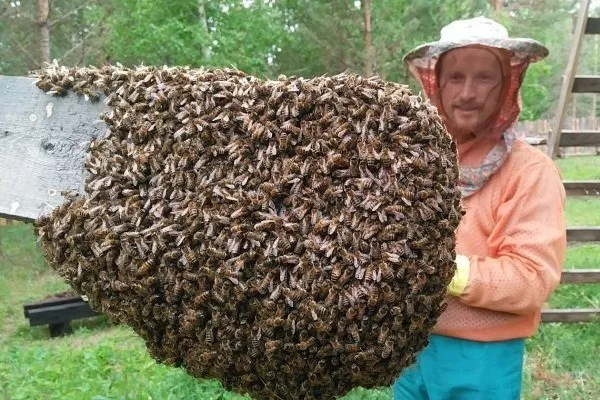
Causes of swarming
Swarming is a natural response of bees to a successful hive. If we consider this process in terms of its causes, it can be reproductive or a consequence of hive overcrowding.
Reproductive swarming is observed in the spring and summer. During this time, queens are actively laying eggs, which is why babies appear in the hive. dronesThis indicates that swarming season is approaching.
Before the start of the active honey flow, when only a small number of bees are collecting pollen and nectar, and there are fewer larvae than nurse bees, the queen can no longer lay eggs because all the frames are occupied. All this instinctively prompts the bees to swarm.
Instinctively, bees begin swarming when spring begins late. In this case, the young are ready to collect nectar, but they are not yet fully formed.
In most cases, swarming occurs due to hive overcrowding. There may be several reasons for this:
- lack of space for nectar, which begins to accumulate in the nest;
- too large reserves of nectar or pollen, in which case there is no room left for egg laying;
- lack of space for a club;
- too dense a flow of bees passing through the nest;
- poorly organized ventilation;
- the appearance of a large number of brood due to the nest not being expanded in a timely manner.
Factors that provoke swarming
| Factor | Critical period | Solution |
|---|---|---|
| Overcrowding of the hive | The end of spring | Nest expansion |
| Excess feed | Before the honey harvest | Honey extraction |
| Overheating of the hive | Hot days | Shading, ventilation |
| Old uterus | 2+ years | Uterine replacement |
| Lack of work | After the bribe | Adding wax foundation |
Signs of the beginning of swarming
The primary sign of swarming is the queen's cessation of egg laying. This occurs abruptly. Concurrently, comb construction ceases, and nectar and pollen are collected in reduced quantities. Preparation for swarming can be confirmed by the presence of wax foundation in the hive, which remains loose for three days.
The approaching swarming can also be inferred from the fact that many bees no longer fly out early in the morning to collect nectar and pollen. Instead, the insects become more restless, congregating on or under the landing board.
To prepare for swarming, bees begin laying queen cells. These are necessary for the production of new queens. After laying a queen cell, the bees seal it on the eighth day. A couple of days later, the first swarm emerges.
This video explains how to recognize the first signs of bee swarming:
Swarming begins with a loud hum and the bees flying out of the hive.
First, they gather on a nearby tree or fence. After a few hours, the swarm flies off in an unknown direction. This situation often catches novice beekeepers off guard.
The clustering of bees on a tree or fence during the first swarming is explained by the fact that the swarming is led by an old queen, who is unable to fly quickly. She settles near the hive, and the swarm, attracted by her scent, gathers around her. The entire swarm flies out of the hive within five minutes.
The swarm remains in one place for several hours. This time is necessary for the scout bees to find a site for a new hive. It is during this period that the swarm can be captured, as once they have flown to a new location, there is virtually nothing that can be done.
How to deal with swarming that has begun?
Swarming can be controlled even if it has already begun. It's not always possible to recapture bees that have already left the hive, but it is possible to prevent the process from progressing.
In this case, we need to start from the reasons for the swarming that is occurring:
- If there is no space for nectar, then the problem can be solved by adding new stores.
- If there's no room for the queen to lay eggs, remove the honey-filled combs and replace them with empty ones. The bees will begin to draw out the combs, the queen will begin laying eggs, and the nest will have more room for the cluster.
- If the bees don't have room for a cluster, they need to create space under the nest. For this purpose, slatted inserts are used. You can also create space on the sides of the nest by installing dividing strips on the outer sides.
- If the nest is experiencing a heavy insect flow, it's a good idea to install upper entrances. These will provide additional access for honey-collecting bees.
Swarming doesn't happen spontaneously. Bees prepare for it. The best way to prevent swarming is to reduce the queen's pheromone secretion. This will increase the number of drones, or worker bees, that lay eggs. The bees will begin laying queen cells, and building activity will decrease.
If swarming is expected, the hives should be moved out of direct sunlight and ventilation increased. The bees need increased workload to encourage them to build comb.
During swarming, it's effective to separate the bees. To do this, separate the mature bees from the young within a colony. Once the nectar appears and the honey flow begins, return the bees to the main colony.
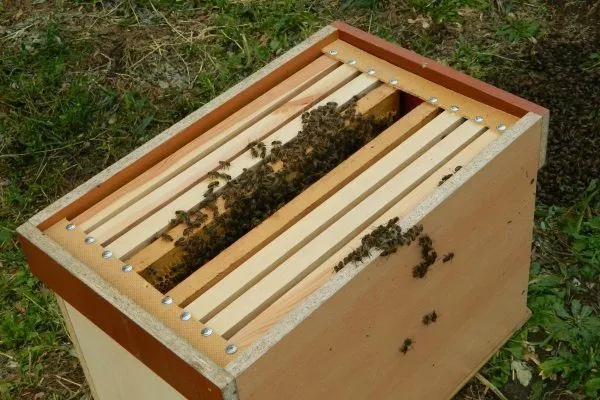
Catching a swarm
To catch a swarm as quickly and effectively as possible, you should begin monitoring the hive at the first signs of swarming. First, the queen emerges, moving from the entrance across the entire landing board. At this stage, she can be caught with a cap and placed in a cage, which is then placed in a swarm box—a special trap. It is hung in the area where the bees are most concentrated. The queen attracts them with her scent, so all the insects gradually converge in one place.
It's much more difficult to catch a swarm when the queen isn't captured right away. If the swarm is nesting in a tree or under a roof, wait until all the insects are gathered in one spot, place the swarm box underneath them, and quickly shake them into it.
The task becomes more difficult when the swarm has gathered in a place where it's impossible to dislodge it. In this case, it's necessary to set up a swarm box nearby and transfer the bees there manually. A large spoon or wooden ladle works well for this.
Comparison of catching methods
| Method | Efficiency | Complexity | Risk of loss |
|---|---|---|---|
| Queen bee trap | 95% | Low | Minimum |
| Mechanical harvesting | 70% | Average | High |
| Decoy hive | 85% | Low | Average |
| Chemical attractants | 60% | Low | High |
The main thing is to move the queen to the swarm box, then the rest of the bees will gradually move towards her.
After collecting the bees in a swarm box, leave it in a cool place for several hours. This time is necessary for the insects to calm down. After this, transfer the captured swarm to a hive with a pre-prepared nest.
For every kilogram of bees, two frames of wax foundation should be installed. A ramp of exposed brood, taken from a healthy colony, should be placed in the center of the nest. This prevents the bees from escaping.
This video shows how to transfer captured bees from a swarm box to a hive:
If you don't have a trap handy and swarming has begun, a regular box will do. Simply place two frames of dried honey in it and provide an attractive scent. Apiroy can be used for this purpose.
You can also catch bees without a trap. To do this, use the bottom box of a hive. It is installed approximately 50 meters from the apiary. Eight frames filled with dried honey are placed inside and rubbed with a material that attracts bees with its scent. This method is attractive for its simplicity and the elimination of the need to relocate the captured bees.
Methods of preventing bee swarming
Controlling bee swarming can be quite challenging, so it's important to take precautions in advance. Several preventative measures can help prevent swarming.
Prevention calendar
- April: Checking ventilation, expanding nests
- May: replacement of 30% of queens, formation of colonies
- June: queen cell control, adding cases
- July: culling of excess brood
- August: The unification of weak families
Organizing a hive from several bodies
To prevent swarming, a large hive should be provided for the bees. It should have a second and third hive body to allow the colony to grow vertically naturally.
Besides setting up such a hive, it's necessary to keep the bees busy. This requires ensuring the timely installation of frames with comb and foundation. Once the box is filled with frames of food and brood, an additional box should be installed. The bees will be busy with this, leaving no time for swarming.
Uterine replacement
To prevent swarming, the queen should be replaced regularly, rather than waiting for it to happen naturally. The queen should be replaced when she is over two years old or is too weak.
Replacing a queen involves organizing her hatching and forming a colony. A queen can be hatched using swarm cells, emergency queen cells, or artificially.
How to replace the queen with colonies is shown in this video:
Selection of frames
This is necessary to equalize the strength of the families. The frames containing the seeds should be taken from the strong families and given to the weaker families.
This approach allows a weak colony to gain strength for the honey flow, and prevents swarming in a strong colony.
Artificial swarming of bees is also considered a preventative measure.
Artificial swarming of bees: how and why to do it?
Periodically, breeding activities are necessary in an apiary. This involves dividing bee colonies, known as artificial swarming. This method allows for increasing the number of colonies in the apiary.
Artificial swarming involves separating a portion of the bees, the brood, and the nest from the main colony. The separated bees then produce a queen, which is the beginning of a new colony.
The artificial swarming process should be as close as possible to the conditions created naturally. Breeding activities should be carried out at the time when bees typically begin to swarm instinctively.
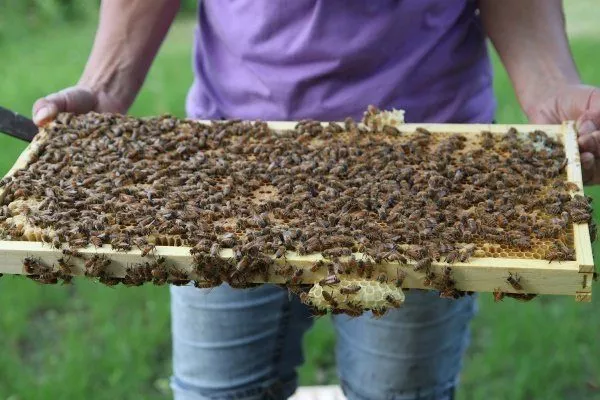
The advantage of artificial swarming over the natural process lies not only in the beekeeper's control, but also in the bees' behavior. When artificially separated from the main colony, they maintain their working spirit, even becoming more active. If swarming occurs naturally, the bees may do nothing for several weeks.
There are several methods of artificial swarming: Taranov, Kostylev, Dernov, Demari, Simmins, and Vitnitsky. They are also called anti-swarming methods.
Regardless of the method chosen, the following rules must be followed:
- Select bees that can quickly remember their hive.
- Use artificial swarming only for strong colonies.
- Avoid dividing the colony before the main nectar flow. The optimal time for artificial swarming is a month before the nectar flow. This allows the bees to prepare well for winter.
Taranov's method
This method is commonly referred to as artificial swarming. The following algorithm must be followed:
- Open the hive and treat the insects with smoke so that they collect honey in their crops.
- Place boards in front of the hive entrance, where you can shake off the queen and any overweight bees. They will all gather under the board, from where they should be moved to a swarm box and left overnight in a cool place.
- Destroy all queen cells and release the bees back into the hive.
- Provide sufficient work to prevent the emergence of new queen cells.
Technical parameters
| Indicator | Meaning |
|---|---|
| Smoke treatment time | 2-3 minutes |
| Aging in a swarm | 4-6 hours |
| Storage temperature | 12-15°C |
| Amount of wax foundation | 4-5 frames |
How artificial swarming is carried out using this method is shown in the video:
Demaree method
This method allows you to expand the nest without stopping egg laying. To do this, choose one of the following options:
- Leave one frame with the queen in the lower box with the brood exposed. Transfer the rest to the upper box and isolate them. Replace them with frames of wax foundation.
- Transfer the young to the upper body, leaving the queen with empty combs below.
- Remove the closed brood from the queen and leave the open brood with the bees.
Kostylev method
In this case, artificial swarming begins in the evening, after the bulk of the insects have returned to the hive. Boards should be placed nearby beforehand, onto which the selected colony is placed. All queen cells should be removed. The brood is transferred to another colony that was not intended to breed.
Additional feed and sealed frames should be placed in the hive. The brood exposed in the other hive is returned in the morning, adding wax foundation. The boards with the swarm colony are placed near the entrance, and they are returned. Since there is no sealed brood or honey, the insects begin raising larvae and collecting nectar.
Dernov's method
This method is used if queen cells have already been established, but swarming is unavoidable. The following options are available:
- Place all the flying bees in the empty hive and destroy the queen cells in the old one. Turn the new hive entrance toward the old one so the bees return to the queen.
- Destroy the old queen and all queen cells, leaving only one. Repeat this process every 5 days until a new queen emerges.
Simmins method
This method is used when hives consist of two bodies. The following algorithm should be followed:
- Remove the entire family with the queen and shake it off in front of the entrance of the lower body.
- Install the dryer and wax foundation in the lower body.
- Separate the bodies with special hive grates (Hahnemannian).
- Transfer all frames with brood to the upper body.
When part of the colony returns to the hive, they will climb up through the grating to care for the brood. The remaining bees will begin creating foundation, and the queen will begin seeding the available frames.
Vitnitsky's method
This method is the simplest and most effective. To prevent swarming, the bees need to be kept busy. This is done by using empty combs to divide the nest in half. The bees then begin building foundation and stop swarming.
Bees swarming occurs naturally, but it's undesirable in an apiary. It can be prevented through prophylaxis or artificial swarming. If the natural process has already begun, the insects are captured in a swarming box.