
It can be done in different ways remove the queenYou can purchase a special device at the store or make one yourself using simple and readily available materials, such as syringes. Raising queens with syringes has many advantages if the process is properly organized.
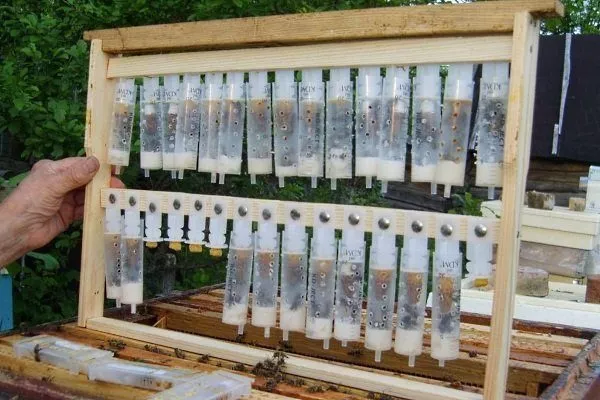
Choosing a syringe
A regular medical syringe is suitable for removing the queens. You can buy one at any pharmacy. It's important to choose the correct volume—a 20 ml syringe is typically used.
It is proposed to manufacture the device in a grafting frame - syringes are installed in two rows of 11-12 pieces each, that is, 22-24 syringes are required for one frame.
Additionally, other materials and tools are needed:
- stationery knife;
- sandpaper;
- hammer with nails, drill or screwdriver with screws;
- Bowls – you can buy special devices at a beekeeping store or make them yourself.
Instructions for making the structure
The construction of a queen-rearing structure is quite simple. Follow the following steps:
- Trim the tops of the syringes.
- Clean up the edges.
- Drill 6 holes along the entire length of the syringe on 4 sides – there should be 24 in total.
- The last pair of holes are made right at the entrance of the syringe piston - they will be used for transportation.
- Clean the holes.
- Make a hole in the syringe piston for the bowl with an indentation to the side - the bowl should be attached to the side so that queen bee could freely get out if necessary and not die.
- Cut off and clean the lower part of the piston.
- Cut off the top of the piston so that a small plate remains for fastening to the frame; the syringe is secured with a screw or nail.
- Make a groove in the piston plate, through which the device will be attached.
The syringes prepared in this way should be attached to the grafting frame so that there is a distance of 35-40 mm between them. When making this frame, do not attach the bottom bar, otherwise it may crush the bees.
The end result should be a U-shaped structure with an additional bar in the middle to which the second row of insulator syringes will be attached. The distance between the two rows should be sufficient to allow for easy attachment and removal of the insulators. They should be attached a short distance from the edges (at least 4 cm), as these are cold spots that bees dislike.
This video shows the process of making a structure for breeding queens:
How to breed queens in syringes?
To breed queens in the prepared structure, it is necessary to place a small ball on the bottom of each syringe CandyAll the balls must be covered with round paper caps, in the centers of which a hole with a diameter of 6 mm is made.
First you need to place it in spatulas bee larvaeA nurse bee is also needed, which must be removed approximately two days before the queen bee emerges.
- ✓ The temperature in the hive should be maintained within 34-36°C to ensure optimal conditions for the development of larvae.
- ✓ Air humidity should be at least 60-70% to prevent the larvae from drying out.
At this time, the main part of the structure—the syringe bodies—should be attached to the spatulas. Two to three bees should be introduced into each body, which will provide feeding for the queen after she emerges.
There's a certain age difference between the larvae, so the queens hatch at different times—usually within a few hours. Even if they hatch simultaneously, isolation prevents them from killing each other.
After hatching, the queen should be removed. The remaining larvae are left behind to allow the remaining individuals to hatch.
Advantages and disadvantages of the method
There are certain advantages to using syringes to breed queens:
- availability of materials – syringes are sold in any pharmacy, other materials and tools can be found at home;
- minimal cost of construction – ready-made devices are much more expensive;
- the possibility of isolating queens and preserving their large numbers;
- safety of queens from being eaten by their relatives;
- ease and safety of transportation – the use of such structures provides the necessary air flow, and they are very easy to carry;
- the ability to quickly attach a queen cell between the combs for installation in a nucleus.
The only drawback to this method is the need for fabrication work. In reality, this will only be difficult the first time; preparing such devices will subsequently take minimal time and seem very easy.
Using queen-rearing syringes allows you to produce a fairly large brood without the risk of queens being destroyed by their fellow queens. The devices are fairly easy to make, using inexpensive and readily available materials. This method is ideal for beginning beekeepers, as it is both simple and highly effective.