
Drones are the males of a bee colony whose job it is to fertilize the females. A drone serves no other function, except to keep the brood warm during cold weather. The bees determine the length and quality of a drone's life; they decide when it's time to be born and when it's time to end its life. While the "male" is useful to them, they feed, warm, and nurture him, but when the honey harvest is over, the bees discard him, and he soon dies.
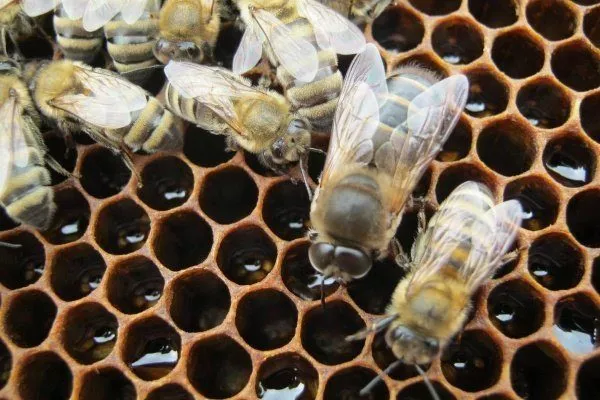
Description and role of the drone
Drones can be confused with drone bees. They have similar names, but the individuals themselves are distinct. A drone is a male bee, while a drone bee is an underdeveloped female bee that develops from bees that feed the queen. A drone bee appears in the nest when the queen is either absent or has ceased producing. If the queen is severely weakened or dies, the bees feed each other royal jelly, and several drone bees develop within the egg cells. Because the eggs are not fertilized by the drone, the drone bees are born underdeveloped and die quickly.
A male bee cannot fertilize any bee, so there must be a queen in each hive.
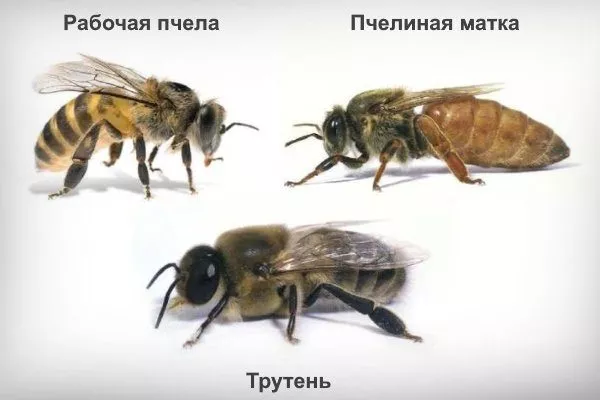
The female bees are the worker bees and the queen bee, while the male bees are the drones.
| Criterion | Drone | worker bee | Uterus |
|---|---|---|---|
| Role in the family | Fertilization | Food collection, care | Reproduction |
| Life expectancy | 2-3 months | 30-60 days | 3-5 years |
| Honey consumption (per day) | 0.5 kg/kg of mass | 0.12 kg/kg mass | 0.3 kg/kg of mass |
| Anatomical features | No sting, no proboscis | There is a sting, a proboscis | Reduced sting |
| Number of children in the family | 400-1500 | 30,000-60,000 | 1 (rarely 2) |
Drones are lazy and do nothing; their only role is to fertilize the queen. A single colony can produce over a thousand drones in a single season.
What does he look like?
Drones can be seen from the last month of spring to the last month of summer. These insects fly away in the afternoon and return home only in the late evening. A distinctive feature of a drone is its relatively large size compared to the queen bee and the bees themselves. It weighs 250 milligrams and is 15 centimeters long. It has well-developed wings.
It is interesting that the drone does not have:
- sting;
- wax glands;
- a proboscis, which serves to collect food and carry it somewhere.
Therefore, without outside care he will not survive, he will not even be able to feed himself.
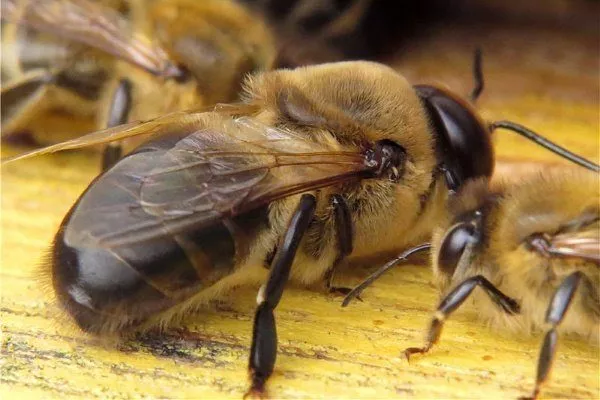
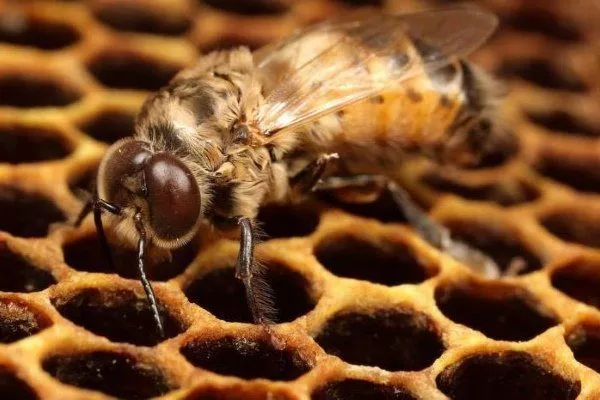
Nature has endowed drones with everything they need for mating: exceptional charm, excellent vision, and high flight. A drone can spot a female in flight and catch her faster than his rivals in order to mate. Males have very well-developed wings, allowing them to fly high and over long distances in search of a queen.
Drones are very voracious, consuming over twenty kilograms of honey per kilogram of these bees. This lasts for two or three months; they don't live longer. Males consume four times more honey than the females, who produce it. For one kilogram of drones to survive, they consume more than half a kilogram of honey per day, which is almost 16 kilograms per month. During the summer, 50 kilograms of honey are consumed per kilogram of insects. There are approximately 4,000 drones in one kilogram.
The drones' flight is accompanied by a loud buzzing sound. When they land on a particular resting surface, they make sounds as if they have fallen from exhaustion.
Life cycle
If a bee colony produces few drones, it means the queen is aging, and her chances of being fertilized are minimal. The better, after all, if many drones surround the queen. Before mating, the drones fight for the queen, eliminating the weak and helpless, and ultimately leaving the strongest. This ensures that future bees will have good genes.
The industrious bees care for and raise the drones, beginning in May and finishing only when it's time to harvest honey. A single colony contains approximately 400 drones, but it's not uncommon for a single colony to contain as many as a thousand or even fifteen hundred males.
Drones are located in the cells as follows:
- above;
- from below;
- on the sides.
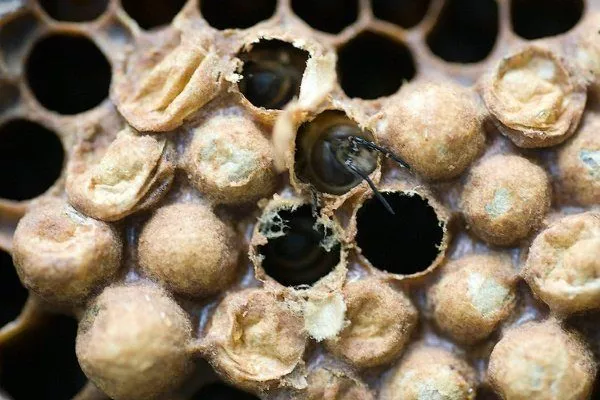
The egg stage lasts 3 days, and the larval stage lasts 7 days. Bees feed the larvae royal jelly, then bee bread, and honey. The cells are then sealed, allowing the bee to identify the drone.
Stages of development
- Egg (3 days)
- Larva (7 days, feeding on milk → bee bread + honey)
- Sealed cell (14 days, convex shape)
- Young drone (10 days of enhanced feeding)
- Sexually mature individual (from 14 days, flights for mating)
These cells are more convex because the fruit is large and will require more oxygen.
After emerging from the cell, the drone feeds heavily for about 10 days, gaining strength for future mating. A week after birth, they fly out only to explore the outside world. But after 14 days, they are already flying to find a queen.
The drone detects the queen's secretions as it moves, and then realizes she's nearby. However, it can only be detected at a high distance, no lower than 3 meters from the ground. Once it's close to the queen, it activates its vision.
Six to eight bees fertilize a single queen at once, and after successful fertilization, the drone, having fulfilled its duty, dies. Males live in the hive where they were born, but as long as they have their own sperm bank, they are welcome in any other hive. Wherever they are, the bees feed them, viewing them as clients for the queen.
After the main honey harvest, they no longer need drones; they weed them out to conserve food. At first, they are simply kept away from the honey, then they starve, weaken, and are forced out of the nest, where the drones die.
Drones may be left to overwinter only if there is no queen, or if she is not fertilized. If drones are present in the hive during the winter, this indicates a dysfunctional swarm. How long a drone's lifespan will depend on several factors:
- Is there a queen in the hive?
- is she capable of fertilization;
- general condition of the swarm;
- weather conditions.
Importance in the bee family
The reader's first question will be: why do drones serve a bee colony if they can't feed themselves, are voracious eaters, and offer no assistance to the worker bees? But they are the only bees that perpetuate the bee family; they are a flying sperm bank.
To fulfill their duty, a drone must be resilient and strong, as they will have to travel long distances to find a queen. They will also have to compete with other drones hunting the same prey.
Drones produced by a queen bee carry the same genetic material as she does. Each male bee has 16 chromosomes, while the queen has 32. Two weeks after hatching, the drone is ready to fertilize the queen.
Outside the hive
In the hive, the drones pay no attention to the queen, but as soon as she flies out in search of sperm, several others follow her as guards, driving away birds and other insects. They mate in flight; once her sperm receptacle is full, she compresses the chamber, and the reproductive organ of the drone who last inseminated her breaks off. The drone dies immediately, and both he and the queen fall to the ground.
Also, once a year, all the drones flock to a specific location far from their home. From there, they circle within a 100-meter radius, waiting for the queen. This distance from their home apiary is necessary because mating with a queen from another colony avoids kinship. For the same reason, several drones inseminate her at once to ensure a mixed sperm count.
In the hive
Drones also have useful features that they “use” while in the hive:
- It has recently been discovered that bees' mood is affected by the number of young. It is recommended to place frames of dried bees in the cells containing drones. This will cause the bees to begin raising drones, and the swarming state will be eliminated.
- Somewhat previously, everyone believed that drones were created and capable only of producing offspring. It was recommended to kill all drones to ensure the possibility of collecting more honey. Now, however, it is believed that drones are not only a flying sac of sperm, but also motivate the bees to work.
- Drones are also capable of warming their hives in winter. At the first frost, they huddle together, shielding the brood with their bodies. In doing so, they sacrifice themselves for the future of the bee colony.
| Function of drones | Period | Efficiency |
|---|---|---|
| Fertilization of the uterus | May-July | Critical |
| Stimulation of worker bees | All season | Increases harvest by 12-18% |
| Warming of brood | Winter/early spring | Temperature +34°C |
| Family Health Indicator | Autumn | Accuracy 93-97% |
Beekeepers have studied that if all drones are destroyed, the bees collect honey worse and more lazily, so today a certain percentage of drones are left alone.
The Importance of the Drone
In a bee colony, there are no essential or unimportant individuals; they all participate in specific functions. The queen reproduces the bees, and the drones directly assist her in this process. The colony is inhabited by worker bees, which hatch from a fertilized egg. Therefore, everyone's work is important; it's inappropriate to think about who's the odd one out in the swarm. Yes, drones are voracious, and because of them, the amount of honey in the hive quickly decreases, and beekeepers understand this, but it's important to understand that without these losses, there would be no honey at all.
There are also some advantages: in the fall, when drones die, it's possible to understand the state of a particular bee colony. If there are many dead drones lying around the hive, the colony is doing well, but if there are few or no drones at all, it means the queen needs replacing.
Questions and Answers
QuestionWhy does the drone die after insemination?
AnswerTo mate, the drone releases its reproductive organ, which had been inside it until that moment. This is almost like a human's internal organs coming out. Therefore, the drone dies without a chance of survival.
QuestionIs it possible to determine the breed of bees by the appearance of the drone?
AnswerYes, you can! For example, Caucasian bee drones are black, while mongrel drones are gray. The "Italian" breed is red, while forest drones are dark red.
A drone plays only one role in a bee colony, but it's the most important one: fertilization. It's incapable of anything else, not even feeding itself or transporting food to another location, because it lacks all the necessary resources. They are fed from birth by industrious bees, and after completing their mission, the drone dies.