
Dancing is a method of communication for bees. It's how they communicate specific information to each other. There are several variations of bee dance, each with its own characteristics and meaning. Bees perceive space in a unique way, which is reflected in their signaling system.
The Meaning of Dance for Bees
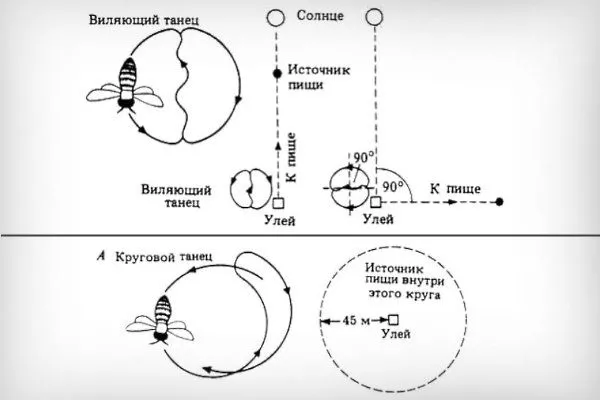
The dance serves as a kind of compass for insects. In the spring and summer, scouts search for a source of nectar and pollen, and upon finding one, they return to the hive and transmit information to foragers. The signaling individual uses the dance to indicate the direction relative to the sun:
- upward wagging movements mean that you need to fly towards the sun;
- when moving in a straight line - fly away from the sun;
- If you deviate to the right or left, you need to make the appropriate correction in flight.
- ✓ The angle of deviation from the sun, which is not specified in the article, but is critical for accurately determining the direction to the honey plant.
- ✓ The speed of vibrations of the bee's body during the dance, which affects the perception of information by other bees.
Thanks to this system, bees collect nectar and pollen from a specific honey plantIts aroma is the guide. This allows for the production of a specific type of honey, corresponding to the plant—acacia, linden, heather, and others. Read on to learn about the different varieties and types of honey. here.
The mechanism of this communication is partly related to vibrations. The insect's body vibrates due to the contraction of powerful wing muscles, but unlike in flight, the wings are folded during dancing.
The vibration of a signaling bee spreads across the entire surface of the honeycomb, making it detectable by other bees. The signal is only heard by bees within the same hive.
Many scientists had doubts about the possibility of communication between insects, with their tiny brains. This communication mechanism was confirmed using a small robot that meticulously reproduced every nuance of the dance. At its signal, the bees were supposed to fly to specially designed feeders—the experiment was a complete success.
Circle dance
During this dance, the bee makes circular movements. This way, it signals to its fellow bees that a rich source of nectar and pollen is located near the hive—within a radius of approximately 45 meters.
During the circle dance, the signaling bee does not indicate the direction in which to move to the site it has found. Attracted by the scout, foragers surround it and follow it. They are guided by the scent of flowers lingering on the abdomen of the insect that has found the honey plant. This scent is detected by the bee's antennae.
The scout bees' circular dance lasts only a few seconds, but it's enough to attract other worker bees and convey the necessary information. The bee begins dancing after dispensing the collected nectar—it also releases it during the dance. After finishing the dance, the insect immediately heads off to summer, and from there to the flowers it found. When the bee brings food again, it begins to dance again. This confirms that it has found a rich source of nutrition.
During the circle dance, nearby individuals repeat the movements of the scout, trying to touch her abdomen with their antennae. After these honey bees They begin to prepare for the flight – they clean themselves and head towards the flight hole.
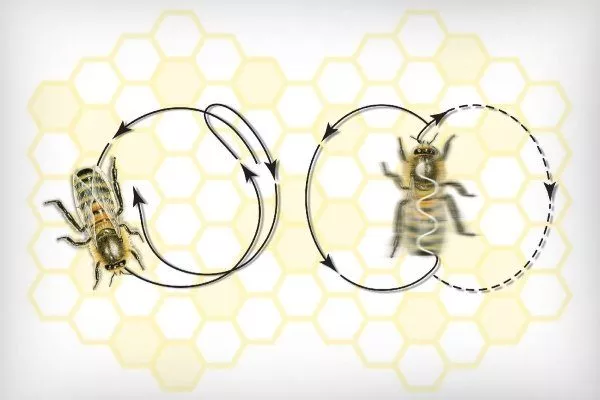
The circling and waggling dance of bees
The waggle dance
The movements during this dance resemble a figure eight and are semicircular. The bee runs upright and flaps its abdomen. The number of flaps indicates the proximity of the honey plant it has found. The more the insect flaps its abdomen, the closer the food source. Eight flaps per second indicates the honey plant is 6 km from the hive. If the bee flaps 20 times per second, the food source is approximately a kilometer away.
Bees resort to the waggle dance when honey plants are at a great distance. It is determined not only by the number of abdominal flaps but also by the number of circles they make. If the honey plant is approximately 100 meters from the hive, a bee will complete approximately 10 circles in 15 seconds. If it completes seven circles in the same time, the distance is twice as great: four circles equal 1 km, and two circles equal 6 km.
Scout bees can distort their distance data to honey plants. This depends on weather conditions. A headwind slows the bees down, while a tailwind accelerates them, so some errors are possible.
With its waggle dance, a bee can not only communicate the distance to a honey plant it has found but also indicate the direction in which to fly. If the insect dances horizontally on the entrance, the line connecting the figure eight indicates the direction to the honey plant. A certain distance is left between the semicircles of the figure eight—this distance corresponds to the angle of flight relative to the sun.
Dance in the Hive
The circle and waggle dances are effective and informative when the weather is clear and the sky is bright. In the dark, bees cannot see, but they perceive certain information through smell and touch.
The scout can indicate the direction in which the honey plant is located as follows:
- straight-line movement down the honeycomb - the food source is on the side opposite the sun;
- upward movement – the honey plant is located towards the sun.
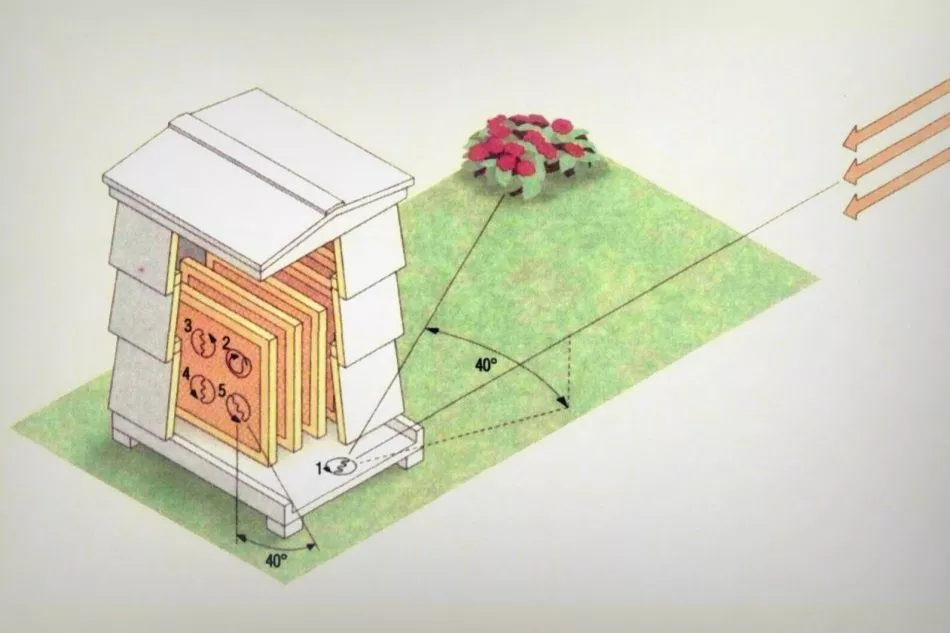
1 - dance outside the hive; 2 - circle dance inside the hive; 3 - waggle dance, downward movement; 4 - waggle dance, upward movement; 5 - vertical version of dance 1
Bees can only use their dance to indicate the distance to a honey plant and the direction toward it. They cannot indicate the height of food sources. This has been confirmed by experiments with high-mounted feeders.
Bee perception of space
Bees have compound eyes made up of ommatidia (structural elements). This feature allows for mosaic vision—the insect sees each object individually, rather than the entire image.
Bees have light-refracting eyes, so clear weather is essential for proper orientation. Using Polaroid cameras, the insect can navigate even in the dark, but at least a small amount of light is necessary, otherwise the bee may stray from the correct direction.
Dancing is a form of communication among bees. By performing specific movements, the insects can communicate to their hive the distance and direction of a honey plant. Bees rely on the sun as a reference point, so they only actively move in clear weather.