
Uterus - the only female in bee colony, having full-fledged genitals, and drones – the individuals required for fertilization. Mating occurs during the mating flight and has several peculiarities. It is important to monitor the process, and certain methods can be used to improve the quality of bee colonies and conduct selective breeding.
The mating flight of the queen and drone
Before the mating flight, the queen makes several orientation flights. This occurs approximately 3-5 days after she emerges from the queen cell. The mating flight occurs 7-10 days later and lasts no more than 20 minutes. The timing may be delayed by poor weather.
The queen mates with several drones (up to 6-8), so she may perform repeated flights. This is done only in warm weather—the air temperature must be at least 25 degrees Celsius.
During their mating flight, drones gather in several locations at altitudes of 10 meters. They identify a barren queen by the aromatic secretion she emits. The bees do not mate over water, as they fall during the process.
- ✓ Secretion of an aromatic substance that attracts drones.
- ✓ The queen's activity in searching for drones during the mating flight.
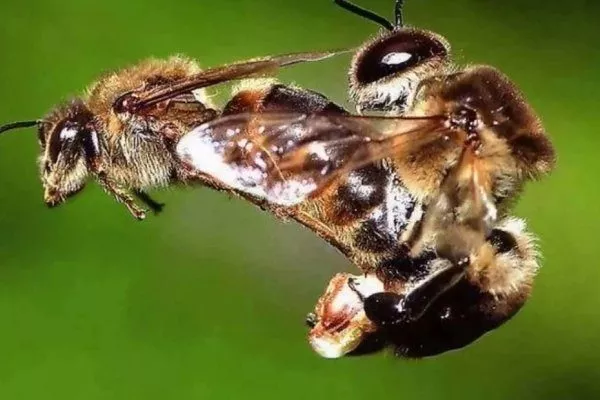
Uterine fertilization: features of the process
Drones inject sperm into the queen's paired oviducts, from where they are deposited in the seminal receptacle. During mating, several million sperm accumulate. They remain in the queen's seminal receptacle throughout her life.
The sperm is contained in the seminal vesicles of drones. During mating, it is forced under pressure into a special channel, from where it enters the queen's paired oviducts. The sperm's passage is facilitated by mucus secreted by the drones' accessory glands.
The queen requires a certain number of sperm (5-7 million). If she doesn't receive the required number in one flight, the process repeats.
If mating does not occur within a month, the queen loses her ability to mate. She becomes a drone and stops flying.
Mating and fertilization in bees are separate processes. During the mating flight, the queen only receives sperm. She then uses them to fertilize eggs, which will become queens and worker bees. Drones are produced from unfertilized eggs.
The queen is most active in producing offspring during the first two years. Then, the number of eggs laid decreases, with the process beginning later and ending earlier (spring and fall). An increasing number of eggs are unfertilized. In this case, the queen is said to have become drone-dead, and a replacement is necessary.
Drone barrier
Mating of queens and drones must be controlled. To organize breeding efforts and ensure their implementation, a drone barrier is created. This ensures mass selection and purebred breeding, which improves the quality of bee colonies.
To create a drone barrier in early spring, drone colonies are established, providing the best conditions for intensive drone rearing:
- sufficient amount of food (protein and carbohydrates);
- high-quality nest insulation;
- installation of special drone cells.
No more than five drone colonies are established, which will produce up to 3,000 individuals. This is necessary to ensure the queen can find a suitable partner. Otherwise, the search may lead her to another apiary, which would defeat the purpose of the breeding program.
When establishing drone colonies in full-fledged bee colonies, drones should be eliminated by promptly removing the brood. This measure is an excellent preventative measure against varroatosis, as the population peaks. Varroa miteoccurs when drones emerge en masse from the brood where the parasite develops.
How to treat bees from varroatosis, you can find out in the following article.
Double change of queens
This technique is used to quickly change breed of beesFirst, the queen is replaced—the new individual must be of the desired breed. Her offspring will be raised by local nurse bees. Replacing all the bees will take approximately 40 days.
Mating bred queens with drones will produce offspring of a mixed breed. This applies only to queens and worker bees. Drones will be produced exclusively of a new breed, as the eggs used to produce them are not fertilized.
Throughout the year, all queens in the apiary are replaced with individuals bred from a queen of a new breed. This replacement must be completed before autumn. The following year, another queen of a new breed (unrelated to the first) is taken, and queens from her progeny are used to replace the previous year's queens.
Drones produced by the first, unrelated queen will mate with the new queens. This avoids inbreeding, and at the end of the season, all bees will be of a new breed.
During a double queen replacement, drones from other apiaries must be excluded—a radius of 5-6 km is considered. Another option is to replace all queens in the area. The new breed will inevitably be influenced by the old nurse bees and drones, but this influence will only ensure better adaptation to local conditions.
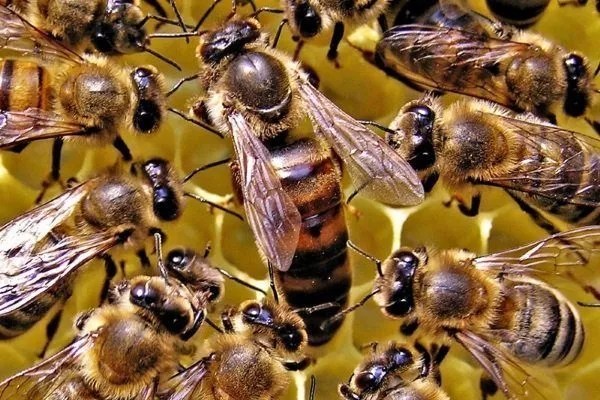
Evening mating of the drone with the queen
Drone flight ceases around 4-6 PM. The exact time is determined by observing the summer for several days. Evening mating can only occur on warm days, when the air temperature is between 20-25°C.
The following work is required:
- sexually mature, unfertilized queens in the nucleus and bee colonies with sexually mature drones should be kept in a dark, cool room during the day;
- when the flight ends in the evening, the drones should be taken out to an area that is illuminated by the sun, with the entrance turned to the west;
- provide fertilizer or spray the frames with warm syrup;
- After the queen and drones have flown, close the entrances and put them in a cool room;
- repeat this algorithm for several days, always placing the nucleus in the same place.
This stimulation is carried out until mating occurs.
Organization of mating stations
The flight of a barren female is limited to a radius of 5 km. Mating stations are established to monitor the breeding process. These stations should be located in areas free of bees and drones.
The required number of queens and drones are delivered to the selected sites. Once mating is complete, the colony leaders are removed, and the infertile young females are added to the nuc. They may be bred in the same area. Here You will learn the methods and rules for breeding queens.
Instrumental insemination of the queen bee
This queen fertilization method is attractive because it allows you to select the most suitable drone. The process begins with raising high-quality drones, which are marked upon exiting the cell. The selected individuals must be large. It is also necessary to select and mark high-quality queens.
Instrumental insemination requires laboratory conditions, including a special machine, a binocular microscope, and optimal temperature. Instrument disinfection (using an iodine solution) is mandatory to prevent melanosis.
Before fertilization, all queens are examined to cull any damaged individuals. The following procedures are performed:
- preparation for the operation – flight of drones and the queen within the laboratory premises;
- shaking the drone's abdomen to ejaculate - you need to act carefully;
- collecting sperm in a special syringe;
- placing the uterus in a special tube and mounting it on a machine;
- opening of the chamber with a sting using special hooks;
- introduction of sperm into the reproductive tract of the uterus;
- placing an individual in a cage.
The queen is returned to the colony when her ovaries are mature. The inseminated individual is introduced into a specially created colony. This colony should contain one street of young bees and mature capped brood. It can also be introduced into a larger colony or a colony with a queen removed a few hours earlier. The new individual should be introduced into a mesh isolator.
Instrumental insemination is performed in a specialized laboratory. This method is suitable for large-scale apiaries conducting breeding work.
Fertilization of queen bees is essential for the reproduction of bees and the continued existence of the apiary. Mating with the drone occurs during the mating flight. Monitoring this process is essential, especially during breeding. Several methods are used, and the appropriate option should be chosen based on goals and resources. For more information on reproduction methods, read here.