
Nursery family – a bee family that provides feeding for queen larvae during artificial feeding breeding queensA foster family must be strong, which is ensured by its proper formation. This process is carried out according to certain rules, taking into account a number of specific features. There are various ways to form a foster family.
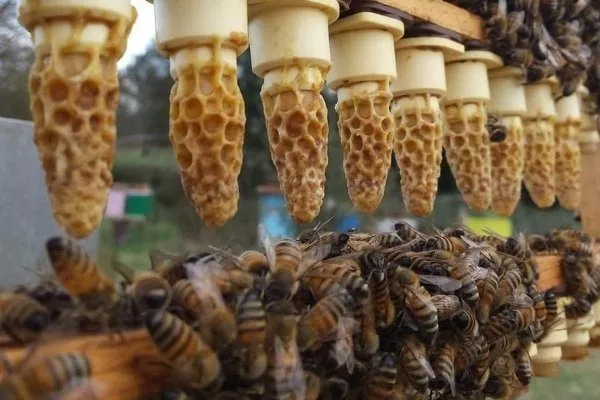
Functions
The primary task of a nurse colony is to raise queens, which will later be used to form colonies. These goals determine the following functions of the nurse colony:
- construction of queen cells;
- feeding future queens;
- providing future queens with ideal care;
- ensuring good physical development of future queens.
To effectively perform all of these functions, it is necessary to form a strong nurturing family.
Conditions of formation
The beekeeper begins identifying a strong colony to become a nurse in the fall. Formation will occur in the spring, and its success depends on the following factors:
- selection of a strong bee colony;
- the presence of a large number of nurse bees;
- the presence of several frames with sealed brood (can be taken from other bee colonies);
- the presence of abundant reserves of honey and bee bread;
- good insulation of the hive - from the sides and from above, and on cold nights also from below;
- mixed age composition of bees.
- ✓ The presence of at least 8 frames densely covered with bees.
- ✓ Absence of signs of disease in bees and brood.
- ✓ The presence of a young, fertile uterus, no older than 2 years.
Features and stages of formation of a foster family
The family from which they come larvae A colony used to produce a queen is called a mother colony. High-quality drones are also required for breeding work in an apiary, so a paternal colony is prepared. The creation of special conditions within it ensures the production of a large number of drones.
When choosing a future nurse colony, it's important to focus on the economically beneficial traits you want to see in the future offspring. It's also important to remember that a queen raised by a nurse colony will pass on to her offspring not only her acquired traits, but also the traits of the colony from which the larva was taken for such rearing.
When preparing foster families, it is important to observe several points:
- install dividing grates on the entrances - this provides protection against the penetration of foreign queens, which are attracted to orphaned bee colonies;
- use the selected queen - she can be added to a colony (formed from another strong bee colony), to increase the additional mass of bees, used for honey collection, and raising queens;
- correctly arrange the combs in the nest of the foster family: place frames with honey at the edges, then bee bread in the combs on both sides, then brood (mostly closed), in the middle open brood, leaving a large well-street (35 mm) between the frames for installing the grafting frame with breeding larvae;
- feeders place near the grafting frames.
To ensure closer contact between the larvae and the brood combs, it is recommended to use a narrow grafting frame (compared to a standard frame) without dividers. This design also simplifies the work.
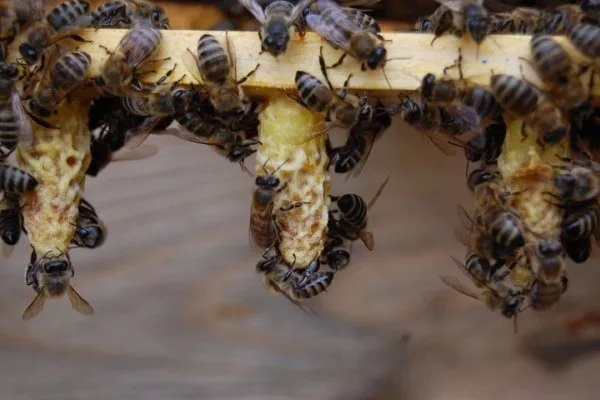
The algorithm for forming a foster family is determined by the chosen method. The process typically follows the following order:
- Preparing the paternal colony. This should be done at least two weeks before preparing the nurse colony, as drones develop eight days longer than queens. They are fed a honey-protein mixture, and the drone brood is checked on the 16th day.
- Selection of fertile queens from nurse colonies and formation of colonies. On the same day, the combs containing one-day-old larvae are trimmed.
- The foster families are fed supplementary food using a honey-protein mixture. It is given at night every night for 10 days.
- The next day after the selection of queens, check the condition of the colonies and release the queens from the cages.
- Prepare the hives where the new growth will be placed. Provide comb, adequate insulation, and feed.
- Cull the queen cells.
- Isolate mature queen cells in the nurse colony (using cages).
- Form cuttings and nuclei.
- Place queens in the colonies.
- Disband foster families.
- Prepare a honey-protein mixture in a 3:1 ratio.
- Provide feeding daily in the evening.
- The duration of feeding is 10 days, starting from the day of queen selection.
Less than a month passes from the establishment of drone brood to the disbandment of the nurse colony. All work is recommended to be carried out in accordance with the beekeeper's calendar.
Watch a video about the beginning of the foster family assembly cycle:
Possible methods of formation
There are different ways to form a foster family.
Queenless colony with brood of different ages
This option is especially suitable for Central Russian bees and improves larval reception with a small number of emergency queen cells. The nurse colony is formed according to the following algorithm:
- Selection of the queen.
- The orphaned nurse colony will become restless. This is indicated by their running along the front wall, which occurs after approximately six hours. Beekeepers call this time the golden hour. It is necessary to give the nurse colony time to produce larvae.
- After feeding the larvae and sealing the queen cells, you need to wait 5-6 days and place another batch of larvae into the nurse colony, while simultaneously removing all the emergency queen cells.
- If desired, a third batch of larvae can be introduced after another 5-6 days. Due to the capping of all the brood, the quality of this batch will be lower.
When using this method, each batch of queen cells should be collected on the 10th day. After the queens have hatched, the fertile queen should be returned to the nurse colony. It will take several weeks for her to recover, after which she can be used for honey collection or for re-raising queens.
Formation by division of a family with subsequent unification
In this case, it's necessary to prepare the hive and install a solid partition. The halves should be different sizes. Each half of the hive requires its own entrance, and they should face different directions. This hive is installed in place of the previous one on the day the foster colony is formed.
The process is carried out according to the following algorithm:
- Place the hive so that the entrance of its smaller part faces the same direction as the entrance of the old hive.
- Transfer the queen and the frame with open brood to the smaller part of the new hive.
- The colony will be formed in most of the hive. To do this, you need to fill the frames with only sealed brood.
- Divide the food supplies between both parts of the hive so that honey and bee bread were in sufficient quantity in each of them.
- All the older bees will flock to the queen's side of the hive, so to strengthen the nurse colony, shake bees from frames that will be placed in the other half of the hive. Additional bees should also be shaken into the nurse colony—2-3 frames from other strong colonies are sufficient (they must be healthy, and only one frame from each colony should be taken).
- Once the queens have been raised, the partition must be removed from the hive so the colony can merge. Only one entrance should remain.
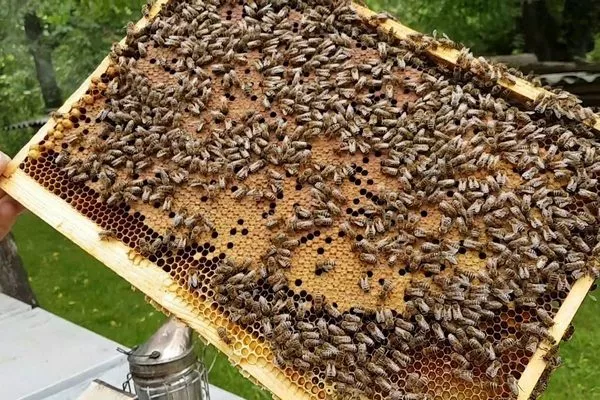
Formation of non-flying bees
This method of forming a foster family implies the following algorithm:
- Prepare an empty hive. Place 2-3 frames of sealed brood and 3-4 frames of honey and bee bread.
- Shake the bees from 8-10 well-covered frames into a prepared hive. The frames can be from different bee colonies, as long as they are strong and healthy.
- Some of the bees shaken off to the new hive will return to their original locations. Only the young, flightless individuals will remain.
- Provide the new hive with water or liquid sugar syrup for 5-6 days. To do this, install a feeding frame.
A queenless colony type formed with sealed brood
This method of forming a nurse colony was once widely used. After selecting a strong colony and selecting a queen from it, the following algorithm should be followed:
- Wait 8 days, on the 9th day there should be only sealed brood.
- A thorough inspection of the comb (it's best to sweep away any insects). Destruction of all queen cells.
- Placing a batch of larvae for their further rearing.
- On the 10th day, remove the queen cells from the bee colony and then use them for their intended purpose.
- Providing a fertile womb to the former foster family.
Today, this method has been modernized. Before hatching, the queen bee in the colony is isolated by placing her in a side compartment (pocket). A dividing grid is used for isolation, and the compartment should contain three frames. In addition to the queen, the brood (one comb) is placed in the compartment, surrounded by light-brown combs where the eggs will be laid.
Formation of a nurse colony during artificial swarming
Keeping a bee colony in a swarming state ensures a greater number and better quality of larvae. The size and weight of the emerging queens also increases, and they are able to fly immediately after emerging from the queen cell.
The advantages of this option also include the increased strength of the bred queens, their high egg production, and their winter hardiness. The formation of a nurse colony is carried out according to the following algorithm:
- Selection of the majority of open brood.
- Resettlement of a family using sealed brood at the exit.
- Squeezing the nest.
- Bringing a bee colony into a swarming state.
- Obtaining eggs in artificial cups from a working mother bee colony.
- Attaching these bowls to the grafting frame and installing them in a bee colony that has been brought into a swarming state and has begun to lay swarm queen cells.
- Destruction of established queen cells.
- Transferring the queen to a colony or an isolator (a part of the hive without an entrance, limited by a dividing grid).
Properly establishing a strong nurse colony allows for the production of high-quality queens, which are then used to establish colony colonies. The process follows a specific algorithm and has a number of specific features. Nursery colony management is initially carried out on a general basis, and then becomes more specific.