
Bees are unique insects characterized by a high level of organization. Every hive contains uterus, drones And the main force is the worker bees. They are extremely functional and responsible for many processes in the hive throughout their entire life.
Characteristics of a worker bee
| Name | Length of proboscis (mm) | Weight (mg) | Life expectancy (days) |
|---|---|---|---|
| worker bee | 5.5-7.2 | 100 | 35-45 |
| Uterus | 3.5 | 200 | 1460 |
| Drone | No data | 200 | 90 |
Mostly any bee colonies The worker bees are the mainstays. In winter, their population averages 35,000, and in summer, it increases by 2-3 times or even more. A colony with fewer than 18-20,000 worker bees is considered weak. There's a risk of it dying during wintering. Therefore, beekeepers must take care of wintering, and here's how to do it right. Here.
- ✓ The optimal temperature inside the hive should be maintained in the range from +2 to +8 degrees Celsius.
- ✓ The air humidity in the hive should not exceed 75-80% to prevent the development of mold.
Every worker bee is female, but its reproductive organs are underdeveloped—this distinguishes it from the queen. Worker bees in the same colony are essentially sisters, as the queen produces all the brood.
A worker bee may develop reproductive organs if the queen suddenly dies and there are no bees in the nest. larvaeMating with drones is impossible, so the eggs remain unfertilized—these are future drones. A bee with functioning ovaries is called a drone.
- ✓ The presence of functioning ovaries in a worker bee in the absence of a queen.
- ✓ The ability to lay only unfertilized eggs, from which drones develop.
In nature, hermaphrodite bees with both male and female characteristics are sometimes found. This structure indicates that some developmental defect has occurred in the insect.
The underdevelopment of the reproductive organs is responsible for the worker bee's size—it's smaller than the queen. Its average length is 12-14 mm, and its weight rarely exceeds 100 mg (excluding nectar).
The worker bee's structure is determined by its need to perform multiple functions. The internal organs are protected by a hard yet elastic integument—all segments are articulated.
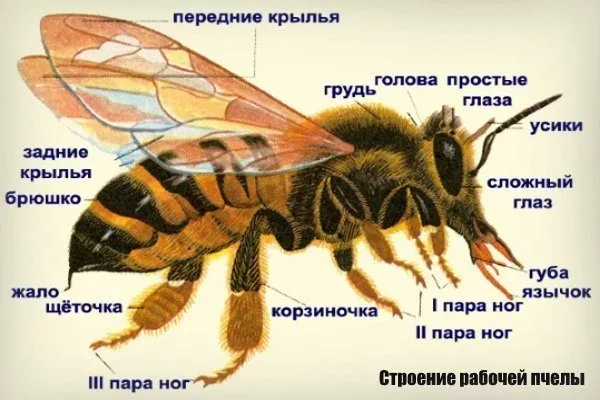
The worker bee's body consists of three parts: the head, thorax, and abdomen. The insect has five eyes—two compound eyes and three simple eyes. Smell and touch are provided by antennae on the head. The head also contains the pharyngeal gland, one of the most important organs. Initially, it secretes royal jelly, which is used to feed the brood and queen. As nectar is collected, the organ begins to produce the enzyme invertase.
Six legs and four wings extend from the insect's thorax. The legs collect pollen and cleanse the entire body. The thorax and abdomen have spiracles on each side, which enable the insect to breathe. Air first enters special sacs, and from there, it flows into the tracheae.
The worker bee's abdomen, in addition to its internal organs, contains glands that secrete wax. The abdomen ends sting With barbs. This is what causes the bee to die after stinging—its stinger gets stuck in the victim's body, tearing off along with the abdomen and damaging internal organs. The abdomen also contains a honey stomach—a hollow organ for collecting nectar.
A worker bee's proboscis is typically 5.5-6.5 mm long, but can reach 7.2 mm—this mainly depends on the species. By comparison, the queen's proboscis is only 3.5 mm long. This difference is important for worker bees when collecting nectar.
Worker bees' work involves caring for the entire colony. Depending on the work they perform, the insects are classified as:
- wet nurses – feeding the brood;
- stoves – heat generation, can heat up to 44 degrees;
- scouts - morning flight, inspection of the surrounding area for the best source of nectar;
- foragers - collecting nectar with a proboscis;
- receivers - collecting nectar from gatherers and processing it;
- guards - protect honey reserves, they are the ones who sting people most often;
- water carriers – needed only when there is a shortage of water;
- thieves - take supplies from other hives.
Worker bees strictly focus on their duties unless there's a need for reorganization. For example, foragers don't take on other duties in bad weather, but rather laze around.
Flying and hive bees
Worker bees can be classified as summer bees or hive bees. This distinction is observed in the spring and summer. In the fall, however, all insects are considered equal.
When bees first emerge from the brood cells, they lack strength, so they even move with difficulty. They are fed by older bees.
Gradually the bees begin to get stronger, but they are not yet able to fly far, although cleansing flyby They perform. During this period, they perform feasible tasks in the hive:
- cleaning the cells in the honeycomb;
- feeding the larvae - first with bee bread and honey, then with the produced milk;
- honeycomb construction.
Bees typically remain hive-keepers until they are 15-18 days old. As they develop, their responsibilities expand, and the following duties are added:
- keep the nest clean;
- seal honey-filled combs and brood cells;
- guard the nest;
- accept nectar from foragers;
- evaporate water from the resulting nectar and process it.
Between the 15th and 18th days of life, the bee becomes capable of flight. It collects nectar and pollen, bringing water and sticky resinous substances back to the hive.
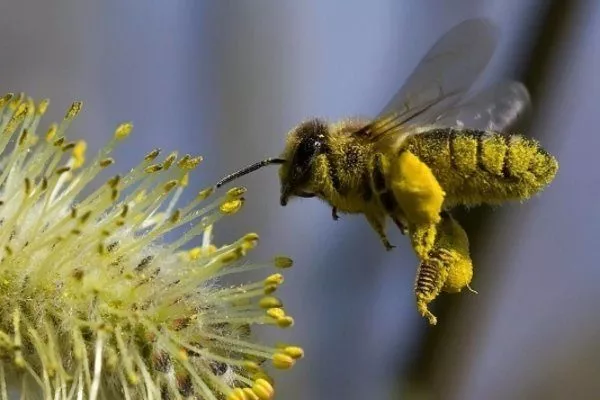
The structure of the mouthparts and proboscis enables nectar collection. Through the esophagus, it enters the honey stomach, which serves as a storage area for the nectar before it is delivered to the hive.
A bee's body is densely covered in hairs. During flight, these hairs accumulate static electricity, attracting pollen. The bee collects the maximum amount of pollen while on a flower. The bee rubs its legs against the flower, which contain brushes that brush pollen grains into special depressions on its hind legs. Special glands secrete a secretion that, along with nectar, moistens the pollen, ensuring its safe preservation until it arrives at the hive.
Bees need water. They get it from nectar, and in the absence of nectar, water-carriers emerge in nature—flying bees that collect water in their crops. Sometimes, mammal urine is used instead. The liquid is necessary to cool the nest and liquefy the honey.
The purpose of worker bees at different stages of life
Throughout its life, a worker bee performs certain functions within the colony. These functions depend on the individual's age:
- first days of life – warming the brood;
- 3-5th day of life – cleansing flight around the hive, removal of garbage, guarding the entrance (individual individuals);
- 4-10th day of life – production of royal jelly;
- 10-18th day – wax secretion (there are special glands for this, which develop at this stage);
- from the 20th day of life – the beginning of the flight period, nectar collection.
The functions of worker bees are not clearly delineated by time frame. The development of different individuals within a single brood may vary.
Instincts of worker bees
Every bee has certain instincts. These are innate and can be simple or complex. The former is typical of individual bees or small groups of insects. Simple instincts include:
- remove dirt from the hive;
- provide ventilation for the hive;
- fly away from the smoke;
- sting an irritating or threatening object (defensive instinct).
Worker bees have more complex instincts. These instincts determine the insects' primary activities and the characteristics of their organized life. Complex instincts include:
- build hexagonal honeycombs;
- fly and bring nectar, water;
- accumulate honey;
- raise offspring;
- feed the larvae;
- drive out drones;
- take care of the queen.
Thanks to complex instincts, bees are able to find their hive and return to it after a flight, raise offspring, and store honey.
A bee doesn't remember the location of its hive, but instead navigates by various cues—other hives, surrounding vegetation. Even a slight shift in position can disorient the insect.
During their life cycle, worker bees also develop conditioned reflexes. These include the ability to distinguish between honey plant flowers.
Development of worker bees, lifespan
A bee begins to develop from the moment the egg is fertilized. This occurs when the eggs are laid.
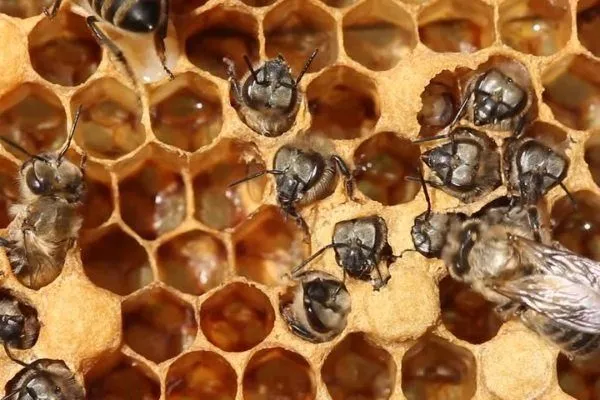
A bee's development takes three weeks. First, it's the egg stage, which lasts three days. Then the larva hatches, and nurse bees provide it with royal jelly. This food is provided for only three days, after which it is replaced. bee bread and honey.
The larval stage lasts six days. During this time, the brood is considered open. Then the cell containing the larva is sealed, closing the brood. The prepupal stage begins, followed by the pupal stage. The process resembles the pupation of butterflies—the larva spins a special cocoon. The pupa actively consumes the reserves accumulated during the larval stage.
By the 21st day, the insect is fully developed. It chews through the sealed cell lid and immediately gets to work.
The lifespan of a worker bee varies and depends on many factors:
- spring-summer period – 35-45 days;
- autumn bees - up to 10 months, they usually survive the winter due to a well-developed fat body and internal glands;
- in strong bee colonies the lifespan of worker bees is higher, since the young become flight-ready;
- in weak families, worker bees are overloaded with various duties, and therefore live shorter lives;
- The lack of culling of honeycombs leads to the degradation of bees, their weakening - as a consequence, their lifespan is also reduced.
During the summer, most flying bees die outside the hive. The insect's body does not regenerate, and constant flying takes a heavy toll on its wings. It often turns out that the bee simply failed to return to the hive with its cargo.
Worker bees make up over 80% of the bees in a hive. They perform all duties except reproduction. Worker bees are short-lived—their lifespan depends on the season and the strength of the colony. There are several types of worker bees, depending on their duties within the colony and whether they are performed inside or outside the hive.