
Each bee package contains a complete bee family, which has all the resources to harvest in the first season. Bees must be placed in a hive according to certain rules, taking into account its type—comb or combless. Proper preparation for the process and proper care of the bees are essential.
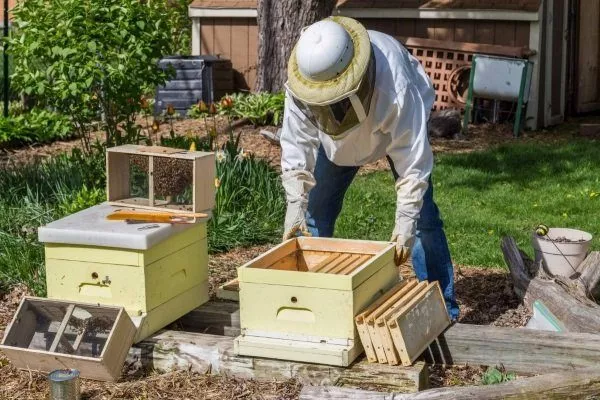
Preparing for transplantation
Before transferring a bee colony from a package, it's important to properly prepare the hive. Follow these guidelines:
- Clean and disinfect the hive. If this is ignored, the colony may flee after the transfer due to foreign odors. Even new hives require disinfection.
- Treat the inside of the hive using a blowtorch, then rinse and dry in the sun.
- Sweep the hive immediately before replanting. Use lemon balm, lemon catnip, and motherwort for this.
- Place the hives correctly. Locations for them must be allocated in advance.
- Install a drinking bowl and frames with wax foundation.
- Prepare sugar syrup for feeding.
- ✓ The ambient temperature should be between 15-25°C for optimal bee activity.
- ✓ Air humidity should not exceed 70% to prevent mold development in the hive.
Bee packages Bees are purchased only in the spring, so it's during this season that they are replanted. First, the bee package should be placed briefly in a cool place. This will encourage the bees to cluster together.
Transferring bees from honeycomb-free and honeycomb packages into a hive
When transferring a bee colony from a package to a hive, it's important to consider the type of hive—comb or combless. This determines the specifics of the procedure.
Honeycomb bee package
When transplanting bees from a honeycomb package, you need to follow a certain algorithm:
- Place the bag in front of the hive.
- Open the entrance and the flight will begin.
- Sweep the bees from the bottom onto the frames.
- Place the frames from the package into the hive - it is important to maintain the same order of placement as in the package.
- Release the queen when the bees have calmed down.
In some cases, a test flight can be avoided. Place a bee package behind the hive and narrow the entrance—aim for 2-3 bees. Move the frames immediately, remembering the order in which they were placed. In this case, place the queen cage between the frames. This option is risky, as the bees may take a long time to find their way back to their hive.
To release the queen from the cage, open the top opening and seal it with wax foundation, piercing three or four holes. The bees will break through the wax foundation and release the queen.
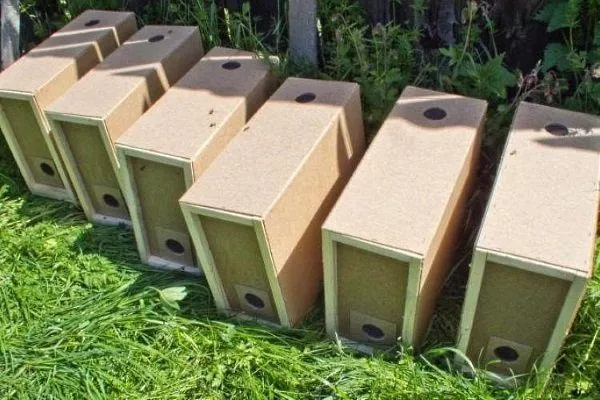
Honeycomb bee package
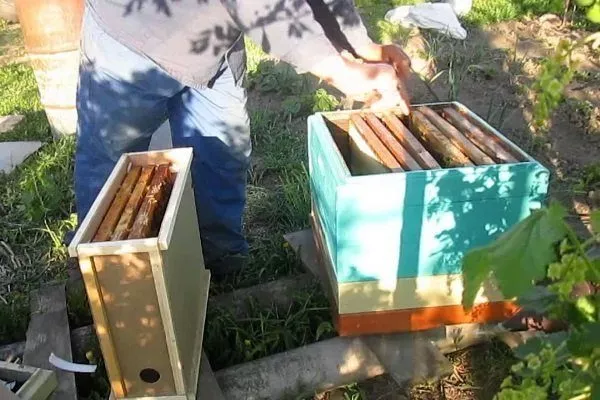
transplanting bees from a honeycomb package
Honeycomb-free bee package
The bee transplantation procedure in this case involves preparing comb. When using a Dadan-Blatt hive, a 1.2 kg colony requires four frames of foundation, meaning one frame for every 0.3 kg. The foundation is securely attached to the wire, taking into account the expected load.
If the queen is not isolated, the bees should be shaken out into the hive by removing the mesh. This can be done through the feeding hole.
When choosing a horizontal or 12-frame hive, the cage should be secured between the combs, the insects should be sprayed with water, and shaken onto the bottom of the hive. When using a multi-box hive, the queen should be placed in the first box between the frames, and the bee package should be turned over and placed in another section.
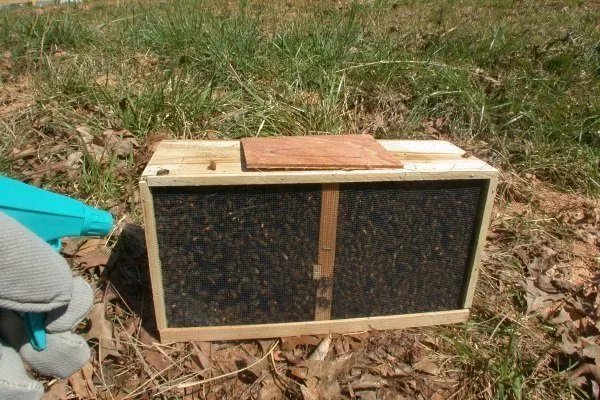
Honeycomb-free bee package
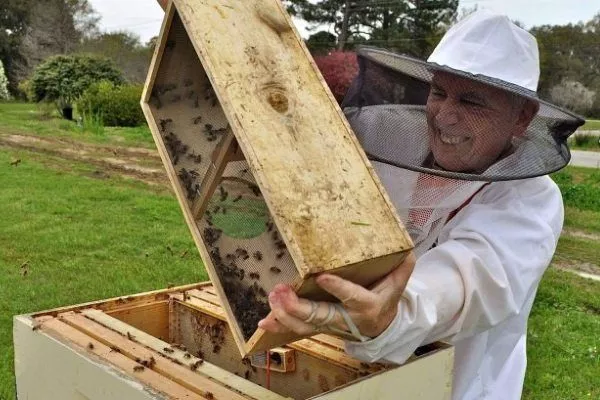
transplanting bees from a honeycomb-free bee package
On hot days, it's best to relocate bees in the evening. On cooler days, the timing is irrelevant.
Development and inspection of the bee package after transplantation
After the transfer, the bees are inspected 24 hours later. It's essential to check for the queen with exposed brood. If there is any, insulate the nest using side and top cushions.
- Check for the presence and activity of the uterus within the first 24 hours.
- Assess the degree of honeycomb construction on the second day.
- Monitor the queen's egg production and brood development during the first week.
When examined, the queen often tries to hide among the bees. This behavior is normal, but an inexperienced beekeeper may mistake it for her loss.
After the transfer, the bees immediately begin building the combs. By the next day, they will be approximately 60-70% complete. The queen also begins her work on the first day—by the following day, eggs are visible in the unfinished cells. Egg production will increase as the nest is built.
If the comb-less package is developing well, by the end of the month, the capped brood will have grown to 20,000-30,000 cells. Within 12 days, they will hatch and increase the colony's strength by 2-3 kg. This means that appropriate expansion with frames of wax foundation is required. Failure to add these frames may delay development. There is also a risk of swarming.
If you encourage the development of bees, then after a month and a half the weight of a bee colony can reach an average of 4 kg, and after another half a month – 6 kg.
When the colony's strength reaches 10 frames, a super will be needed. It should be added at the beginning of the main honey flow. The rest of the process is the same as with standard bee colonies.
Top dressing
A colony transferred from a package bee to a hive needs to be fed. The bees will obtain carbohydrates from collecting nectar, and they will also need sugar syrup—to prepare it, use sugar and water in a ratio of 1:1.5.
If the bee colony is being relocated during cold weather and there is no honey flow, it needs to be fed immediately.
If the bee colony doesn't have the bee bread from the package, place a frame on top of the colony. If you don't have any, you can find honey-and-bee bread comb from other beekeepers. Place the frame near the outermost brood frame.
If bee bread If you can't find any, you can make a mixture of 1 kg of honey, 1.6 g of acetic acid, 0.2 kg each of dry fodder yeast and soy flour, 0.2 l of water, 2.3 kg of granulated sugar, and 80 g of dry milk. The flour and milk should be skim. Mix all the ingredients thoroughly until smooth. Then form 0.5 kg cakes, place them on a metal mesh, and place them on the top frame bars. Be sure to cover the top of the mixture with plastic.
What is prohibited during a transplant?
When transferring a bee colony from a package to a hive, certain actions are prohibited, as they produce undesirable results:
- Don't replace wax foundation with honeycomb frames. This will cause the entire colony to congregate on the honeycomb frame, which will reduce building energy.
- Do not expand the transplanted colony for the first month. The frames will be filled with sealed brood, and the bees in the bag will gradually die off. In the last ten days, young bees will emerge, allowing the colony to regain its strength.
Watch the video to see how to transfer bees from a package to a hive:
Using bee packages offers certain advantages for beekeepers. Transferring a bee colony to a hive requires proper preparation, taking into account the type of bee package—it's especially important during the preparatory stage. After transferring, the colony should be monitored and fed.