
Capped brood is also called covered brood, as opposed to open brood. Every beekeeper should be familiar with the maturation time of capped brood and understand how to properly introduce it to a bee colony.
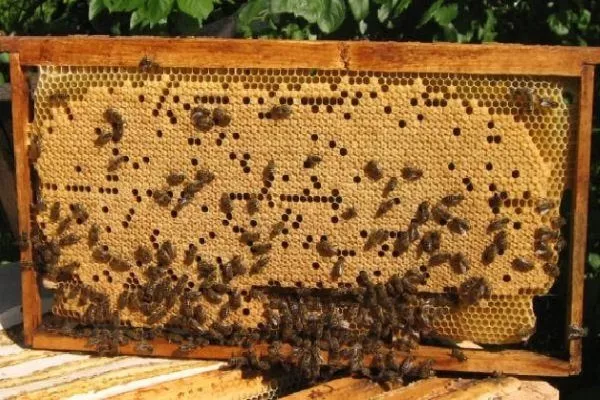
What is sealed brood?
The sealed brood is called the pupae and bee larvae, which grow in sealed cells. These are sealed around the sixth day of the larva's growth, when it has grown significantly and its head is extended toward the exit. Before this, the eggs laid by the queen and the larvae that hatch from them remain in open cells and constitute open brood.
The cap that seals the cell containing the larva varies in shape. For bee brood, flat caps are formed, while for drone brood, a convex cap is created.
Queens don't have any special brood—they hatch from the same cells as worker bees. Drone brood should only hatch in large cells; if it ends up in the honeycomb, it's called false brood.
Brood can be young or mature. It reaches maturity when there are a maximum of three days left before the bees fly. Brood increases the strength of the colony and can therefore be added to a weaker colony.
The brood on a single comb can vary in maturity, as it can take several days for the queen to fill it. In any case, a discrepancy of several hours is present. A fertile queen can lay one egg per minute—in spring, this number can reach approximately 1,500 per day. Their combined weight is approximately equal to the queen's own.
The area with the largest brood in the hive is called the nest. The queen fills the combs one at a time. This allows the bees to better warm the nest, even with little force.
This video explains what sealed brood is:
Ripening time
| Name | Ripening period (days) | Type of individual | Nutrition |
|---|---|---|---|
| worker bee | 21 | Working | Honey and pollen |
| Uterus | 16-17 | Uterus | Royal jelly |
| Drone | 24 | Drone | Honey and pollen |
The larvae hatch from the queen's eggs in about three days. They are small and white. The bees immediately provide them with food. The larvae's appetite is so high that it takes only five to seven days for them to fully develop. During this period, their weight increases hundreds of times.
After the larval cell is sealed, the next stage begins. This is called the external dormancy stage. It is at this stage that the open brood becomes capped.
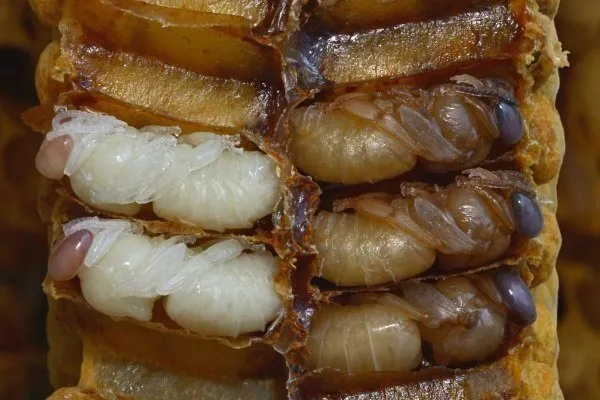
After the cell is sealed, the larva's metamorphosis continues. It becomes enveloped in a fine web, forming a pupa. The larva creates this covering itself. Initially, it is white. Cocoon spinning begins on the sixth day of queen larvae, on the seventh day of worker bees, and on the eighth day of drone larval development.
In the next stage, the larva becomes a prepupa. Four molts occur before the brood is sealed. Spinning the cocoon takes about a day, then a few hours later the fifth molt begins.
The pupa gradually develops a head, wings, and legs. As it matures, its color also changes. Darkening begins at the head.
The length of time the larvae remain in a sealed state before the emergence of the formed insect depends on the type of individual:
- worker bee – approximately 12 days;
- uterus – about 9 days;
- drones - 2 weeks.
The development time of bees varies depending on their status.
If we consider the entire stage of development from a one-day egg, then:
- the worker bee emerges after 3 weeks;
- the uterus is completely ready on the 16-17th day;
- Drones take the longest to develop – 24 days.
During the development of bee brood, the nutrition of worker bees and queens differs. At the initial stage, it is the same: royal jellyThe worker bees' food then becomes coarser, with the addition of honey and pollen. Royal jelly remains the queen's primary food, but nurse bees supplement it with a special substance produced by their glands. It is biologically active, but secreted in such small quantities that its chemical composition has never been determined.
Resettling a family of offspring
A colony is a collection of selected brood and bees from strong colonies. Capped brood can be used to strengthen an existing colony or to establish one at the initial stage. The latter is usually used as an anti-swarming measure.
- ✓ Make sure that the frame does not show any signs of disease (mold, rot, parasites).
- ✓ Check that the cell caps are intact and undamaged.
- ✓ Assess the degree of maturity of the brood – pre-mature brood is preferable.
A weak colony is given a frame of capped brood when it has already reached maturity, meaning the bees are almost ready to emerge. Before transferring the frame, the bees are shaken off the brood.
After the brood hatches, 3-5 days later, you can add another 1-2 frames of sealed brood. This option is especially good for colonies with a barren queen.
Capped brood is the term used for brood that has been sealed with caps. The maturation time of bees depends on their status (worker, queen, or drone). Capped brood can be used to form a colony nucleus or to introduce new bees to a colony. prevent swarming.