
Queen cells are special cells that are built or extended and used to raise the queen. There are two types of these cells, each with distinct differences. Most of these differences are related to the specifics of how the queen cells are formed. The larva develops within them in stages. Excess queen cells are used in various ways.
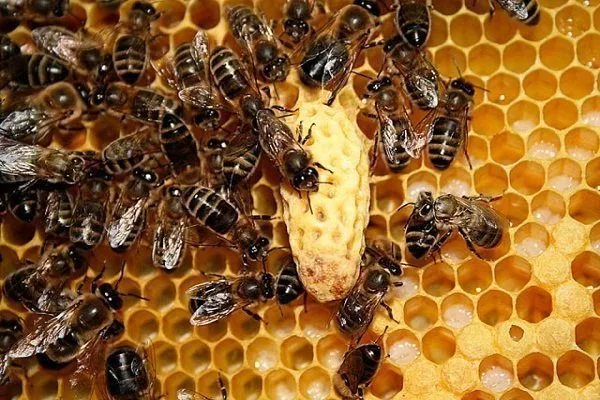
What is a queen cell?
Queen cells are the largest cells built by bees. They are where queens are raised.
Queen cells differ from other cells in that insects build them not during the active phase of their life, but rather in response to specific events. This may be the colony's preparation for swarming or the need to obtain a new queen. In the latter case, the reason for replacing the queen may be the death of the old queen, her illness, or her inability to lay eggs. The type of queen cell depends on the reason for its construction.
Bees also store food supplies in the bee and drone cells. Queen cells are never used for this purpose.
Types of queen cells and their differences
| Name | Type of queen cell | Color | Location in the nest |
|---|---|---|---|
| Swarm queen cells | Swarmers | Rich brown | The edges of the honeycomb or the edges of its openings |
| Fistulous uterine cells | Fistulous | Close to snow white | They use ready-made cells |
There are two types of queen cells: swarm cells and emergency cells. Bees build the first type when preparing for swarming, while the second type is used when the queen is lost or becomes unavailable. In the case of emergency cells, their construction is an emergency measure. If the queen dies or becomes unable to lay eggs, the colony is at risk of extinction.
The differences between the two types of queen cells also lie in a number of other factors:
- shape of the queen cells;
- dimensions;
- color;
- location in the nest;
- members of the bee colony who participate in construction;
- laying eggs: swarm queen cells are filled with eggs after they have been built, while emergency queen cells are built on cells with already fertilized eggs;
- the value and productivity of the bred queens - with swarming queen cells these qualities are higher.
You can also learn about the different types of queen cells from the following video:
Construction of a queen cell by bees
The specifics of queen cell construction vary depending on the type. The material used is the same: wax.
Fistulous uterine cells
To form emergency queen cells, bees use existing cells, only adding to them. For expansion, they use adjacent cells. This work is carried out by construction bees. They have well-developed wax glands. The use of fresh wax results in the light color of the emergency queen cells—it's almost pure white.
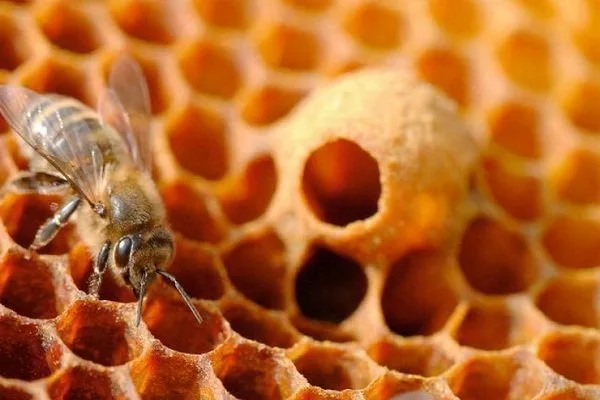
Bees don't build emergency queen cells all at once. Initially, they form a structure large enough for a single larva. As the larva develops and grows, the queen cell grows in size. It is shaped like an elongated protrusion on the cell.
Swarm queen cells
Swarm queen cells are completely rebuilt. To do this, the insects select the edges of the combs or the edges of their openings. Construction is carried out by bees over 25 days old. At this age, the wax glands are less functional, so the insects take wax from used combs. This characteristic causes the swarm queen cells to have a rich brown color.
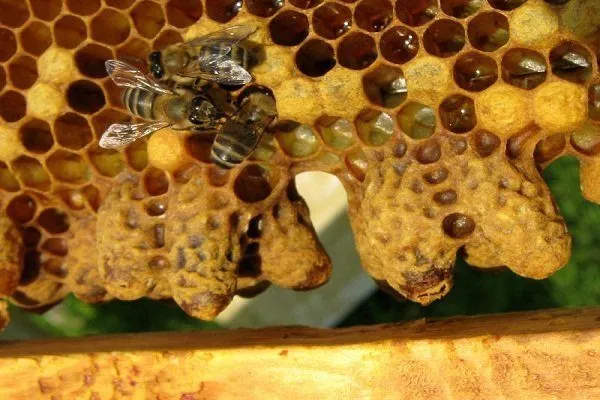
The basis for a swarm queen cell is a special cup with a round bottom. In exceptional cases, bees use the waxy protrusion of a cell to secure it. The swarm queen cell is then built on the flat surface of the honeycomb.
The outer part of the swarm queen cell is composed of bumpy hexagons, reminiscent of a honeycomb. The inner walls are smooth and shiny.
Dimensions of the queen cell The size of queen cells depends on several factors and can range from 750 to 1400 cubic mm. Swarm queen cells are larger. Their shape is compared to elongated acorns hanging singly from the comb. Paired queen cells are less common, and some southern bee species even build them in groups.
Stages of larval development in the queen cell
The larva in the queen cell develops in stages:
- An egg is laid.
- On the third day, the transformation occurs—the egg becomes a larva. At this stage, it is fed generously with royal jelly. This food is highly valuable and high in protein. It is this that allows the transformation of an ordinary fertilized insect larva into a fully-fledged queen bee.
- On the eighth day (maybe a day later), the queen cell is sealed. A special plug is used for this purpose. Bees make it using wax and bee bread.
- The sealed queen cell remains sealed for a week (possibly up to 9 days). During this period, the larvae gradually pupate.
- The transformation into an adult occurs on the 15th to 17th day. Once this process is complete, the upper part of the queen cell is uncapped.
Cutting out the queen cell
Constant monitoring is essential in an apiary. Early detection of queen cell construction allows the beekeeper to prevent swarming or provide a new queen to an orphaned colony. In both cases, the formed queen cell must be removed.
Removing the queen cell should be done at a specific stage of the larval development. The appropriate time for this procedure depends on how the queen cell is intended to be used. If it is to be transferred to a new colony, it is necessary to wait until the queen is sufficiently mature. Choosing the right time increases the likelihood of survival.
- ✓ Make sure that the queen cell has a rich color, which indicates its maturity.
- ✓ Make sure the queen cell is located in an area of active bee movement to ensure warmth and ventilation.
The required phase for transplanting the queen cell is determined by highlighting the queen cell Its walls are transparent, so the contents can be seen. Once the thick, elongated, dark body is clearly visible, you can begin cutting it out. If it's still moving, don't hesitate—the insect is about to emerge.
When illuminated, the queen cell may appear empty. This could indicate either the early stages of development or the death of the larva. The situation will become clear in a few days.
The queen cell must be removed correctly. The following conditions must be met:
- Use only a sharp knife. The wax walls of the queen cell are quite thin and can be damaged by a blunt instrument.
- Before handling, be sure to wash your hands with a neutral, fragrance-free cleanser. Even the odor of sweat that lingers on the transplanted queen cell can cause it to be rejected by the colony.
- To reduce the risk of damaging the queen cell, cut in a circular pattern, maintaining a radius of 10 mm. If adjacent cells are filled with brood, it's best to remove some of it but preserve the queen.
- Before cutting out the queen cells, carefully inspect them. These cells may be arranged in pairs, connected to each other. They should be transplanted in this manner. Cutting out a queen cell is only recommended if there are more than three clustered together. The central segment should be removed.
- If the queen cell wall is damaged, use wax. Warm it slightly and apply it to the affected area with a knife. The layer should be thin. Bees may not accept such a queen cell, but there is still a chance of success.
- The cut queen cell should be candled without changing its original position. Avoid turning it over or tilting it sharply.
- Temperature control is essential when cutting out the queen cell. If for some reason the process takes too long, the cut queen cell should be returned to its original hive. The bees will warm the pupa.
The queen cell must be excised as quickly as possible. Delaying the procedure increases the risk of damaging the larva. Prepare and sharpen the tool in advance, and prepare wax in case the queen cell wall is damaged. Everything you might need during the excision should be readily available.
In the following video, an experienced beekeeper will explain what to do if bees have laid a queen cell, how to stop swarming, and how to tidy up the nest:
Using extra cells
Excess queen cells are used in various ways. They can be cut out for culling, but it's also advisable to find other uses for them:
- A supply of high-quality queen bees. This measure is especially important in large apiaries with numerous bee colonies. For every 10 colonies, five spare queens should be kept. If the old queen dies, becomes ill, is lost, or is unproductive, she can be quickly replaced. As a result, the colony quickly recovers with minimal loss of productivity.
- Replanting into a new colony. This measure allows for the formation of a full-fledged bee colony.
- Sale. This option is practical for breeding sought-after breeds. The offspring of fertile parents is valuable, and the extra income never hurt anyone.
Laying a queen cell in a new bee colony
If you plan to transfer a cut queen cell to a bee colony, be prepared for potential complications. It's better to use the entire comb on which it's located, rather than the cut cell itself. For transfer, choose the most mature larvae possible, as they have a better chance of being well received by other bees.
When moving and securing the queen cell in a new location, be careful and gentle. Avoid exposing the cell to direct sunlight, shaking it, or allowing it to cool.
The specifics of laying a queen cell for a new bee colony depend on its strength, the time of year, and weather conditions:
- On cold days, the laying of the queen cell should be done as close as possible to the brood that is already in the bee colony - this area is characterized by increased activity of the bees, which is accompanied by higher temperatures;
- If the weather is warm enough and the bee colony is strong, the queen cell can be placed in a drift or at the bottom of the hive.
- ✓ Ensure that the colony is strong enough to accept the queen cell.
- ✓ Consider the time of year and weather conditions when choosing a stash location.
The queen cell placed in a new bee colony must be placed strictly in the same position in which it was located in the old nest.
There are different ways to transplant a mother plant:
- Cut it off partially, along with the honeycomb. Place a portion of the honeycomb in a wooden stick split lengthwise, securing its edges with thread. Place this structure next to the nest.
- Carefully push the queen cell between two honeycombs and secure it.
- When placing bees in a Dadant frame hive, place the queen cell on the wall of the comb. To do this, use your finger to make a depression of the appropriate size, insert the queen cell, and secure it with wax (preheat the wax first).
- Use a special cap. It's made from a lightweight metal sieve. The cap should be sunk into the honeycomb with its edges. The queen will grow stronger under this cover without disrupting her feeding.
After laying the queen cell, it is imperative monitor the resultsIf the queen cell is secured on the second day and undamaged, it's a success. If there's a hole at the end of the cell, the queen has emerged. A hole in the wall indicates that the wax was gnawed through and the queen was killed. In this case, the placement can be repeated, but if another queen is killed, it's better to introduce a mature queen.
It's important for beekeepers to promptly detect the formation of a queen cell and determine its type. There are several options for using queen cells—choosing the right one should be based on the needs of the apiary and personal preferences.