
Beekeeping involves many subtleties. One of them is catching bee swarms, which achieves several goals at once. Traps are used for this process. It's important to create, place, and remove them correctly. Catching bee swarms has certain advantages.
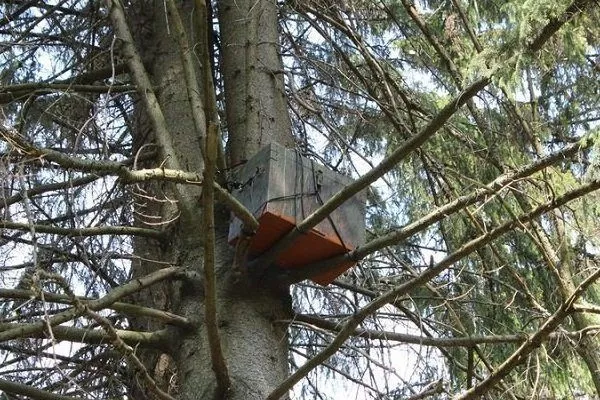
Why catch bee swarms?
The main purpose of catching bee swarms is to expand an apiary or replace older individuals. New bees are available for purchase, but catching a swarm allows for savings. Catching wild bees is attractive because they are highly productive and resilient to wintering conditions and various diseases. By catching new bees, it is possible to form multiple colonies, each unique in its own way.
Another reason for catching bees is swarming in your own apiaryThere are several methods for preventing it, but they aren't always successful. In this case, the swarm must be captured. Capturing bee swarms can save many insects. During swarming, they die en masse because they are often unable to find a new home or stock up on honey in time.
Some bees are called wild only provisionally. It's possible that a captured swarm is actually insects from another apiary, where the beekeeper failed to prevent the swarming or was unable to catch the colony in time.
Creating a trap
To catch a swarm of bees and queen bee, you need to properly prepare the trap for this. It must meet the following requirements:
- volume 40-60 l;
- light weight – up to 5-6 kg, it is difficult to perform various manipulations with a heavy device;
- the presence of a 10-12 sq. cm entrance - imitation of the entrance to a hollow, where they prefer to live wild bees;
- water resistance;
- strength and durability – it is better to use one trap for a long time, since certain pheromones remain in it, which will attract other bees during the next trapping;
- Possibility of installing frames.
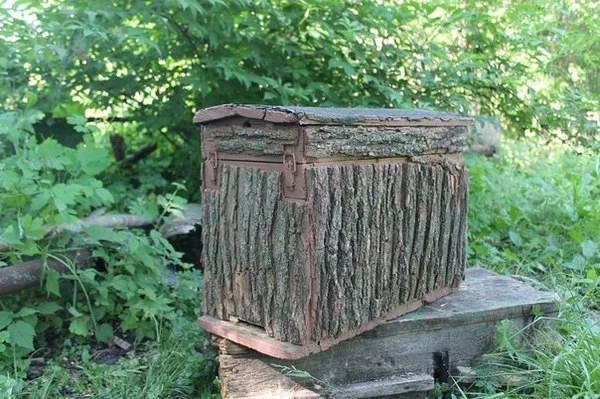
- ✓ The tree must be healthy, without signs of disease or pest damage.
- ✓ Trees with dense foliage are preferred to provide shade and protection from overheating.
- ✓ Choose trees located away from roads and industrial areas to avoid pollution.
Bee traps are made from wood—boards or plywood. The species should be deciduous. The trap walls should not be smooth. A material thickness of 8-10 mm is sufficient. The dimensions can be arbitrary, but it is recommended to prepare two 25x50 cm pieces for the bottom and roof, two 27.5x50 cm pieces, and two 22.2x27.5 cm pieces for the sides.
The trap should be assembled as follows:
- Connect all the parts except the roof using wood glue. Use screws for reinforcement.
- Step back 2-2.5 cm from the top of the box and attach (using glue or screws) thin slats to hang the frames.
- Attach a 7x60 cm plank vertically to the middle of the back wall, making a round hole in its upper part - this way the trap will be attached to the tree; you will also need to use wire or rope.
- Make a flight hole (1.5 x 8 cm) and attach a metal mesh on top to protect against unwanted guests (rodents, birds).
- Make a landing board - a 3 cm overhang is enough.
- To secure the roof, use a screw with a washer so that it can be turned.
- Paint the finished trap – the paint should be light, this serves as protection from overheating.
For bees, smells are of equal importance to dancing, so the trap needs to be thoroughly dried and ventilated. To attract insects, a new trap can be effectively treated with propolis—simply rub the inside of the trap with a softened piece of propolis. A special pheromone bait can also be used. Old, darkened honeycombs are a good attractant. Place at least one such frame in the trap. To reduce the risk of disease, keep the old honeycomb in the freezer for two days.
When catching wild bees, remember that the trap may attract other insects. Scents that bees perceive normally can help repel them. These include pine needles, nettles, cherry, blackcurrant, and raspberry leaves.
You can see 4 different ways (4 different traps) to catch bees with detailed instructions in the video below:
- Conduct an inspection and repair of traps a month before the start of the season.
- Prepare baits and pheromones two weeks before setting the traps.
- Identify and mark potential trap locations on the map.
Rules for placing a trap
One of the key factors for successfully catching a bee swarm is proper trap placement. Follow these guidelines:
- The right height. It's recommended to install traps 4-6 meters above the ground. Bees typically choose high locations for their hives to keep the damp ground further away, which can make it difficult for some honey lovers to reach.
- A shaded location. The trap shouldn't get too hot during the day, otherwise the bees will simply ignore it. For the same reason, it's recommended to paint the device light-colored.
- The right location. The trap should be installed at least 30 meters from the apiary; bees don't swarm any closer. Choose a prominent tree, either by size or location. The trap location should be attractive to bees. It will be discovered by scouts looking for a source of nectar and pollen. Attractive honey plants should be blooming nearby. The tree used for placing the trap must be a living tree.
- Safety. There should be no anthills, wild animal burrows, or power lines near the trap.
- Water. The trap should be installed in locations where a water source is no more than 100-200 meters away. Bees need water, so they won't live far from it.
- A proven location. If a trap has been set before and a swarm was successfully caught, the same success can be replicated in the same area.
- Direction summerhouseIt is recommended to choose southern directions.
The trap must be stable. It must be securely fastened to the tree, but in a way that allows for quick removal—working at height is inconvenient and dangerous. The branch used to set the trap must be sufficiently thick and sturdy.
If you haven't been able to prevent swarming in your apiary, it's important to detect it early. It may be necessary to organize a watch to prevent the bees from flying too far away. A colony doesn't fly away immediately. It will first settle near the apiary—on a tree or fence. The scouts will then begin searching for a new location. This is when the insects are easiest to catch. To prevent them from flying away, spray them with water. If the swarm is on a branch, you can hit it with a stick to shake the insects into the trap.
You can watch detailed instructions for making a simple trap using scrap materials in the video below:
Rules for using the trap
It's important to catch bee swarms during swarming. This period begins in late spring and lasts, depending on the region, until early to mid-July. Experienced beekeepers recommend timing the viburnum bloom, as this is when a massive flight of bees occurs. According to statistics, over 80% of bees swarm by mid-June. Bees also swarm in September, but only small swarms can be caught during this period—usually no more than 1.5 kg. These can be used for rehousing with other bee colonies or left in a trap—the bees will continue to store honey until the frost sets in, after which they can be placed in a regular hive.
The trap should be checked regularly. Weekly inspections are sufficient. The success of the trap can be judged by the large number of insects. You can confirm that a swarm has been captured by tapping the side of the trap and placing your ear against it. A loud buzzing sound indicates success. If only a few insects are making this sound, these are scouts; the trap should be removed later, when the entire hive has gathered. This process usually takes 1-2 days.
The presence of several dozen or hundreds of bees at the entrance doesn't mean the trap has worked successfully. They are still scouts. Their presence at the trap doesn't guarantee success—the insects might not like the location.
You can be sure that you have successfully captured a bee swarm by the following signs:
- collecting pollen - the scouts do not do this;
- fast and abrupt movements of bees, confident movement into the trap and back - if individuals have just arrived, then they cannot immediately find the entrance;
- The walls of the trap and the tree trunk are covered with bees – the swarm has already arrived, but has not yet settled in; the process will take several hours.

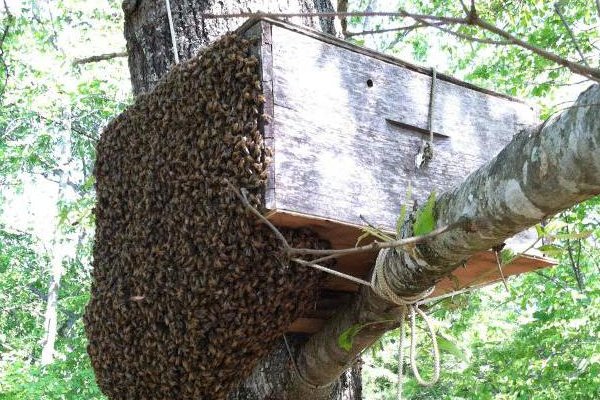
To catch a bee swarm, you can use not only specially made traps but also empty hives. These are filled with 6-8 frames. To attract your own swarm or other domesticated bees, use fresh frames.
Removing the trap
The trap should be removed in the evening—when the sun sets, the bees will return to the trap. When working in the dark, it's a good idea to use a flashlight with a red filter—the bees can't see this light. Follow these steps:
- Cover the entrance. Fine-mesh netting works well for this purpose; it's easy to attach with a stapler.
- Lower the trap to the ground. It's awkward to do this by hand, so it's best to use a rope. This will make the process easier and safer—the trap could be dropped.
- If the apiary is located near the trap, the captured bees should be moved in a different direction. The entrance should be opened and the trap left for several days—this is necessary to prevent the insects from returning to the place where they were captured.
- If the swarm was captured on rainy days, the bees didn't have time to stock up. It's essential to provide them with frames of honey.
To better adapt captured bees to the apiary, they should be provided with brood—frames should be taken from other hives. The insects will be busy working, so they won't be able to swarm.
Catching a bee swarm allows you to catch your own bees during swarming or replenish your apiaries with strays, all without spending extra money. Successful swarm capture depends on proper organization: you need to make a suitable trap, place it correctly, and, if carried out correctly, achieve the desired result.