
Wild beekeeping has been known since ancient times. Even in the ancient Rus', people discovered the unique taste and benefits of wild bee honey. Today, the craft of beekeeping is widespread in only a few regions, where the knowledge is passed down from generation to generation. In this article, you'll learn about the benefits of wild beekeeping and what it takes to make wild bee honey.
What is beekeeping in a hive?
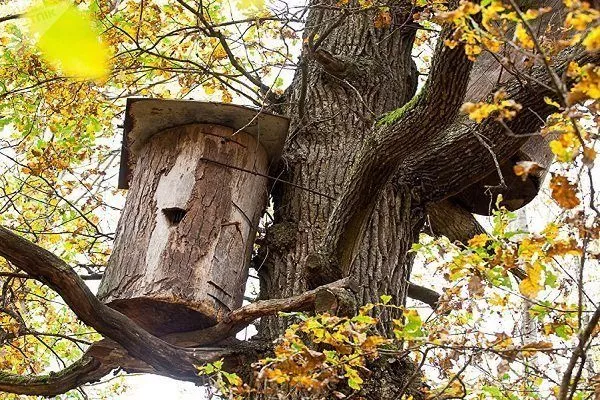
Bortevye (honey-keeping) is a type of beekeeping in which bees are kept in a natural or artificial tree hollow, located at a height of at least 7 meters. Inside the hollow, the bees create their honeycomb. Beekeepers, known as boronists, climb the tree and extract honey using special sticks.
You can learn more about the development of beekeeping in our country by examining the history of the craft.
Story
The history of beekeeping dates back to ancient times. The first beekeepers were people who harvested honey from the hollows of wild bees, thereby leaving them without food, which led to the death of the bee colony.
Over time, the craft of beekeeping began to develop, and new bee colonies began to be artificially introduced to replace lost ones, thereby increasing the quality of honey by weeding out weak insects.
The decline of beekeeping occurred in the late 18th century, when the number of trees decreased due to deforestation. Bees were domesticated and began to be kept in regular apiaries.
Modernity
Today, wild-hive beekeeping is not as widespread. Only people living in wooded areas practice wild-hive beekeeping.
Beekeeping has retained its popularity in Bashkiria. This is due to the locals' dedication to traditions, the sharing of knowledge, and the large number of trees suitable for cultivation.
The work of a beekeeper today is more complex than that of those who pioneered the craft. Holes are usually artificially constructed, and bees require constant supervision and care.
Peculiarities of beekeeping
Several significant features of beekeeping can be identified.
Characteristic
A modern hive is a hollow log with a hole left on the side for extracting honey. The hive is hung from a tree, and bees are then placed inside.
To avoid swarming, the hive should be expanded, as bees tend to breed intensively in a narrower space.
The meaning of the tiers in the deck
The tiers in the log hive are of particular importance for keeping bees.
Their main characteristics:
- Dimensions. The ideal option is 30 cm in width and height.
- Quantity. Up to five tiers can be created, depending on the total weight of the swarm. Most often, three tiers are left for the bees, with two additional tiers used to prevent swarming.
- Deck. The correct log in which to build a nest for bees should be 1 m in height and at least 500 cm in diameter.
- The meaning of the hollow elements. If three compartments are used, the top one is where the bees live, the middle one is where they build the combs, and the bottom one is where waste accumulates.
Terms of Service
The main conditions for conducting beekeeping in apiaries are:
- Selecting a location. It's best to choose a forested area with a variety of honey plants. Cranberries, lingonberries, linden, blueberries, and heather are all suitable.
- Mastering a craft. A beekeeper must be able to use tools for making beehives and extracting honey. They must have protective gear, such as special clothing and a mask. They must be able to climb to great heights. This requires a safety rope, a harness, special shoes, and a ladder. They must also be familiar with bee behavior.
- Beekeeping. Bees require care. In cold regions, the hive is insulated for the winter, and enough food is left for the bees to survive the winter.
In some regions, the hive is removed before wintering, the bees move into hives, and the honey is completely removed.
- Period of use. A properly made bedding can last up to 10 years.
Honey collection takes place in the autumn, when the first frosts begin.
You can learn about the appearance of a beehive, the specifics of preparing it for winter, and how to extract honey by watching the video below:
Protection from wild animals
You can protect the hive from predators by making a special trap: tie a rope to the bottom of the hive, and hang a log on it.
If a bear wants to feast on honey, it will have to push the log away, which will then attack it. The predator will fight the log until it retreats. To enhance the effect, spikes or nails are driven into the log.
Pros and cons
There are several advantages of beekeeping in a hive compared to conventional beekeeping:
- Bee colony health. Over the winter, wild bees are left in the nest with a supply of honey, which has a positive effect on their immune system. Bees in the hives are usually given sugar syrup.
- Making honeycomb. Bees themselves determine the size of the honeycomb in the hive. They usually make it larger, which has a positive effect on the insects, who grow larger.
- Number of bees. A hive can hold three times as many bees as a hive, typically up to 20,000. Consequently, they produce more honey and are less prone to swarming.
- Yield. One beehive can yield about 2 buckets of honey, and if the honey plants are blooming well, up to 50 kg.
- Savings. It takes less time and money to care for wild bees.
But one should also pay attention to the disadvantages:
- Bees are capricious. If the insects don't like the material the hive is made of, they may refuse to settle. Therefore, the choice of wood must be approached with particular care.
- Risk of bee death. During honey harvesting, when combs are cut and broken out, the insects can be harmed.
- The bee colony is independent. The beekeeper has virtually no control over it.
- The importance of skill. This craft requires a sound knowledge of beekeeping and proper training.
Making bee bread
You can make the beetroot yourself if you follow the recommendations given.
- ✓ The tree must be healthy, without signs of disease or pests.
- ✓ Softwood species such as linden, ash or oak are preferred for ease of processing.
- ✓ The trunk diameter must be at least 50 cm to ensure stability and sufficient internal space.
Materials and tools
What you will need:
- Inventory. An axe with a sharp blade and a chainsaw are required.
- Materials. You'll need a wooden block of appropriate size. Ash, linden, and oak are considered ideal materials. You'll also need clay and a piece of iron.
Step-by-step instructions
The sequence of making borti is as follows:
- Select a tree. It should be tall and healthy. Cut the log at a height of about 5-7 m.
- Formation of walls. To do this, use an axe or chainsaw. Remove the tree's interior. The thickness should be at least 60 mm.
- Making a window. This is necessary for inspecting the hive and collecting honey. Cut it out with the end of a chainsaw, about 30 cm from the top. The width should be at least 6 cm. Nail two lids—an upper and a lower one—on top with maple blades.
- Creating a flight hole. There are 2 of them. They are formed at the bottom of each lid.
- Drying of the beehive. This will take about 2 weeks.
- Strengthening the tiers. They are made using special frames.
- Closing the board. The bottom is boarded up, leaving a gap for the bees to fly out. The top is insulated with a piece of iron or roofing felt to protect the bees from precipitation.
- Creating ventilation. To do this, you need to make several small holes in the side.
- Placement of the board. Hanging a beehive on a tree is a labor-intensive task. It's usually quite heavy, so an assistant is needed to carry it to the tree and hang it above the ground. Up to three beehives can be placed on a single trunk.
- ✓ The hutch must be completely dry before occupancy to avoid mold.
- ✓ The inner walls of the hive should be treated with wax or propolis to attract bees.
- ✓ It is better to resettle the bees in the spring, when the bees are most active in searching for new housing.
The properties and value of wild honey
The characteristics of wild-hive honey are:
- Benefit. Wild honey contains more beneficial minerals and vitamins. It strengthens the immune system and helps prevent and treat many diseases, including cardiovascular diseases. It is widely used in alternative medicine. Honey has disinfectant properties, so it is recommended for the treatment of pneumonia, flu, and sore throat.
- Characteristics. The product is predominantly dark brown in color, with a linden aroma. It is easily digestible and has a pleasant, slightly tart flavor. The honey is viscous and has an opaque, thick texture.
- Collection. This process is done entirely by hand, without the use of mechanical means. This ensures the honey's quality remains unchanged.
- Storage. It should be done in containers made of natural materials. Clay pots and cedar barrels are best.
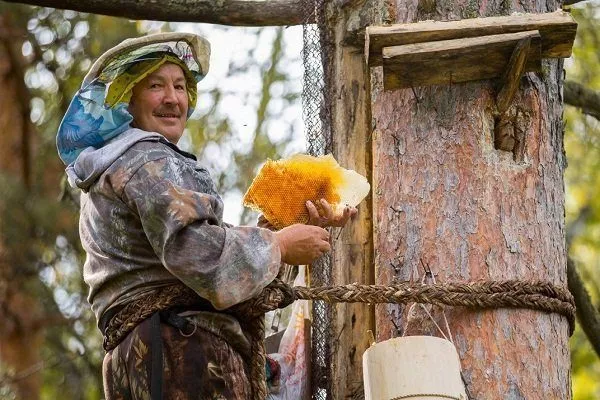
Bee nests are usually located in ecologically clean areas, so the honey is natural, without harmful impurities.
Beekeeping in a hive is a craft that requires specialized knowledge and skills. It's essential to properly construct the hive, place it in the tree, and study the basic behavioral characteristics of wild bees and their care. This is the only way to obtain truly high-quality and delicious honey.