
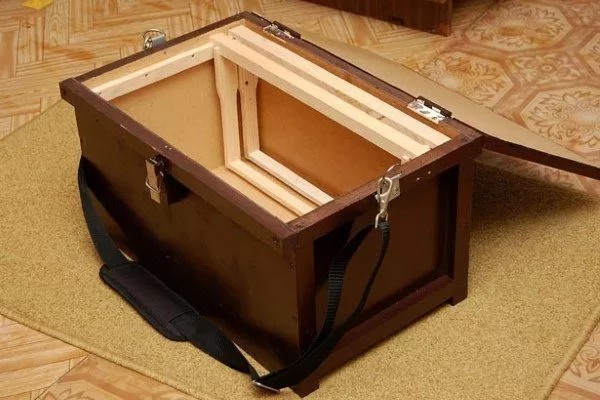
Various frame manipulations are an integral part of beekeeping. These tasks can be facilitated by using a special frame-carrying box, called a frame carrier. You can make this design yourself. There are certain requirements and operating rules for it.
Requirements for the frame
To ensure that the frame carrier is easy and convenient to use, its design must meet certain requirements:
- lightness – a heavy box will be impossible to use, so it should be small (usually for 6-8 frames) and made of lightweight material (usually plywood);
- certain dimensions - they must correspond to the dimensions of the frames used in the apiary;
- Multifunctionality – in addition to carrying frames, the structure can be used to catch swarms;
- ease of carrying – the box must be equipped with handles and a belt;
- Moisture resistance – this property is achieved by impregnating the material with drying oil, which additionally increases the wear resistance of the product.
The ramonos can even be used to house insects, but only for short periods. This option can replace a special swarm box, which can be very disturbing in the darkness.
Making a DIY Frame Carrying Box
Simple ramonos
Making a frame carrier is easy. The dimensions of the structure depend on how many frames it will hold. A six-frame carrier is most common. The optimal length is 47 cm, width 30 cm, and height 35 cm (always leave a 5 cm allowance). The internal dimensions are calculated based on the width and number of frames used. If the carrier needs to hold six frames, each 3.7 cm wide, then its internal width should be 22.2 cm (6 x 3.7).
To make a frame carrier you will need the following materials and tools:
- plywood or boards - for the bottom and lid, 4 mm thick;
- lid hinges;
- slats;
- a screwdriver or drill (a screwdriver will do);
- wood screws;
- lid lock;
- handles and carrying strap.
- ✓ Plywood must be moisture-resistant grade FSF, at least 4 mm thick to ensure durability.
- ✓ The slats for the rebates must be made of hard wood (oak, beech) to prevent deformation under the weight of the frames.
The production of the frame is carried out according to the following algorithm:
- Cut out the component parts: front, back, ends, bottom and lid.
- Attach a strip to the inside of the front and back walls; this will serve as a rabbet for the frames. Leave a 1.5 cm gap from the top edge. Both walls are made using the same procedure.
- The side walls are also reinforced with slats.
- On the lid, from the inside, screw the slats around the perimeter.
- Assemble the component parts of the structure. The bottom is a simple piece of plywood, but legs can be added if desired.
- Make ventilation holes in the frame. Their size depends on how the frame carrier will be used. The holes can be covered with fine-mesh netting or fitted with movable plugs.
- Connect the back of the product to the lid using folding hinges.
- Attach the lock to the lid.
- Attach the handles and carrying strap. The strap can be attached to the lid of the structure, but it's more convenient and secure to use the ends of the frame carrier. The carrying strap should be strong enough, but not too stiff, otherwise it will chafe your shoulder.
- Soak the finished piece in drying oil. This step can be done second, if it's more convenient to treat the component parts immediately after cutting them out.
Letok The entrance can be made in different ways – at one of the ends or at the front. A plug for the entrance should be provided. One convenient option is to attach two small grooved slats to opposite sides and insert a suitable piece of plywood that can be moved to the side.
- ✓ The carrying strap should be at least 5 cm wide to fit comfortably over the shoulder.
- ✓ It is recommended to choose a lid lock with corrosion protection (stainless steel or coated).
The design of a homemade 12-frame hive is shown in this video:
Ramos for two
For large-scale apiary operations, a larger structure capable of holding 20-22 frames should be used. The dimensions of such a structure are 90 x 80 cm. This structure is quite bulky, so it should be operated by two people.
Making a frame bed for two follows a standard procedure, but there are some peculiarities. One of these is the thickness of the material used. The structure is bulky, so its weight, including the frames, will be considerable. This places increased demands on the materials used. You can make the base from thick planks and use plywood for the sheathing.
It's recommended to connect the two-person frame carrier's components with nails. The side planks and walls can be fastened with screws. Due to the frame's weight and size, its handles and carrying strap should also be extra strong.
A mandatory step in the production of a frame for two is the impregnation of the finished product or its individual components with drying oil.
Rules for operation and care of the product
Ramos is a fairly simple structure, but it does require some maintenance:
- Disinfection. This should be carried out after each use of the structure.
- Ventilation. The frame hive should be ventilated not only before its first use but also thereafter. Bees are very sensitive to odors.
- Before using the frame plant, it is recommended to sprinkle it with herbs that are attractive to bees.
- Ramos is a wooden product, so it must be stored accordingly. The storage area should be sufficiently dry, avoiding significant changes in humidity and temperature.
- Use during swarming. In this case, place a couple of frames of dry bees in the frame-mounted hive, then shake off the bees. The frame-mounted hive lid and entrance must be closed. Leave the frame-mounted hive in a cool place overnight. Proper ventilation will provide the bees with the air they need and also reduce the temperature inside the frame-mounted hive, which has a calming effect on the bees.
A ramos is often called a working or universal box. This design is very convenient in an apiary and significantly simplifies a number of tasks. You can make one yourself—all the materials and steps are simple. A properly designed design ensures its multifunctionality.
Thank you for the informative information