
The Dadan hive is a convenient design used to expand a bee colony and increase honey production. It consists of several easily replaceable parts, extending the hive's lifespan. Read this article to learn what's needed to build the hive and how to do it correctly.
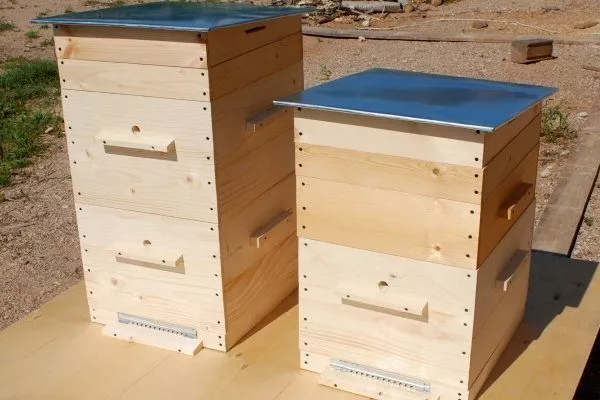
What does it represent?
The hive was designed by Charles Dadan and improved by the Swiss beekeeper Blatt. It is also known as the Dadan-Blatt hive.
It is a collapsible structure consisting of several parts. The hive's characteristic features include:
- Adjusting the position of the frames. They can be placed parallel to the back, front, or side wall. This allows the hive's design to be adjusted to suit winter temperatures.
- Height of frames. They are taller than 30 cm. For example, the height of Root type hives is 25 cm.
- Replacement of frames. There's no need to completely rebuild the hive body. Replacing any full or damaged frames is sufficient.
- Convenience. In a hive with 12 or more frames, you can hang a feeder on the side, since the design allows it.
Pros and cons
Advantages of the Dadan hive:
- There's plenty of space. It can accommodate a large bee colony. It's also possible to combine two colonies into one hive during wintering. However, to do this, they need to be separated with partitions.
- Reduced swarming. This allows for better control over the hive's design.
- The extraction process is simplified. Honey is collected in one easily accessible location.
- Durability. The hive will last for over 25 years.
- Parts are readily available. They can be found at any store. It's easy to make your own.
Among the negative aspects:
- Slow development. With the arrival of spring, the bee colony takes longer to gain strength.
- Inconvenience of movement. Due to its large number of parts, the hive is bulky and difficult to transport. Therefore, it is not suitable for nomadic travel.
Characteristics
The design has several types of characteristics.
Material of manufacture
The following materials will be required:
- Wood. Preferably made from deciduous trees. It must be well-seasoned, free of knots and signs of rot. Spruce and pine are suitable only if the wood has been dry for at least one year.
- Plywood. Don't skimp on materials, otherwise the hive will quickly become unusable. Plywood must be glued together using harmless raw materials, so it will be more expensive. Ideally, it should be made entirely of natural wood. A cheaper option is a wooden frame covered with plywood and filled with sawdust. Foam filling is also acceptable.
- Expanded polystyrene. Hives are warm and lightweight, but they also last much shorter. The same applies to polyurethane foam structures.
- Glue. PVA or casein will do.
- ✓ Wood moisture content should not exceed 15% to prevent deformation.
- ✓ The thickness of the boards for the walls of the body must be at least 35 mm to ensure sufficient thermal insulation.
The materials used to create the hive must be of good quality, harmless to insects and odorless.
Types of insulation
There can be 2 types:
- Single-wall. A summer option suitable for southern regions. The construction is lighter, but it retains less heat.
- Double-walled. Insulation is placed between the two walls. Sawdust, straw, and polystyrene foam are used. This helps retain heat even during temperature fluctuations.
Components
To make a Dadan hive you will need:
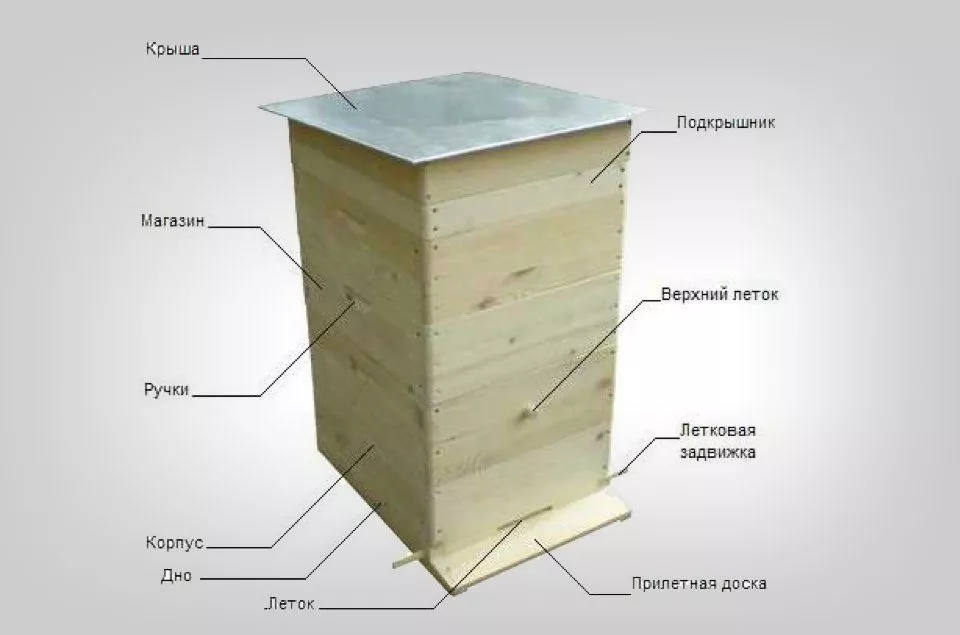
- Bottom. It's a rectangular wooden board with three planks installed on each side. The fourth plank is replaced by a gap. summerhouse. It is attached to it landing board.
The size of the entrance can be adjusted using a thin wooden insert – flight gate valveIt can be removable or attached to the body. A one-piece design is suitable for transport, but it makes it more difficult to inspect the bees and extract honey. - Frame. A wooden box without a bottom or lid. The remaining hive components are attached to it. A hole is also made – upper flight hole.
- Shop. It is used during the honey extraction period. The main thing is to ensure that the queen does not lay eggs in the super. Sometimes, for convenience, they make these in the store. pens.
- Roof. It should be as lightweight as possible, as it needs to be moved frequently. It can be made flat, gable, or mono-pitched. Hives with flat roofs are easier to move, but creating a gable-type shelter allows for additional ventilation and improved temperature regulation.
- Roof liner. Provides additional insulation.
The number of parts can be changed depending on the size of the bee colony and the size of the honey flow.
Step-by-step manufacturing instructions
The production of a Dadan hive has several features.
Preparatory work
During the preparation process it is necessary:
- Study the drawing.
- Outline the order of work.
- Prepare materials, dry and process wood.
- Have a hammer, nails, and a wood sander on hand.
- Make planks about 18 x 4 mm wide.
- Sand all surfaces to remove burrs.
- Treat the wood with an antiseptic that is safe for bees.
- Dry the boards for 48 hours after treatment.
Drawings and dimensions
The size of the hive is important. The tables show the internal dimensions of the parts. The external dimensions will depend on the thickness of the board you use.
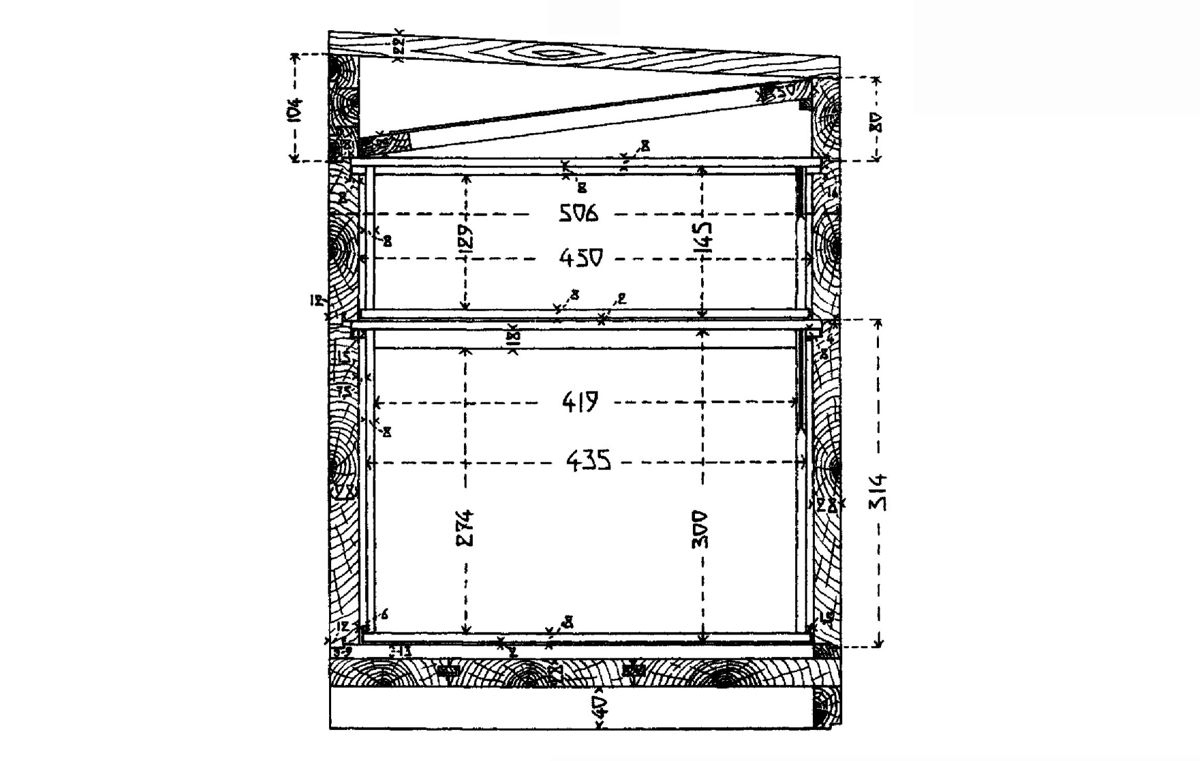
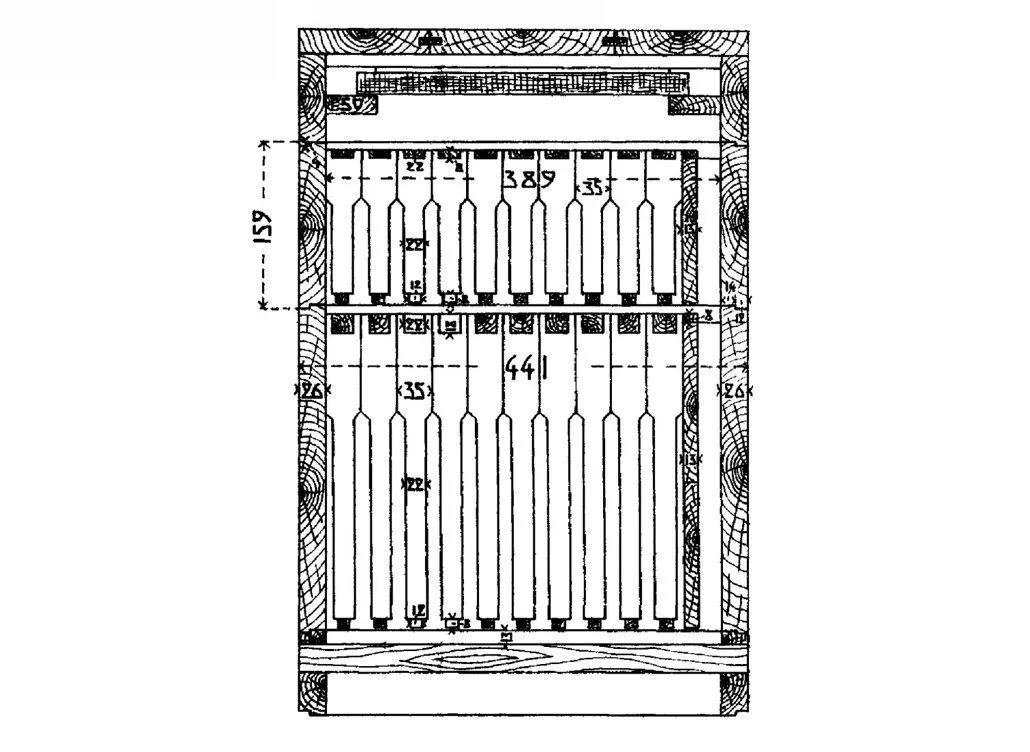
10 frames
To make a 10-frame hive, use the following parameters.
Table of dimensions of the components of a 10-frame Dadan hive.
| Detail | Internal size | ||
| Length, cm | Width, cm | Height, cm | |
| Frame | 389 | 419 | 300 |
| Shop | 389 | 419 | 145 |
| Roof | 585 | 585 | 120 |
12 frames
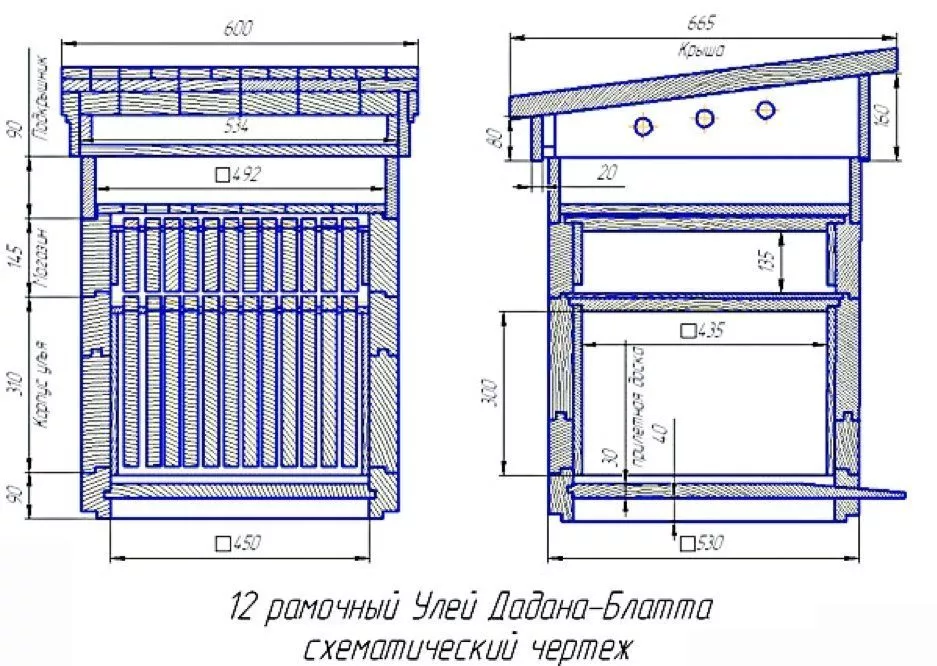
For manufacturing you will need the parts listed in the table.
Table of dimensions of the components of a 12-frame Dadan hive.
| Detail | Internal size | ||
| Length, cm | Width, cm | Height, cm | |
| Frame | 450 | 435 | 300 |
| Shop | 450 | 435 | 145 |
| Roof | 600 | 665 | 80 |
It is necessary to take into account the distance between the side bar and the wall - 0.7 cm and the distance under the frame - 2.5 cm.
14 frames
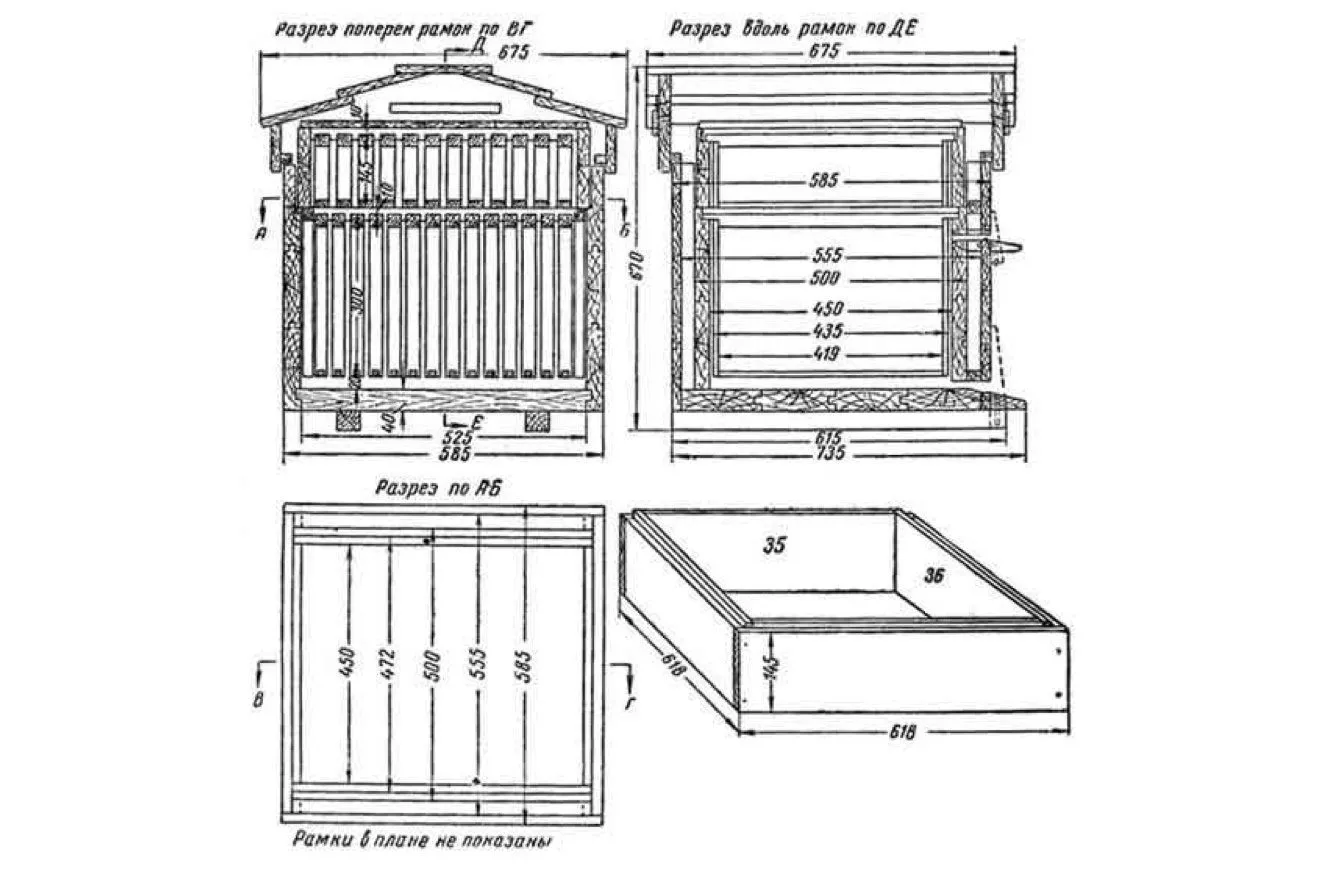
You need to take into account the dimensions from the table.
Table of dimensions of the components of the 14-frame Dadan hive.
| Detail | Internal size | ||
| Length, cm | Width, cm | Height, cm | |
| Frame | 525 | 435 | 300 |
| Shop | 525 | 435 | 145 |
| Roof | 675 | 675 | 80 |
16 frames
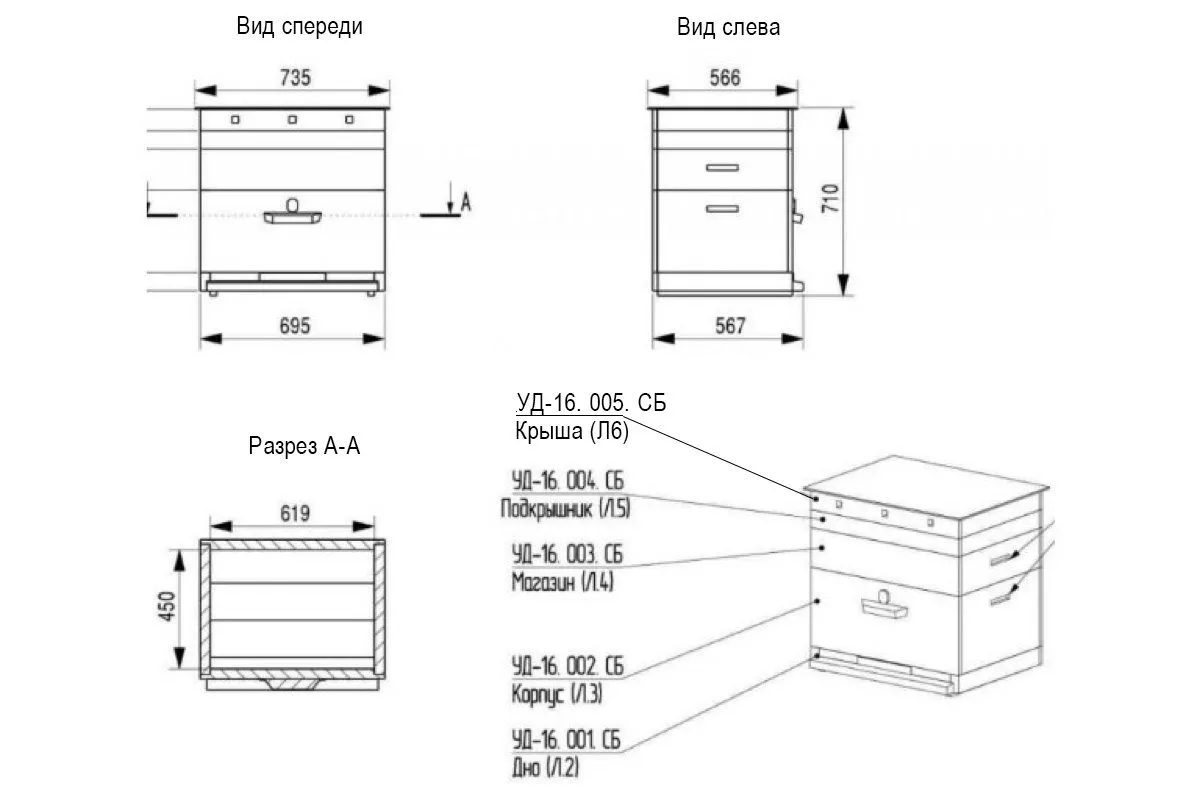
The details listed in the table are required.
Table of dimensions of the components of a 16-frame Dadan hive.
| Detail | Internal size | ||
| Length, cm | Width, cm | Height, cm | |
| Frame | 619 | 450 | 300 |
| Shop | 619 | 450 | 145 |
| Roof | 735 | 566 | 80 |
Work order
The steps to make a hive are as follows:
- Place the drawing in front of you. Prepare boards of the appropriate dimensions. For the frame, it's best to use boards 3.5-4 cm thick.
- Cut grooves into the boards that will connect the walls of the case.
- Use a router bit to join the walls together. Leave a 7 mm gap in the middle.
- Make thin planks, their parameters are 1.8 by 0.4 cm.
- Coat the grooves well with glue and connect the boards together to form a shield.
- You should end up with 5 shields.
- Make a body out of 4 of them using glue and nails.
- Use the fifth shield as the bottom. It can be firmly attached to the body or made removable.
- Coat the exterior of the hive with varnish or exterior paint. This will protect the structure from water.
- Be sure to make a roof cover. Make holes in it for the entrance and ventilation.
- Lastly, make the lid. It shouldn't fit too tightly.
- Pay special attention to sealing cracks. For this, use putty, then coat it with non-toxic paint.
It takes 6-8 hours to create 1 hive.
You can see how a Dadan hive is made by watching the video below:
Dadan frame
For frames, it's best to use softwoods. Willow or linden are ideal. The main frame dimensions are 43.5 x 30 cm. The dimensions of the magazine frame depend on its height. The standard ratio is 43.5 x 14.5 cm.
How to work with Dadan hives
Working with a hive depends on its type.
Single-hull
In this case, after spring arrives and the colony strengthens, the hive is expanded using supers. To prevent the queen from laying eggs there, the distance between the combs is increased. As the colony strengthens, the normal distance should be restored and the queen should be allowed to lay eggs in the super.
When honey collection begins, a second super is installed, positioned between the first and the nest. These are removed when the extraction period ends.
Double-hull
This is used if large quantities of honey are planned to be extracted. The second box is installed when the bee colony occupies 11 nest frames. Delays are essential, otherwise swarming will occur.
Be sure to add frames from the main box containing larvae and eggs, capped brood, wax foundation, and one honey-and-pollen frame to the additional box. These frames are replaced with frames containing dried brood and wax foundation. Gradually, the number of frames is increased. When the second box contains 12 frames, move the combs with capped brood to the top and the combs with open brood to the bottom. This will increase the honey yield.
If necessary, a 3rd hull and various superstructures are added.
Using a Dadan hive has many advantages. It's simple and easy to make, requiring no special skills. All you need is a blueprint and properly treated wood. By following all the recommendations, you can create a hive that will last for many years.