
A beehive, as a special home for bee colonies to live and reproduce, is the most important attribute of any apiary. However, choosing a beehive based solely on the needs of honey plants is not an option. Ease of maintenance for the beekeeper plays a significant role. Manufacturers offer a variety of designs, sizes, and other features. Making a choice without sufficient knowledge is quite difficult.
How are hives constructed?
A beehive is a unique structure. Everything within it is designed to provide comfortable living conditions for the swarm. Hives are primarily made of wood. Anyone skilled with a plane and hammer can build one themselves. But to do so, a thorough understanding of the construction of a beehive is required.
- ✓ The wood must be dry, free of rot and cracks, with a minimum number of knots.
- ✓ The thickness of the boards for the hive walls should be at least 3.5 cm to ensure good thermal insulation.
- ✓ To protect against moisture and increase the lifespan of the hive, it is recommended to treat the external surfaces with water-repellent compounds and paint them in light colors.
The first step is to find high-quality material. The longevity of the hives depends on it.
High-density wood (oak, birch, etc.) is not used in construction, as the structure must not be too heavy. The hives will have to be moved around the apiary or transported to the flowering site of honey plants.
- ✓ The hive must have bottom and top ventilation holes to ensure good air exchange.
- ✓ The size of the ventilation openings should be adjusted depending on the season and ambient temperature.
General requirements for hives:
- simplicity and ease of use;
- reliable protection from temperature changes, rain, and other weather factors;
- good ventilation, providing a favorable microclimate;
- the presence of insulation (protects from heat in summer and from cold in winter);
- the possibility of increasing or decreasing the size of the structure during operation;
- hive parameters corresponding to the swarm size, size and number of frames;
- bright, recognizable for bees, coloring of the "house".
The hive's core is a parallelepiped-shaped body. Inside is the nesting area. The walls are single or double, with insulation.
Entrances are placed on the front wall—they're where the bees enter their home. Typically, two openings are made in the front: a long slit at the bottom and a rounded opening above it (often used for ventilation). The entrances have dampers.
The following removable elements are attached to the main module of the hive:
- Bottom. Dead bees and waste fall here. The beekeeper removes them periodically. There's a stand at the bottom, raising the hive above the ground. Sometimes the bottom is connected to the body, but that complicates cleaning.
- Framework. These are rectangular pieces designed to hold wax foundations. The foundations are suspended in the hive body so that the bees can fill them with honey and bee bread.
- Landing boards. They are secured under the flight holes.
- Roof. It protects the hive from sun and precipitation, protecting it from pests. A roof liner, a rectangular insert that improves ventilation, is often placed under the waterproof roof.
- Diaphragm. This is a thin board placed inside the hive body. It separates the brood frames in the hive.
- Shop. A section of the hive body used for storing commercial honey. Compared to the nest module, it is lighter, taller, and has thinner walls. During periods of active honey flow, several additional extensions are installed in the hive.
- Dividing grid. It prevents the queen from moving to the other half of the hive.
The dimensions of the structural elements are determined by the hive top and the materials used. It's important that all parts fit tightly together, without gaps or cracks. If any are present, they are immediately sealed to prevent the bees from becoming overchilled.
The first beehives were created by humans 4,000 years ago. In Palestine, they were made of unbaked clay and straw; in Europe, they were hollowed out of wood to form logs. Designs similar to modern ones appeared in the 19th century. The first frame hive was created in 1814 by beekeeper Pyotr Prokopovich.
Types of hives and their classification
Hives are usually made of softwoods such as spruce, willow, poplar, aspen, and linden. They can be collapsible or non-collapsible, making them bulky and difficult to use. Hives are also categorized by design as horizontal or vertical.
| Name | Type of construction | Number of frames | Weight | Climate features |
|---|---|---|---|---|
| Horizontal | Horizontal | 14 | Big | Universal |
| Vertical | Vertical | Depends on the cases | Big | Cold regions |
| Alpine | Vertical | 48 | 20 kg | Universal |
| Dadanovsky | Vertical | 12 | Average | Universal |
| Ruta | Vertical | Depends on the cases | Average | Universal |
| Cassette | Combined | Depends on sections | Compact | Problem regions |
| Lounger (Vladimirsky) | Horizontal | 32 | Big | Warm regions |
| Horned | Combined | Depends on the cases | Average | Problem regions |
| Boa | Vertical | Many buildings | Small | Universal |
| Varre | Vertical | No limits | Small | Universal |
| Shapkin's hive | Vertical | Depends on the cases | Average | Universal |
| Plastic | Various | Depends on the model | Small | Universal |
| Multi-hull | Vertical | Depends on the cases | 30 kg | Universal |
Horizontal
The hive's design allows for up to 14 frames. Additional modules with wax foundation can be installed if needed. The modules are separated by bars separating the bee colonies.
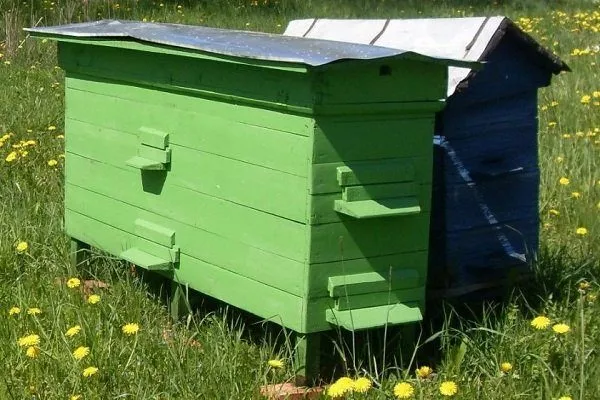
Pros:
- convenient to care for bees;
- ease of maintenance;
- There is no need to lift the stores for inspection.
Cons:
- very heavy weight;
- difficulty of transportation;
- To store spare combs, special cabinets are needed (in vertical hives this is not necessary, since they have a spare body).
Vertical
The design allows for the possibility of increasing the hive's volume vertically by stacking additional hive bodies on top of each other. The vertical hive resembles a natural tree hollow, giving the bees the impression of being in a natural environment.
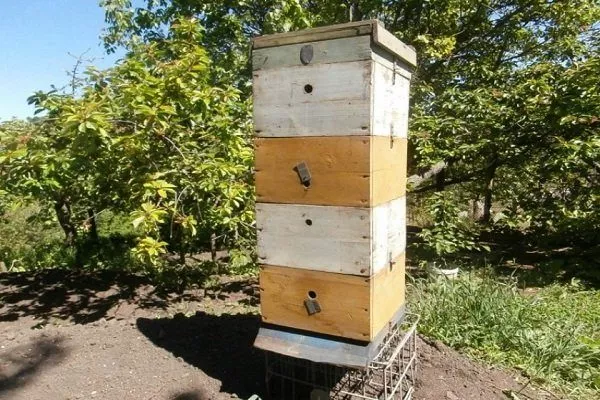
Pros:
- the ability to extract honey without opening the nest;
- ease of maintenance and operation;
- bees tolerate wintering well;
- there is no dampness;
- no mold or harmful bacteria appear;
- bee colonies reproduce well - beekeepers do not have to make any additional efforts;
- the structure of the hive allows the beekeeper to prevent swarming;
- Convenient to transport in a trailer or in the back of a car.
Cons:
- a large food supply is required;
- impressive dimensions and weight - very difficult to carry;
- the presence of flanges complicates maintenance and manufacturing;
- It is impossible to install additional flight holes - they cause drafts, which disrupts the microclimate in the hive.
When using vertical hives, the bottom must be turned over several times during the season to adjust the size of the vest. This procedure is difficult to perform without assistance.
Popular types of hives
Hives used in apiaries vary in design, capacity, ease of use, and other parameters. Some hives are designed for large honey harvests, while others are more suited to small home beekeeping needs.
Alpine
This type of hive was designed by Roger Delon (France). The multi-body structure measures 300 x 300 mm. Additional bodies are added to provide space for the bee colony to grow. These are stacked vertically.
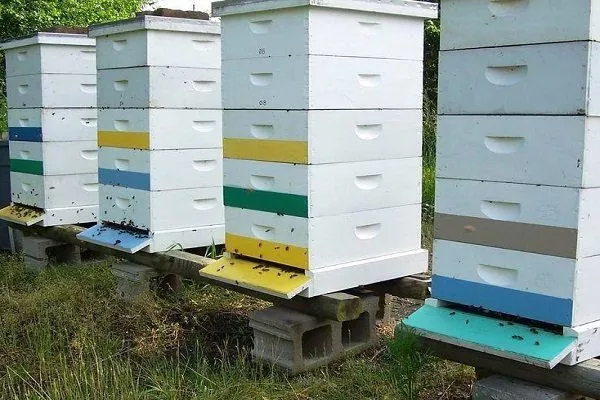
The entrance to an alpine hive is a 7 mm gap. This is created when the lower hive body is placed on the bottom. The opening allows for air exchange within the insects' home.
Pros:
- promotes rapid growth of the bee colony;
- light weight (even with honey the hive weighs about 20 kg);
- easy to clean;
- ensures good wintering;
- maintains a stable microclimate.
Cons:
- It is necessary to constantly monitor rapidly developing bee colonies;
- you need a lot of frames - at least 48 pieces for one house;
- bees quickly begin to swarm;
- It is difficult to obtain frames and other equipment due to the low prevalence of this model;
- It is difficult to sell bee packages with families and queens - the market is not very focused on alpine hives.
Dadanovsky
One of the most popular vertical structures. Its distinctive feature is the material used. They are made exclusively from spruce. The design was developed by the Frenchman Charles Dadan. This type of bee house is the most popular in Russia.
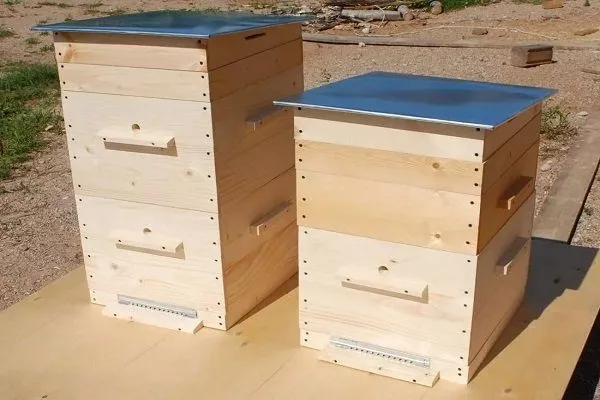
The Dadanovsky hive was created half a century ago. Since then, its design has undergone some modifications. It now contains 12 frames, and the body consists of two supers. A spare super is used when needed.
Pros:
- can be used in different climates;
- ease of manufacture and maintenance;
- for wintering, double insulated walls are made;
- usually 1 or 2 nests are installed (they become heavier as the number of frames increases);
- enough space for large families.
Cons:
- many outdated structures - the "fleet" needs to be updated;
- the frame is too big.
Dadant hives are used in small farms. Large-scale production does not use them due to their labor-intensive maintenance.
The Dadan hive provides excellent protection from both cold and heat. Its vertical design minimizes disturbance to the bees during the honey flow period.
Ruta
The Ruta bee house appeared 150 years ago, but remains one of the most popular. Its well-thought-out design and convenient frames make maintenance easy. Ruta's distinguishing feature is the uniform frame size and the lightweight nature of the individual frames.
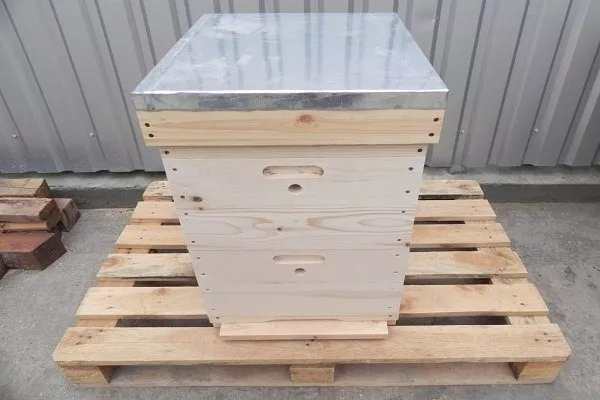
Pros:
- it's not difficult to do it yourself;
- rapid increase of the swarm in a short period of time;
- increased productivity;
- the possibility of forming two-queen families;
- ease of transportation.
Cons:
- Due to the large size, newcomers do not have time to fill the entire hive with honey and bees - voids lead to hypothermia in winter;
- The presence of free space allows the queen to move freely around the hive, which complicates the beekeeper's work.
Cassette
Cassette hives are designed to reduce bee disease rates. This is achieved through thin walls, allowing the honey plants to control their own microclimate. These hives are especially popular in areas unfavorable for beekeeping.
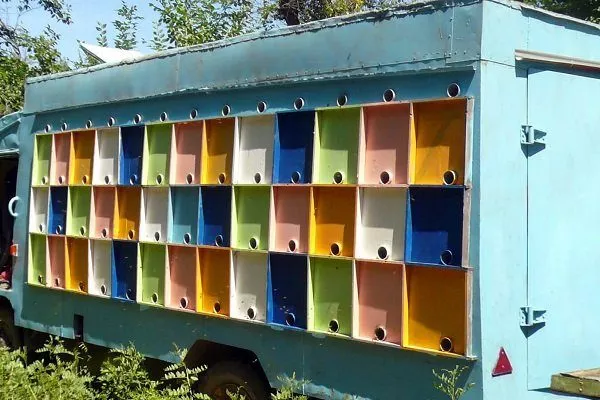
The hive's sections are connected vertically and horizontally. Their number is determined by the number of queens and bee colonies. Each section consists of a body, a basement, a superstructure, and a partition dividing the module.
Pros:
- compactness;
- easy to transport in a truck or trailer;
- The design simplifies beekeeping, cleaning and disinfection;
- reliable protection of bees from negative influences;
- rapid growth of bee colonies.
Cons:
- You cannot paint the walls (you can only impregnate them with hot wax);
- Overcrowding can lead to the loss of queens during the flight, especially in windy weather.
Lounger (Vladimirsky)
This type of bee hive has been popular with beekeepers for many years. These structures are particularly common in what is now Ukraine. These hive beds resemble chests with hinged lids. The walls are thick and insulated with cushions.
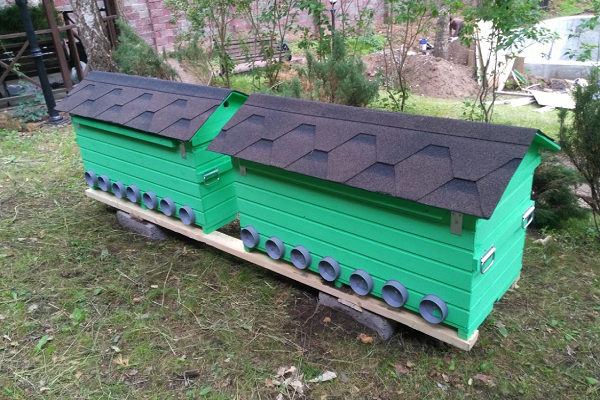
The key feature of sunbed hives is the horizontal, rather than vertical, placement of the nest. These hives have an elongated body, which can accommodate up to 32 frames. Two colonies can be kept in a single hive, separated by a partition—a separate entrance is cut in each compartment.
Pros:
- quick cleaning;
- The horizontal arrangement of the frames makes them easy to change;
- ensures high performance;
- convenient for breeding bee colonies;
- Durable construction - due to the connection of the bottom with the body.
Cons:
- bulky - suitable only for large and spacious apiaries;
- Insufficient air exchange - this has a negative impact on the health of bees in winter.
In some types of sunbeds, the frames are positioned vertically. This makes the frame narrower and taller, allowing bees to breed comfortably by climbing up the combs.
Horned
This is one of the most successful designs. Thanks to their ease of maintenance and low price, these hives are suitable for beginning beekeepers. They are sold unassembled, but any beginner can assemble them in a few hours.
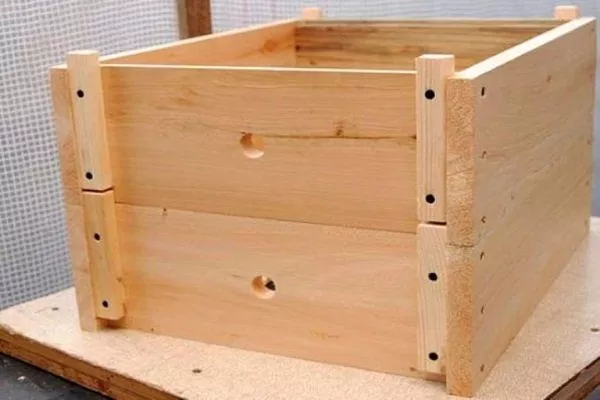
Pros:
- suitable for problematic climates;
- easy to care for bees;
- ease of honey collection;
- provides good protection from bad weather.
These hives have no known drawbacks, except that they are unsuitable for mass honey production. This design is more appealing to beginning beekeepers who keep bees to provide their colonies with honey and bee products.
On average, beekeepers collect from 20 to 80 kg of honey and 2 kg of bee bread from one hive.
Boa
The hive's popularity stems from its simplicity. It contains multiple bodies, yet is lightweight. Its main feature is its unique design, which creates a special microclimate. Boas are made from wooden beams up to 5 mm thick.
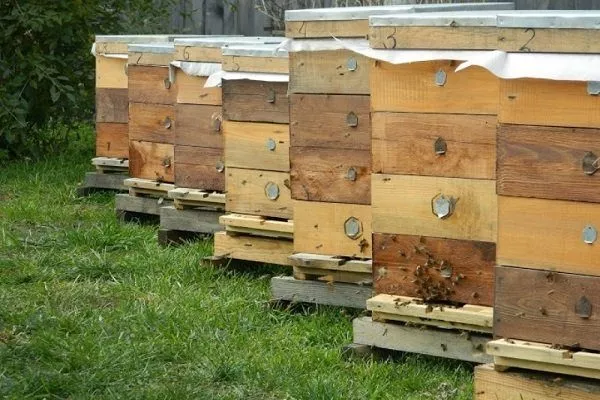
Udav hives are recommended for novice beekeepers. If you're willing, these hives are easy to make yourself.
Pros:
- no insulation work required;
- good ventilation;
- high performance;
- non-standard frames can be used;
- ease of waxing - the entire body can be filled with frames in a matter of minutes;
- ease of installation;
Cons:
- insufficient stability due to great height;
- relative complexity of installation - many parts.
Varre
The main feature is the manipulation of the hive bodies, rather than individual frames. The hive house is small, measuring 30 x 30 x 21 cm. These hives will appeal to female beekeepers, as they are easy to move from place to place.
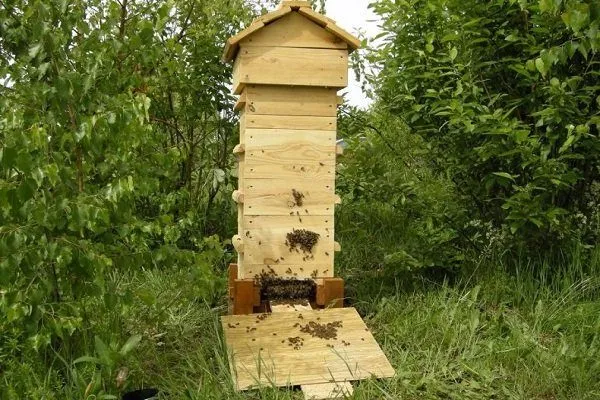
Warre hives are made up of boxes of the same size, stacked on top of each other. These structures create the most comfortable conditions for the bees. The hives resemble traditional Japanese houses.
Pros:
- low cost;
- there is no need to remove the frames - this allows you to keep the bees calm;
- light weight - due to the absence of frames;
- easy to care for and monitor bees.
Cons:
- due to the low location of the hive entrances, mites accumulate at the bottom of the hives;
- There is no high-quality ventilation, which leads to excess humidity.
Shapkin's hive
These hives embody the principles of beekeeping in log hives. In ancient times, the insects lived in them according to their own rules, with virtually no intervention from the beekeeper.
A modern log hive is constructed from planks and has a multi-part structure. Beekeepers build combs vertically. Beekeepers often insulate these hives with a combination of plywood and foam. This type of bee house is typically used in small, non-commercial apiaries.
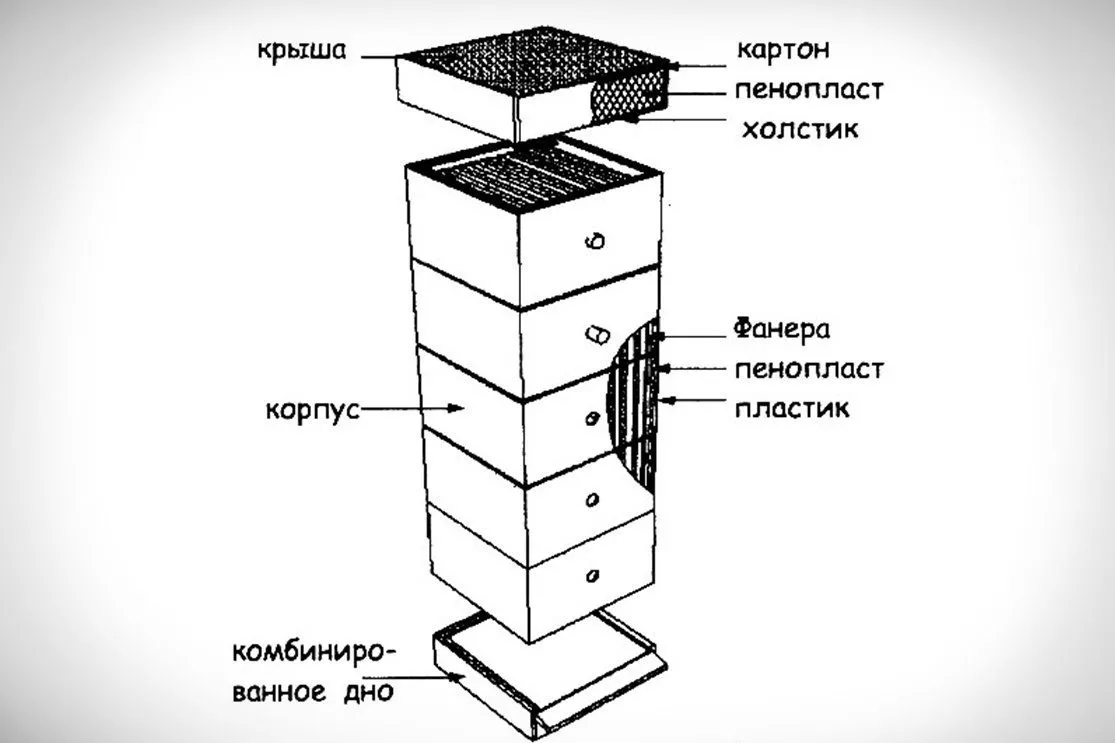
Pros:
- simplicity of design;
- minimal material costs.
Cons:
- If the bees don't like the home, they will leave it, and the beekeeper will not be able to stop them;
- low productivity.
Plastic and frames
Hives have always been made of wood, but over time, an alternative emerged: plastic bee houses. These structures feature pull-out trays, carrying handles, a lid, and so on. Plastic is suitable for industrial beekeeping but is not used in home apiaries.
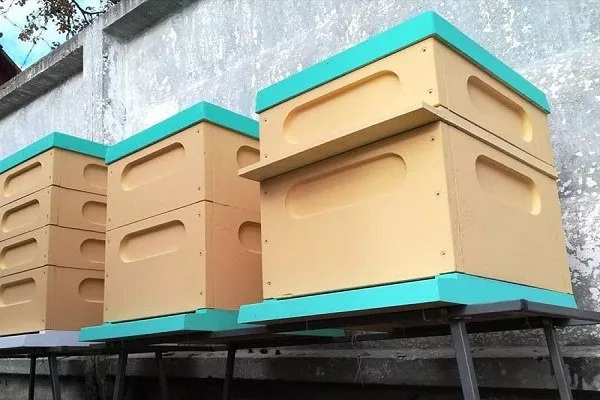
Pros:
- light weight;
- ease of disinfection;
- functional design.
Cons:
- weighting is necessary - light hives are turned over by the wind;
- interior wood paneling is needed;
- plastic is not an environmentally friendly material;
- Plastic walls cannot be scraped off and propolis cannot be collected from them.
Multi-hull
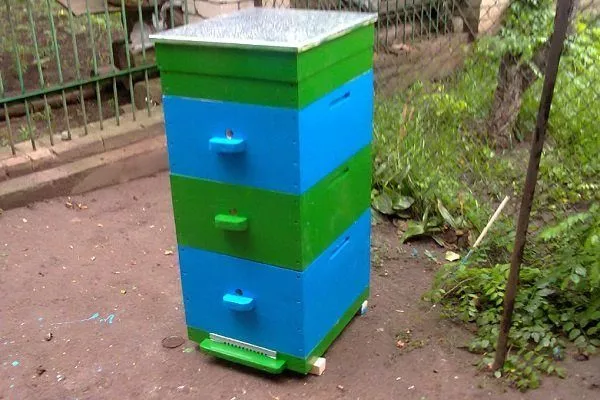
These hives are designed to best meet the needs of bees. The house consists of several bodies, the number of which depends on the season. It features a roof, a solid ceiling, a removable floor, a separating grid, a stand, and an entrance liner for adjustment. The bodies are tightly connected to each other with clamps.
Pros:
- convenient for beekeepers;
- are easily transported;
- Working with frames rather than individual frames reduces labor costs;
- optimal conditions for the growth of bee population and good honey collection.
Cons:
- there are problems when organizing wintering;
- large weight of honey cases - up to 30 kg.
How to choose?
Successful beekeeping depends largely on the proper selection of hives. They are chosen based on the needs and goals of the beekeeper.
Bee hives are most often purchased. However, beekeepers skilled in working with tools and wood can build their own hives—if they have a small apiary and simple structures.
In any case, you'll need to choose the right type of honey plant house. There aren't many criteria for choosing.
Size and number of frames
The productivity of bees depends on the frame size. The most popular are Dadant frames (47 x 30 cm). They are suitable for almost any hive, from horizontal hives to multi-box designs. They can be purchased at any beekeeping supply store.
The second most popular frame size is 47 x 23 cm. They are typically used in multi-box hives. However, bee kits for these frames are more difficult to find. Therefore, Dadant frames are recommended for beginners.
When purchasing a hive, it's important to choose the right number of frames. For a Dadant hive, 12 standard frames are sufficient, while for a horizontal hive, 20 or 24 frames are sufficient.
According to climate characteristics
When choosing a hive, consider the regional climate. If there's a risk of early frost, insulated structures are needed. Double-walled hives with an insulating layer are commonly used.
In regions with frequent adverse weather conditions, the size of the house is a must-have when purchasing. It should be transportable without any particular difficulty.
Based on the material
Hives were once made exclusively from natural materials—wicker, clay, straw, and cork. Wooden structures appeared later, in countries with cold climates. Despite the abundance of new materials, wood remains the best.
Requirements for wood:
- dry;
- free from rot and cracks;
- without knots - they interfere with the free movement of bees;
- thickness - up to 5 mm;
- without chips or roughness.
The best woods for beehives are willow, cedar, and spruce. Linden and poplar are also good options. Plywood, fiberboard, reeds, and sandwich panels have proven themselves to be good choices.
By manufacturer
There are many different manufacturers on the market offering quality products. Zukunft Bienen (Germany) offers particularly popular vertical and horizontal hives.
Along with German products, Finnish equivalents are popular. They offer good insulation and are ideal for regions with cold winters.
Beekeepers' tips for choosing hives
Beginners are advised to choose hives that are simple in design, lightweight, and affordable. When making a purchase, consider the following:
- Focus on the effort and time required to maintain and transport the hives.
- The duration of the honey flow in the apiary's area. If the honey flow is limited, there's no point in purchasing multi-body hives for stationary use. For transporting hives to areas with abundant honey flow, lightweight multi-body or cassette designs are needed.
- Bee breed. This is the one that primarily influences the development of a bee colony.
It's recommended to purchase hives that contain identical parts and components. This will reduce apiary maintenance costs.
How to make a beehive with your own hands?
Building a beehive is no easy task, as it requires strict adherence to blueprints and the use of numerous tools. Typically, the construction is undertaken by enthusiastic beekeepers with carpentry experience.
Materials, tools
Homemade structures are usually made from planks—pine, spruce, and other softwoods. They are easy to work with and retain heat well.
Tools for making hives:
- It is advisable to have a carpenter's workbench - it is convenient to process and assemble wooden parts on it;
- saws;
- plane, jointer and other tools for planing work;
- chisel, gouge and other chiselling tools;
- drill;
- screwdriver;
- drills;
- hammer;
- axe;
- pliers;
- mallet;
- pliers;
- measuring tape, level, ruler, etc.
Step-by-step manufacturing instructions
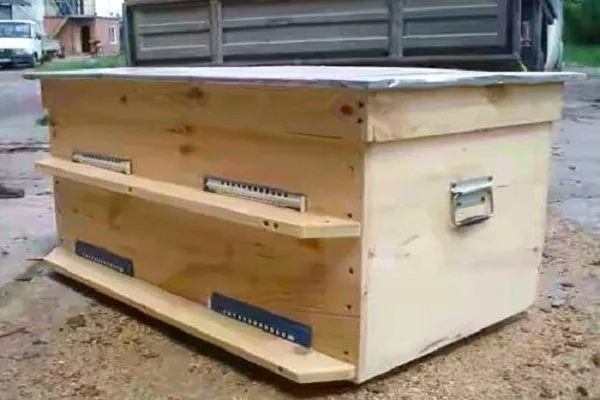
The easiest way to build a horizontal hive is by hand. But, in principle, the work involved in building any bee house is the same. Before you begin, determine the exact dimensions. Draw your own drawing or use a ready-made one.
How to make a beehive step by step:
- Cut 4 cm wide boards for the front and back walls of the hive. The boards for the side walls should be 3 cm thick. Measure according to your drawing.
- Assemble the structure so that three walls—the back and two side walls—are flush with the bottom. Install the front wall slightly (1.5 cm) from the bottom. This gap will serve as the entrance. Butt the corners with a mitered edge and secure with nails.
- Make the floor from 3.5 cm thick boards and the ceiling from 1 cm thick boards.
- Build the roof at your discretion - flat, single-pitched or gable.
If the apiary is set up in a northern region, insulate the hive on both sides.
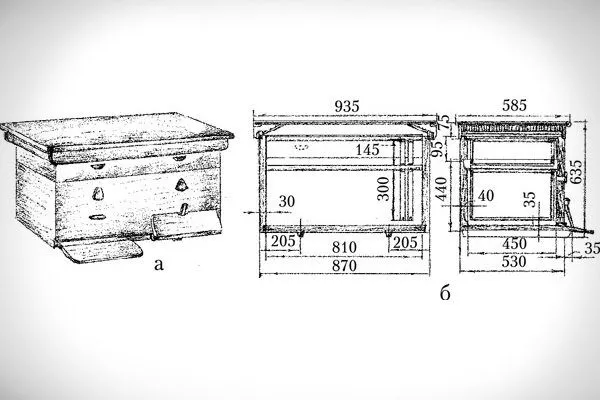
Recommended dimensions of a 20-frame bed:
- front wall - 87 x 37 cm;
- back wall – 87 x 34 cm;
- side shields - 44 x 49 cm;
- bottom - 84 x 54.5 mm.
Features of manufacturing hive parts
Despite the diversity of designs, the basic components of beehives must meet uniform requirements and fulfill specific functions. Below are the manufacturing features of the main components of beehives:
- Frame. This is the main part. It looks like a standard four-walled box. As the colony grows and its numbers increase, beekeepers stack the boxes on top of each other. Hives can have one, two, three, or more boxes.
The optimal wall thickness for a hive is 3.5 cm. This thickness allows the insects to survive the winter safely. The body parts are fastened together with nails or PVA glue. A 1 x 4 cm slit is always made in the front. Indentations are made on the sides, 7 mm from the top of the body, to provide carrying handles.
Holes are drilled into the bottom of the housing to allow fresh air to enter. The outside of the housing is coated with a water-repellent compound and painted in a suitable color—white, yellow, or blue. - Roof. It's usually made from 2-cm-thick boards. The structure is prefabricated, like a panel. For added security, the roof is covered with metal sheets. Even tin is sufficient—the main thing is to protect the wood from excessive moisture and prevent rot.
Beekeepers often place mesh on top of their hives to allow for additional air exchange during transport. The mesh also serves as protection for the swarm from adverse external factors. - Bottom. In regions with harsh winters, it is constructed from two layers of boards. Insulating backfill is mandatory. In the south of the country, insulation is not required; the bottom is single-layered. It is assembled from beams in a U-shape. Grooves are made in the side beams, and the structural components are inserted.
Beehives come in a wide range of designs, allowing every beekeeper to choose the optimal option based on their needs and the scale of their honey production. With the desire and the right skills, any beekeeper can not only build their own hives but also customize them to their liking.