
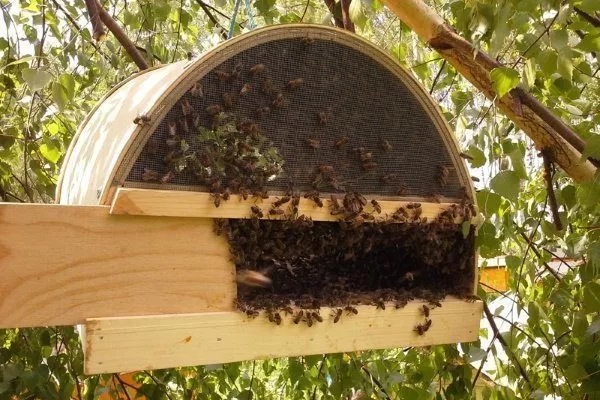
A swarm trap is a special box-shaped device used to capture a swarm of bees and return them to the apiary. This trap can be made at home, as it doesn't take much time and doesn't require any special skills or materials.
Basic requirements and volume of the trap
A swarm box is a temporary shelter for bees. Beekeepers use it to catch and store bees that have escaped from their permanent hives. There are specific requirements for creating a swarm box:
- When making a swarm box, pay attention to its size, smell, and distance from water;
- The shape of the swarm box does not matter at all for the bees, but the beekeeper himself should pay attention to how he will install the trap on the tree;
- Plywood barrels are suitable for swarming boxes - after the entrance holes are made, the roof is covered with roofing felt, and frames with wax foundation are placed inside.
- ✓ Plywood must be moisture resistant for at least 24 hours when completely immersed in water.
- ✓ The thickness of the plywood for the side walls must be at least 20 mm to ensure sufficient strength.
To determine the size of the trap, you should also know some nuances:
- housing for bees should be as spacious as possible, because they do not like being crowded;
- a trap that is too big will be cumbersome, and a small one will be ignored by the bees;
- If the volume of the trap is 20 liters, then drive a small swarm into it (such a family can be hatched at the end of summer), since a large swarm that was hatched at the beginning of summer will not fly into a 20-liter trap;
- The optimal volume of the trap is from 40 to 80 liters.
How is a swarm box constructed?
In beekeeping practice, several types of swarm box designs are known. Before building one yourself, review the following tips:
- Make a swarming box in the shape of a basket or box with a lid. The swarm is trapped in it and kept there for a certain period of time.
- The swarm box also requires a scoop for collecting the swarm and a swarm catcher (a net with an unusually shaped lid). Use a hook to secure the net to the area where the swarm is located, then pour the swarm into it and close the lid.
- To make a trap, use either three-layer plywood or fiberboard.
- The size of the box inside depends on the frames - for example, their length and depth are the same, but the width depends on the number (with five frames, the size of the trap is 191 cm).
- To allow the bees to freely fly out of the swarm box, it is necessary to make an entrance—special holes—with the upper one measuring 20-25 cm in diameter and the lower one 7-8 cm. The upper one must be round, while the shape of the lower one is not important.
- The thickness of the back and front walls is 20-24 mm, the side walls – 3-4 cm. Leave 10-15 cm of space under the frame.
- There should be no gaps in the trap under any circumstances, so that the bees cannot escape from it.
What tools and materials will be needed?
To build a swarm box yourself, you first need to select a material that meets all requirements. Beekeepers choose from the following list:
- metal mesh;
- sheets of fiberboard or plywood;
- boards and sheets made of pressed wood chips;
- cardboard sheets;
- tube of glue;
- woodworking tools;
- scissors;
- tools for joining parts together.
Plywood swarm box
Plywood is ideal for swarming boxes because it is inexpensive, lightweight, and durable. Plywood is an environmentally friendly material and comes in several types, varying in thickness, cost, and moisture resistance.
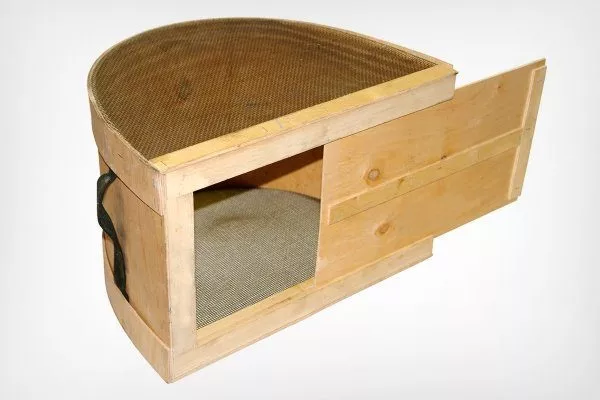
To make a swarm box from plywood, you will need the following materials:
- plywood;
- metal and mosquito nets;
- wooden plank or pressed boards;
- cardboard;
- waterproof glue;
- scissors;
- woodworking tools.
Dimensions of the swarm box:
- bottom – 35x45 cm;
- side walls (2 pcs.) – 30x45 cm;
- front wall – 35x20 cm;
- lid – 20x45 cm.
There are two ways to make a swarm box from plywood, let's look at each.
Method 1:
- Cut out the pieces.
- Glue them together.
- On the side wall, make a 1x8 cm entrance.
- Make an air exchange frame.
- Place the mesh on the frame and secure it with shoe nails.
- Make a box out of four walls.
- Attach hangers inside the back and front walls, and bevel the bottom part - this is where the frames with honeycombs will be placed.
- Make a hole in the lid, cover it with mesh, and then hang the lid on the bolts.
- Attach hooks to the sides, which are needed to hang the bee trap on a tree.
Method 2:
Cut the side slats and frame from 4cm wide slats.
- Make the folds in the frame necessary for installing the frames.
- Cut a 1x1 cm hole in the front wall.
- Assemble the side and end walls.
- Secure and cover the roof with tin.
- Install a dryer and at least 5 frames.
- To attract bees to the trap, rub it with wax, propolis or mint.
- Attach the handles.
- If you want your swarm box to last longer, treat it with drying oil and paint it. However, this should be done so that all odors have time to dissipate before using the trap.
The video below shows the process of assembling a swarm box from plywood:
Styrofoam trap
Polystyrene foam is a moisture- and air-impermeable, environmentally friendly material. It's lighter than plywood and mold-resistant. However, it can accumulate excess condensation, requiring additional holes in the polystyrene swarm box.
Polystyrene foam conducts heat well and is not damaged by mice or birds, but sunlight and mechanical damage can destroy this material.
Building a swarm box from polystyrene foam is not difficult, as it is quick and the materials are inexpensive.
This swarm box consists of the following parts:
- lid and bottom – 51x36 cm;
- 2 side walls – 51x35 cm;
- front and back walls – 30x35 cm.
To build a polystyrene foam swarm box you will need:
- polystyrene foam sheets (thickness – 30 mm);
- liquid nails;
- glue;
- stationery knife;
- ruler and pencil;
- screwdriver and screws.
To ensure a secure lid closure, make a 3.0 x 0.5 cm recess and secure it with screws.
Cut out a small square entrance and attach mesh and tape to it during transport to make it easy to hang the swarm box on a tree.
Care should be taken during transportation – due to the fragility of the material, the swarm box body can be damaged by tree branches.
Butlerov's Roevnya
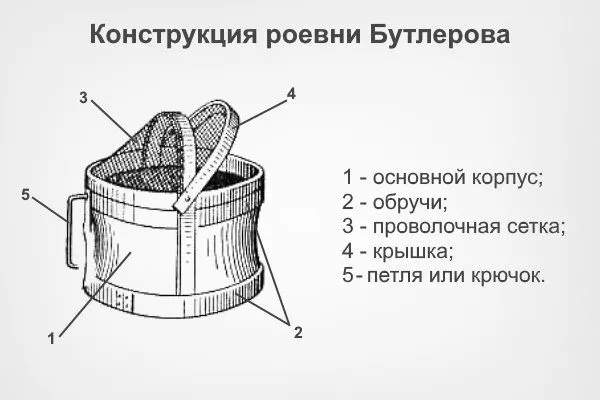
The Butlerov swarm trap is the most popular bee trap model. It consists of a frame with hoops attached to it. To make it, you'll need the following materials:
- thin plywood (pre-soaked in water for 24 hours);
- staple gun;
- fasteners (bolts, clusters, studs, etc.);
- wire mesh;
- canvas;
- loop, hook or handle.
The height of the swarm box will be 400-450 mm, and the diameter will be 300-350 mm.
The process of creating a swarm is as follows:
- Cut a strip of plywood about 1 m long and 40-45 cm wide. This will be the body.
- Cut two strips of plywood 1 m long and about 3 cm wide. These will be the hoops.
- The plywood needs to be shaped into a cylinder. To do this, use staples to secure a hoop to the bottom of the future "cylinder." The hoop strip should be at least 5 cm from the edge on one side and overlapping on the other. Do the same with the hoop at the top of the "cylinder."
- Cover the bottom of the structure with canvas, securing it with staples.
- Prepare another narrow strip of plywood and staple it to the height of the "cylinder." This will create a handle for the basket (see the picture below).
- Cut a strip of plywood for the lid and secure it with a pin or bolt so that it can move.
- First, cover the fixed part of the lid with mesh, and then lower the moving part of the lid down and cover it too (as in the picture below).
- Attach a hook or handle to the side of the hive body for easy carrying or hanging from a tree. The handle should be mounted on the opposite side from the sliding lid.
Arrangement of a swarm box
Once the trap frame and its main components have been constructed, it needs to be painted and filled with bee-attracting material. Painting and filling the swarm box has its own nuances.
What and how to paint?
There are also several nuances when painting a swarm box:
- Use oil-based paints for painting. Painting the trap will make it more resistant to both hot weather, preventing premature cracking, and rain, as the paint will prevent the main body of the trap from becoming damp. Paint the swarm box six months before settling the bees, allowing time for all odors to dissipate.
- Choose green paint to help the trap blend in with the surrounding trees.
- Avoid using quick-drying paints because they retain an unpleasant odor for a long time and crack quickly.
- Paint only the outer part of the wall, as the inside must be permeable to moisture and air, and not become covered with condensation due to temperature changes.
Filling the trap
The inside of the swarm box also needs to be carefully prepared for the bees to settle in:
- Bees dislike the smell of dry wood. To eliminate the smell, expose the swarm box to rain with the lid open.
- To attract the attention of bees, rub the inside of the swarm box with lemon balm or black currant leaves;
- Hang traps on spruce trees, as they release phytoncides that repel parasites.
- Also, rub the heated walls of the trap with broken queen cells or wax, and coat the edges of the walls with an alcohol solution of propolis.
- Apply a piece of pine resin dissolved in ether to the wooden parts of the frames. After a while, the ether evaporates, but the resin smell remains.
- Rub the entrance and its edge with wax or honey.
- ✓ Using propolis to treat the inner walls increases the attractiveness of the trap to bees by 40%.
- ✓ The presence of frames with wax foundation inside the trap reduces the time it takes for the swarm to settle by 2 times.
When to check the swarm box?
During the period swarming Bees can leave their foraging grounds, flying 2.5-3 km, so there's a chance that a foreign swarm will be caught. Set up traps in the last days of spring or the first days of summer. Ideally, set them up by the 13th-15th of May, as by this time, scout bees have discovered the new home and led the rest of the swarm to it.
Predicting the success of swarms is very difficult, and this is a significant drawback, as it takes a lot of time and the outcome may be uncertain. However, with due patience, you can establish your own apiary in a couple of years without major financial investment.
You can learn about how to catch a bee swarm in a swarm box, how to place a captured swarm in a hive, and what equipment is needed for catching it in the video below:
Making a bee trap isn't difficult or time-consuming. This swarm box will last for years. The key is to follow all the installation and trapping instructions. wild bees.