
You can make a swarm box for bees yourself. There are a number of requirements for this design. It has a specific structure and can be constructed in a variety of ways. Once constructed, the swarm box must be painted, properly filled, and installed correctly.
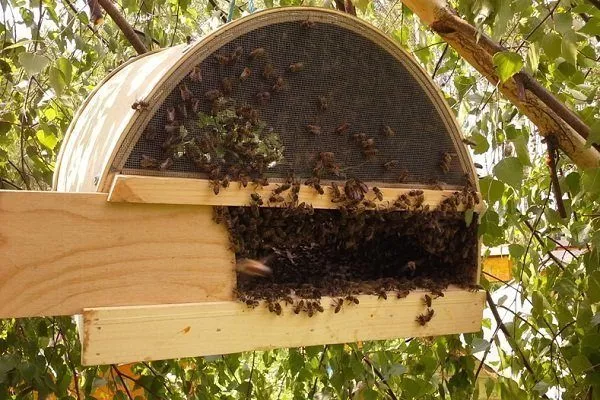
Bee trap requirements
Bee hives may differ in design features and materials, but the requirements for them are the same:
- sufficient capacity: the swarm box should accommodate a swarm of any strength, the optimal volume is 40-80 l;
- strength;
- tightness - the mood of the bees inside the swarms is far from favorable, so they should not accidentally get out;
- ease of design – the lid is of particular importance; it should be easy to open and close;
- free flow of fresh air;
- The lightness of the design – it may be necessary to lift it on a pole to remove the swarm, which is very difficult and dangerous given the large weight of the trap.
Roevni device
A swarm box can be a box or a basket. It is used to catch swarms or temporarily house insects during various apiary operations.
The swarming box cover is made entirely or partially of mesh, ensuring excellent ventilation. A sufficient supply of fresh air also helps cool the bees more quickly, allowing them to calm down.
- ✓ The mesh size of the lid mesh should be no more than 3 mm to prevent bees from escaping.
- ✓ Additional ventilation holes should be located at the bottom of the swarm box for effective air exchange.
A swarm box is a portable structure, so it's usually equipped with a strap or handle for carrying. The average capacity of a universal device is 60 liters. For smaller swarms, a 20-30 liter unit can be made. The finished swarm box should weigh no more than 2 kg.
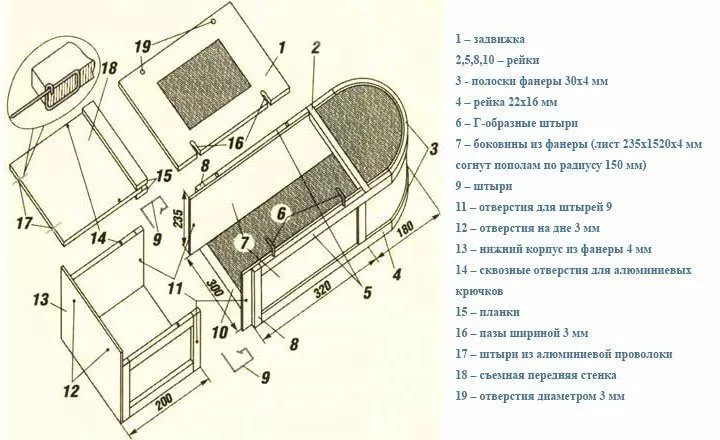
Options for making a swarm box for bees with your own hands
Building a swarm box yourself is easy. The materials for such a structure are readily available, and there are several design options.
Made of plywood
Plywood is a common, inexpensive, and readily available material for making a swarm box. In addition, you'll need to gather a few other materials and tools:
- slats;
- fine-mesh metal mesh;
- mosquito net (can be replaced with strong fine tulle);
- screws;
- screwdriver (you can use a drill);
- small nails (preferably shoe nails) and a hammer;
- Bulgarian.
Using plywood for the swarm box allows for the construction of any size. The following parameters are optimal:
- side walls (2 parts) – 0.3x0.45 m;
- front wall – 0.35x0.2 m;
- bottom – 0.35x0.45 m;
- cover – 0.2x0.45 m.
The production of a swarm box is carried out according to the following algorithm:
- Cut out the pieces of the required size from plywood.
- Strengthen the bottom and cover of the structure with slats.
- Attach the side walls of the swarm box to the slats. Use screws.
- Make a flight hole.
The mesh can be secured in a variety of ways. One option is to use two frames on the front wall, one of which will open. Another option is to cover a pre-drilled hole in the lid with mesh. Use small nails to secure the mesh.
Glue or liquid nails can also be used to secure the swarm box components. In this case, ventilation of the swarm box is especially important.
The finished structure should be equipped with a strap for easy carrying. The strap, as well as its fastening, should be of high quality, otherwise the swarm box could fall at a crucial moment.
To learn how to make a swarm box for bees from plywood, watch the following video:
Made of polystyrene foam
The advantages of using expanded polystyrene include its eco-friendliness, air and moisture impermeability. This material is lighter than plywood and has no risk of mold formation. It is also impervious to birds and rodents.
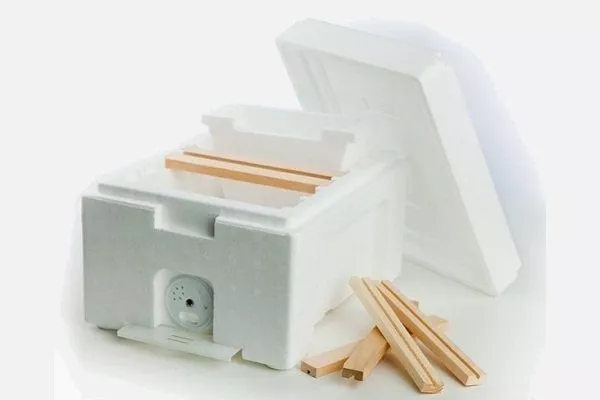
Expanded polystyrene has few drawbacks. One is the potential for excess condensation to accumulate within the structure. This problem can be solved by drilling additional holes. Another drawback is the risk of damage, which can be mechanical or due to sunlight.
To make a swarming box from polystyrene foam, you need to prepare the following materials and tools:
- sheet polystyrene foam, optimal thickness – 30 mm;
- self-tapping screws;
- screwdriver;
- glue and liquid nails;
- pencil with a ruler.
The algorithm for making a polystyrene foam swarm box is as follows:
- Cut the necessary parts from polystyrene foam. These are two side panels measuring 0.51 x 0.35 m, a bottom measuring 0.51 x 0.36 m, a lid of the same dimensions, a front panel measuring 0.3 x 0.35 m, and a back panel of similar dimensions.
- Fasten the main parts of the swarm box, except for the lid.
- Make a recess around the perimeter of the lid opening. Make it half a centimeter deep and 3 cm wide.
- Secure the cover with screws.
- Make a small square entrance. Provide a mount for the mesh covering it.
- Make a carrying attachment. If using a strap, it should also be placed along the bottom of the structure, as the material is fragile.
Butlerov's Roevnya
This type of construction is quite popular in beekeeping. A swarm box is constructed using the following materials and tools:
- thin sheet plywood;
- jigsaw (you can use a hacksaw or circular saw);
- construction stapler (staple gun);
- bolts or other fasteners;
- canvas;
- wire mesh;
- handle (can be replaced with a hook or loop).
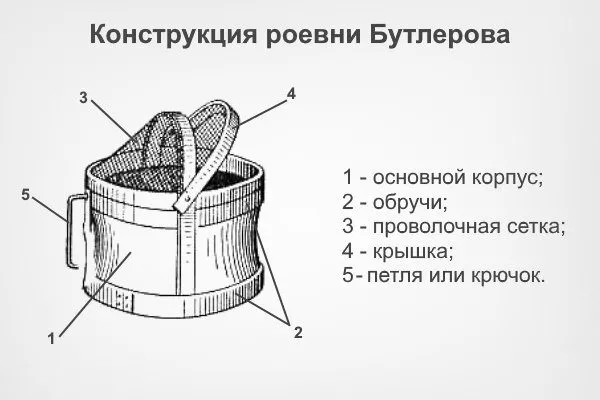
The algorithm of actions is as follows:
- Soak the plywood in water. 24 hours is enough.
- Cut out the swarm box body. It's a meter-long strip of plywood, 0.4-0.45 m wide.
- Cut two hoops from plywood. These are meter-long strips, 3 cm wide.
- Secure the bottom hoop with a stapler, leaving 5 cm (more is possible) from the edge of the body sheet.
- Secure the top hoop with a stapler, overlapping it with the edge of the body sheet.
- Cut another narrow strip of plywood. Staple it perpendicular to the frame's hoops. This strip will serve as the handle.
- Cover the bottom of the swarm box with canvas. Secure it with a stapler.
- Cut a strip of plywood for the structure's lid. Secure it with a bolt (or pin) to ensure the piece can move freely.
- Cover the fixed segment of the lid with wire mesh.
- Lower the movable element down and tighten it.
- Attach a carrying handle to the side of the case; the movable lid should be on the opposite side.
All parts must be connected tightly and without gaps. It is recommended to draw a preliminary design drawing.
Painting the swarm box
The completed structure must be painted. Oil-based paints should be used for this. This coating will protect the swarm box from moisture and the damaging effects of sunlight.
Painting the swarm box also provides camouflage. For this purpose, choose green or brown.
Quick-drying paints are not recommended. Quick drying is achieved by using special additives, the odor of which lingers for a long time. Another disadvantage of this type of coating is the rapid formation of cracks.
The swarm box should only be painted on the outside. Such a coating on the inside will prevent air and moisture from penetrating, and even slight temperature fluctuations will cause condensation to accumulate.
After painting, it's not recommended to use the swarm box for several months. The optimal time is six months. By this time, the paint smell will completely dissipate.
Filling the swarm box
Before using the swarm box for its intended purpose, a few more preparations are necessary. Dry wood emits an unpleasant odor to bees, so during rain, the open structure should be placed outside.
The inside of the swarm box should be rubbed with plants that attract insects. These can include blackcurrant leaves or lemon balm. The following treatment is also effective:
- broken queen cells or wax - treat the heated walls of the swarm box;
- alcohol solution of propolis - apply to the edges of the walls;
- pine resin (dissolved in ether) – treatment of wooden frame elements;
- wax or honey - rub the entrance along with the edge.
- Perform a leak test by placing a light source inside in the dark to detect any cracks.
- Leave the swarm box outdoors for 48 hours to allow any foreign odors to dissipate.
- Check the fastenings and handles for strength before hanging them on the tree.
It is essential to place standard material inside the swarm box:
- waxed frames for building honeycombs;
- frame with food: honey, bee bread, dried fruit;
- empty frames.
Installing a swarm box
A properly constructed and prepared swarming box must be set up correctly. Beforehand, observe the swarm you plan to capture. If the bees regularly gather in a specific location, the trap should be placed there. Otherwise, choose an area with nearby honey plants.
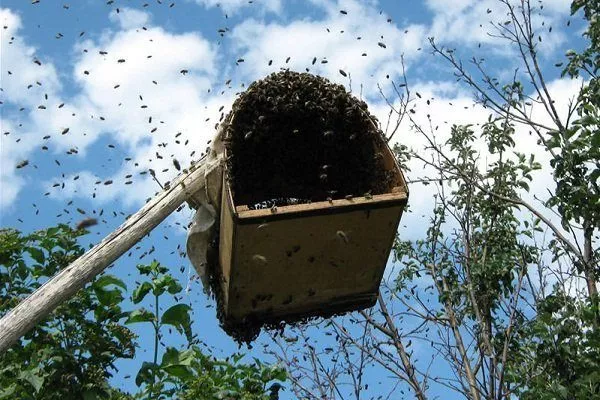
The installation of a swarm box is carried out according to certain rules:
- the presence of a river or other body of water nearby;
- distance from apiaries is at least 1-1.5 km;
- hang the swarm box on a strong branch - the height should not exceed 7 m, preferably 2.5-4 m;
- To lift the trap up the tree, use a rope, throwing it over the desired branch;
- fasten the structure so that it is securely positioned, but can be quickly removed if necessary;
- Deciduous trees are also suitable for installing swarming boxes, but it is better to choose spruce or pine;
- place the structure in the shade;
- the entrance should face south;
- access to the swarm box must be free, not cluttered with branches;
- provide bait in the trap;
- there should not be a power line nearby;
- You can't set a trap on the road, but you can set one near it.
A swarm box is an essential apiary tool. You can make one yourself in various variations—in any case, the technology is simple, and the materials are inexpensive and readily available. Once completed, the swarm box must be painted and properly filled. Proper installation of the trap is crucial.