
Beekeepers and receivers always test honey for moisture content to determine its quality. This is done using a refractometer, a specialized instrument that measures the moisture content of any sugar-containing food product, regardless of environmental conditions. Read more about this instrument and how it works below.
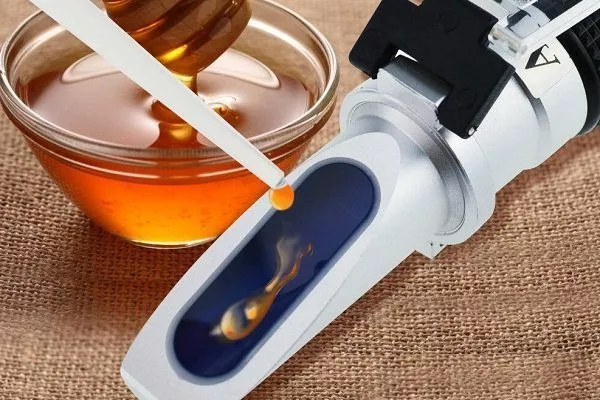
What kind of device is this?
A refractometer is an optical instrument, with or without a power source, that measures the concentration of dissolved particles in a liquid medium using a light beam. In beekeeping, it is used to determine the moisture content of honey.
According to GOST requirements, this indicator should be maintained in the range of 18.5-21%, which is also considered the honey quality range. These figures are not determined randomly, but rather due to the following characteristics of beekeeping products:
- At humidity levels less than 18%, honey becomes excessively viscous.
- At humidity levels above 21%, yeast microorganisms present in honey become active, metabolizing sugar and affecting the product's sugar content. Furthermore, they trigger fermentation processes, rendering the product unfit for consumption.
To ensure that the water content of honey does not exceed 21%, when extracting honey from bee colonies, wipe the combs, which are sealed with wax caps up to two-thirds of their height. Additionally, monitor the water content using a refractor.
Different varieties of honey have different viscosities when assessed organoleptically, so it is not always possible to visually assess their water content.
The device structure
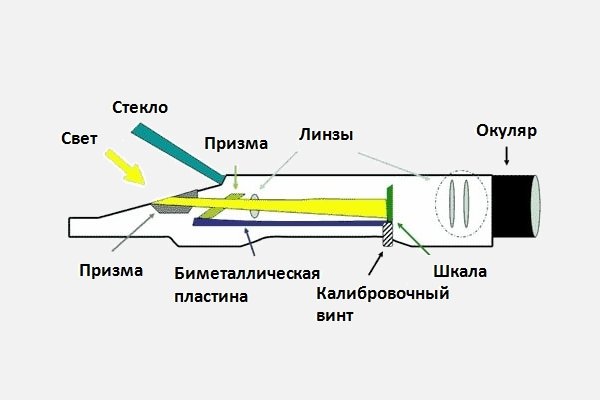
The main elements of a refractometer are:
- PrismThis is a key optical element in the form of a "stage" where the substance being studied is applied. It is made of a material with a high refractive index.
- Hinged protective glassThe glass's smooth surface is lowered onto the prism and compresses the layer being examined.
- Calibration screwLocated on the inclined cut, it is used for instrument calibration. A special miniature screwdriver is included for turning the screw until the dividing line is set to the desired mark.
- Optical lens systemIt is located inside the housing, specifically in the area of the oblique cut. The lenses are tinted blue and have an optically uniform structure. They refract light—either artificial (from a lamp) or natural (from the sun).
- Bimetallic plateThis is a "corrector" built into the housing and changes the optical characteristics of the refractometer depending on the temperature.
- ScaleA beam of light hits a scale—a graduated circle—through a system of optical lenses. The illuminated portion of the scale will be light, while the rest will be dark (not illuminated). Many refractometer models designed for honey analysis feature multiple scales:
- WATERA water scale with readings ranging from 12% to 27%. Helps determine the moisture content of the product being tested.
- BrixA scale ranging from 58 to 90% indicates the sugar content of honey. For example, a Brix reading of 80% means that 100 grams of honey contains 80 grams of sugar.
- Baume (Bome)A scale with arbitrary degrees Baumé (Be°), which measures the density of a liquid. For example, the density of pure distilled water at +15°C corresponds to 0Be°, and 15Be° corresponds to the density of a 15% solution of table salt.
- MonocularA special hole on the handle of the device through which the test results can be seen.
The structure of a hand-held refractometer is shown in the following diagram:
Operating principle
The refractometer operates using refractometry, a method that involves analyzing a substance based on the refractive index of sunlight striking it. This principle is implemented as follows:
- Honey is applied to the surface of the prism and covered with protective glass on top to create a uniform layer of a strictly defined thickness.
- When hitting honey, a beam of incident light passes from one medium to another, and at the boundary between them, it deviates from its straight-line direction by a certain angle, that is, it is refracted. The denser the medium, the more the beam's speed slows.
The magnitude of the angle of refraction of light depends on the composition of the solution and its density (concentration).
- Next, inside the housing, the light beam passes through a system of optical lenses, hits the device's scale, and moves up or down depending on the angle of its refraction. The scale itself resembles a mercury thermometer or a thermometer for measuring body temperature, with a column of liquid moving up or down.
- One part of the scale is illuminated, the other remains in darkness. The dividing line between light and shadow can be used to determine the optical density or refractive index of the compound being studied.
Types of the device
There are several types of refractometers:
- laboratory – a tabletop device of large size and weight;
- industrial (flow) – an automatic refractometer that is built into technological installations and operates in real time;
- portable – an optical instrument used by most beekeepers and honey sellers, as it is compact in size and takes all measurements with maximum accuracy.
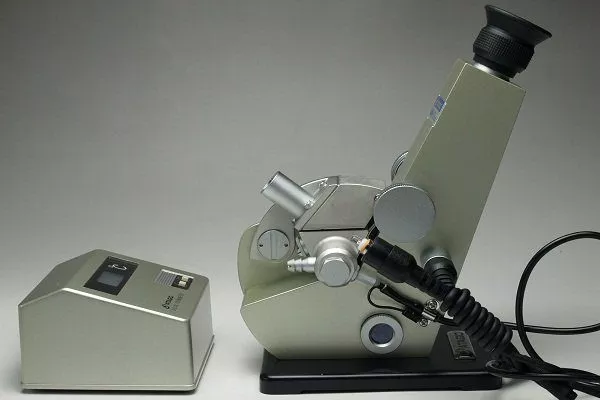
If large-scale solution analysis is planned for industrial facilities, industrial refractometers are the best choice. For individuals and small businesses, portable instruments are the best choice.
Portable models can also be of two types:
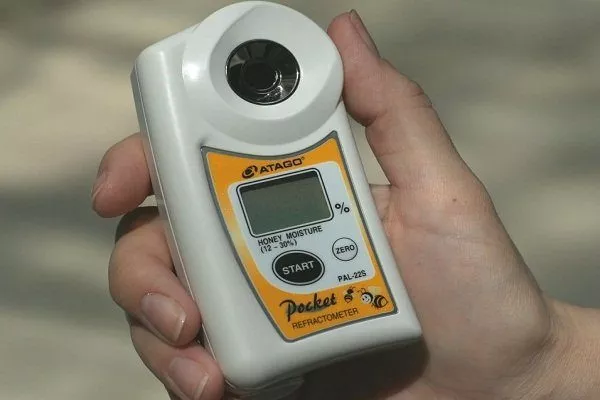
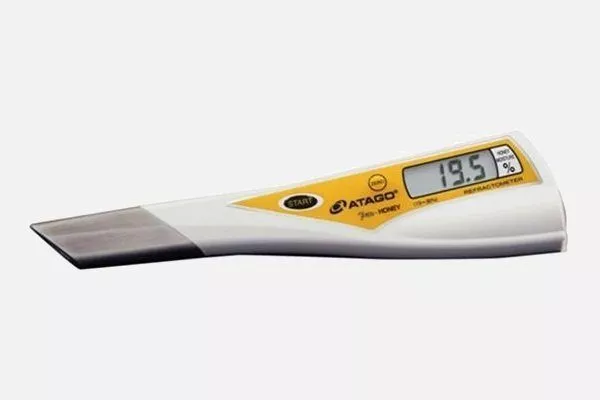
- digital – have a liquid crystal display that displays measurement data, are usually battery-powered, and can simultaneously determine various characteristics of honey;
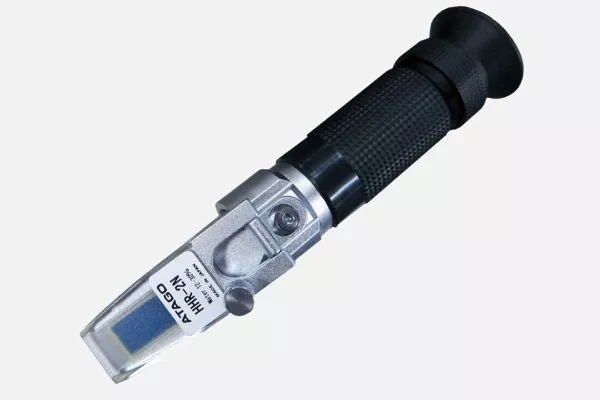
- manual – they do not contain electronic circuits or power elements, so they require natural or artificial light to operate.
Handheld refractometers are attractive due to their affordable price, compact size, and high analysis speed, but digital models, which can be used even at night, are more practical.
Features of a refractometer with ATC function
For a refractometer to accurately measure honey moisture levels, measurements must be taken at an ambient temperature of +20°C. Of course, in most cases, this is difficult for a beekeeper to achieve.
This was taught by refractometer manufacturers, who equipped their models with automatic temperature compensation (ATC). It eliminates the impact of ambient temperature fluctuations on measurement accuracy. This is achieved by a bimetallic plate that expands or contracts with temperature changes, maintaining the correct operation of the instrument's optical system.
The magnitude of the plate shifts is calculated in such a way as to fully compensate for the effect of temperature on the refractive index.
How to choose a honey refractometer?
Portable refractometers are designed for testing various products, but their appearance is virtually identical. To determine whether a particular device is suitable for honey, two parameters should be considered:
- Chemical composition of the test solutionFor honey and other sugar-containing solutions, a refractometer is required to determine the sugar content and the solution's moisture content. Devices that measure protein and solids in milk samples are suitable for analyzing milk and dairy products. They are not suitable for honey testing.
- Brix scale valuesHoney is a highly saturated solution, so refractometers with the following Brix values are suitable for it: 45-82%, 58-92%, or 0-87%.
Review of popular models
Beekeepers often choose the following refractometer models:
- PAL-22SA digital pocket-sized device with an LCD screen that displays honey moisture readings. The moisture range is 12-30%. The refractometer features an ATC function (+10…+40°C) and operates on two AAA batteries.

- PEN-HONEYThe device is also battery-powered and measures honey moisture within the range of 13-30%. Unlike the previous model, the product to be analyzed does not need to be applied to the prism; simply touch the sample with the tip of the device. Readings can also be taken under a light source. The housing of this refractometer is reliably protected from water and dust ingress. The prism is also protected from dust and temporary immersion in water. The device is equipped with an ATC function, allowing for accurate sample analysis at ambient temperatures of +10 to +100°C. Calibration is performed with distilled water.
- HHR-2NA handheld device that measures product moisture from 12 to 30%. It requires no power source, as it contains no electronics. Calibration is performed using a special liquid included in the kit.
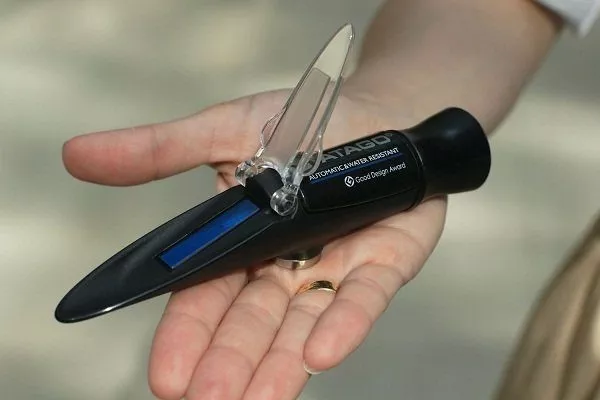
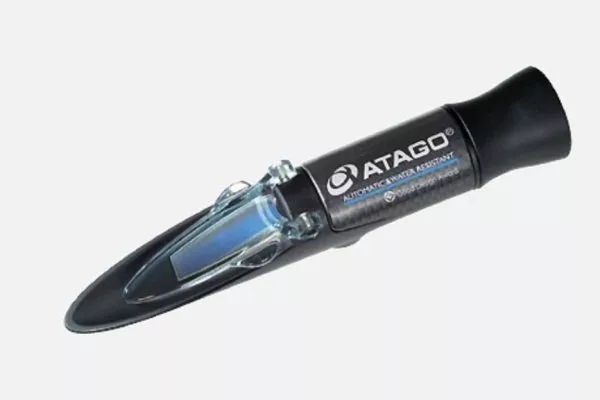
- Master-HONEYA pocket-sized device that allows you to analyze honey anywhere. It features an ATC function and determines moisture content in the range of 13-30%. What makes this refractometer different from other devices is that the sample being analyzed can be either liquid or solid (crystallized). The housing, except for the eyepiece, is protected from jets of water and dust. The device operates at ambient temperatures of +10 to +40°C.
- Master Honey/BXA handheld optical refractometer with dual scales. The first scale determines honey moisture (12-30%), and the second (Brix) determines sugar content (58-90%). The instrument is calibrated with distilled water or a special liquid called "Sakharozka." It features an ATC function and operates at ambient temperatures of 10 to 40°C.
- RHB Portable RefractometersAll devices in this line can measure moisture content on the Water scale (12-27%), sugar content on the Brix scale (58-90% for the RHB-90 and RHB-90 ATC models, 58-92% for the RHB-92 ATC), and density on the Baumé scale (38-43Be°). The RHB-90 model does not have an ATC function, so it is better to choose the RHB-90 ATC and RHB-92 ATC devices. All RHB devices are compact, require no power source, and are sold pre-calibrated.
- Refractopolarimeter RePo-4This device combines a refractometer and polarimeter, allowing for a more in-depth analysis of honey. In addition to moisture (13-30%) and Brix (0-85%), it can also determine fructose content (0 to 99%). The latter allows for the detection of counterfeit honey and the identification of its type. The device features an ATC function and is dust- and water-resistant. It requires four AAA batteries. The required sample volume for testing is at least 3 ml.
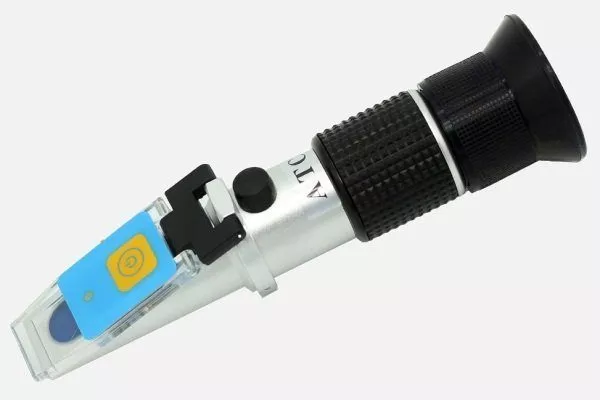
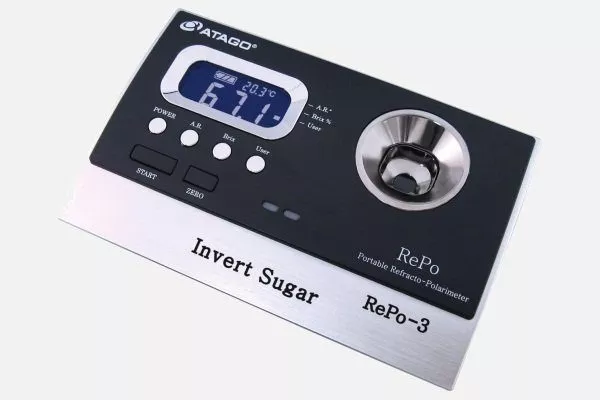
A review of the RHB 90 ATC refractometer is provided in the video below:
Calibration of a refractometer
To ensure the device displays results with minimal error, it must be calibrated. This will require distilled water or refractometer fluid, which is usually included with kits.
- ✓ Make sure the water temperature is +20°C before use.
- ✓ Check the expiration date of the water if it has been stored in an open container.
Calibration of the device is carried out in the following sequence:
- Lift the lid to expose it to daylight and use a pipette to apply 2-3 drops of distilled water to the main prism.
- Close the protective glass so that the water is evenly distributed over the entire surface of the prism. There should be no air bubbles or empty spaces.
- Wait about 15-30 seconds for the sample to adapt to the ambient temperature.
- Point the refractometer toward a natural light source and look through the monocular. You'll see a graduated scale in the center of the circle. If the graduations are difficult to see, adjust the monocular's focus.
- Wait until the top of the device becomes dark in color and the bottom becomes light.
- Adjust the calibration screw so that the boundary between the dark and light areas is set exactly at the zero mark or at 78.4%, depending on the device model.
- Wipe the prism surface with a soft, dry cloth and use the refractometer as intended.
An example of what the instrument scale looks like before and after calibration is shown below:
Operating instructions
All steps are performed in the same sequence as during calibration, but instead of distilled water, a few drops of honey are applied to the prism. The step-by-step instructions are as follows:
- Take a honey sample from the comb using a glass or plastic rod. If you need to measure the moisture content of already collected honey, take a sample from the jar. If the crystallized product has a heterogeneous consistency and contains solid particles, preheat it in a water bath (up to 40°C), cool to room temperature, mix thoroughly, and use as directed.
- Open the protective plate, use a pipette to apply 2-3 drops of the prepared honey to the prism surface and distribute it evenly, removing all bubbles and dry particles. Close the prism lid. If excess solution leaks outside the measuring area, wipe it away with a soft cloth. Preparing honey for measurement
- ✓ For crystallized honey, make sure it is completely dissolved and has cooled to room temperature.
- ✓ Check that the honey is free of solid particles before applying it to the prism.
The thinner the layer of evenly distributed honey, the more accurate the measurement results will be.
- Wait 30 seconds for the sample and the instrument to equalize in temperature. Do not touch the calibration screw during this time—it should remain in the original position set during instrument calibration.
- Point the refractometer towards the light source – natural daylight or an incandescent lamp.
- Look through the monocular to see the measurement results. The humidity reading will be visible on the white-blue scale. The monocular's focus can be adjusted to improve the clarity of the graduations.
The accuracy of measurements depends on the calibration of the instrument, as well as on the same temperature of the prism and the sample being tested.
The following video clearly demonstrates how to test honey moisture with a refractometer:
How to store a refractometer?
To ensure the device lasts as long as possible, keep the following recommendations in mind when using it:
- Do not immerse the refractometer in water or use it in damp or humid conditions. If water gets inside the housing, the image will become blurred. To correct this, seek the assistance of a qualified technician.
- After each use, wipe the refractometer with a soft, damp cloth. Failure to do so will result in inaccurate measurements and damage to the prism surface.
- When cleaning the device, do not use abrasive or chemical agents, as they may damage the surface of the main prism.
- Never disassemble the refractometer to avoid losing its settings or causing it to fall or be impacted.
- The optical instrument must be stored carefully, avoiding any mechanical damage, as any scratch on the prism surface will lead to distortion of measurements.
To begin honey extraction promptly, beekeepers can regularly test its moisture content with a handheld refractometer. Consumers, however, will need this device to determine the quality of honey before purchasing it. Analyzing the honey requires minimal raw materials, which is an additional advantage of this device.