
A radial honey extractor has a number of design features. This type of honey extraction equipment has several advantages. It must be used correctly, following the instructions. The unit can be homemade from a variety of materials.
Design Features
The design of the honey extractor includes the following elements:
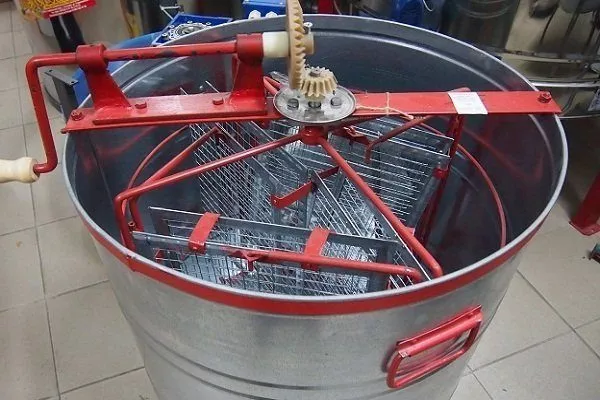
- A honey extractor of any type consists of a tank-like body, inside of which is located drum rotating cassettesOpen honeycombs are placed in them.
- The rotation of the drum in the unit provides centrifugal force, which scatters the honey along the inner walls of the tank body. A drain hole, through which the product flows into a special container. The drain is usually equipped with a tap.
- The design feature of the radial unit is the location frames in the drum. Each of them is part of the radius of the tank body and extends like a beam from its center, which is represented by a rotating mechanism. The number of frames that can fit into the unit is limited only by its dimensions.
- Bottom of the tank body It is curved and cone-shaped. The outer surface is often fitted with hoops, which make the structure more secure.
- Inside the tank body there is installed vertical axis, which secures the metal cage. It is movable and equipped with an upper and lower crosspiece. The first supports the upper stop ring with protrusions that secure the frames. The lower crosspiece holds three rings: the lower stop ring (smooth and outermost) and two with cutouts for the frame sides.
- The top of the vertical axis is a steel rod with a bevel gear at the end. Its rotation is provided by ball bearingIt is located in a special plate, which is fixed to the crossbar of the tank body.
- Also provided horizontal axis with handle, on which a vertical gear is mounted, ensuring the movement of the drive.
- The radial honey extractor can be equipped with manual or electric driveThe first option is attractive due to its lower cost, but requires more time and effort.
Advantages
The radial honey extractor has certain advantages:
- the body can accommodate an impressive number of frames – up to 48 pieces;
- strength and reliability of the design – all parts, except the rotating drum, are firmly fixed;
- centrifugal force acts on the bar, so the risk of honeycomb rupture is minimal;
- the honeycombs are almost completely dried out from honey, losses are minimized;
- high productivity – almost twice as high as that of a chordial unit;
- The radial design does not require turning the frames over to the other side;
- there is no need to monitor the operation of the unit after it has been started – if the structure is equipped with an electric drive, then human presence during honey pumping is not required;
- After finishing work, it is easier to remove the honeycombs from the housing-tank, since they do not stick to the drum.
Radial honey extractors are quite large and take longer to extract honey than chordial units, but this is offset by their large capacity and high drying efficiency. Beekeepers spend less time because they can load many frames at once.
Operating instructions
When using a factory-manufactured unit, be sure to read the operating instructions before first use and follow them each time. The specifics of using the equipment depend on its design.
The general operating provisions are as follows:
- Before each use, rinse the parts with hot water. You can use a high-pressure washer or detergents designed for food-grade components.
- The electrically powered unit must have a residual-current circuit breaker (RCCB) that controls the rated starting current. Its proper functioning must be checked regularly.
- The equipment may only be installed on a dry floor (soil). The surface must be relatively level.
- If the non-disconnectable power supply or connecting cable is damaged, repairs and replacement must be performed by a technician, a warranty representative, or a specialized repair facility. Do not use the unit with a damaged cable.
- The power cord must be kept away from sharp, cutting surfaces (edges), heat sources, and open flames.
- Only connect the unit to the power supply with dry hands. Be sure to first ensure the controls are off (switch position "0"). Ensure that the rated voltage of the equipment matches the power source.
- Once the honey extractor lid is closed, it is prohibited to open it until the end of the cycle.
- While the unit is in operation, it is prohibited to move it or perform any maintenance work.
- The equipment engine and its controls must be protected from moisture during operation, cleaning and storage of the equipment.
- Persons with limited physical, mental and sensory abilities, or lack of necessary knowledge and experience are prohibited from operating the unit.
- If a malfunction or any hazard occurs during operation of the unit, the emergency stop switch must be engaged. The equipment may only be restarted once the problem has been resolved.
- Equipment must not be stored at sub-zero temperatures. It can be turned on at temperatures above 5 degrees Celsius. If the unit was moved to or from a room with a different temperature before use, it must be left for a period of time to reach ambient temperature.
- The honey extractor should be stored clean and in a well-lit area.
- The unit must be cleaned and dried after each use (several cycles without cleaning are allowed during one honey collection).
When cleaning the product, do not allow electrical components to become wet. Also, do not allow the bearing to come into contact with water.
The operating cycle of the unit and preparation for it are carried out according to the following algorithm:
- Install a honey extractor.
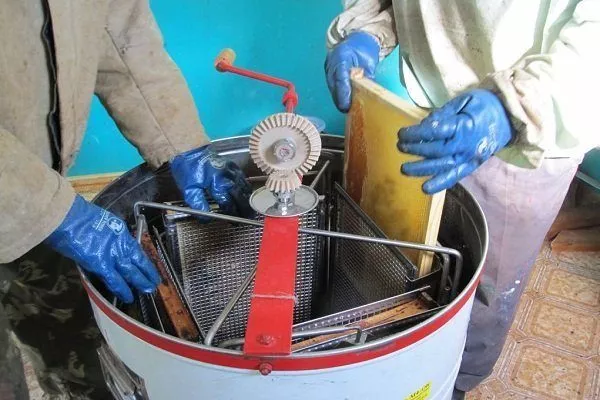
- Install the frames - they must be positioned correctly and fit into the cassette.
- Close the lid.
- Start the equipment.
- Increase the rotation speed gradually. Don't start at high speed right away.
- At the end of the operating cycle, disconnect the equipment from the power supply.
- Remove the unit cover.
- Remove the frames.
- If honey extraction is no longer planned, clean the equipment, dry it, and store it.
DIY radial honey extractor
You can build a radial honey extractor yourself. This option is especially attractive for small apiaries, where purchasing ready-made equipment takes a long time to pay for itself or may be completely unprofitable.
- ✓ The thickness of stainless steel sheets must be at least 1.5 mm to ensure the durability of the structure.
- ✓ The diameter of the drain hole must match the diameter of the tap to prevent honey leakage.
The production of the unit involves the following stages:
- The tank body is best made of stainless steel. You can use a ready-made container of a suitable size or fabricate the body from sheet metal. If you don't have a welding machine, you can use rivets or cold welding. The recommended body diameter is 88 cm and height 69 cm.
- The bottom of the container should be concave. If you're using a pre-made container as a base, its bottom should be cut off and replaced with a homemade one.
- The main part of the interior structure is the cage, supported by two crosspieces. Three circles should be attached to the lower crosspiece: the upper one with a diameter of 77 cm and a space of 6.1 cm inside. The lower and upper circles should be fitted with metal protrusions for the frames.
- A steel rod must be screwed into the cage axle. A metal cup with a steel ball must be installed in the center of the crosspiece; this serves as a support for the rod.
- Make a drain hole in the bottom of the housing and install a faucet. It's best to use stainless steel components for the honey extractor assembly.
- The equipment doesn't require a very powerful motor. A power rating of up to 80-90 watts is sufficient. Be sure to install a protective mesh to prevent insects from getting through. To regulate the speed, install a rheostat. A relay from a washing machine can be used.
- Check all welds for leaks before installing internal components.
- Install the cage and crosspieces before mounting the axle and rod to ensure proper alignment.
- Check the ease of rotation of the drum manually before connecting the motor.
For processing small volumes of honey, you can build a mini honey extractor. A washing machine drum is a good base for it.
To learn how to make a honey extractor yourself, watch the following video:
A radial honey extractor has several design features and advantages over chordial equipment. A radial unit is considered more modern. You can buy a honey extractor or build one yourself—all the materials are readily available, and the cost is several times lower.