
Many beekeepers transport their apiaries to increase honey production or to obtain specific types of honey. Mobile beekeeping can double nectar yields. Let's learn how to transport hives to the honey flow site and how to set up an apiary in a new location.
Why export bees?
Mobile beekeeping is a complex and expensive undertaking, undertaken only by experienced beekeepers. Transporting hives requires time, money, and effort. A single hive without honey weighs 18-20 kg.
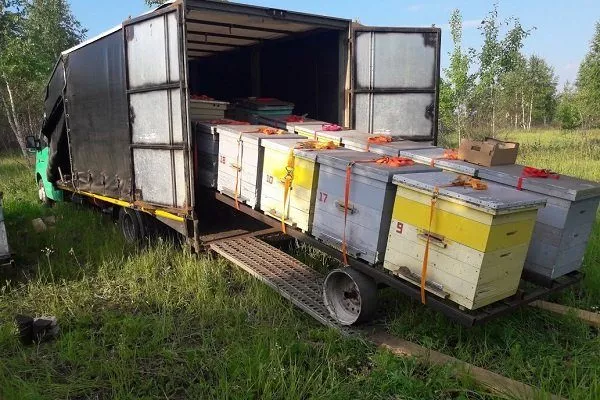
Despite the difficulties, many beekeepers practice transporting their apiaries. Reasons for mobile beekeeping:
- the possibility of installing hives in an ecologically clean area in order to obtain high-quality honey;
- placing the apiary near certain plants to collect a specific type of honey – buckwheat, alfalfa, etc.;
- search for places not occupied by competitors and a better food source for bees.
Some bee species are unable to fly long distances for honey. Typically, their flight radius is 2-5 km. By transporting apiaries to fields and plantings with blooming honey plants, honey is within walking distance.
Some beekeepers initially set up mobile apiaries, counting on a rapid honey flow in fields, meadows, and plantings. Others begin transporting their hives out of necessity, due to a shortage of food supplies.
Pros and cons of transporting an apiary
Transporting hives is challenging, given their weight and the risks to the bees during transit. However, migratory apiaries have many advantages.
Pros:
- Thanks to transportation, it is possible to obtain a certain volume of honey much faster than in a stationary apiary;
- honey collection starts earlier than the standard time and continues throughout the season – from early spring to late autumn;
- the ability to control the schedule and volumes of honey collection.
Cons:
- difficulties of transportation and costs associated with it;
- beekeepers have to live in the field, enjoying a minimum of amenities;
- the need to constantly monitor the apiary;
- obtaining a special permit for transporting hives;
- the risk of death of bees due to unfavourable conditions – increased temperature and humidity in the hive.
Mobile apiaries require serious physical effort from the beekeeper, sacrificing comfort and good health.
When to transport bees?
The time chosen for transporting the bees is when it is possible to fly over nearby areas—meadows, fields, and forests. The transport takes place during the period of swarm activity.
It is recommended to transport hives in early spring and fall. Beekeepers most often transport hives early in the spring, when the first flights begin.
Advantages of spring transportation:
- there are few bees and brood in the hives;
- no heavy frames with honey;
- there are no new honeycombs built by bees.
Transporting bees in winter is not recommended, unless absolutely necessary. The most dangerous period for transporting bees is late winter, when a critical amount of fecal matter accumulates in the hives.
Transportation features:
- carts or trailers are used for transportation;
- maximum transportation time – 48 hours;
- It is forbidden to transport bees in extreme heat - they experience discomfort and may die;
- In summer, hives are transported in cloudy or rainy weather, or at worst at night.
Preparing for transporting hives
Transporting an apiary is a responsible task that requires special preparation. First, select a location, then prepare the transport, hives, and equipment. If you don't prepare well for the journey, you risk losing your bees and damaging their hives.
Features of the new location
The most important factor when choosing a location for an apiary is the type and quantity of honey plants within easy reach of the bees. The more flowering herbs, trees, and crops in the area, the greater the volume of honey collected.
Requirements for the apiary location:
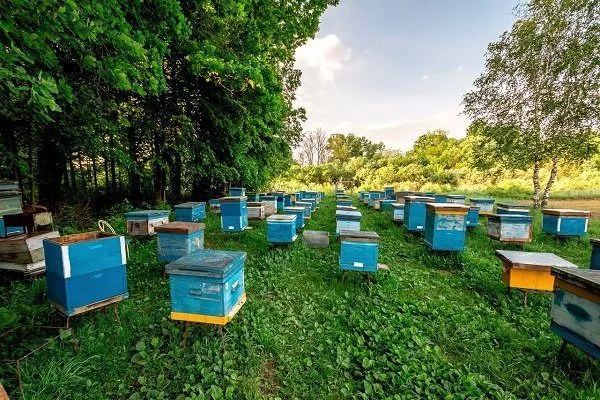
- The presence of a large and level area that can easily accommodate a specific number of hives.
- No drafts, rain, wind or direct sunlight.
- A body of water with clean water nearby.
- High honey production potential. The more honey plants, the less frequently you'll need to move the apiary. It's best to rotate the honey plants.
- The optimal terrain is hilly. Plains and plateaus are less suitable.
- No quarantine restrictions.
- Distance from roads, enterprises, residential areas, other apiaries.
- The minimum distance to the old site is 3-4 km. Otherwise, the bees may return to familiar places.
- ✓ Availability of natural or artificial windbreaks to reduce wind speed below 3 m/s.
- ✓ The distance to the nearest source of chemical pollution (fields treated with pesticides) must be at least 5 km.
Transport requirements
The choice of transport for transporting an apiary depends on the number of hives, the frequency of transport, the availability of a driver's license (category), and other factors.
Transport requirements:
- To operate a mobile apiary profitably, heavy-duty transport is essential. To transport hives weighing over 0.75 tons, the driver will need a Category E driver's license.
- If a beekeeper has a category C license but wants to transport the hives on his own, he must re-equip the vehicle accordingly.
- You can transport an apiary using a tractor and trailer, but you'll need a special permit. Categories B and C won't help, as the trailer alone weighs more than 0.3 tons.
- If the beekeeper has neither transport nor a driver's license, the problem is solved by hiring a carrier.
Decommissioned equipment, such as an old bus or other type of transport that can accommodate a dozen hives at a time, is often used to transport the apiary.
Inventory
A variety of equipment is required for operating and transporting mobile apiaries. For transportation:
- nomadic network – it is necessary for ventilation of the hives and preventing the bees from becoming sealed;
- bars – to connect hives;
- staples – to secure bee houses;
- mesh sling – to provide external fastening (it can also be used to build a canopy for a beekeeper’s booth).
Beekeepers live on the move in special structures called migratory hives.
To set up and maintain an apiary, you will need the following equipment and tools:
- main and spare smoker;
- spray;
- carpentry tools;
- empty hives;
- swarms;
- scales in a casing;
- flashlight.
How to prepare hives for transportation?
If transporting bees is done in the spring, before the heat sets in, no special conditions are required. Simply secure the frames in the hives to prevent them from shifting during transport.
If hives are transported in the summer, some frames may be filled with honey. To prevent them from falling onto the brood during transport, they are removed and placed around the trailer's perimeter. Special dividers ensure they remain stationary.
When the honey collection is complete, the bees are transported along with the honey contained in the combs.
How to prepare bee houses for long-distance transportation:
- If you are planning a long journey – more than one night – cover the hives with a tarp to protect them from sunlight and overheating.
- Improve nest ventilation to prevent overheating inside the hives. It's recommended to increase the hive's volume or replace the wooden "ceilings" with lattice frames.
- To prevent injury or death, ensure the hive is free of objects that could fall on the bees. Check the combs, seals, and other components of the hive to ensure each element is securely fastened.
- Remove all hive parts (combs, frames) that could fall off due to vibration. Secure all non-removable parts. Nothing should slip out of their grooves, slide, or come into contact with other surfaces.
- Before loading the hives, herd the bees inside. If they resist, use a smoker. After smoking, the bees become irritated and agitated, requiring airing out their hives, which is not recommended before transport. Water can be used instead of smoke.
- If large hives are transported in the spring, wax foundation is added to the bee nests. As temperatures rise, space is cleared at the top—approximately 10 cubic meters.
Loading rules
Hives must not only be prepared for transport but also loaded properly. Loading poses risks both to the hives and to the people handling them.
Loading features and recommendations for its implementation:
- It's recommended to load the hives with the car engine running. This allows the bees to get used to the hum and vibrations before moving.
- Hives are arranged as compactly as possible. For example, a 1.5-ton truck can accommodate 12 hives on a single tier. This can be doubled by installing a second tier, which is placed on sturdy boards.
- To prevent severe shaking when driving on uneven roads, line the bed of the car or trailer with a layer of straw, and tie the hives with rope. If the journey is long, check the tightness of the knots periodically.
- If you're driving on a good asphalt road or a smooth dirt road, place the hives with their backs or fronts facing the direction of travel. When the vehicle accelerates or brakes, the force of inertia exerts pressure along the surface of the combs, not on them. This prevents them from breaking.
- If the vehicle is going to travel on a country or forest road, where the speed is extremely slow, the hives are placed in the vehicle or trailer so that the plane of the honeycombs is across the road.
This arrangement makes them more stable when exposed to forces that arise from sudden vibrations in the transverse direction – when driving over potholes and bumps.
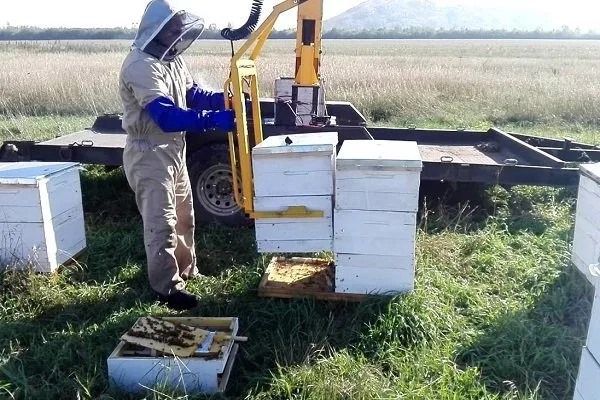
How to transport beehives?
When transporting their apiaries, beekeepers strive to ensure maximum comfort for the bees. Particular attention is paid to maintaining the temperature and humidity in the hives.
Air access
During transportation, it's important to ensure a favorable atmosphere inside the hives. Beekeepers' job is to prevent the air from overheating and becoming too humid.
How to ensure air exchange:
- To increase air flow into the hives, mesh is attached to the cuffs in the frames.
- To improve air flow, small holes are made in the lid and covered with mesh.
- They leave small gaps through which insects cannot squeeze. In this case, there is a risk that bees clinging to the gaps will block the air supply to the hives.
If bee hives are transported during the summer heat, they are spaced so that 15 cm gaps are left between adjacent rows. This improves air circulation. To ensure this distance, spacers made of beams of appropriate width are placed between the hives.
Safety of people during transportation
To ensure that the transported hives and people involved in loading and transporting them do not suffer any damage during transportation, a number of special measures are taken:
- All bee colonies are closed so that the insects cannot escape. The bees, irritated by the loading and the roar of the engine, will inevitably attack people once they escape.
A particularly dangerous situation occurs when insects enter the driver's cabin. A bite can cause the driver to lose control of the vehicle and the road for a split second, increasing the risk of a traffic accident. - To prevent bee attacks, beekeepers carry smokers, which they keep ready. People involved in transporting bees wear protective clothing and masks to prevent insect bites.
- An antihistamine (anti-allergy medication) is added to the car's first aid kit. Bee stings can cause a severe allergic reaction, and the above-mentioned medications can help prevent it.
Speed of movement
A driver transporting bees selects a speed based on the quality of the road surface and the characteristics of the cargo being transported. If the road surface is good, the vehicle travels at the same speed as when transporting regular cargo.
When driving on roads with problematic surfaces, as well as on forest and country roads, speed must be reduced to prevent the valuable cargo from shifting.
Despite the measures taken (fixation), strong shaking can lead to loosening of structures, falling off of individual elements, which often results in the death of bees.
Recommended driving mode:
- the optimal speed on a road with good asphalt surface is 50-70 km/h;
- speed on roads with problematic surfaces or without them – 15-30 km/h.
In areas where travel is difficult, reduce speed to 5-10 km/h. It is not recommended to stop while transporting hives with bees. If you must stop, do so in a quiet and shaded area.
Other conditions for mobile beekeeping
When engaging in migratory beekeeping, one must adhere to certain rules and take into account a huge number of nuances:
- To simplify loading and unloading of hives, it is recommended to make them from lightweight materials;
- hives must have flat and even roofs to allow for their installation in several tiers;
- For successful transportation of bee colonies, it is important to comply with all sanitary standards applicable to these insects.
Typical mistakes beekeepers make
Transporting bees, like setting up an apiary in a new location, is a risky and costly undertaking. Beginners often make mistakes that lead to losses.
Wrong actions:
- Placing hives on the coast of a reservoir. It's especially dangerous when honey plants are located on the opposite bank. Bees flying across the water can fall into the water and drown if the wind picks up.
- Installing an apiary in a lowland. The climate here is unfavorable for bees – there is often fog and cold.
- Location near other people's hives. There is a risk that the bees will fly away to a neighboring apiary.
- Placing an apiary near agricultural fields. If hives are transported to agricultural land, work with farmers to ensure timely warnings about pesticide use. Thousands of bee colonies die from pesticide poisoning every year.

How to install hives in a new location?
Upon arrival at the new apiary site, after unloading and setting up the hive houses on the ground, the hives are not opened immediately. They wait until the honey plants, excited by the transport, have calmed down before opening the hive entrances. Adaptation to the new location takes about 12 hours.
Features of installing hives in a new location:
- After arriving at the honey-producing area and unloading the hives, they begin to arrange them. The bee houses are positioned so that they are not exposed to direct sunlight.
- A good location for hives is in the shade of trees and shrubs. Beekeepers typically place their hives in plantings separating fields of alfalfa, sunflowers, and other honey plants.
- If there is no suitable vegetation nearby to provide shade, bee houses are covered with branches and canopies are built.
- Once the bees have adapted to the new location and calmed down a bit, beekeepers begin to gradually open the hive entrances at intervals of several hours. Typically, they open the entrances of 50% of the hives at once—every other hive. They don't open all of them at once, as the insects first need to get their bearings.
- Gradually opening the hive entrances allows the bees to become accustomed to the area. They make a preliminary flight and gradually calm down and settle in. This approach also helps prevent colonies from mixing.
- Once the bees have adapted and are no longer nervous, beekeepers begin installing frames.
- If the hives are brought to a new location at night, the entrances to all the hives are opened simultaneously.
- If the bees are irritated and do not calm down after transportation, wait with unpacking the hives and installing the frames - this procedure is carried out the next day after arrival.
- During the first 3-5 days in a new location, bees exhibit unusually aggressive behavior. While flying around the territory, they continue to be aggressive. During this period, the insects are capable of attacking anyone they encounter. They attack people and bees from other apiaries.
- To calm the insects, the entrances are opened with a smoker at the ready. The smoke helps to pacify the bees' aggression. Typically, 3-4 puffs of smoke are enough to calm them down. After this treatment, the bees become calmer and are less likely to attack passersby.
- The hives are converted from their travel position to their normal position as soon as possible. Ideally, this should be done on the evening of the day of arrival. Sometimes, supers with dry combs are installed immediately. Beekeepers then carry out all necessary beekeeping procedures.
- On the day of arrival, landing boards and waterers are installed. If water is delayed, the insects will go in search of it themselves. They will find water, but it may be of poor quality.
Once bees have discovered a drinking source outside the apiary, it will be difficult to train them to use waterers. - When installing hives in a new location, be sure to consider the presence of other apiaries. Avoid placing bee houses in the flight path of neighboring bees.
When the honey flow is good – over 2 kg per day – the bees hardly use waterers, since the water contained in the nectar is enough for them to prepare larval food.
Bees' reaction to relocation
Bees are easily irritated by any interference in their lives. Engine noise and the movement of houses from their nesting sites greatly upset honeybees. When a car starts moving, vibrations and confined spaces further irritate the bees.
Nervous bees experience accelerated metabolic processes, and their oxygen requirements increase exponentially. This is precisely why the insects are so determined to escape. They seek out the smallest cracks to squeeze through.
Due to the insects' agitated state, the temperature inside the hive rises, honey is consumed more than usual, and humidity rapidly increases. Under these conditions, the combs can break off, crushing not only the bees but also the queen.
What should I do if the hive is damaged during transportation?
Despite all safety precautions, hives are often damaged during transportation. If loading or transporting instructions are not followed, damage is inevitable. Beekeepers handling hives must have the necessary materials, tools, and equipment to quickly repair any damage.
Oakum and clay are commonly used to repair cracks. Bring a pre-prepared clay solution with you. This will come in handy if insects start squeezing into cracks—you can stuff them with oakum and then seal them with the clay mixture.
If you notice honey leaking from the hive during transport and insects flying out, the bee colony has been seriously damaged. What to do if honey is leaking from the hive:
- Open the top entrances and lift the lid. Let the bees fly out.
- When the insects have calmed down, dismantle the hives and remove the damaged honeycombs.
- Remove dead bees.
- Clean the bee house from honey drips and repair it.
- Replace damaged honeycombs with new ones.
- Provide the bees with food, prepare their nests, and close the hive lid. Do not block the entrance.
- Stop the vehicle immediately and assess the extent of the damage.
- Isolate the damaged hive from the others to prevent bee aggression.
- Use pre-prepared materials for temporary repairs (tow, clay).
When performing repairs, keep the smoker lit at all times. Wear protective clothing.
How to make a cart for transporting beehives?
If a beekeeper doesn't yet have a trailer or platform for transporting hives, they can build a small vehicle—a bee cart—for transporting bees over short distances. It can accommodate just one hive.
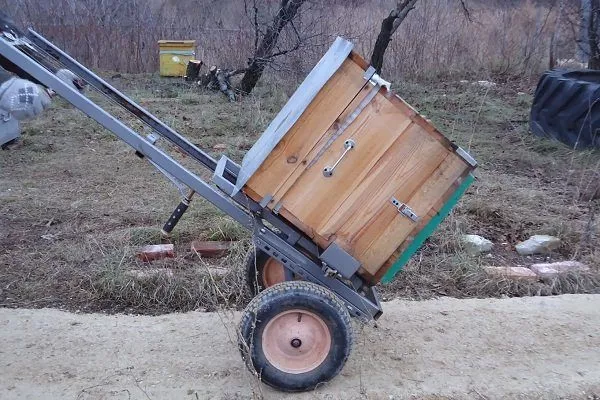
To make a cart, you need a metal frame and large-diameter wheels; transporting it with small wheels will be difficult and require significant effort.
How to make a cart for a small country apiary:
- Attach two handles to the frame.
- At the bottom of the frame, near the wheels, weld two metal pipes and a fork.
Before transporting, the cart is positioned close to the hive so that the fork fits under its bottom. The bee house is then placed on the structure, eliminating the need to lift and carry heavy hives. To transport multiple hives at once, reinforce the axle to increase the load-bearing area.
To avoid losses during transportation of apiariesStrictly adhere to transportation and safety regulations. When transporting bees to honey plants, it's important to consider all the nuances of delivery and the specifics of the new location. This will minimize the risks associated with operating a mobile apiary.