
A bee pavilion is a versatile structure that makes beekeepers' work and wintering bees easier. It also reduces the time spent on hive maintenance. Any beekeeper would benefit from such a structure, which is very easy to build. No special skills are required. Simply choose the type of pavilion, select the material, and draw up a precise drawing.
Types of pavilions
There are only three types of bee pavilions, each with its own characteristics.
| Name | Type of construction | Possibility of supplying communications | Convenience for wintering |
|---|---|---|---|
| Stationary | House on a foundation | Yes | High |
| Mobile | Wheeled design | No | Average |
| Cassette | Cabinets with drawers | Depends on the type | High |
Stationary
A permanent pavilion resembles a small house. It is built on a foundation, which can be either strip or columnar. Many beekeepers prefer this design because it allows for easy installation of lighting, plumbing, and even sewerage. It also provides heating in the winter. These factors are crucial when working with bees, as the conveniences of civilization speed up the process of cleaning up after insects and create a favorable atmosphere—the bees stay healthy and work better in the spring.
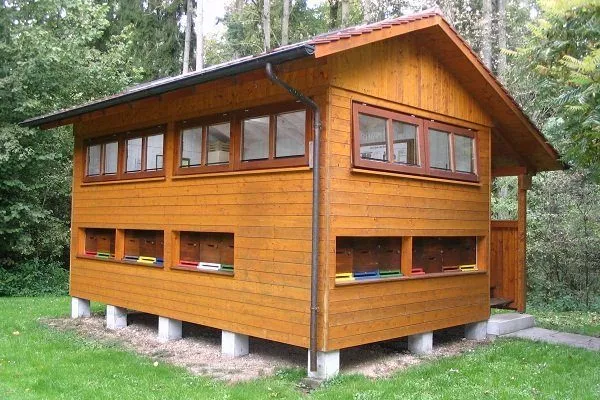
There are also pavilions without heating. But this doesn't mean the bees are uncomfortable and cold in them. There will be sufficient heat if the structure is positioned so that the long wall faces southwest or southeast.
Mobile
Mobile pavilions are the most common among beekeepers, as they have wheels instead of a foundation. This allows for easy movement around the property. The base is typically a trailer from a truck or any other piece of agricultural machinery.
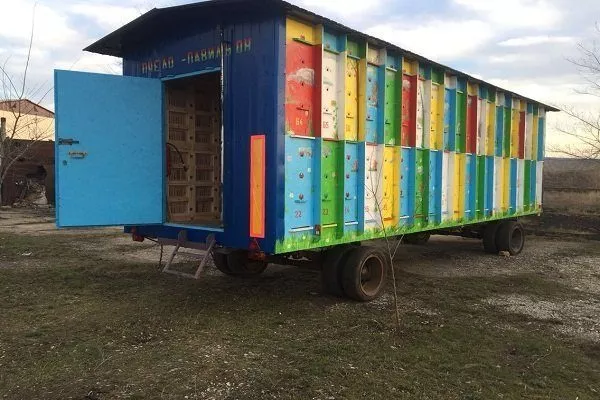
Sometimes a stationary pavilion is converted into a mobile one. The structure is lifted from its supports using a jack and placed on the base of a truck. It is then moved closer to the honey plants. Once the honey harvest season is over, the structure is returned to its original location and the bees are settled for the winter.
Mobile bee pavilions cannot be equipped with plumbing or sewer systems. However, lighting and heating are essential. Electricity is supplied via a cable from the main power grid.
Cassette
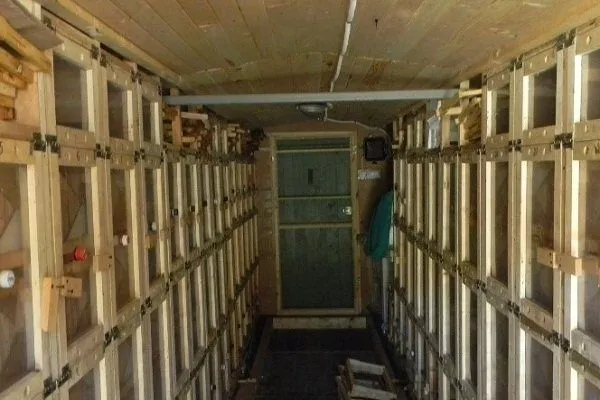
Beekeepers often refer to this type of bee housing as a "multi-apartment house" because it can accommodate up to 46 bee colonies. The hives resemble cabinets with drawers. This is extremely convenient, as each hive has its own space. The frame containing the bees can be easily removed, treated for pests and diseases, and returned without disturbing the other inhabitants.
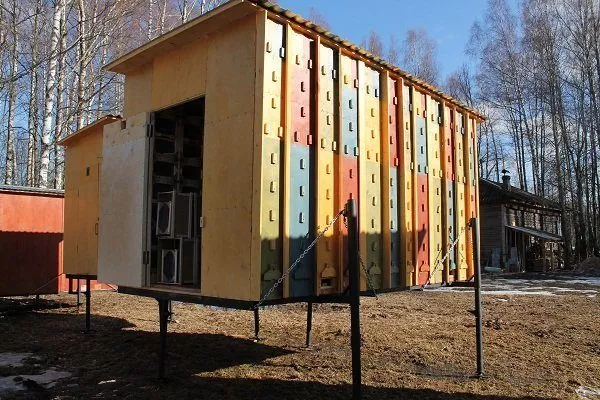
This type can be either stationary or mobile. Cassette pavilions are very popular among beekeepers.
DIY
Building a pavilion yourself is easy. The entire process is similar to building a small shed. But to achieve a high-quality end result, you need to be patient and follow the steps.
Preliminary preparation
Before starting construction, carry out thorough preparation, as this stage is extremely important. Consider the design of the future home for honeybees. Decide on the size, as a fairly large space will be needed to accommodate several bee colonies. However, remember that it's best not to install more than twenty cassette hives, as the bees will become overcrowded.
Next, the ventilation, heating, and sewerage systems are included in the plan. Any professional beekeeper will build special compartments in their pavilion to conveniently store work clothes, honey extraction tools, and cleaning equipment. So, include these rooms in the plan.
An approximate diagram of a stationary pavilion looks like this:
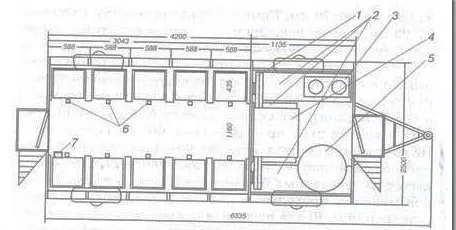
It shows:
- 1 – folding trestle bed;
- 2 – boxes for storing honeycombs;
- 3 – corner table;
- 4 – work table;
- 5 – honey extractor;
- 6 – nests;
- 7 – ventilation hole.
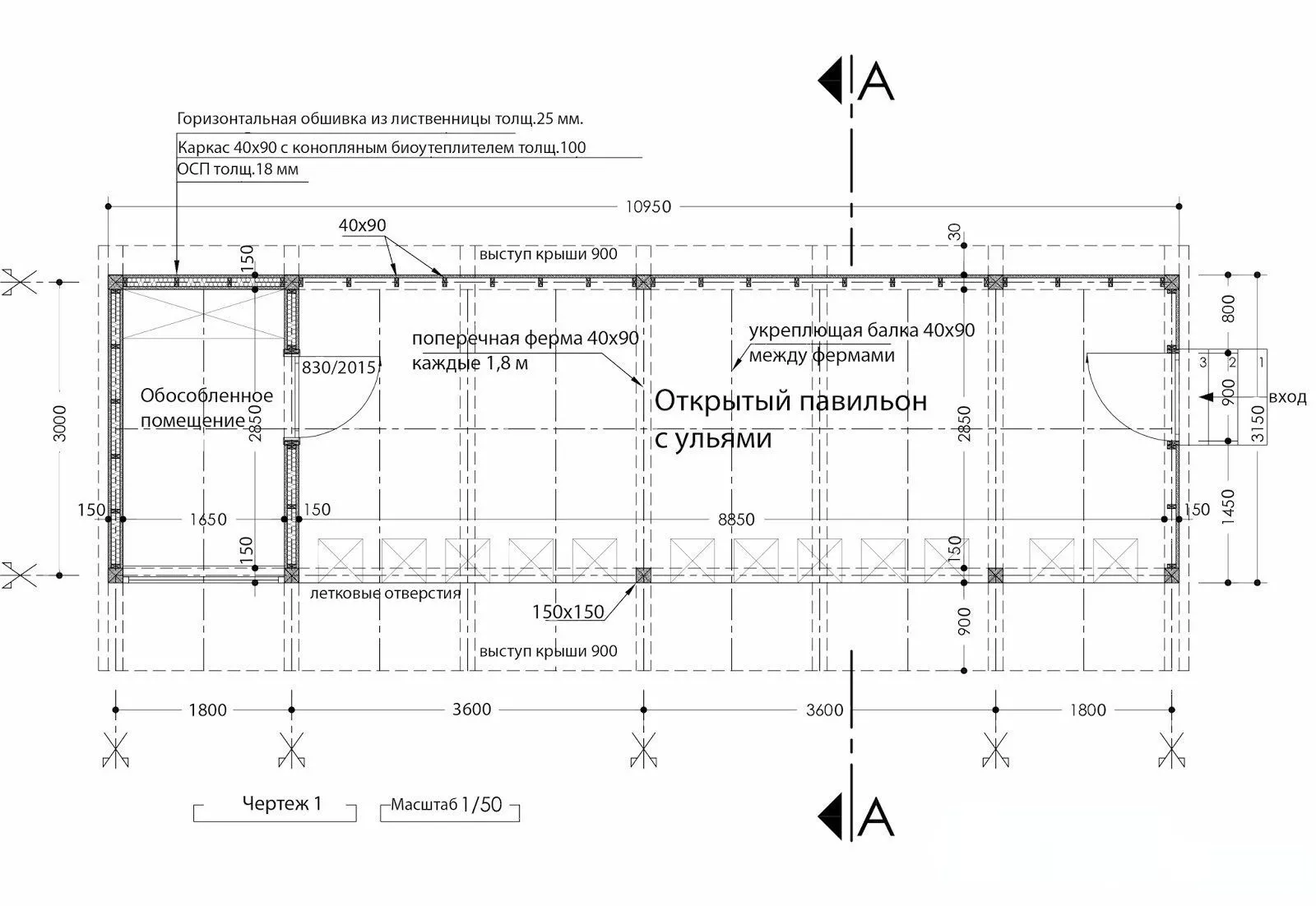
Sample drawing of a mobile pavilion:
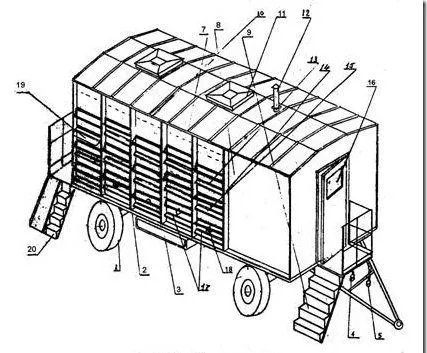
Here you see:
- 1 – wheel;
- 2 – platform;
- 3 – box;
- 4 – brake system;
- 5 – electrical equipment system;
- 7 – compartments for hives;
- 8 – beekeeper’s closet;
- 9 – service ladder;
- 10 – roof covering;
- 11 – hatch;
- 12 – exhaust shaft;
- 13 – flight hole;
- 14 – vertical divider;
- 15 – landing board;
- 16 – window;
- 17 – flying targets;
- 18 – volumetric figures;
- 19 – horizontal divider;
- 20 – technological ladder.
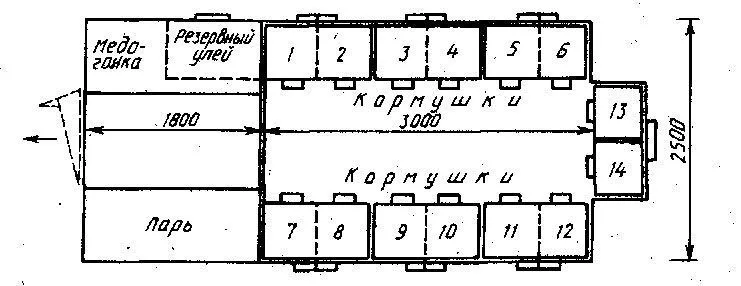
Once the plan is ready, check it several times to ensure that all the necessary elements are included, as if even one detail is missed, the bees will feel unwell, get sick frequently, and their productivity will drop sharply.
Necessary tools and materials
Once the design is complete, prepare a set of tools and materials. If the bee pavilion is planned to be mobile, a sturdy structure with wheels will be required. A jack and a welder will also be needed, as you'll be working with metal.
It is best to seek help from a specialist who is knowledgeable in mechanics and welding when building a mobile bee house.
For both a mobile and a stationary pavilion, the following set of materials and tools will be required:
- boards;
- plywood;
- Fiberboard or chipboard (a couple of sheets are enough);
- wooden or metal beams to create the frame;
- measuring level;
- ruler or tape measure;
- hammer, saw, nails, screws, hinges for doors and window structures, as well as fasteners;
- roofing material (roofing felt or iron are good choices);
- dye;
- insulation (regular foam plastic will do).
Manufacturing of compartments
Making the compartments and feeders is an important step in building the pavilion. Typically, the bee compartments are positioned in one direction, but you can also position them in two opposite directions. The utility compartment should be located in an accessible and convenient location.
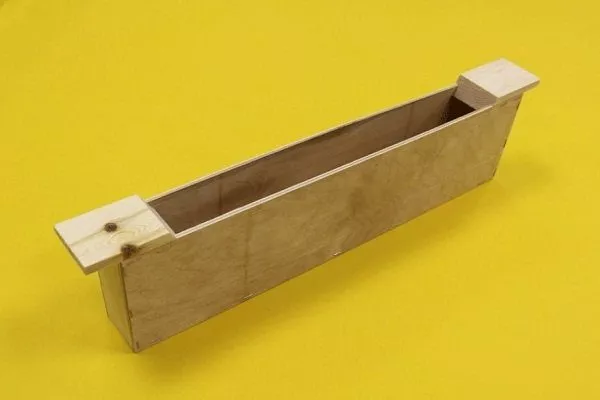
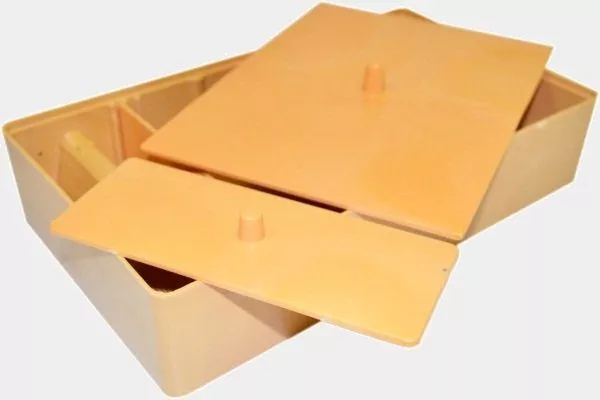
Bee feeders are placed indoors during wintering, once honey collection is complete. They are divided into two types: in-hive and external.
Intra-hive, in turn, have several types:
- Ceiling. It's a simple box that can be filled with insect food without opening the hive. This type is suitable and convenient even for long-term feeding.

- Framework. This type of feeder resembles a frame with plywood sides. It's placed near the nests. This type of feeder is very convenient for autumn.

- Ceiling plastic feeder with a glass inside. This type is considered functional. However, if you decide to install this type, keep in mind that insects will be able to penetrate the food compartment.
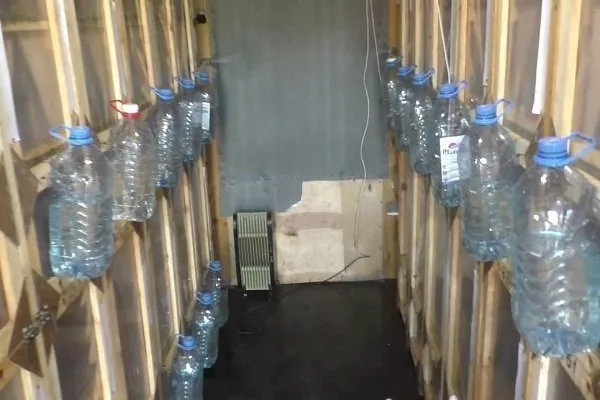
- From plastic bottlesFeeders made from this type of container resemble waterers with a dispenser. These types are usually attached to the bottom of the hive. They are best used only once.
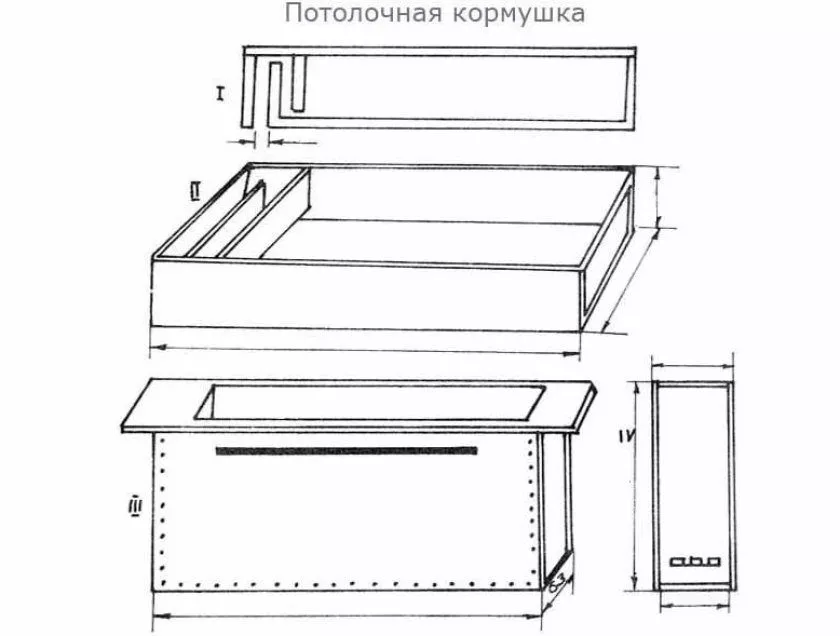
There are only two types of outdoor feeders:
- General. It is typically placed near the plot. This type of feeder is effective if there are no other apiaries nearby.
- Wall-mounted. This type is attached to a summer hive. The advantage is that there's no need to open the hive to add food. The disadvantage is that it can attract unwanted insects.
Lighting
For the beekeeper's convenience, lighting is installed in the pavilion. This is easy to do: wires are run from the nearest transformer. It's best to arrange a combination of fluorescent and incandescent lamps. The latter must be protected with shades to prevent the bees from being harmed by the bright light.
Often, beekeepers do without light and use an ordinary lantern.
Beekeeper's closet
A bee pavilion definitely needs a small room. Its size and location depend on each individual's needs. If the structure is intended to be portable, it's best to place the small room in the back. This will allow for more bee colonies. However, this room should not be a walk-through room, so as not to obstruct access to the hives.
In the closet, build shelves or even a cabinet to hold all the necessary equipment for work. Also, don't forget a place to store bee food, dishes, and frames. You can add a small sofa for relaxation and a food prep area.
Insulation
Insulation is an important step in building a bee pavilion that shouldn't be ignored. Since the bees will spend quite a long time in it, it needs to be approached thoroughly.
The walls are insulated with foam plastic sandwiched between two sheets of plywood. Carefully inspect the door frame and window frames. Cold air should not penetrate through any cracks. If there are drafts in the room, insulate the doors and windows. This will require filling all cracks and crevices with construction foam. If severe and prolonged frosts are forecast for the winter, you can install a heater.
Ventilation
Ventilation is important for the health of honey bees, so pay special attention to it. From spring until mid-autumn, pavilions are naturally ventilated using doors and windows.
- ✓ The size of the ventilation openings should be at least 5% of the total floor area to ensure sufficient air exchange.
- ✓ The location of the ventilation openings should facilitate natural air circulation, avoiding drafts.
In winter, a special ventilation system will be required. This can be either a supply or exhaust system with dampers. This system prevents moisture accumulation in the room, removes stale air, and retains heat.
Security measures
Since the pavilion is constructed of wood and plywood, every safety precaution is taken. A fire extinguisher is required in both the stationary and mobile bee house, as a sudden short circuit and fire could occur in the room.
The safety precautions for a mobile pavilion require a more careful approach:
- the design must include brakes;
- If you plan to keep more than 48 families, it is better to build several pavilions connected to each other, which will allow you to freely move the structures around the apiary.
Installation stages
The assembly of a stationary structure is carried out in several steps:
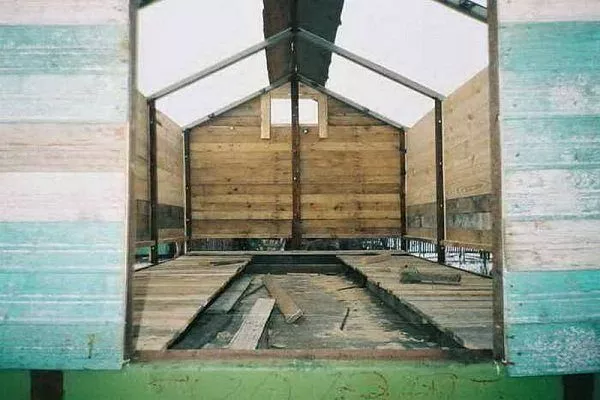
- Construction of the frame. For this, you'll need wooden or metal beams. Use this material to construct the structure of the future pavilion. Make sure it's not too low, as it will be difficult to enter—you'll have to constantly bend over and remain bent over while inside. A very tall bee house would also be inappropriate, as it will complicate beekeeping.
At this stage, also ensure that the foundation for the permanent structure and the platform with wheels or car trailer in the mobile pavilion are level.
- Creating a floor. Flooring is made from planks. It's a good idea to treat the material with a moisture-repellent solution before installation to prevent rapid wear.
- Construction of the internal frame. We need to create a frame inside the pavilion that will separate the bee colonies from each other. The dimensions depend directly on the size of the hives. Refer to the prepared drawing and calculations as you work.
- Placement of compartments. Bee compartments can be placed on either side of the pavilion. The distance between them should be approximately 80 cm. If the compartments are placed close together, a standard honey extractor will not fit between the hives.
- Construction of a closet. Shelves are attached, a table, a sofa for relaxation and other necessary things for comfortable work are installed.
- Insulation and ventilation. At this stage, begin insulating the pavilion and creating a ventilation system. How to do this was discussed above.
- Creating a roof. The roof of a bee pavilion is an important component of a permanent hive. It comes in two types:
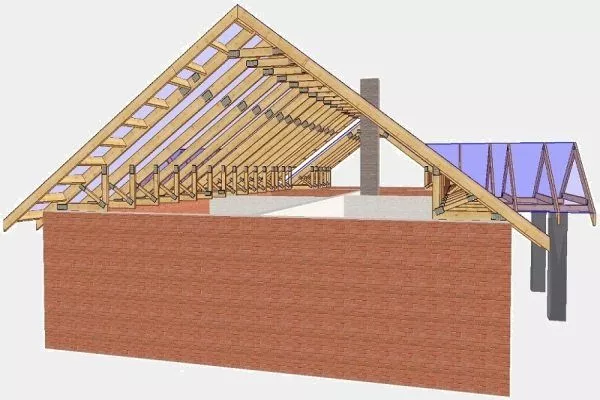
- Gable roof. This type of roof is usually constructed without built-in hatches, so the window structures are placed on the walls. This type of roof requires leaving some space between the hive cassettes and the walls, which is not very convenient.
For this type of roof, a frame is first constructed from wooden or metal beams. A mauerlat (wall plate) is then attached to the top, providing the foundation for the rafters. This is essential for creating a high-quality and durable roof.
Next, rafters are made from beams measuring 5 cm x 5 cm. Afterwards, the roof is covered with a water-repellent material.
- Flat. This option is more convenient due to the presence of outward-opening hatches. This eliminates the need for wall windows, allowing the hives to be installed flush against the walls, saving space. To construct this type of roof, a drawing must be prepared indicating the number and size of the hatches. The roof itself is flat, as the name suggests. Holes for the hatches are cut into the structure.
- Gable roof. This type of roof is usually constructed without built-in hatches, so the window structures are placed on the walls. This type of roof requires leaving some space between the hive cassettes and the walls, which is not very convenient.
- Equipping the pavilion with doors and hatches. At this stage, doors are installed and hatches are attached using fasteners.
- Placement of hives. They are installed slightly away from each other to make it easier to care for the bees and use the honey extractor.
- Manufacturing of steps. If necessary, steps can be built into the pavilion.
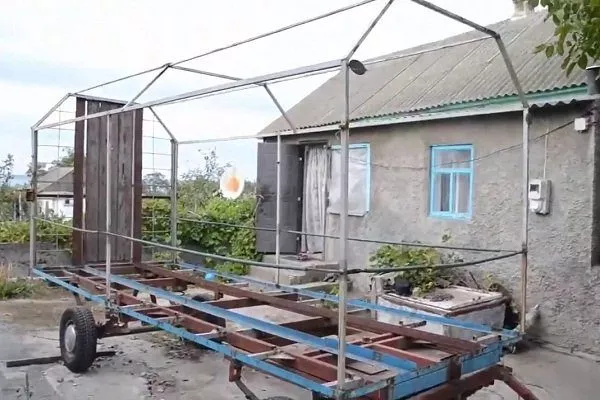
The installation of a mobile structure has only a few additional stages:
- Step 1 – find a suitable trailer or truck body.
- Step 2 – disassemble the structure, leaving only the chassis.
- Step 3 – Place the resulting "foundation" horizontally. Place stones or bricks underneath for stability.
- Step 4 – if the body is made of iron, weld a frame prepared according to the dimensions of the car frame using a welding machine.
Then complete all the work steps as when installing a stationary pavilion.
Pros and cons of the design
The bee pavilion has a number of both positive and negative aspects.
TO pros The following applies to the structure:
- The pavilions are very compact. The structure can be built even in a small apiary.
- You have a roof over your head year-round. There's no need to place hives on the property or worry about insects during rain or sudden cold snaps.
- Even in a small pavilion it is possible to house many bee colonies.
- The pavilion is convenient for examining bees and caring for them during the honey flow-free period.
- You can take out the bees one by one for inspection without disturbing the others.
- The honey yield increases several times.
- The mobile pavilion is easily transported to honey plants.
- There is a chance to collect different varieties of honey in one season if you place one mobile pavilion near each plant variety.
- The pavilion creates a favorable climate during the winter. The bees remain healthy and thrive.
- Keeping bees in a pavilion is much safer for people and animals than in standard hives located in an apiary. The bees are confined to one area, do not fly around, and do not sting.
Negative aspects bee house are as follows:
- High fire hazard due to the use of flammable materials.
- Hives indoors are usually placed close to each other. This disrupts the bees' coordination, causing them to confuse their respective nests.
- If one bee gets sick, the disease spreads very quickly in the pavilion, affecting all the insects.
5 useful tips from beekeepers
A bee house must meet all quality standards to ensure the safety of the bees and create a comfortable environment for them. To achieve this, follow these simple guidelines:
- Tip #1. When building, use non-toxic materials. Bees are sensitive to various chemicals.
- Tip #2. Keep a fire extinguisher nearby, as all bees die quickly in a fire.
- Tip #3. Try to create a safe environment. If you need to provide additional heating to the pavilion with space heaters during the winter, make sure the device is completely safe. It's best to purchase an infrared heater.
- Tip #4. If you're using a portable pavilion to house your bees, try to transport it as calmly as possible. Even the slightest stress can reduce the honey bees' productivity.
- Tip #5. To prevent bees from confusing their hives, which often happens in small spaces, paint the front walls of the hives different bright colors. The insects will remember these landmarks and always return to their original locations.
For information on keeping bees in a pavilion during winter, as well as how to build one yourself, watch the following video:
Building a pavilion yourself is a doable task. High-quality bee housing will be achieved if you select safe materials, position the hives and feeders correctly, provide electricity, and properly insulate the space. A properly constructed pavilion will be comfortable not only for the bees but also for the beekeeper.