
Migratory beekeeping involves transporting bees to areas with blooming honey plants during the season. This process allows for large quantities of honey to be collected, making it possible to start a business. Migratory beekeeping requires a complex lifestyle and specialized techniques.
Reasons for the emergence of migratory apiaries
Migratory beekeeping is a challenging task even for experienced beekeepers. Transporting apiaries requires a significant amount of time, effort, and money. However, there are a number of reasons why migratory beekeeping emerged:
- search for ecologically clean places for honey collection;
- maintaining the required volume of collected honey;
- searching for plants to collect a specific type of honey;
- the presence of a large number of competitors;
- The bees are not satisfied with the food supply available in the region.
Depending on the species, some bees are unable to fly far enough from their hives. The standard maximum flight radius from an apiary is 2 to 5 kilometers. If the area containing flowers that the bees can access is located further away, it remains untouched.
Criteria for choosing a nomadic method
| Factor | Threshold value | Recommendations |
|---|---|---|
| Radius of honey plants | >5 km from the apiary | Transportation required |
| Concentration of competitors | >3 apiaries/km² | Search for new locations |
| Inpatient hospital profitability | <15 kg/hive/season | Transition to nomadic life |
| Accessibility of transport | Load capacity ≥1 t | Minimum 2 shipments/season |
For this reason, beekeepers have to move along with their bees.
Some people start nomadic apiaries from the start. Others switch to this type of production out of necessity. The latter option is usually preferred when a lifestyle change will positively impact income.
Advantages and disadvantages of migratory apiaries
The use of migratory apiaries includes the following advantages:
- the ability to collect a specific volume of honey in a shorter period than in a standard apiary;
- harvesting begins earlier than usual;
- Honey can be collected throughout most of the year, starting in early spring and ending in late autumn;
- nomadic apiaries are more mobile than stationary ones, which means they can be transported to almost any location;
- You can control your work and harvest schedule yourself.
The list of disadvantages includes the need to:
- annual transportation of hives;
- living in field conditions with minimal amenities;
- devote most of your time to searching for honey-bearing places and harvesting;
- constant supervision of the apiary;
- obtaining official permission to engage in such activities.
Migratory beekeeping requires more physical effort than might initially appear. Therefore, it is not recommended for people with health problems.
Selecting a location
One of the factors influencing harvesting is the choice of location. When setting up a migratory apiary, it is necessary to focus on a region that currently has a large number of honey plantsThe more flowering plants are located near the apiary, the more honey the bees will be able to produce.
An apiary requires a group of hives. Therefore, the planned location should include a large, level area where the hives will be installed. The area where the apiary will be located should be protected from:
- draft;
- rain;
- dampness;
- winds;
- direct sunlight (at high summer temperatures).
If there are already apiaries nearby, it's important to check whether they have been quarantined due to infestation. If bees work in unfavorable conditions, not only will their honey yield decrease, but they also risk dying.
There must be a clean body of water near the apiary.
Before choosing a location for your apiary, carefully consider its honey-producing potential. The more plants the apiary contains for bees to use during flowering, the less frequently you'll need to relocate. It's recommended to place hives as far away from roads, businesses, and residential areas as possible.
Transport requirements
Migratory beekeeping, which requires a large number of hives, is highly profitable. Therefore, transporting them requires a truck. If the total weight of the hives being transported exceeds 750 kilograms, a category E driver's license is required. If you have a category C driver's license, you can convert your vehicle to avoid the need for a different category.
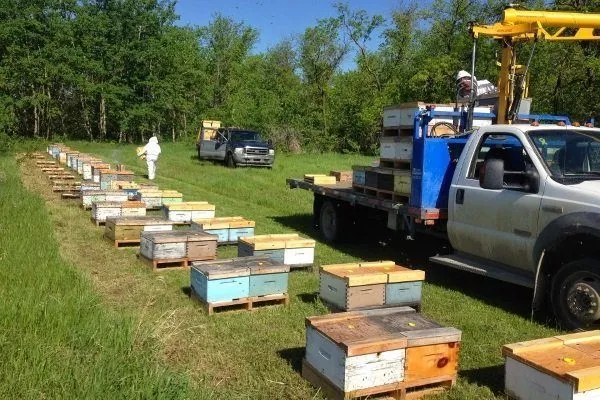
A tractor with a trailer can be used to transport hives.
Comparison of transport options
| Type | Load capacity | Price/season | Maintainability |
|---|---|---|---|
| Gazelle Next | 1.5 t | 85,000 rubles | High |
| MTZ tractor + trailer | 3 t | 120,000 rubles | Average |
| Kamaz 5320 | 8 t | 210,000 rubles | Low |
This method requires obtaining a driver's license. Categories B and C won't help in this case, since the trailer alone weighs over 300 kilograms.
Depending on how frequently you plan to transport your apiary, you can save money by using a freight company on a regular basis rather than purchasing your own transport.
A decommissioned bus or a trailer trailer can also be used for nomadic beekeeping.
Inventory
Transportation of hives is carried out using:
- nomadic mesh (provides ventilation in the hives, so that the bees do not get overheated);
- clamps for fastening hives;
- mesh slings (provides external fastening and can be used to create a canopy);
- nomadic booth;
- beams for connecting hives.
It is recommended to use a travel shelter during transport. It is required for accommodation and for staying during adverse weather conditions.
To install and maintain an apiary, a set of equipment is required, consisting of:
- main and spare smoker;
- sprayer;
- carpentry tools;
- empty hives;
- swarms;
- scales in a casing;
- lantern.
Depending on how long you plan to live near the apiary, you may need household items.
How to prepare hives for transportation?
When transporting hives in spring weather, when the hot temperatures outside have not yet settled, no special provisions are required. The frames are reinforced to withstand the impact of vehicle movement.
Standard hives are designed with special frames. When transporting the hives, frames with dividers are placed around the perimeter to ensure they remain stable. If special frames are unavailable, they can be replaced with beams secured with nails.
During the summer period, many frames may already be filled with honey.
They must be removed during transport. Failure to do so could result in the frame falling onto the brood and bees while the vehicle is moving, resulting in their death.
After the honey flow, the bees are transported not in their hives, but together with the nests containing the honey. Hives are not secured only if their bottoms are nailed down.
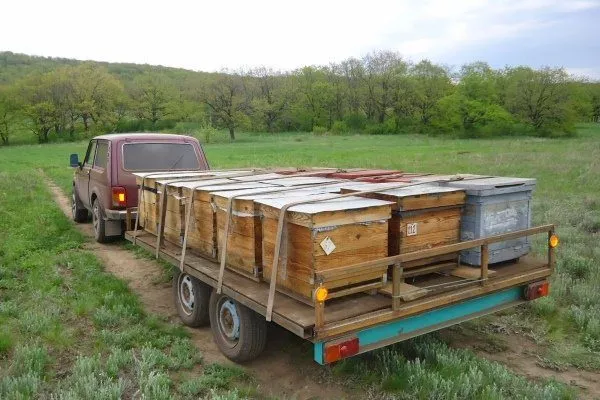
Under what conditions can bees be transported?
It is recommended to carry out transportation at night for a number of reasons:
- the bees are in a sleepy state;
- the temperature is lower, which reduces the risk of honeycombs melting and falling;
- lower noise and traffic on the road.
After transport, bees need to explore and acclimate to their new surroundings. Therefore, transport should take place after they emerge from hibernation or before they enter it.
Early spring or late fall are best for this purpose. Transporting bees during the winter is strictly not recommended.
Early spring is suitable for transportation because:
- the hives do not contain a large number of bees and brood;
- the frames are not filled with honey and have not gained weight;
- new cells have not yet been built.
The duration of transportation should not exceed two days.
Transportation schedule
- April: Moving to the willow plantations
- May: Linden trees (moisture control)
- June-July: buckwheat fields (night temperature not below +12°C)
- August: return to winter quarters
Bees can use the provided food within two days. After that, they may die.
If transporting bees in the summer or during the day, it's best to wait until cloudy or rainy weather arrives. High temperatures can be fatal to bees. Bees should not be transported more than twice during the season.
Nomadic pavilions
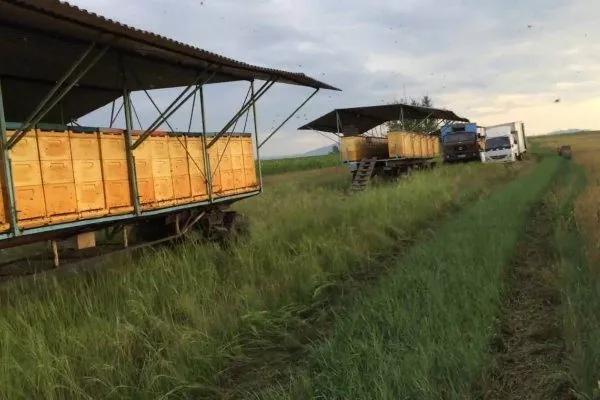
A nomadic pavilion is a truck trailer specially equipped for transporting bees. This device allows for the mobile and efficient transport of bees from one location to another. Nomadic pavilions have other advantages:
- comfortable and convenient conditions for the beekeeper;
- creation of optimal living conditions for bees (cleanliness, minimum humidity level, suitable temperature);
- simple breeding of queens;
- no need to dismantle hives to collect honey;
- anti-theft protection;
- comfortable conditions for wintering and breeding.
The main advantage of mobile bee pavilions is the elimination of the need to load and unload hives. Despite these advantages, this method of transporting bees also has its drawbacks. The list of disadvantages includes:
- small space and amount of light;
- elevated temperature in the summer;
- low level of queen flight;
- angry and irritable behavior of bees;
- large amount of money required for arrangement;
- risk of mass disease of bees.
Lack of light can be addressed by installing additional windows and hatches. To increase the space in the pavilion, wide and long trailers should be used. To reduce temperature, the walls of the pavilion and hives should be painted white, and ventilation should be installed in the bottom of the trailer.
You can learn more about the specifics of migratory beekeeping using pavilions by watching this video:
Is it necessary to remove the apiary annually?
Transporting bees is associated with a number of risks. Migratory beekeeping is recommended only if you are completely confident it will pay off. The first year will reveal how profitable this method of beekeeping is.
It's recommended to conduct a trial bee harvest in the spring to determine by summer whether honey harvesting using this technology is profitable. If the project doesn't pay off, mid-summer may still provide time to recoup the financial losses.
It's not always necessary to remove the entire apiary—just a few hives can be removed periodically. Also, there's no need to relocate for the entire season—only during periods when there are no honey plants nearby.
Important nuances in the organization
When following the instructions for nomadic beekeeping, there are a number of nuances that even experienced beekeepers must take into account:
- Before transportation, it is necessary to ensure the integrity and strength of the hives;
- To ensure that the bees are kept safe and quiet during transport, the hives should be positioned so that they do not hit each other;
- For ease of loading and unloading, hives should be made in advance from lightweight materials;
- the roofs of the hives must be straight and level so that they can be placed on top of each other;
- rope and wire will help to secure the hives more securely;
- the recommended distance for transporting bees is no more than 30 kilometers;
- By adhering to sanitary standards, the risk of bee diseases can be reduced.
Control parameters
| Indicator | Norm | Verification tool |
|---|---|---|
| Humidity in the hive | 60-80% | Hygrometer |
| Temperature | +10…+25°C | Temperature sensor |
| Vibration | <3 m/s² | Accelerometer |
| Gas pollution | 0 mg/m³ CO | Gas analyzer |
Migratory beekeeping is a method that doubles honey yields. Transporting bees is associated with significant risks, so it is recommended only for experienced beekeepers willing to dedicate most of their free time to the task.