
A honey decrystallizer is a specialized device that converts crystallized honey back into a liquid state. This equipment operates according to a specific principle and is designed in a specific way. It can be purchased ready-made or made at home. Honey decrystallization equipment comes in different types.
What is honey decrystallization?
Decrystallization of honey is the reverse process of crystallization, meaning it liquefies (dissolves). This is achieved through heating. Therefore, this device is also called a honey warmer.
The process involves following several rules:
- Temperature. Proper temperature is one of the most important aspects of decrystallization. It must be sufficient to liquefy the honey without compromising its properties. The optimal temperature range is 28-40 degrees Celsius—this temperature ensures equilibrium, where the formation of new crystals ceases. Honey crystallizes at 14-15 degrees Celsius and melts at 50 degrees Celsius. This upper limit should not be exceeded.
- Processing time. The duration of decrystallization directly depends on the volume of the product. The larger the volume, the longer it will take to liquefy. For a product in a small jar, it's enough to leave it near a radiator (or other heat source) or in a double boiler for a while.
- ✓ Use only food grade materials for heating elements that come into contact with honey.
- ✓ Mandatory thermostat calibration before first use for accurate temperature control.
The design and operating principle of a honey decrystallizer
The design features of honey decrystallizers vary depending on their type. In all cases, the equipment consists of one or more heating elements that are immersed in the honey mass or provide external heating to the container.
The operating principle of honey decrystallizers is extremely simple. The device is plugged into an electrical outlet and heated (fully or partially). The increased temperature softens the honey mass, gradually turning it completely liquid. If the correct temperature is maintained, the honey's properties are preserved.
Some of the most important components of a decrystallizer are the temperature sensor and thermostat. These devices allow for monitoring the process temperature and maintaining it at the proper level, which is a key requirement for proper decrystallization.
Types of decrystallizers
Honey decrystallizers come in several design variations. Each has its own unique characteristics, which should be considered when making your choice.
Immersion (spiral) decrystallizers
This equipment consists of metal tubes formed into a spiral. The tubes are immersed in the honey mass, where they are heated to ensure decrystallization.
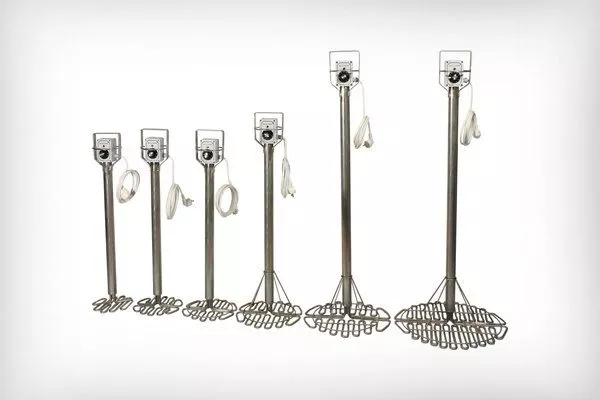
The size of the spiral decrystallizer depending on the diameter of the container with honey
A mandatory requirement for the technological process when using a coil is that its heating element be completely immersed in honey and not exposed to air. To facilitate the immersion of the decrystallizer's heating element in the crystallized honey, a recess is first created. The coil, lowered into the recess, is then coated with the honey mass removed to create the recess.
When a coil immersed in honey heats up, the honey around its heating element first decrystallizes. As it heats up, the honey softens, causing the coil to gradually sink deeper. The completion of the decrystallization process is indicated by the coil reaching the bottom.
A variation of the spiral decrystallizer is the cone-shaped model. It resembles a boiler, but the diameter of the coils tapers toward the bottom, forming a cone. This model is used only in households, as it is intended for small volumes of honey.
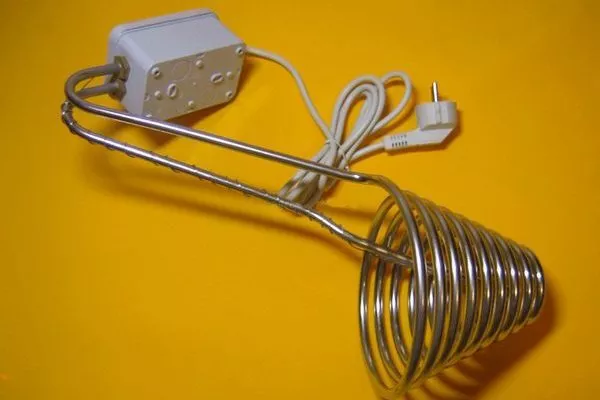
A type of spiral honey decrystallizer. Its appearance resembles that of a boiler.
External (flexible) decrystallizers
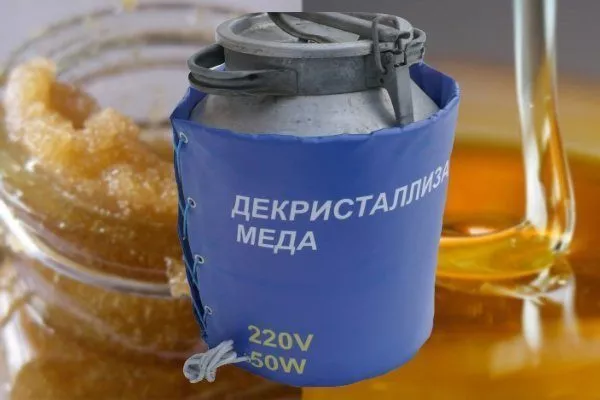
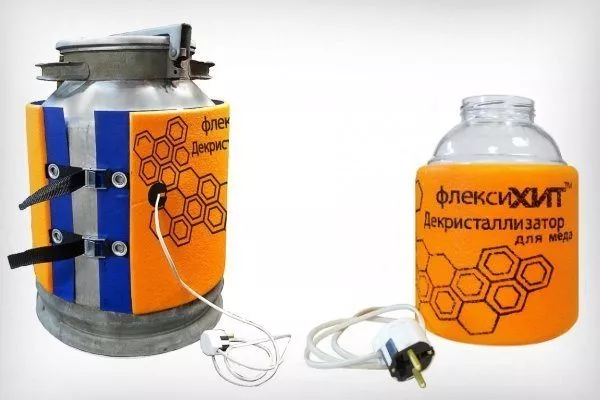
This equipment resembles a large electric heating pad. It consists of a flexible synthetic plate containing heating elements. These elements emit infrared radiation, which is what produces the heat.
An external decrystallizer is used as a wrap for a container of honey. Its maximum capacity directly depends on the size of the decrystallizer. It can be designed for a 40-liter flask or a 200-liter barrel. However, for home use, a model suitable for a three-liter jar or can is more suitable.
Cassette-type decrystallizers
This equipment is a large metal box. Heating elements are located on its inner walls—essentially four thermoactive cassettes connected to each other, forming a closed space.
Case decrystallizers are often of a collapsible design, which simplifies their storage.
The video below explains how a case-type decrystallizer looks and works:
How to choose a decrystallizer?
When choosing a decrystallizer, it is necessary to focus on the volume of honey, as well as the design features:
- For home use, spiral models are convenient – the equipment is inexpensive and takes up little space;
- The disadvantage of spiral and conical decrystallizers is the need for cleaning, since they are immersed in the honey mass;
- Flexible and cased devices are attractive due to their contactless decrystallization, i.e. they do not require immersion in the liquefied product;
- Decrystallizers with infrared radiation are attractive due to their uniform heating and lower energy consumption (savings on electricity).
It's impossible to say definitively which decrystallizer is best. The choice should be based solely on individual needs. Beekeepers absolutely need such equipment: most varieties of natural honey crystallize within 1-2 months, which significantly complicates packaging. At the same time, decrystallization improves presentation—most consumers prefer a more liquid product.
DIY
A decrystallizer is simple to construct and can be made independently. This allows for customized equipment and significant savings. There are several options for manufacturing decrystallizers.
- Check the integrity of all heating elements before assembly.
- Make sure the thermostat and temperature sensor are present and in good working order.
- Perform a test heating without honey to check for even heating.
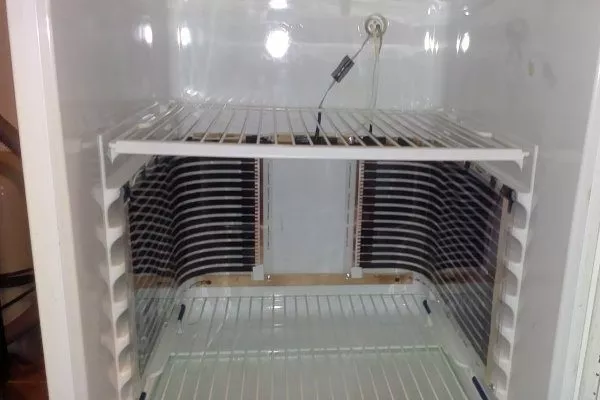
Old refrigerator
A heating element (infrared film or lamp) must be installed inside, and a thermostat with a sensor must be installed to control the temperature. This will maintain the set temperature in the improvised decrystallizer. The amount of honey processed is limited only by the size of the refrigerator used.
The advantage of this method is that the refrigerator is already thermally insulated.
Wooden case
The cabinet equipment can also be made of wood. Izospan can be used for thermal insulation. Temperature control is also provided by a thermostat and sensor.
The advantage of this option is that the frame can be made in any configuration and size. Honey containers can be loaded vertically or horizontally.
Thermal chamber
This option involves dedicating an entire room to decrystallization. Its height should be low, which is appropriate for large-scale honey production. The interior of the room is lined with foam sheets. Electric heaters and a fan heater are used to achieve and maintain the desired temperature.
The advantage of this decrystallization method is that it can process large quantities of product simultaneously. However, energy consumption is also high.
Warm floor
The inner surfaces of the foam box must be lined with heat-insulating material (usually isospan), wrapped with an infrared floor (film material), a temperature sensor must be installed, and the required parameters must be set.
What this type of decrystallizer looks like is shown in the video below:
A decrystallizer is essential equipment for honey production. There are several variations, designed for different purposes. You can even make your own decrystallizer.