
There are two types of zodiac by which the signs of the Moon can be determined:
- sidereal (astronomical);
- tropical (astrological).
The difference between these two zodiac systems is 1-2 days.
Tropical Zodiac Used in ancient times. Around 2,000 years ago, the first astronomers "tied" the zodiac to the seasons, using the vernal equinox (0 degrees Aries) as the reference point. However, the positions of the constellations are fixed, while the vernal equinox actually shifts by 1 degree every 72 years due to changes in the tilt of the Earth's axis. In modern times, this point is actually located in the constellation Pisces, not Aries, as we still believe. Until recently, the lunar calendar used by our grandmothers was useful. Now, however, it is no longer objectively accurate to the actual positions of celestial bodies in the sky. It's hard to admit, but crops yield crops not because of our ancestors' adherence to the lunar calendar, but in spite of it.
Sidereal Zodiac The fixed stars are used as a reference point. The signs of the sidereal zodiac correspond exactly to the astrological constellations. The sidereal zodiac model takes into account the shift of the Earth's axis and the position of the Earth relative to the Sun.
We use the sidereal (astronomical) zodiac because it takes into account the actual position of the Moon and its passage through the zodiacal constellations. And when providing recommendations for working with crops, we draw on the theory and practical experience of Rudolf Steiner and Maria Thun, authorities in the field of biodynamic farming.
Our calendar is designed to help gardeners plan sowing, planting, and other crop care activities. It also highlights days when gardening is not recommended.



Recommended
This day is a good time to pick flowers and the above-ground parts of medicinal herbs (stinging nettle, shepherd's purse, sweet clover, red clover, motherwort, string bugle, fireweed, sage, etc.). Irises, roses, daisies, peonies, and other seasonal flowers cut on these days are more fragrant and last longer. Opt for single-flower bouquets, as many flowers do not tolerate mixing with other species.
Not recommended
Do not sow any seeds, the plants will be weak (due to the negative influence of the apogee of the Moon and retrograde Mercury), do not transplant.
Beekeeping is important!
The Moon's position these days stimulates brood production and the development of bee colonies. There's a high risk of swarming. Take appropriate measures!

Recommended
Transplanting above-ground leafy crop seedlings (all types of cabbage) is possible. Water the seedlings generously a few days before planting. Transplant them into moist, fertilized soil, along with the root ball. The roots will be less sensitive to damage during this period.
Pinch out side shoots from tomatoes, removing no more than 4-6 side shoots at a time. Determinate tomato varieties do not require pruning or staking.
Not recommended
Leafy greens (lettuce, sorrel, etc.) should not be harvested during these days, as the greens will spoil quickly. As an exception, pick and use immediately (do not store until tomorrow). Milk processing is also not recommended.
Beekeeping is important!
Do not carry out any work on the hive during these days.


Recommended
Recommended: The right time for growing fruit and berry crops (cherry/sweet cherry, apple/pear, strawberry, raspberry, blackberry, currant, gooseberry, blueberry, cranberry, grape, peach, apricot, plum, mulberry, etc.) and nightshade, melon, pumpkin, legume plants (cucumber, zucchini, eggplant, pumpkin, watermelon, melon, peas, beans and other legumes, sweet pepper), as well as cereals (wheat, corn) and nuts.
Treat strawberries (replant if necessary, but do not fertilize).
You can harvest leafy plants (pick the greens before lunch, while the juices are still running).
Cultivate and loosen the soil to encourage weed seeds to germinate and then weed them out to get rid of them for good.
Transplant tomato seedlings into open ground.
Not recommended
Fertilize to avoid burning the plants.
Beekeeping
The Moon in Leo stimulates bees to collect nectar. Therefore, you can move your hives to meadows where honey plants are blooming. Depending on the location, acacia, mustard, and meadow grasses (such as clover and others) are in bloom now. Also, watch for swarming and take steps to prevent it in advance.

Recommended
This is the optimal time to transplant beets, radishes, turnips, horseradish, and rutabagas to their permanent locations. Avoid transplanting in hot weather or in direct sunlight.
You can thin out plantings and hill up potatoes, as well as perform any soil cultivation.
During the period of the waning Moon on the days of the Root, it would be good to start making compost (if you haven’t started already).
Not recommended
The day is not suitable for harvesting and processing crops - everything will be ruined.
Beekeeping
Encourage bees to build comb. This will keep them busy, reducing the risk of swarming. Ensure they have space to build comb by placing several frames of artificial wax foundation in a row (but not between frames of brood or mixed with finished comb).

Recommended
This is a good time to repot flowering plants and tend to flower beds, as well as to harvest flowers and above-ground medicinal herbs. Flowers cut during these times have a stronger fragrance and last longer in a vase. Dried flowers preserved their colors better during these times.
Pruning faded lilacs is essential. This will help the bush, as the buds are weakening it.
Leafy plants should be harvested before lunch, while strength is still rising.
Not recommended
Flower Day is not intended for working with fruits, berries, vegetables and greens, as this period is considered barren for them.
Beekeeping
These days stimulate the brood and development of the colony of bee families.

Recommended
Rest and recharge. Today, you should be more mindful of your body. Avoid overexerting yourself. You may not feel tired for a long time, even when you really need a break. If sitting idle is difficult for you, then tidy up, clearing space for the new by demolishing the old.
It would be a good idea to detoxify your body of toxins and other harmful substances. A light diet based on fruits and vegetables, plenty of fluids, taking sorbents, and avoiding alcohol, strong tea, and coffee.
If you have problems with your genitourinary system, pay attention to this issue. Drink more still water, go for walks, and take breaks from work, especially if you're sedentary. Avoid sitting in cold or drafty areas to avoid triggering cystitis. Start taking a course of medication to prevent the development of kidney stones, if this is a concern for you.
Not recommended
Unfavorable period.
No agricultural or gardening work is allowed today. Harvesting is also prohibited.

Recommended
You can transplant seedlings of deciduous plants, water them, and loosen the soil.
Step-son tomatoes, removing no more than 2 young stems at a time.
Not recommended
Do not harvest crops in a water sign, as this makes them perishable.
Avoid working with tools - things can fall out of your hands, and there is a risk of injury.
You should not process milk or make yogurt - this is not a good day for this.
Beekeeping is important!
It is not recommended to work with the hive on this day.

♐ Sagittarius (from 16:02)
Recommended
Time to rest, meditate, celebrate.
Collect medicinal herbs.
On the eve of the Full Moon, pest and fungal activity increases. Morning on an empty stomach is a good time to take antiparasitic treatments for yourself and your pets.
Not recommended
Sowing, planting, and replanting are prohibited. Harvesting is also prohibited.
Don't work with bees!
The best way to combat varroa is with an oxalic acid sublimator. Treatment with bipin or fluvalinate is strictly prohibited in the summer, as the toxic substances will contaminate the honey!

Recommended
Conduct pest control.
Not recommended
Avoid sowing, planting, or transplanting during the perigee. Plants will grow weak and be susceptible to various diseases.

Recommended
Inspect plants for damage by fungal diseases and pests (especially slugs and snails).
Carry out pinching of pome fruits and pinching of stone fruit trees.
You should add phosphorus-potassium fertilizer to currently flowering vegetables: cucumbers, zucchini, tomatoes, etc.
It's time to harvest.
Not recommended
This is the day of the Fruit, so it is not suitable for working with greens and root vegetables.
Beekeeping
Nectar collection by bees.


Recommended
Hilling and fertilizing root crops (carrots, potatoes, beets, radishes, turnips, horseradish, daikon, garlic, onions, leeks, celery root, parsnips, ginger, Jerusalem artichoke, kohlrabi, rutabaga, sweet potatoes, etc.).
It is good to add potassium-phosphorus fertilizer (for example, wood ash).
Weed out the weeds or carry out cultivation and stubble cultivation if the planting area is large.
These are the days when harvesting and storing crops should be done.
Not recommended
Replant plants.
Beekeeping
Encourage bees to build honeycombs.

Recommended
Apply phosphorus fertilizer to flowers that are currently in the budding period (carnations, lilies, lupines, clematis, etc.).
Now they are starting to prepare hay.
Not recommended
To replant plants.
Beekeeping
Collection of pollen by bees.
Recommended
Fertilize any type of cabbage. It requires nitrogen, phosphorus, and potassium. Apply a mullein solution, for example, to the plant.
Not recommended
Engage in milk processing.
Do not replant plants during this period.
These days are not suitable for harvesting, preparing and storing crops.
Beekeeping is important!
Don't work with the hive, the time is not favorable for this.

Recommended
This is a celebration of nature at its peak. Spend time outdoors with your family and recharge with the sun's energy.
Not recommended
Work in the garden and vegetable patch.


Recommended
Provide care for above-ground leafy crops.
Not recommended
Processing milk, replanting plants, harvesting, and making preserves. We also don't work with the hive.

Recommended
Care for fruit and berry trees and shrubs, as well as nightshade, melon, pumpkin, and legume plants.
Harvesting the first strawberries/wild strawberries and early cherries in the southern regions.
Not recommended
Transplant seedlings.
Beekeeping
Nectar collection.
Recommended
Use cosmic energy to your advantage: make radical changes (in your career, relationships, social status) and resolve important issues. Engage in creative work or connect with pleasant people, establish connections with loved ones, and avoid conflicts.
Not recommended
The Great Parade of Planets (all the planets of the solar system line up) – unfavorable day for any work.

Recommended
Relax in nature with herbal tea and pleasant music in the background. Spend the day calmly, leisurely, and measured. Focus on your inner peace and be patient for the rest of the day. You can create a cozy and comfortable atmosphere in your cottage or recreation area. Buy and install something beautiful and practical, such as a canopy bench, a garden swing, a pergola for climbing plants, a flower pot, or a garden figurine (or even make one yourself).
Not recommended
An unfavorable day neither for work in the garden and vegetable garden, nor for harvesting.
You shouldn't experiment during this period, Taurus doesn't like it.
Taurus is also prone to overindulgence, so while resting today, don't overindulge in treats and alcoholic beverages. Avoid fatty, spicy, and starchy foods to avoid harm.

Recommended
Water and loosen the soil, fertilize root crops.
Beekeeping: honeycomb construction.
Not recommended
To replant plants.
Recommended
The day before the New Moon – rest, do not do any agricultural work. The maximum is haymaking.
Not recommended
You should not work on this day.

Recommended
An unfavorable day. It's time to rest, meditate, and celebrate. At most, you can chop down trees, remove weeds, and fight pests.
Not recommended
Do not carry out any gardening work during the New Moon. The apogee also negatively impacts plantings, so today is doubly undesirable for plant manipulation.
Recommended
Propagate phloxes using cuttings. Provide supports for climbing plants.
Not recommended
Plant or transplant plants.
Beekeeping
Pollen collection.
Recommended
You can sow, transplant and care for above-ground crops.
This is a good time to mow your garden lawn to encourage grass growth (if it has become, for example, unsightly).
Not recommended
If you engage in milk processing, the products will be of worse quality than they could be.
These days are not suitable for harvesting, preparing and storing crops.
Beekeeping is important!
You shouldn't work with the hive on this day.
Trigons
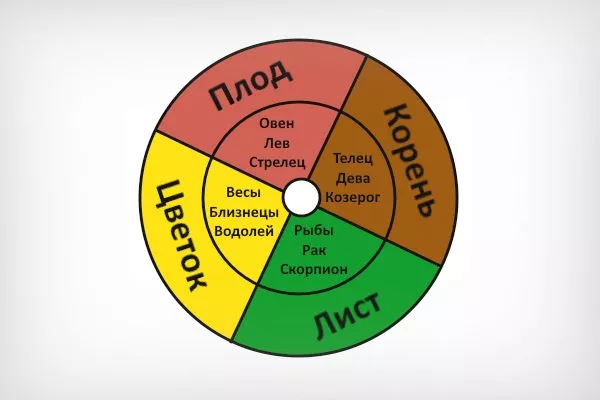
Plants consist of four main organs, each of which is associated with one of the four elements:
- Fruit and seed = Fire
- Flower = Air
- Leaf and stem = Water
- Root = Earth
- ✓ Consider local climate conditions when planning your work, as biodynamic recommendations may require adjustment depending on the region.
- ✓ Check the Moon phase and its position in the Zodiac sign before starting any agricultural work for maximum efficiency.
Each of the 12 zodiac signs is also associated with one of the four elements. According to the principles of biodynamics, when the Moon is in a particular zodiac sign, one can expect better development of the corresponding plant organ and poorer development of other, unrelated organs.
- The fire trine "Aries, Leo, Sagittarius" = Fruit, seed. During this period, the cosmos sends warm impulses to Earth, which are necessary for the formation of nightshades, melons, pumpkins, legumes, and fruit trees.
- The trine of air and light "Gemini, Libra, Aquarius" = Flower. The buds need plenty of light to bloom and retain their fragrance for a long time.
- Water trine "Cancer, Scorpio, Pisces" = Leaf, stem. During this period, the soil is saturated with moisture, which is essential for all cruciferous plants and greens.
- Earth trine "Taurus, Virgo, Capricorn" = Root. During this period, cold impulses reach the Earth, which have a beneficial effect on the fruits underground.
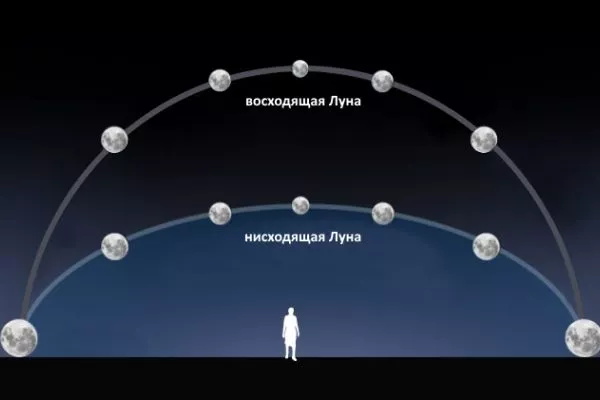
Waxing and Waning Moon
In our calendar, we, like Maria Thun, used the sidereal cycle of change the ascent and descent of the moonAs the Moon ascends, it arcs over the horizon every evening, rising higher and higher each day. As it descends, it arcs lower and lower. This cycle influences the movement of sap in plants.
The influence of the mini-cycle of the moon on plants:
- Waxing Moon (leaves, fruits and all above-ground parts of plants)During the waxing moon period it is favorable. sowing seeds, as germination is strong during this period. During this period, you can harvest early crops (except root vegetables), medicinal plants, and flowers, as well as prepare hay and silage (in Aquarius or Gemini), and other animal feed. This is a good time for storing and preserving harvests (but not when the Moon is in Pisces). Fruits and vegetables harvested during the waxing Moon will be juicier and have a longer shelf life, but it's best to eat them fresh, while they're still rich in vitamins and energy. Avoid replanting plants during this period, as the sap rises!
- Waning Moon (roots and root crops). Favorable plant transplantation, because they take root better. It’s good to carry out pruning trees and bushes, the veal juices and energy move downwards, into the roots. During the waning moon, it is recommended to make compost and apply it to plants (best done in cool weather), prepare and cultivate the soil (just not during wet periods!), transplant seedlings, container plants, trees, and shrubs, and also perform harvest (including root crops, but best on Root Days, when the Moon is in Virgo). Pruning fruit trees (when the Moon is in Leo or Sagittarius), flowering trees/shrubs, and roses (when the Moon is in Gemini or Libra) is possible. Collecting and planting cuttings for rooting is favorable.
- ✓ Harvest in the morning hours when plants are most saturated with moisture and nutrients.
- ✓ Avoid harvesting crops on days when the Moon is in Water signs to prevent rapid rotting.
Phases of the Moon
The Moon revolves around the Earth, which in turn revolves around the Sun. Depending on the relative positions of these celestial bodies, we can observe a certain portion of the Moon illuminated by the Sun. In astronomy, this phenomenon is divided into phases: waxing moon, first quarter, full moon, waning moon, last quarter, and new moon.
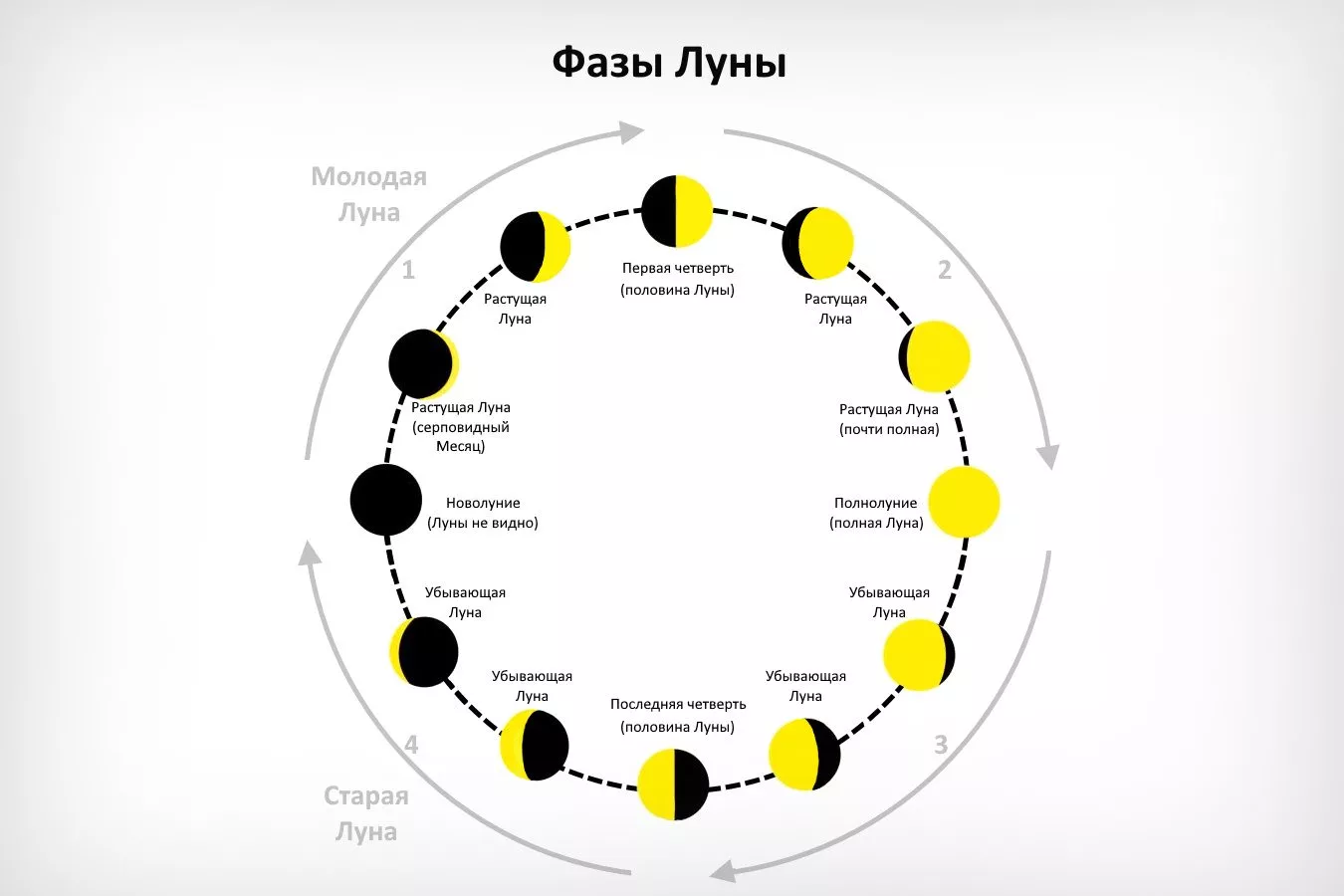
The influence of the moon phase on plants:
- Waxing Moon – the activity of all metabolic processes increases, and the movement of sap accelerates. Energy flows upward, into the stems and foliage, enhancing the development of the above-ground parts of plants.
- Phase 1 (LEAVES)The moonlight is intensifying. The gravitational pull is extremely strong. The energy is moving upward, into the foliage. It's time to sow/plant. above-ground leafy plants, lawn, and grass. Tree grafting, lawn mowing, and foliage trimming (to promote foliage growth) are possible. This is a favorable time for sowing (including green manure), planting, and fertilizing. Shoots for seedlings are pruned during this period.
- Phase 2The moonlight is getting stronger. The gravitational pull is decreasing slightly. The energy is moving upward. You can sow/plant above-ground fruit plants and those that with seeds inside (cucumbers, zucchini, eggplant, pumpkins, watermelons, melons, peas, beans and other legumes, corn, sweet peppers, tomatoes, as well as all fruits and berries), cereals. Tree grafting, lawn mowing, and foliage trimming (to promote growth) are possible, and the best way to do this is 2 days before the Full Moon.
- Full moon – a time for rest, meditation, and celebration. This is a good time to gather medicinal herbs. Harvesting root crops during the Full Moon is prohibited, as is storing them. Two days before the Full Moon, it's favorable to sow seeds (low humidity and warmth are recommended), and to apply liquid manure (in the afternoon, several times during the growing season). During the Full Moon, you can treat plants for pests and fungi (with horsetail infusion, 0.5% sodium silicate, etc.), and cleanse animals of internal parasites (on an empty stomach, for example, with garlic and apple cider vinegar).
- Waning Moon – Now the soil can absorb more liquid than during the waxing moon, so to avoid polluting groundwater, we apply fertilizer now, and not during the waxing moon.
- Phase 3 (ROOTS)Moonlight decreases. Gravitational attraction decreases. Energy is drawn into the roots. This strengthens root growth, which is favorable for transplanting, rooting, and healthy root formation (when propagating by cuttings). Root crops can be sown/planted (carrots, potatoes, beets, radishes, turnips, horseradish, daikon, garlic, onions, leeks, celery root, parsnips, ginger, Jerusalem artichokes, kohlrabi, rutabagas, sweet potatoes, horseradish root, and root parsley). Trees, shrubs, biennials, and perennials can also be planted. All crops can be harvested, fertilized, replanted, and the lawn can be mowed and foliage trimmed (to reduce growth).
- Phase 4Moonlight has diminished to its minimum. Gravitational pull has also diminished. Energy is being drawn into the roots. This is a sterile phase. It's time to rest and prepare for the next cycle. Avoid sowing seeds. Harvesting and storing crops, fertilizing, replanting, weeding, mowing the lawn, and pruning foliage (to reduce growth) are possible.
- New moon – time to rest, meditate, celebrate. You should not sow seeds. You can cut down trees. The day before the New Moon is also a rest day, and don't do any agricultural work. Plants that are starting to get sick or wither can be successfully cured by removing the top of the plant closer to or on the New Moon. The cut is made above a selected bud, which will grow upward and become a conductor.
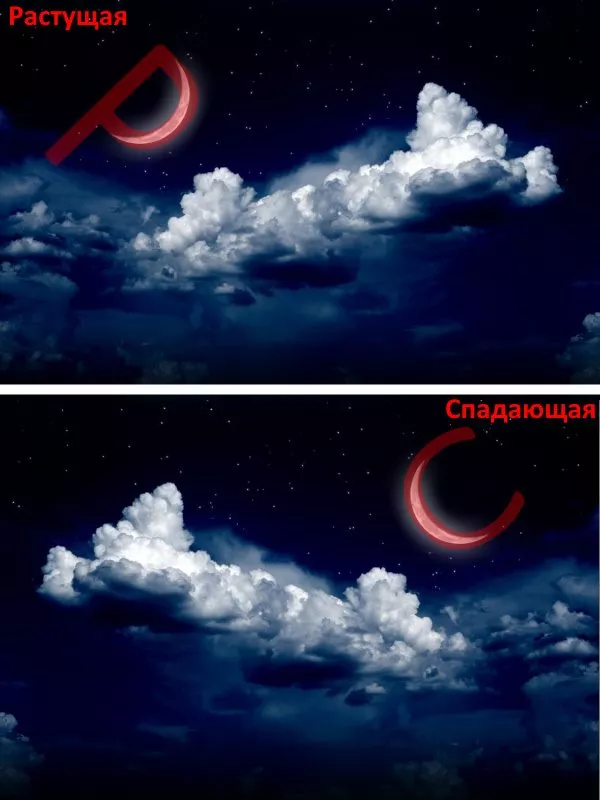
How to determine whether the moon is waxing or waning?
If the crescent moon is in the form of a semicircle from the letter "P" (i.e. you can mentally draw the letter "P"), the Moon is waxing, and if the crescent moon is in the form of the letter "C", the Moon is waning.
💥💥💥What does astrology say about June 2022? Recommendations for farmers💥💥💥
The month will be filled with worries and concerns. It's as if the stars are saying, "Get busy!" Not everything will work out, plans may change, agreements may fall through, and things will stall. Overall, the month will be hectic, but whether you like it or not, it's time to pay off debts and finish previously started tasks.
🚀During the period from June 4 to October 23, 2022 Saturn is moving retrograde (i.e., retrograde relative to Earth) in the sign of Aquarius. This is a time of correcting mistakes, a time of preparation and anticipation, so you need patience and composure, discipline and responsibility. Saturn is also responsible for experiencing practical experiences.
If farming is an important part of your life, then over the next five months, focus on establishing a farm, rethink your approach to gardening, try to learn new practical skills, get rid of what no longer holds value, and tidy up. Don't be afraid to let go of something so that something better can take its place. The time is perfect for this.
🚀From May 11 to October 29, 2022 Jupiter enters a new 12-year cycle and enters the first sign of the Zodiac – Aries, beginning its journey through all 12 signs. Jupiter is the planet of luck and fortune, the planet of expansion and growth of opportunities. Everyone will feel Jupiter's influence, but to varying degrees and in different areas of life.
If you've long dreamed of, for example, starting a new intellectual pursuit (writing remotely for a farming journal, taking training to improve your knowledge), or considering expanding your business (no matter what it is: poultry farming, selling seedlings, bee products, or something else), or planning to relocate and develop your business there, draw up an action plan, discuss a partnership—luck will be with you, despite any difficulties or setbacks. You'll be able to assess the results after October 23rd. Alternatively, devote time now to planning and careful preparation, and after October 23rd, begin realizing your goals.