
Deep litter for pigs is characterized by the presence of lactic acid and photosynthetic bacteria, which help retain heat for a long time. The use of fermentation material creates comfortable conditions, saves money (no need for additional heating), and promotes waste absorption.
The essence and features of the technology
In simple terms, deep litter functions like a composting toilet—specific bacteria are infused into dry sawdust or other material. This technology has been used for many years in the US, Asia, and Europe, as it is highly cost-effective, reducing farm costs. The key principle of deep litter is a continuous chain of chemical reactions that cause fermentation.
- ✓ The pH level of the solution water should be within 6.0-6.5 for optimal bacterial activity.
- ✓ The room temperature when introducing bacteria should not fall below +5°C.
Coprophagous bacteria are contained in special biological preparations. Their action is aimed at the following:
- elimination of unpleasant odors;
- heat release – up to 40 degrees;
- neutralization of pathogenic microflora;
- strengthening the immunity of pigs;
- reducing the number of times the pigsty needs to be cleaned;
- decomposition of animal waste;
- manure composting.
Deep litter is considered durable—it can be used for up to four years. However, the key requirement for this to be true is the constant presence of livestock in the room. Otherwise, the introduced bacteria die (their food source disappears).
After laying the materials, at least three days must pass for the bacteria to begin to act, and the layer thickness must be at least 50 cm, maximum 1 meter.
Pros and cons
Any innovative technology has its pros and cons. Deep litter offers the following advantages:
- economy;
- ease of design creation;
- no need to install a ventilation system;
- wide range of applications – for large farms and private small-scale livestock farming;
- the possibility of using available materials;
- increase in body weight of pigs (weight gain per day is 85 grams);
- there is no need to clean the air from ammonia vapors;
- durability;
- relatively low cost of biopreparations;
- the bedding always remains dry;
- there is no need to remove manure (bacteria absorb it);
- cleanliness of pigs;
- Due to the high temperature of the litter, rodents and other pests do not breed;
- the possibility of using the resulting manure as organic fertilizer.
An automatic feed hopper can be installed in deep litter to feed the birds once a week. This saves on feed.
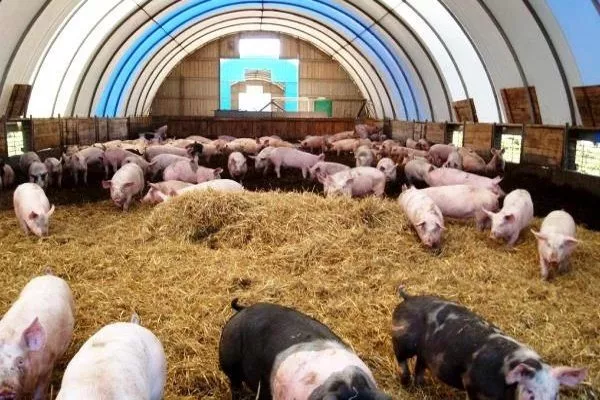
Among the disadvantages, one can note the difficulty of removing the litter (although this should be done every 4-5 years). This is due to the fact that the layer is too thick.
How to properly arrange deep litter?
To ensure that the deep litter system functions properly, please follow these guidelines:
- eliminate drafts;
- provide the room with simple ventilation;
- Do not lay the material on concrete flooring – it is better to use soil;
- minimum air temperature – 0 degrees;
- natural materials must be dry (this is the only way to add the biopreparation to them);
- Before laying the first layer, disinfection measures are carried out, dirt and old manure are necessarily cleaned out;
- the temperature when creating the bedding should be from +5 to +10 degrees;
- the first layer should be 20 cm, after which the preparation is added (then the same amount of materials is laid down, the preparation is added again, etc.);
- The basis of the pigs' diet should be fiber (40-60%), since it is this substance that increases fermentation.
The biological layer should be made of natural materials. Cereal straw, sawdust, hay, and similar materials are used for this purpose. You can use one of these materials or mix them in a free ratio. When the biological material wears off, an unpleasant odor develops, and the bedding does not absorb moisture. Various products are used to create a deep bedding layer.
- ✓ Sawdust should be of a large fraction to prevent rapid compaction.
- ✓ The straw must be free from signs of mold or rot.
We also recommend that you read the detailed information on pig care in this article: Features of pig breeding.
Animal Farm
This product is popular among farmers. It is available in powder form. When installing the litter layer, follow these recommendations:
- To achieve a positive result, a soil floor should be created, with a slight slope. If the pig barn has a concrete floor, a grate should be laid on it to allow drainage. The soil should be well-drained, which can be achieved by adding a small amount of sand or sawdust.
- When laying materials, the temperature must be above freezing. Otherwise, bacteria will not multiply and function.
- The packaged substance is mixed with a dry substrate—flour, bran, or sawdust. Only then is it sprinkled over the surface of the straw.
- To distribute the powder evenly, sift it through a sieve.
- As it should be, a layer of natural raw materials of 20-30 cm is poured first, then the preparation.
- The pigs are launched immediately.
- After a couple of days, it is necessary to add straw and the preparation again (layer up to 30 cm).
- To enhance bacterial activity, the preparation is added once a month. This is especially important when the layers are heavily compacted.
- The minimum shelf life of Stalny Dvor (Stalny Dvor) without additives is one and a half years. However, this is only if it has an organic base. If the product is added to a mixture of straw and sawdust, the shelf life is extended.

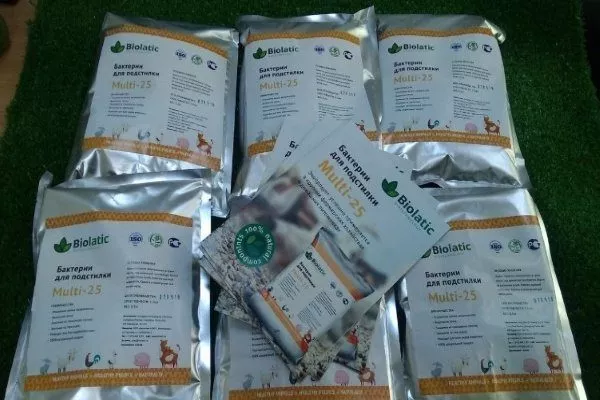
Biolatic Litter Bacteria
Another popular new-generation product, approved for use on concrete surfaces, the layer should be 40-50 cm thick. If the bedding layer is formed on soil, the layer height should be increased by 10-15 cm.
Rules:
- One head should be placed per square meter, that is, if there are 5 pigs in the pigsty, then the room should be at least 5 square meters.
- To promote bacterial activity, it is recommended to add the product to sawdust. If you combine it with straw, the ratio of sawdust to other material should be 7:1.
- The humidity of the interlayer should not exceed 30%.
- There's a "wet start" technology used to create deep litter using Biolatic. This involves combining a free-flowing powder with purified, chlorine-free water. 2 kg of the product is required per 100 liters of water.
- First, create a 20 cm thick layer of sawdust, then spread the resulting solution. For even application, it's recommended to use a spray bottle.
- Next, another layer is created, this time using manure or bran. The solution is then spread again.
- They release animals.
- If a single barn contains many pigs, the layer should be replaced every 2-3 years; if there are only a few, every 4-5 years. This means that with fewer pigs in the barn, the duration of the product's effectiveness increases.
- A special feature: it's advisable to dig the soil layer 1-2 times a week to evenly distribute the bacteria throughout the room. If you don't dig it, you'll have to add the bacteria monthly.
- After the sawdust layer has become very compact and settled, it is necessary to add the biological agent again, but in smaller quantities.
Netto-Plast
The most well-known and widely used product. This universal product is ideal for soil, concrete, wood, and other materials. This means you can create bedding layers on any surface. Furthermore, there's no need to replace the existing bedding layer, as the enzymes can multiply on any substrate.
Among natural materials, sawdust and wood shavings are preferred. If a mixed bedding is used, seeds, buckwheat husks, straw, and other materials can be added. However, wood should make up more than half of the bedding, at 10-20%. There's no need to measure the room's humidity.
The process of arranging deep litter:
- Lay natural materials over the floor surface. Be sure to allow for shrinkage (usually 10-15 cm).
- Sprinkle the powdered product by hand as evenly as possible.
- Dig with a shovel or pitchfork, which will speed up the fermentation process.
- Let the pigs in.
Features of using the drug Netto-plast:
- The minimum shelf life of bacteria is 3 years from the date of application. However, to achieve this, all instructions must be followed.
- The penetration of antibacterial agents and chemicals that destroy beneficial bacteria into the layers is excluded.
- Strictly ensure that feces are evenly distributed throughout the barn. If pigs defecate in only one area, you'll need to shovel the excrement to other areas to ensure the bacteria are active everywhere.
- It's advisable to create ventilation. To achieve this, periodically loosen the layers. A pitchfork can be used.
- When compacting, add additional wood chips or sawdust. To prevent the bedding from becoming compacted, it's advisable to use coarse wood chips.

Methods of keeping pigs and piglets on deep litter
This technology is relatively new in our country, but has already established itself as a leader. Deep flooring can be used in a variety of ways, demonstrating its versatility.
Walking method
This is the most optimal option for using deep litter. It can be used for adults and piglets at any stage of development. However, there is one rule that must be strictly adhered to: pigs of approximately the same age must be housed in the same pen. This is because a layer of material up to 40 cm thick is sufficient for piglets, while a deeper layer is needed for older pigs.
The free-range method involves setting up an open pen near the pigsty, where the biologically active material is placed. Free-range feeding should occur daily, with a maximum break of three days. After the onset of cold weather, the bedding is moved to the permanent housing area.
Non-walking method
This method is used in winter, when it's impossible to take the pigs outside. This will increase the sows' reproductive capacity and accelerate the growth of the piglets.
This is achieved through the microclimate created. Furthermore, the lack of high humidity helps the animals develop resistance to disease.
You can also watch a video that provides helpful tips on keeping pigs on deep litter:
Reviews
Using deep litter is a cost-effective approach that reduces costs, creates comfortable conditions for animals, and saves time and effort. The key to successfully using biotechnology is strictly following the recommendations, requirements, and dosages of the products.