
Among all the breeds, Vietnamese pot-bellied pigs stand out in particular, as they are prone to quickly gaining a lot of weight, which makes them the easiest to handle. fatten up for slaughterBreeding pigs provides the owner with a supply of meat.
History of the breed's origin
The breed's name is the result of a historical error. Vietnamese pigs were bred in Southeast Asia. However, they arrived in Europe from Vietnam in 1985, hence the breed's name. Vietnamese pigs were recently introduced to Russia.
Work to improve the breed is ongoing. It is being actively pursued in Ukraine, Hungary, and Canada.
The full correct name of the breed is the Asian herbivorous pot-bellied pig.
| Breed | Average weight of an adult, kg | Age at reaching slaughter weight, months | Fertility, piglets per farrowing | Disease resistance | Feeding requirements |
|---|---|---|---|---|---|
| Vietnamese Pot-bellied | 80-100 | 7-8 | 5-20 | High | Herbivores require vitamin supplements |
| Korean | 70-90 | 8-10 | 6-12 | Average | Herbivores are less demanding of supplements |
| Chinese mini pigs | 20-40 | — | 3-5 | High | Omnivores, special foods |
Many people confuse this species with Korean pigs, or believe that Vietnamese and Chinese pigs are the same animal. In fact, Chinese pigs are popular decorative miniature pigs. Despite the significant differences in appearance, they are indeed related to the Vietnamese pot-bellied pig.
Description and characteristics of Vietnamese pigs
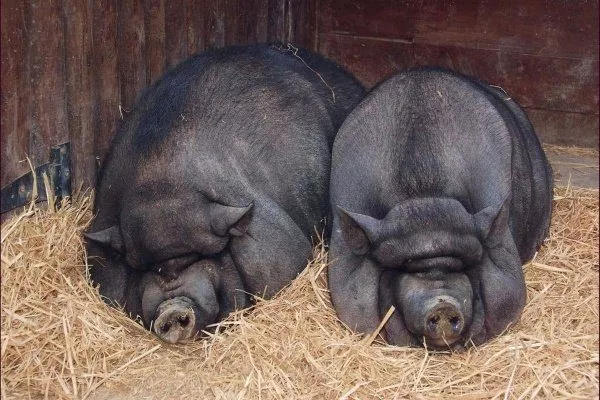
Vietnamese pigs are large animals. Adults should weigh between 80 and 100 kilograms. Breeding specimens of the breed can weigh up to 150 kilograms. Pigs gain weight rapidly during the first five years of life, but this process gradually slows. Wild boars' tusks begin to grow at six months and reach 10-15 centimeters.
Representatives of this breed do not exhibit a wide variety of colors. They can be:
- black (mostly common color);
- black and white.
A noticeable external difference between the Vietnamese breed and others is its drooping belly. This becomes apparent from the first month of life.
The animals are short in body structure, with short, straight, strong legs, broad shoulders and chest, a large head with small, erect ears, a flattened muzzle, and a folded snout.
Advantages and disadvantages of breeding Vietnamese pigs
The Vietnamese Lop-eared pig is one of the most popular breeds for good reason. This is due to a number of advantages:
- Rapid weight gain for slaughter. By 7-8 months, this breed reaches 80 kilograms.
- Early sexual maturity. Females are capable of producing offspring at four months, while boars' reproductive instincts awaken at six months.
- Fertility. A sow can give birth to 5 to 20 piglets, producing two litters per year.
- Ease of breeding. Vietnamese Pot-bellied sows are caring mothers who do not attack their piglets, unlike sows of other breeds.
- Herbivory. This trait makes it easier for farmers to feed their animals.
- High immunity. Common diseases affecting pigs do not affect Vietnamese pot-bellied pigs, so they do not require vaccinations.
- Memory for poisonous plants. Animals remember which foods have harmed them and pass this knowledge on to future generations through their genes.
- Cleanliness. Pigs of this breed always relieve themselves in the same place, located away from the sleeping and feeding areas.
- Unpretentious to climate fluctuations, the breed easily tolerates extreme heat and cold.
- Peacefulness. Vietnamese pigs are non-aggressive, friendly, do not eat their piglets, do not bite, do not squeal, and are even trainable.
- There is no unpleasant odor.
- Valuable meat. It is very tender and contains low levels of harmful cholesterol.
The breed has few disadvantages. These include:
- Susceptibility of animals to helminths.
- Drafts in the pigsty are especially dangerous for Vietnamese pigs.
How to choose piglets?
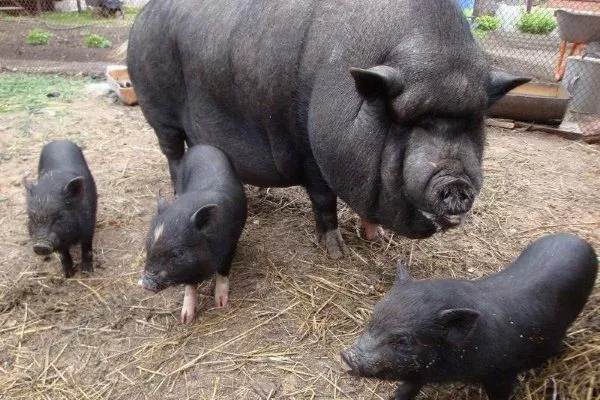
There are a number of rules that, if followed, will help you acquire healthy and strong Vietnamese pot-bellied piglets:
- Buy piglets at the age of 1 month, then they will get used to the new environment faster and easier.
- Find out from the breeder the baby's birth weight and weight gain dynamics.
- Ask to see the piglet's parents; their appearance can determine the quality of the offspring. Pay particular attention to the sow; she should be thinner and have drooping milk lobes. This is a sign that her piglets are about a month old.
- The cub itself should have strong legs, pronounced muscles and a sagging belly.
- For breeding purposes, avoid purchasing piglets from the same litter or from related parents. Their offspring will be sickly and have abnormalities.
- Pay attention to the mood of the little pigs. If they are healthy, they will wag their tails and play actively.
- When purchasing piglets, ask the owner what kind of feed they were feeding the piglets. Young pigs can be transitioned to any other diet, but gradually to avoid stool disorders.
Housing conditions, pigsty
Vietnamese pot-bellied pigs are unpretentious, but if you plan to breed this breed long-term, it is better to prepare thoroughly. To start, build a pigsty:
- It should be strong and without gaps. It's best to have windows higher than the pigs' height to allow air circulation without blowing drafts on the animals. Brick is the optimal material for a pigsty.
- It's advisable to pour concrete on the floor. This will make cleaning up after the pigs much easier.
- The pigsty is divided into stalls by wooden partitions. The "flip-flops" are small, so the stalls for them need to be small.
- Wooden sleeping platforms are installed in the departments.
- Heating is recommended. This breed tolerates frost, but weight gain will be reduced. Low temperatures can be fatal for the sow and her offspring.
Vietnamese pigs go out to graze all year round. Therefore, they need a pen. It should be fenced in, with a canopy under which the animals can shelter from the heat and inclement weather. It is recommended to dig in a few rough logs for them to scratch themselves against, and make a mud pool. This will allow the pigs to cool off in the heat and keep away pesky insects. The water in the pool should be changed at least once a week.
Feeding, products
Many inexperienced farmers, having learned that Vietnamese pot-bellied pigs are herbivores, feed them only pasture. While the pigs do survive on this diet, they won't achieve the desired weight gain.
In addition to natural grazing, which guarantees fresh grass in the diet, it is worth providing "Vietnamese" horses with:
- clover and alfalfa hay;
- fresh zucchini, pumpkin, carrots, apples;
- boiled potatoes;
- vitamin supplements.

This breed thrives on a grain-based feed mixture consisting of ground barley and wheat. Legumes, oats, and corn can be added, but not more than 10% of the total weight. Otherwise, they will cause excess fat accumulation.
The meat's flavor improves when pigs are fed wet feed. To prepare it, a grain mixture with 5-10 grams of salt is steeped in boiling water.
Sows should be given milk, eggs, whey, fish oil, and vitamins. These supplements are added to the cooled grain porridge.
Vietnamese pot-bellied pigs have a small stomach and intestinal diameter, so they are not suitable for food:
- coarse feed;
- straw;
- fodder beet;
- high fiber foods;
- abundance of corn, oats and peas in the feed.
When caring for this breed, it is necessary to regularly give deworming medications.
We also recommend reading, How to make a pig feeder yourself.
Reproduction
The most important thing in breeding pot-bellied pigs is to prevent a boar from mating with a female pig. The offspring will be sick, will gain weight poorly, and may be infertile. To prevent this, you need to know the signs that a sow is ready to mate:
- anxiety and nervousness;
- swelling of the genital loop;
- discharge from the genitals appears;
- freezing in place when pressure is applied to the croup.
Although sows reach sexual maturity at 4 months, and in some cases even earlier, they should only be bred when they have reached a sufficient weight—32-35 kilograms. Otherwise, the offspring will be frail, and the sow may have difficulty carrying the foal and giving birth.
A pregnant sow carries her piglets for 114-118 days. In her first litter, she will give birth to about five piglets. Subsequent litters will average 10-12, but can reach as many as 20.
Five to six days before the due date, the sow will begin to rest and make a nest of straw or hay. If her belly has dropped and colostrum has appeared on her teats, farrowing will occur within the next 10 to 20 hours. Here's what to prepare for:
- Clean the stall and put in fresh hay.
- Fence off and insulate the piglet area. During the first few days, the piglets should be kept at a temperature of at least 20 degrees Celsius, and preferably 30-32 degrees Celsius.
- Increase the overall heating of the pigsty.
- Make sure the female always has clean water. She will not feed on the day of birth.
- Clean and disinfect the machine.
- Prepare an insulated place for the piglets.
- Provide the sow with clean water.
- Prepare the necessary tools and medicines.
Many people avoid interfering with the birthing process and leave the piglets alone for the first few days. However, this can result in the death of the piglets, especially during the sow's first litter. The piglets are born very hungry, and if the sow doesn't produce colostrum early or soon after farrowing, they may die. Therefore, it's important to prepare for the birth itself in advance:
- backup option for feeding newborn piglets;
- diapers for wiping and wrapping;
- a clean flannel cloth to clear mucus from the eyes and respiratory tract;
- disinfectant (for example, chlorhexidine solution);
- scissors and thread to sew up the umbilical cord;
- iodine and cotton wool to cauterize the wound.
Labor in Vietnamese sows lasts from 3 to 5 hours. The end of the process is signaled by the delivery of the placenta.
Raising offspring
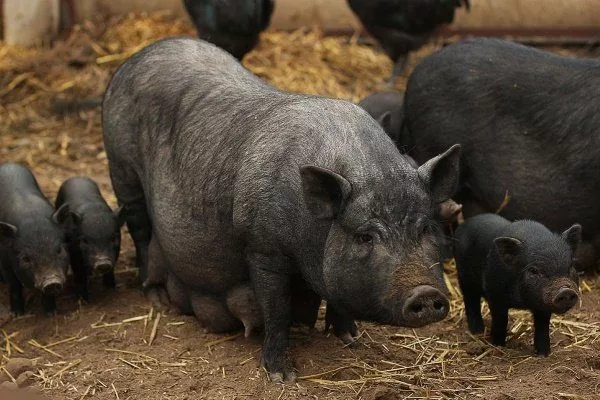
Piglets are surrounded by their mother's care; her milk provides them with all the nutrients they need for the first few days of life. However, strong piglets can push weaker piglets away from the teats; this needs to be monitored, and everyone needs to be helped to have access to nutrition.
Sows' milk contains no iron. This often leads to anemia in piglets. Therefore, they are given intramuscular injections of iron-containing supplements designed for animals, with the dosage and number of injections prescribed according to the instructions.
The following additives are introduced into the diet of the weekly offspring:
- chalk;
- charcoal;
- calcium;
- phosphorus.
On the tenth day, they are given a drinking bowl with clean water; by this time, each piglet should weigh at least 1 kilogram. On the twentieth day, a mixed feed porridge with vitamins is introduced into the piglet's diet. At one month, the piglet is already fed adult food. At this age, it weighs 3 kilograms and is ready for sale.
Weaning should be done gradually, not overnight, offering the piglets an alternative to milk. Otherwise, the piglets will develop nutritional deficiencies, and the sow will develop mastitis.
At 40 days of age, piglets can be given anthelmintic treatments. For example, the drug Brovadazole.
Breeding Vietnamese pigs as a business
A Vietnamese pot-bellied piglet costs 3,000 rubles, while an adult costs 8,000 rubles. To breed, you only need two females and one male.
The maintenance and feeding of this breed require little investment. As a result, all costs will be recouped within one year.
The nutritional properties and low levels of harmful cholesterol, rare among pork meat, make Vietnamese pot-bellied pigs unique, increasing their value. They are in high demand at farmers' markets and food markets.
At meat markets, the meat of young piglets is especially prized. However, more often, adult animals weighing 80-100 kg are sent to slaughter.
To learn more about the care, feeding, and breeding of Vietnamese Pot-Bellied pigs, watch this video:
Currently, the Vietnamese pot-bellied pig is the most profitable breed for home breeding. It grows quickly, produces large litters, has a strong immune system, and a docile nature. Its meat has more beneficial characteristics than other pig breeds. Maintenance costs are minimal and are fully covered by the sale of the first litter.