
This animal has a distinctive character, and its unique appearance attracts particular attention. This breed is characterized by its isolation from people and its habitation near rivers and lakes. At night, the pig emerges in search of food, devouring everything it encounters.
The emergence and spread of the breed
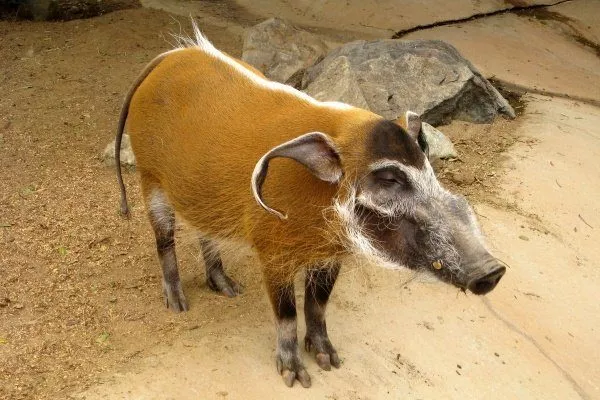
The African hog (or river hog) is an animal that is noticeably different from its more common relatives. It has a distinctive appearance and character, significantly different from that of ordinary domestic pigs. These hogs are strong, agile, and fast, which helps them survive in the wild. The hog gets its name from the long hair that protrudes from the sides of its snout.
Bush pigs originated in West and Central Africa, primarily found in Guinea and Congo. They avoid drought and are found near bodies of water. They are common in both tropical forests and savannas.
Previously, the African and Madagascar bush pigs were considered a single species. However, after comparative analysis, it was established that, although similar in appearance, the animals are actually two distinct species. Madagascar bush pigs are found in eastern and southern Africa and have a less variegated coat than the bush pig.
African bush pigs can vary in color and size, leading to several distinct subspecies, each clearly distinguished by their external characteristics. Previously, five varieties of bush pigs were recognized, but scientists now classify them all as a single species.
- ✓ Coat color and the presence of a white stripe along the ridge.
- ✓ Size and shape of tusks in males and females.
- ✓ Length and color of ears with tassels.
External features and character of the animal
African pigs live near rivers, swamps, or lakes, as they dislike drought. They have a rather distinctive appearance that distinguishes them significantly from other breeds:
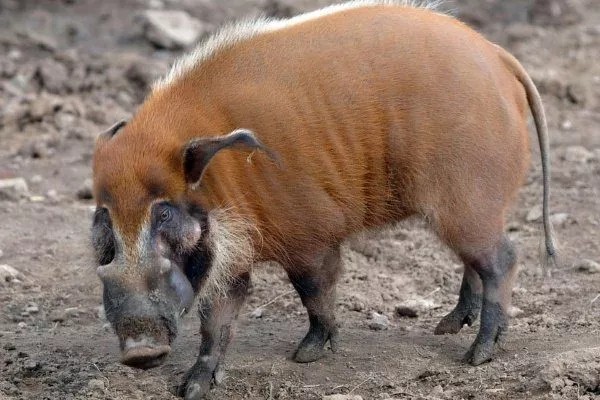
- Short, stiff coat of reddish-brown colour, with a white stripe along the ridge.
- The body length on average reaches 1.5 meters, the height is 80 centimeters, and the weight is 120 kilograms.
- The head is proportional to the body size. The snout is elongated, and the fur is grayish-white. Animals with a dark spot on the forehead between the eyes are most common.
- The animals have a compact and proportional body. The limbs are short and dark below the hock.
- There are white fur circles around the eyes. The sideburns on the sides of the muzzle are the same color.
- African boars have long tails—about 40 centimeters. The tail is practically hairless, with only a distinctive tuft at the end.
- More distinctive about the breed are its distinctive ears—long, drooping, with tufts at the tips. They are colored white and black.
- Their main defense weapon is their sharp tusks, which adult animals can use to cut through almost any object. Males have particularly large tusks, while females have slightly smaller ones.
African bush pigs are nocturnal. During the day, they hide in dense bushes or other vegetation near water bodies. They emerge to search for food when it begins to get dark.
Habitat features
Animals are accustomed to an active lifestyle. At the slightest threat, they try to flee from an enemy, but if forced, they defend themselves fiercely and fearlessly, protecting their offspring.
The bush pig has a keen sense of smell and is quite intelligent. Attempts to catch them with poisoned bait are often unsuccessful.
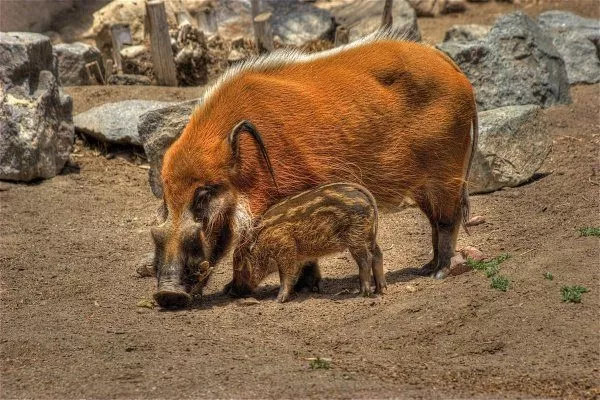
There are isolated cases of domestication of these animals, mainly in East Africa, where they are kept in semi-free conditions.
Each family has its own territory, the boundaries of which are marked by the male: he leaves marks on trees and secretes a special secretion.
Interactions between this pig breed and humans are quite problematic, as the animals are prone to destroying crops and engaging in other harmful behaviors. The bush pig has an aggressive nature, but it has very few enemies in the wild, as its main predator, the leopard, has been driven out of its habitat by humans.
Reproduction
A herd, led by a leader, consists of several females and piglets. Such a family can consist of up to 15 individuals. The female carries her offspring for an average of 4.5 months, giving birth to 1 to 6 piglets. The sow nurses the piglets for 2 to 4 months, after which they gradually begin to eat the same diet as adults. African bush pigs reach sexual maturity at 3 to 4 years of age.
Before giving birth, African bush pigs build nests resembling haystacks. Within a few hours of birth, the piglets are able to follow their mother. Adult females and males of the family look after them. Initially, the piglets drink their mother's milk, then feed on the communal food of the herd. In the wild, African bush pigs live for about 15-20 years.
Nutrition
The animal is quite unpretentious in its diet—it can eat almost any food. They are most accustomed to eating various fruits, tubers, and roots. They also feed on insects, larvae, and other invertebrates.
If a pig is lucky enough to find some carrion, it will eat that too. Today, with the breed somewhat domesticated, it can feed on grapes, pineapple, and other cultivated plants.
Diseases
Scientific research has established that animals suffer from African swine fever. The disease was first recorded in Africa at the beginning of the last century. The first carriers of the plague were wild local pigs, including bush pigs. African swine fever then began to spread to some countries in Southern Europe and the Americas, and by the turn of the 20th and 21st centuries, it had spread to almost the entire region. Today, the disease is found in Russia, Asia, and Western and Eastern Europe.
- Immediately isolate suspicious animals from the main herd.
- Contact your veterinary services for diagnostics.
- Disinfect premises and equipment.
African swine fever manifests itself in affected animals depending on the form of the disease. In acute cases, the pig dies almost immediately; in acute and subacute cases, the disease is identified by several symptoms: difficulty breathing, fever, hind limb paralysis, weakness, vomiting, and others. Mortality from the disease ranges from 50% to 100%.
Since most wild pigs are herd animals, African swine fever can spread very quickly due to close contact within a herd.
The African bush pig is a remarkable wild animal, characterized by its striking appearance and aggressive nature. It is hostile to humans, but has even been tamed by humans. These animals feed on almost anything they come across, allowing them to survive in the wild.