
Pig barn ventilation helps maintain a healthy indoor climate, which improves pig productivity. Adequate air exchange can be achieved using fixed devices available in specialized stores, or you can build your own. However, certain requirements must be taken into account.
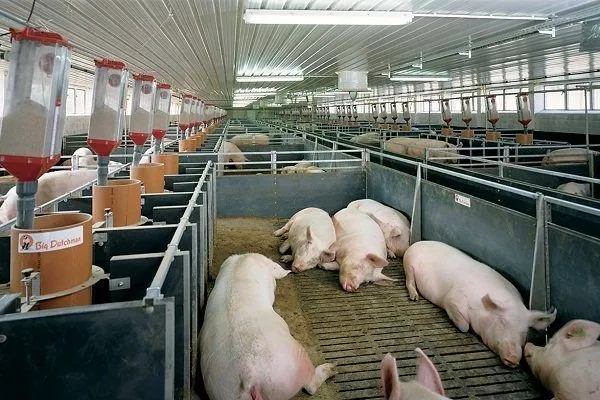
Why is ventilation needed in a pigsty?
A comfortable microclimate in a pig barn is based on three main factors: temperature, humidity, and the availability of fresh oxygen. The ventilation system is designed to maintain these parameters within the building. Simply put, constant air circulation serves the following functions:
- removes carbon dioxide and ammonia from the pigsty, which is released after excrement;
- saturates the room with oxygen;
- normalizes humidity levels (excessive dampness is eliminated);
- prevents the formation of drafts;
- prevents the development of pathogenic microorganisms, mold, fungi, etc.
This leads to the following favorable factors:
- animal growth is accelerated;
- increases fertility;
- the mass increases;
- the taste of meat improves;
- energy is saved (if you install ventilation with additional functions);
- strengthens the immunity of pigs;
- Infection is prevented.
During the cold season, airflow speed must be monitored especially carefully, as excessive airflow can cause death in livestock. The maximum airflow rate is 22-25 meters per second. Measurements are taken at a height of half a meter above the barn floor.
Ventilation options
Ventilation systems can be artificial or natural. Each has its own characteristics, advantages, and disadvantages.
Natural
Natural air circulation requires openings in the wall or ceiling, such as windows and vents. These elements are typically created during the construction of the pig barn, so they are included in the layout.
- ✓ Efficiency depends on wind direction and strength.
- ✓ The need for symmetrical arrangement of inlet and outlet openings for uniform air exchange.
If a farmer wants to allow fresh air to enter after building construction, they'll have to make holes in the designated location. This requires considering the building's construction material, the placement of formwork, rafters, and so on. However, in this case, the most advantageous option is installing a window directly in the wooden door. To do this, simply make a hole, install a mini-door, and a latch.
In many cases, these measures are insufficient, as the room must have two openings—one for air intake and one for ammonia gas exhaust. If the barn contains many pigs, more than two openings are required.
In addition to standard vents, you can install structures made of metal or plastic pipes mounted in the ceiling. Air enters naturally through the wind. Therefore, this system has a significant drawback: in calm weather, there is no air circulation.
You can see how natural ventilation with a condensate drain works in the following video:
Artificial
The artificial structure is a human creation. In this case, fresh oxygen is supplied to the pigsty through special devices powered by electricity. In short, air circulation is forced.
Based on this, we can conclude that weather conditions, wind, and climate do not affect the functionality of ventilation. Furthermore, modern devices are available with additional features for heating the room, controlling humidity, purifying the air, and so on.
Artificial ventilation requires energy consumption when used, while natural air circulation is completely free for consumers. However, the air exchange rate in the latter case is much lower.
Types of ventilation systems and their design
| Type | Energy consumption | Weather dependence |
|---|---|---|
| Natural | No | High |
| Artificial | Yes | No |
Roof (shaft)
This type is considered cost-effective and highly efficient. DIY construction requires little financial investment or experience. The principle is based on the use of different temperatures within a single "room." Based on the laws of physics, warm air emanating from the room rises to the ceiling, then moves through a ventilation shaft (made of pipe) and is exhausted outside. Side openings are used to direct airflow.
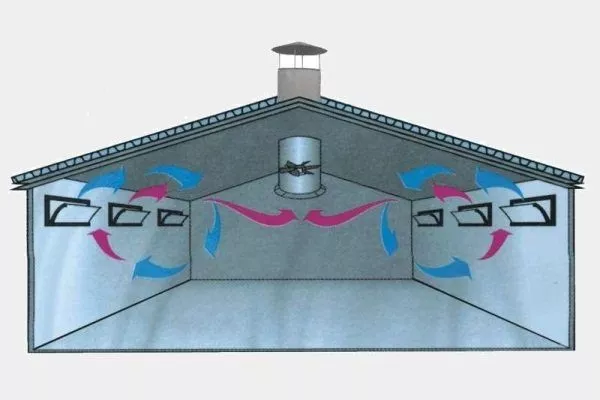
How does air circulate? This design requires wind. Otherwise, oxygen doesn't penetrate, and carbon dioxide is released rather slowly.
Transverse
Cross-flow ventilation is considered a natural ventilation method, as the air circulation rate depends on wind intensity. It's a relatively cost-effective option, requiring minimal expense. Fans can be used to ensure continuous ventilation of the pig barn.
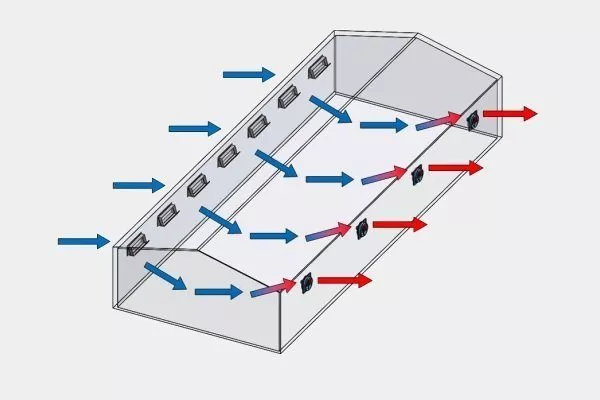
The system is based on openings in the walls, installed in two rows. On one side, valves are installed to allow oxygen to enter. On the other, stationary fans are installed, configured to force air out into the open air.
This method is used for large piggeries. Fans must be set to a minimum airflow rate. The openings must be positioned as symmetrically as possible.
Longitudinal
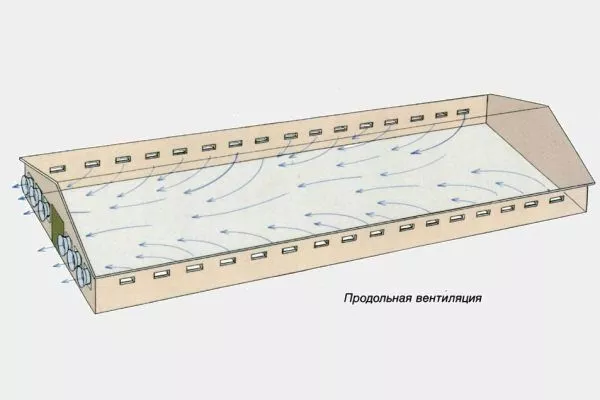
The longitudinal system is completely identical to the previous option, but with the difference that the valves and openings (with fans if necessary) are mounted on the ends of the building. This allows for ventilation of absolutely every corner of the room. It is also ideal for large farms with large livestock.
Tunnel
This type of ventilation can cover a fairly large space, and air circulates actively. Its main feature is the use of louvers on the ventilation ducts. They are mounted at the end of the structure, symmetrically to the fan openings, that is, opposite them. This creates air movement similar to a tunnel, hence the name.
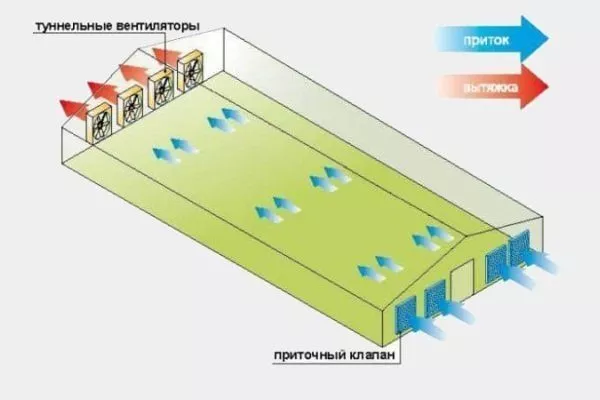
The main advantage is the ability to regulate the airflow speed. Specifically, if the louvers are fully open, air moves quickly throughout the space; if they are closed, circulation slows significantly. The system uses powerful industrial-grade fans (suitable for large pig barns). Along with the force of the blades, the airflow also affects ventilation, so in windy weather, the mechanism can be turned off or its speed reduced.
Modern models have an automatic function, so the speed decreases as the wind increases. This reduces energy consumption and prevents drafts.
Diffuse
This type is similar to the roof type, but with the difference that casement windows are installed on the side walls. To create a diffuse system, openings must be made to allow air flow into the room. There should be three openings:
- the first one is located on the roof (if it is a 2-pitched roof, then in the center of the ridge);
- the second one is in the wall on one side;
- the third is in the wall on the opposite side.
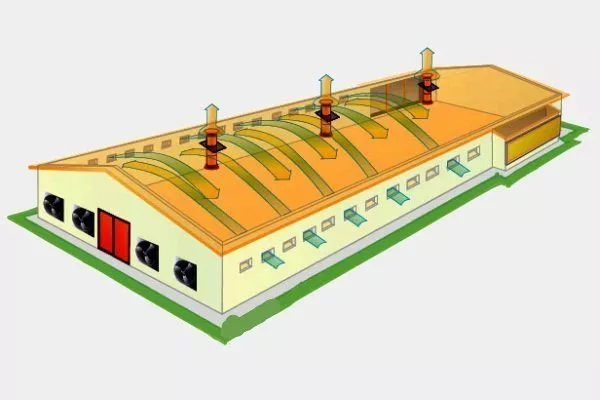
The installed vents on the windows are adjustable (raising them allows more airflow into the room). Fans can also be installed to circulate air in calm weather.
How to make ventilation for a pigsty yourself?
To ensure that the ventilation system meets all standards, it is necessary to comply with special requirements for pig house ventilation:
- in summer, the room should be ventilated several times more often than in winter, due to the hot weather);
- the air flow speed in summer is 0.2 meters per second;
- the air flow in winter should have a speed of 0.1 m/sec.;
- The flows should not be directed towards animals.
What tools and materials will be needed?
Each type of ventilation requires specific tools and materials. We'll look at a forced-air roof ventilation system using fans. What you need to prepare:
- two identical fans with different operating modes;
- plastic/metal pipe with a diameter of 10-20 cm;
- two grilles for exhaust outlets;
- regulatory shields;
- air diffuser;
- fasteners – staples, screws, bolts, etc.;
- deflector;
- meter;
- drill, preferably electric;
- hammer;
- hacksaw.
Manufacturing
Step-by-step instructions for installing a ventilation system:
- First, you need to make holes for the windows. They should be located near the roof.
- We install fans on them according to the instructions.
- Grilles are installed on the outside, and air diffusers are installed inside. This ensures even airflow throughout the entire barn.
- Install shields to stop the air flow during strong winds.
- Make a hole in the roof that matches the diameter of the pipe.
- Insert the pipe and secure it with fasteners.
- Install a deflector, which is aimed at increasing the draft force.
- Attach a protective "umbrella" to the pipe to prevent dirt, leaves, and wet precipitation from entering the system.
- Apply construction foam to all cracks to seal them.
- If ventilation is installed before winter, the pipes must be insulated. Various materials and improvised means (mineral wool, foam, blankets, fur coats, rags) are used for this purpose.
Automation tools
To avoid frequent visits to the pig barn to measure temperature and humidity levels, as well as other parameters, the ventilation system can be automated. This requires specialized automation devices. These may include:
- temperature sensor;
- humidity controller;
- fan blade speed controller;
- control station (collects readings and monitors them);
- servo drives (automatically open, close and regulate valves on the ventilation shaft).
8 recommendations from experts
To avoid mistakes when installing ventilation equipment, it's important to follow the basic rules and requirements for the specific system. It's a good idea to consult the recommendations of those who have already built similar systems.
Please pay attention to the following aspects:
- The pipe located on the roof should be 120-160 cm above the roof level.
- It is advisable to fix the pipe with special clamps.
- For natural air circulation, the wall openings are mounted half a meter above the floor on one side and 50 cm above the ceiling on the other. This will prevent drafts.
- It's preferable to use a round ventilation duct, as a square duct doesn't provide a high level of air exchange. Therefore, pipes are used.
- The opening for fresh air intake must comply with the standards: 2 openings of 2 cm each are required per 1 cubic meter of flow.
- The larger the pigsty, the more powerful the fans need to be.
- The noise level of the system must be taken into account. There are standards for acceptable fan installation in a pig barn, ranging from 57 to 80 decibels. If the standards are not met, the installation was improper. To avoid this, a tarpaulin is inserted into the ventilation ducts during installation.
- After installation, be sure to conduct a smoke test. Close the doors, windows, and vents in the pig barn and let smoke in. The result is determined by the rate of smoke removal.
You can also watch a video about ventilation in a pigsty (without electricity) in the following video:
Whatever ventilation system you choose, always follow the fan instructions. Consult with specialists before beginning any work, and if you're unsure of your capabilities, it's best to hire professionals. Remember, the success of your farm and the health of your animals depend on the design.