
Cysticercosis is a dangerous invasive disease in pigs that can remain asymptomatic for long periods of time, causing significant economic losses to farmers. This article explains how the helminth spreads, how to detect it, and how to prevent infection.
Pathogen
Pigs are susceptible to infection by two types of cysticerci:
Cellulose cysticercosis
Cysticercus cellulosa (cellulosic cysticercosis) develops after the penetration of pork tapeworm eggs into the pig's body.
A single cysticercus is a fluid-filled bladder up to 15 mm in diameter. The cestode's head, the scolex, with its attachment organs (hooks and suckers), is located on the bladder's inner surface.
The prevalence of helminths is influenced by seasonality—pigs are particularly susceptible to finnosis in the spring and fall. This is because cestode eggs can survive for extended periods in a humid environment and at temperatures around 18°C.
Typically, helminths affect muscle tissue, less often various organs, the brain, spinal cord and lower limbs of pigs.
| Parameter | Cysticercus cellulosa | Cysticercus tenuicollis |
|---|---|---|
| Size | Up to 15 mm | 0.5-5 cm |
| Form | Spherical bladder | Blister on a stalk |
| Fixation organs | 4 suction cups + hooks | 2 hooks + proboscis |
| Main localization | Muscles, heart, brain | Liver (80% of cases) |
| Seasonality | Spring-autumn | All year round |
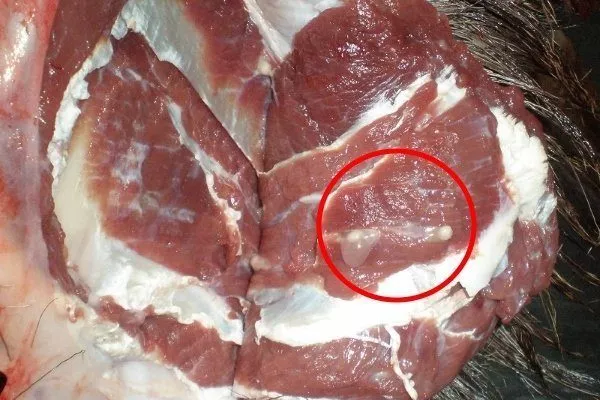
The most common location of parasites is the upper part of the body:
- head area – chewing muscles, tongue;
- occipital and shoulder region;
- heart.
Cysticercosis tenuicollis
Another variety is – Cysticercus tenuicollis (thin-necked, tenuicollis). It is a vesicle on a stalk. Its size varies from 0.5 cm (a pea) to 5 cm (a chicken egg) in diameter. The vesicle consists of fluid with a scolex inside, which is armed with two hooks and a proboscis.
Pigs can become infected with Cysticercus tenuicollis at any time of year. Young animals are most susceptible.
Tenuicolous finnosis is found in the liver because the parasite's eggs, after entering the bloodstream, enter this organ and mature there for several months. Larvae can also be found in the omentum, pleural space, and peritoneum.
Disease development cycle
Pigs are the intermediate host of the helminth.
In the helminthic disease cellulosic cysticercosis, common to humans and pigs, the chain of development is as follows: human-pig-human.
Stages of the disease:
- The eggs mature in the small intestine of humans.
- They enter the environment with the end products of metabolism (feces).
- Pigs become infected through water, contaminated household items, food, pastures and around farms.
The spread of the disease is facilitated by the lack of toilets in the surrounding area and failure to comply with sanitary standards.
- For the disease to develop, tapeworm eggs must reach the stomach. This is important because gastric juices attack the egg shell, releasing the larvae, which then enter the bloodstream and spread throughout the body for further development.
- At the final stage of development, humans become infected through poorly cooked pork.
- Once in the human body, cysticerci reach sexual maturity within 90 days and the cycle begins again.
In thin-neck cysticercosis, the stages of the disease are similar, the only difference being the primary host, which carries the adult form of the helminth. In this case, infection occurs from various carnivores:
- dogs;
- wild predators, such as foxes and wolves.
Here the chain looks like a predatory animal-pig-predatory animal.
The most common source of infection for pigs are dogs guarding the farm territory.
General symptoms, external signs
Signs of infection of the pig's body with parasites include disturbances in the functioning of many organs.

Animals exhibit the following symptoms:
- Gastrointestinal dysfunction, diarrhea - the larvae injure and damage the intestinal mucosa, and also, with their activity, suppress the production of beneficial bacteria;
- myositis – inflammation of the muscles in areas where a large number of eggs are located;
- allergic reactions in the form of swelling of the extremities and itching of the skin (the metabolic products of cysticerci, entering the blood, poison the entire body);
- the heart's function is disrupted, cyanosis (blue discoloration) of the mucous membranes is observed;
- small capillaries through which the parasite moves are damaged;
- weakness, tremors, nervous disorders - indicate toxicity due to severe infestation;
- paresis of the limbs (impaired motor activity);
- elevated temperature – over 40 °C.
- acute hepatitis – during the migration of Cysticercus tenuicollis from the liver.
A weak invasion may be asymptomatic.
Diagnostics
Algorithm of actions upon detection
- Immediate quarantine of the entire herd
- Laboratory testing of soil and water samples
- Disinfection of premises with a 5% solution of carbolic acid
- Screening of staff for taeniasis
- Control slaughter 40 days after treatment
Even with modern advances in various research methods, cysticercosis can only be detected postmortem. A veterinarian visually assesses pig carcasses after slaughter, inspecting them thoroughly and performing tissue dissections to detect any cysts.
Based on veterinary and sanitary regulations, when an infestation is detected, the following actions are required:
- If more than three live or dead parasites are found in a section covering an area of approximately 40 square centimeters, the head and internal organs, except for the intestines, are discarded. The internal fat and lard, which are salted, steamed, or frozen for disinfection, are permitted for use.
- If there are less than 2 cysticerci, the carcass, heart, head, and liver are disinfected and sent for processing.
After disinfection, the viability of the Finns is checked. To do this, follow the following procedure:
- prepare a solution of saline and bile (1:1 ratio) at a temperature of 40 °C;
- Cysticerci are separated from the organs, the egg shell is cut and placed in the prepared solution;
- the solution is placed in a thermostat;
- After 15 minutes, the contents are examined and the percentage of opened scolexes is determined.
If cysticercosis is detected in a particular pig farm, the veterinarian is obliged to notify higher veterinary authorities and prohibit the sale of infected meat.
Treatment and prevention
Treatment of cysticercosis is not cost-effective – medications do not have the necessary effectiveness.

General rules of prevention include:
- conducting timely deworming of existing guard dogs;
- prevent stray and wild animals from entering the farm's territory;
- the need to equip latrines on the farm’s premises in accordance with sanitary standards;
- conducting explanatory work with owners and workers of livestock farms regarding the danger of the disease, routes of infection and transmission of the pathogen.
Preventive measures in small farms, in addition to those described above, include the following:
- Uncontrolled movement of animals on the farm territory and near populated areas is prohibited;
- for slaughter, specially equipped points are organized outside the farm;
The slaughter of animals on farm premises is strictly prohibited.
- Meat that has not passed veterinary inspection is not allowed for sale.
Prevention rules for large farms also include:
- slaughter is carried out exclusively in specially designated places in the presence of veterinarians who carry out a veterinary and sanitary examination of pig carcasses;
- Persons who have not passed a medical examination and do not have a special document confirming it are not allowed to work on a pig farm.
- ✓ Quarterly coprology of guard dogs
- ✓ Fencing of pastures from wild carnivores (fence height ≥1.8 m)
- ✓ Two-stage disinfection of slaughterhouses (hot steam + formalin)
- ✓ Monitoring the pH of gastric juice in pigs (normal 1.5-2.5)
- ✓ Replacement of earthen floors with concrete ones in walking areas
The disease is quite dangerous for both pigs and humans. Despite the difficulties with diagnosis and treatment, it is still possible to control the disease. To do this, farmers must adhere to established sanitary regulations for infestation prevention and conduct timely medical examinations of their workers.