
Sheep's hooves bear significant stress and are often susceptible to various diseases, particularly due to their unique structure. It's important to learn how to properly care for hooves and recognize the symptoms associated with these diseases so you can treat them promptly.
The structure of sheep hooves
Sheep's hooves have a unique feature: glands located between the toes, the walls of which contain multiple glands of the glomerular and sebaceous types. Their secretion fills the cavity of the interdigital basilar gland. The hooves have two toes.
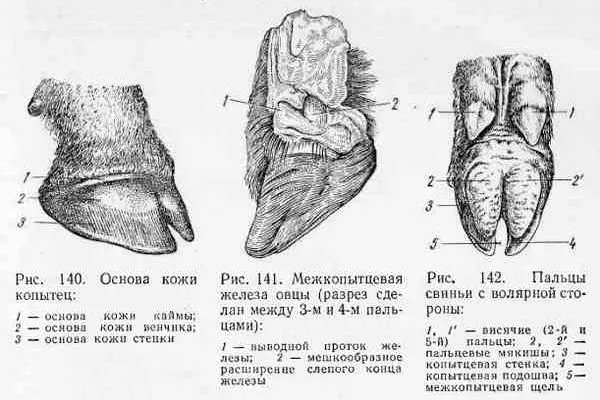
Sheep hooves consist of the following parts:
- hoof border;
- whisk;
- hoof wall (the hardest part);
- sole;
- triangle-shaped pillow;
- finger crumb;
- hard keratin to protect internal tissues;
- corium with nerves and blood vessels;
- corneal capsule.
The hoof is attached to the foot bone by a complex system of tendons and ligaments for shock absorption and flexibility.
Sheep hoof care
Proper hoof care ensures sheep's productivity and overall health. Since their hooves have growths similar to human nails, they must be trimmed. Otherwise, deformities and lameness occur.
In addition, it's important to perform other procedures. Here's a step-by-step guide on how to properly care for sheep's hooves:
- Place the sheep in a separate pen.
- Install a foot bath with a ready-made solution that prevents the occurrence of foot rot.
- Prepare the instruments and disinfect them.
- If you have a special slinging machine, use it. If not, turn the sheep on its side and secure it with ropes.
- Holding the animal firmly, clean the soles of the feet from dirt, then remove the growths on the hooves with scissors.
- Trim these areas with a knife.
- Trim the side of the hoof, gradually moving to the back.
- So cut the “nails” in a circle.
- Now trim the front part and then move on to the inner part of one finger.
- Do the same with the second “nail”.
- Trim the insides of the hoof halves.
Watch the video below to see how experienced farmers trim hooves:
What tools are used for clearing and trimming:
- Hoof nippers. Intended for pruning.
- Knife. Stainless steel is a must. It's used to clean the spaces between the hooves.
- Disk. This is used for trimming hooves. It attaches to an angle grinder and features sharp blades. It's perfect for beginners.
- Scissors with or without teeth. Hoof rot is quickly removed and the “nails” are trimmed.
Foot rot in sheep is the most common hoof disease.
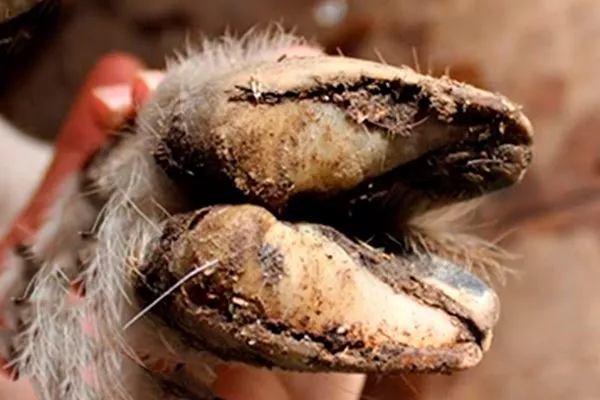
Hoof rot, or simply hoof rot, is a chronic infectious disease affecting small ruminants and characterized by inflammation and softening of the interdigital spaces. This causes the hoof horn to disintegrate, and the sole and sidewalls to peel off.
The causative agent of foot rot
The main infectious agent is a rod-shaped bacterium of the genus Dichelobacter nodosus, which is characterized by its size – from 3-8 x 0.5-1 µm. The rods can be straight or slightly curved, with thickened ends, resembling dumbbells.
Other characteristics of the pathogen:
- Gram staining is negative;
- there is a surrounding of smaller rods;
- is a strict anaerobe;
- considered motionless;
- capsules and spores are not formed;
- the microorganism is capable of producing an enzyme that liquefies proteins in tissues;
- under the influence of ultraviolet radiation the body lives only a few hours;
- at a temperature of 100 degrees the rod dies;
- the bacteria is afraid of phenol, formalin, bleach, sodium hydroxide;
- The spread occurs due to the release of an exotoxin by gastrointestinal microbes, which inhibits neutrophils and macrophages.
There is a lot of controversy surrounding the pathogen: some scientists believe that it remains viable for 2 weeks, others claim that it remains viable for 40-60 days.
Most scientists believe that synergism underlies the infection caused by Dichelobacter nodosus, as other microorganisms also contribute to the development of hoof rot. This most often occurs when hooves come into contact with contaminated soil.
Susceptible animals
Among small livestock, sheep, not goats, are considered the most vulnerable. These animals are more susceptible to infection and have a more severe disease burden. Among sheep, adult males are more likely to become infected. This category also includes fine-wool breeds.
Transmission and infection factors
The main cause of infection is the presence of the pathogen in the pasture or in the building, as bacteria from carrier sheep can spread to the soil. Therefore, there is no need for even direct contact between infected or recovered sheep and healthy ones.
Other negative factors:
- contaminated farmer's shoes;
- tools;
- bedding;
- manure;
- grass and other food;
- regrouping of flocks;
- the appearance of a new sheep in the flock;
- presence of other infectious diseases;
- hoof injury;
- weakened immunity;
- dirt in the pen and high humidity.
Spread of the disease
Foot rot is most common in humid climates. The disease occurs worldwide, but it first appeared in the Soviet Union in the 1950s.
Symptoms and progression of hoof rot
Foot rot in sheep occurs in mild and severe forms, with symptoms developing gradually, making it impossible to miss.
Signs:
- an inflammatory process on the skin between the fingers with redness and swelling;
- increase in the size of the inflammatory focus;
- loss of appetite and weight loss;
- pain and, accordingly, lameness;
- necrotic processes, which are accompanied by abscesses, gangrene;
- necrosis of the sole of the foot, ligaments, tendons and other elements of the hoof.
- ✓ The presence of a specific unpleasant odor from the affected hooves.
- ✓ The appearance of cracks and delamination in the sole area of the hoof.
Diagnostics
Diagnostic procedures include not only detecting signs of footrot but also laboratory testing for the pathogen. A differential diagnosis is essential, ruling out diseases such as necrobacteriosis, smallpox, foot-and-mouth disease, and similar aseptic infections.
The examination includes the following tests:
- growth and development on a special medium with the obligatory addition of agar;
- testing the biochemical and proteolytic activity of the pathogen - carbohydrates are not fermented, gelatin liquefies, milk curdles;
- there is no sensitivity to laboratory specimens (the pathogen does not affect mice, rats, rabbits);
- hooves are examined for recognition of specific clinical signs;
- There are no pathological features in the internal organs.
Additionally, a bioassay on rams, indirect RIF and bacterioscopy are carried out.
Treatment
The treatment regimen involves the administration of the following medications:
- Eleovit vitamins – once at the beginning of treatment;
- every day Nitox 200;
- daily Pyrogenal for applying dressings - potassium permanganate is additionally used;
- dressings with manganese and boric acid;
- foot baths – formalin (10%), zinc sulfate (10%) or copper sulfate (10%).
Other hoof diseases
Sheep's hooves are susceptible to many other diseases, but the most common are foot abscesses, foot-and-mouth disease, dermatitis between the toes, and brittle hoofs. These are conditions worth knowing about.
Leg abscess
A foot abscess occurs as a result of an infection and can also be a complication of foot rot if improperly treated or not treated at all. Other causes include improper hoof trimming, dirt, high humidity, and poor grooming practices.
It is an inflammatory process characterized by the appearance of purulent exudate. At the onset of the disease, body temperature rises in the inflamed area, followed by the following:
- acute pain and lameness;
- swelling;
- the presence of pus in the interdigital space and under the hoof.
How to treat:
- the hoof is cleaned and trimmed;
- a zinc sulfate dressing is applied;
- Injections with antibiotics are given.
Foot-and-mouth disease (FMD)
Foot-and-mouth disease develops rapidly due to viral infection. Transmission routes are the same as footrot. If young sheep are infected, they inevitably die, but the mortality rate in adult sheep is lower (maximum 85%).
Signs:
- pain syndrome and lameness;
- the appearance of papules between the toes or under the hoof;
- formation of ulcers.
There are no treatment methods, so all animals are sent to slaughter.
Ovine interdigital dermatitis (OID)
Dermatitis between the toes occurs due to increased humidity in warm conditions. Symptoms include:
- resembles a burn in appearance;
- redness at the site of the lesion;
- exudate appears, but not always.
Most often, both hooves are affected, not just one. Treatment involves changing the horse's living conditions to drier ones—completely eliminating damp soil and humidity. The bedding is changed daily to dry.
Shelly Hoof
The main cause of the disease is improper care, but some believe this condition has a hereditary predisposition. Another negative factor is high humidity. Signs:
- inflammatory process;
- lameness;
- separation of the hoof horn along the walls.
Quite often, a brittle hoof is accompanied by a secondary infection. In this case, the veterinarian will prescribe antibacterial therapy with foot baths. In other cases, a change to a drier environment and walking the animal over rocky terrain may be sufficient, but only after trimming and cleaning.
Prevention of hoof diseases
Preventative measures can completely eliminate hoof diseases in sheep. Simply follow these simple recommendations:
- Conditions of detention. Be sure to change bedding frequently and monitor humidity levels in the barn or pasture. Ensure proper ventilation and cleanliness.
- Examination. Inspect your sheep's hooves at least once a week - this will allow you to detect any abnormalities in the early stages of any hoof disease.
- Herd assembly. Only import animals from reputable sellers into your herd, and have the sheep's condition checked by a veterinarian immediately after purchase.
- Insulation. Remove any animals suspected of having any illness, especially infectious ones. Quarantine young animals before reintegrating them into the general herd.
- Disinfection. Periodically treat the room and dishes with antiseptic agents.
Never share pastures with other sheep. Treat sick sheep promptly, and if they don't respond to treatment, slaughter them. Experienced farmers even try to give healthy sheep foot baths with antiseptics to prevent infection.