
Lambing is not a spontaneous process, but rather a planned and controlled one. Sheep usually handle the task successfully, but they often need assistance. Let's learn what's needed for successful lambing, how to prepare for it, and how to assist the animal if necessary.
The right time for mating
Ewes can become pregnant as early as seven months of age. However, livestock experts recommend arranging the first mating for females between one and one and a half years of age. Early pregnancy negatively impacts milk production. The best age for mating is 18 months. The ideal time for mating depends on the climate and farming conditions. Ewes are typically mated in September or October, so that lambing occurs in February or March.
The longer the summer, the later mating can begin. Sheep breeders prefer lambing in the winter and spring for the following reasons:
- the fertility of females increases;
- the lambs have the opportunity to get stronger before the next winter;
- The lambs have time to grow up by the time the sheep are taken out to pasture.
Preparing sheep for insemination
Activities to prepare sheep for insemination:
- 45 days before mating, the sheep are transferred to enhanced feeding.
- 2-2.5 months before mating, lambs are weaned from their females.
- After weaning the lambs, milking is gradually stopped.
- Females are examined for mastitis, and their teeth and hooves are inspected.
- They are transferred to pastures with the best grass.
- If necessary, anthelmintic treatment is carried out.
- The hooves are trimmed.
- They get the necessary vaccinations.
- ✓ Increasing the proportion of protein in the diet to 15-17% 45 days before mating.
- ✓ Introduction of vitamin supplements, especially vitamin E, to improve reproductive function.
Not only ewes but also rams are prepared for mating—a month before the scheduled date, they begin to be fed intensively. 1-1.5 kg of concentrate is added to the ram's daily ration.
How to determine pregnancy in sheep?
Pregnancy doesn't always follow mating. Experienced sheep breeders can independently "diagnose" pregnancy based on the females' behavior.
- ✓ Rapid breathing at rest.
- ✓ Refusal to drink water for more than 12 hours.
Signs of pregnancy:
- Three weeks after mating, the ewe shows no signs of heat. A special detector can be used to confirm whether or not she is in heat.
- The estrus period in sheep lasts 48-72 hours. During this period, the female is nervous, bleats, does not eat, and after some time, physiological signs of readiness for mating appear - swelling and redness of the genitals.
- After 12-20 days, the male shows no interest in the female. Inseminating rams react only to unmated ewes.
- Older females tend to be calmer than they were before pregnancy. Young females, however, remain active, and a veterinarian is essential.
A veterinarian can accurately diagnose pregnancy by palpating the uterine arteries rectally, checking for pulsation. Alternatively, an ultrasound detector can be used 36-60 days after mating.
Duration of pregnancy
On average, pregnancy lasts 142-152 days. The extremes are 138 and 159 days. The length of pregnancy is influenced by:
- Breed. Among sheep there are early maturing and late maturing breeds.
- Sex of the lambs. If the lambs are male, the gestation period lasts longer.
- Number of births. Queens with experience in pregnancy give birth faster.
Preparing for lambing
Preparations for lambing begin in advance:
- A month before lambing, the wool around the udder is cut off.
- Two weeks before lambing, pregnant ewes are moved to a separate room—a spacious, warm, well-lit, and draft-free space. The room is cleaned, ventilated, disinfected, and the floor is covered with dry bedding. Each ewe should have at least 2.5 square meters of space.
Heralds of imminent birth
Two days before lambing, ewes begin to show visible signs of lambing. You can tell if they are pregnant by:
- enlarged udder;
- swollen nipples;
- a very sagging belly;
- swollen genitals;
- restless behavior.
Several hours before lambing, the ewe's entire appearance and behavior signal its imminent arrival. The ewe lies on its side, groans, and looks around.
The video below explains the signs of imminent labor in sheep:
How long does lambing last?
The duration of lambing depends on a variety of factors, so it's impossible to predict exactly when the lamb will be born. Typically, the process takes no more than an hour. During this time, all the lambs are born—their number also determines the duration of the birth. The interval between lambings is 10-15 minutes.
Features of lambing
Due to a special physiological rhythm, lambing occurs at night. The ewe usually lambs without human assistance, handling all the tasks herself. All that remains for the sheep farmer is to receive the newborn lamb and dry it.
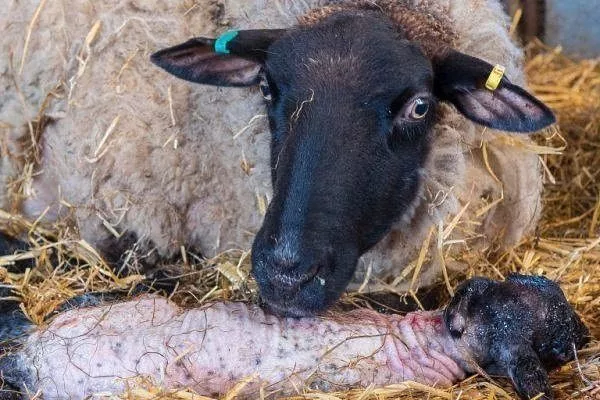
After a normal birth, the ewe rises and, shaking herself, approaches the newborn to lick it. This is an obligatory ritual—the mother, by licking her baby, forever memorizes its scent. Having remembered her offspring, she will willingly allow them to approach her udder.
The lambing process and how to deliver a lamb
Lambing in sheep is a relatively quick and simple process. Human assistance is either minimal or completely unnecessary. However, complicated births can sometimes require human assistance.
During lambing, the sow can lie down or stand, so a thick layer of bedding is essential. The procedure for lambing independently:
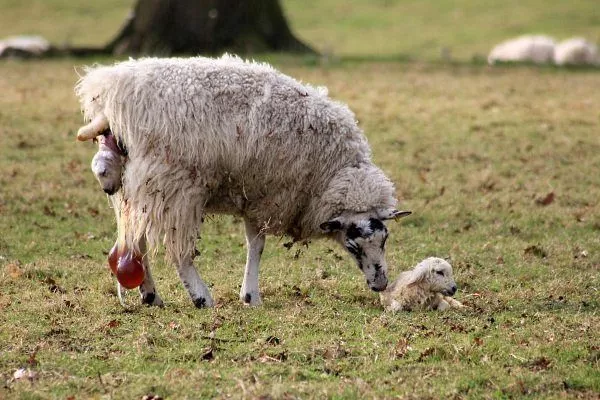
- First, the amniotic sac, filled with fluid, comes out. Don't interfere with the process or puncture it—the sac widens the birth canal, making it easier for the lamb to emerge.
- The lamb comes forward with its limbs - its head rests on them.
- A lamb, falling out, tears the umbilical cord. Or a ewe chews it.
- The ewe independently cleans the newborn from mucus and amniotic fluid.
You can see how lambing occurs without human assistance in the video below:
A ewe may require assistance at any stage of the birth process. The lambing process with human assistance:
- Release of the amniotic sac. No help needed.
- The appearance of the lamb. You may need help:
- If the fetus is in the wrong position—with its hind legs first—the veterinarian can turn the fetus right in the womb, and the birth will be completed without complications.
- The lamb is born in a sac—you need to free the newborn by cutting through the membrane. If a veterinarian isn't nearby, you'll have to manage this yourself. First, the sac is punctured. Wait for the water to drain. Turn the fetus and gently pull it forward—but only when the mother begins to push.
- The birth of a lamb and the breaking of the umbilical cord. If the umbilical cord wasn't broken when the lamb fell or was chewed by the ewe, it should be cut with scissors treated with iodine solution. The cord is cut 8-10 cm from the belly and coated with iodine.
- Clearing the airways. Immediately after the lamb emerges, its nostrils and mouth need to be cleared of mucus - this step is mandatory, both when lambing independently and with human assistance.
- Rubbing. The newborn lamb is wiped with a clean, dry cloth.
If there are several lambs, the second and all subsequent ones will be born faster and easier, since the uterus will have expanded sufficiently by this time.
In his video, the breeder shows how to help a ewe give birth to lambs:
What to do after lambing?
The placenta is expelled 5-6 hours after birth. It should pass naturally on its own. It must be removed and buried. If the placenta is not expelled, veterinary attention is needed as there is a risk of blood poisoning, which can lead to the death of the animal.
To ensure successful delivery of the placenta, the ewe needs to drink plenty of water after giving birth. The ewe is given 1.5 liters of warm water every two hours.
After lambing, clean the room and take care of the lambing ewe:
- Dirty wool is cut off and disposed of.
- Wash the udder with a soda solution and wipe it with a dry cloth.
- The lambing area is cleaned and disinfected. The bedding is buried along with the afterbirth.
- After 20 minutes, the newborns begin searching for the udder. Human assistance is not needed – the lambs find the udder without difficulty and begin sucking. And the ewe, having memorized the lamb's scent while licking, never interferes with the sucking process.
- Feed the ewe 4-9 hours after lambing. It's important to continue feeding the ewe exactly as she did before lambing—changing her diet is not recommended. Changing her diet can cause stomach upset in the lambs.
- The sheep are fed high-quality, light feed, silage (no more than 2 kg), hay, straw, vitamins, and minerals. Full recovery occurs within 8 days.
Overfeeding a ewe after lambing is prohibited – overeating can cause mastitis.
A ewe may go into heat after 1-2 months. However, mating should not begin before 4-6 months.
How to care for the offspring:
- If there is only one lamb, it can be left with its mother; if there are two or more, they are released to the mother every 2-3 hours, and then moved to a separate room.
- If there are weak lambs, they are left on the udder longer than others. When the lambs are two months old, the number of feedings is reduced from six to three times a day.
- If it's not possible to feed lambs sheep's milk, cow's milk is used instead. It must be fresh and warmed to 38-39°C. However, it's important to note that cow's milk is less nutritious.
- From 20-30 days, lambs are gradually fed with flattened grain, crushed oilcake, and bran.
What complications may arise?
Complications are possible not only during lambing but also after. The following symptoms indicate a ewe's poor condition:
- anxiety;
- low mobility;
- bleeding;
- elevated temperature.
The animal should be closely monitored. Discharge from the genitals continues for 6 days, but if it hasn't stopped by the 7th day, there is likely damage to the internal genital organs, and a veterinarian should be consulted.
A ewe may develop postpartum paresis, which causes a coma of the gastrointestinal tract, pharynx, and tongue. The cause of this condition is unknown. However, it has been found to be less common in sheep that spend the winter in stalls. The animal may also experience:
- ruptures and various types of damage to the uterus;
- Infectious diseases caused by infection entering the vagina during lambing.
Pathological childbirth
Types of pathological birth:
- Prematurity. This results in the death of the offspring. The ewe may become ill. A test should be performed – if the cause is determined to be a disease of the female, she is slaughtered to prevent infection of the flock. Most often, premature birth is caused by chlamydia, which disrupts the functioning of the reproductive organs.
- Prenatal remission. This pathology also causes fetal death. It involves respiratory failure. The female also risks dying. It is caused by joint diseases caused by poor nutrition, hypothermia, and poor living conditions. The situation can be saved if the pathology occurs before lambing. Otherwise, the outcome is unknown.
How many lambs can a ewe produce?
Ewe productivity is influenced by health, breed, and feed provided both before and during pregnancy. Breed has the greatest impact on the number of lambs produced. A lamb will produce between 1 and 5 lambs, most commonly 2-3. Predicting the litter size in advance is extremely difficult.
A newborn lamb weighs 4-6 kg. The more lambs born, the less they weigh. Therefore, the optimal litter size is 2-3 lambs, as they are at optimal weight, healthier, and gain weight quickly. A ewe can only fully feed two lambs.
Advice from experts
Useful tips from experienced sheep breeders:
- To ensure successful lambing, pay close attention to feeding the animals.
- Calculate the lambing date so that you can be there at the right moment – suddenly your help is needed.
- Make sure you have a veterinarian on hand in advance so that if the birth becomes complicated, he or she can arrive quickly.
The success of lambing depends directly on its preparation and organization. With proper care and balanced nutrition, the risk of pathologies is minimal. And even if any difficulties arise during lambing, by studying the process in advance, you can help the animal.