
Dressing sheepskins is a multi-step process that requires diligence and even physical strength. This craft is usually performed by specialists, but any beginner can master the craft with a little effort. Let's learn how to dress and preserve sheepskins yourself.
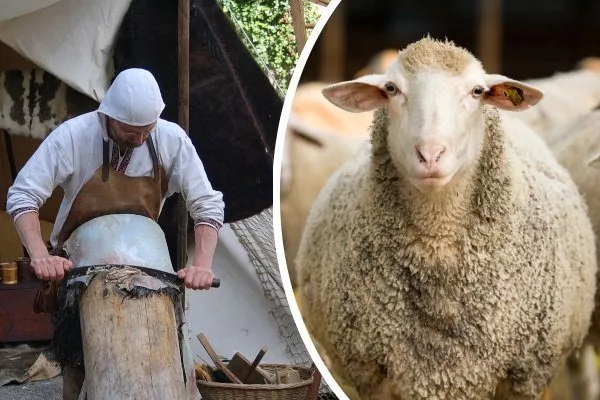
Peculiarities of skin processing
Skins are an important source of income for sheep farmers. However, many breeders simply discard the skins, unwilling to deal with the tanning process. It's truly a tedious process. Some sheep farmers prefer to take raw skins to special collection points. However, if the distance between the farm and the collection point is long and there are only a few skins, such trips are unprofitable.
The best solution is to tan the hides yourself rather than throw away valuable raw materials. Here's what's important to know about tanning:
- The process is divided into several stages:
- fleshing;
- pickling;
- washing;
- tanning;
- drying.
- If skins are being prepared for fur coats, they must be taken from sheep of the same age and color. They must be taken in the same season. On a small farm, skins can be collected gradually, as the sheep are slaughtered. A fur coat requires 7-8 sheepskins.
- The entire manufacturing process takes about a month.
- It's best to dry skins outdoors in dry weather. It's best to tan skins in the summer.
- For the production you will need the simplest materials:
- washing powder;
- salt;
- vinegar;
- sawdust.
- Prepare enough solution so that the sheepskin floats in it and is covered to the top.
The flesh side is the leathery part of the hide. The quality of its tanning determines the appearance and lifespan of the product.
Who should do this?
The processing of hides is carried out by specialists called furriers. In addition to knowledge of dressing technology, furriers require physical strength, as they must handle wet raw materials. A single hide weighs approximately 10 kg when wet. Lifting and crushing raw sheepskins requires considerable muscle strength.
The sheepskin dressing process is long and labor-intensive. To produce a flawlessly dressed hide, one must be a skilled professional. High-quality dressing is easier to achieve in a factory setting. Craft dressing yields lower quality—there may be defects in the flesh, an unpleasant odor, and heaviness. The resulting products are unsuitable for anything other than flooring.
Raw materials
There are three types of raw materials:
- fur;
- tannery;
- fur coat.
Each type requires a specific tanning technology. Features of sheepskin production:
- Sheepskin is obtained from fine-wool and semi-fine-wool sheep. The fur of these breeds is unusually thick and uniform, consisting of down fibers. The skin of these animals contains a high fat content – 20-30%. Products made from sheepskin are worn with the fur facing out.
- Sheepskin is distinguished by its durability and moisture resistance. This raw material is obtained from coarse-wool sheep. The skin tissue is less greasy than that of fur. The process of dressing sheepskins requires more careful handling of the leather tissues.
- Raw hides are not suitable for fur coats or other fur products. Sheepskin is used to make leather and suede products.
The dressing patterns for different types of sheepskin vary:
- Sheepskin fur. In production, the process continues 24 hours a day in the following sequence: soaking, pressing, shearing, fleshing, degreasing, washing, pickling, curing, tanning, curing, dyeing, washing, fatliquoring, drying, and rolling. In artisanal production, the number of stages is reduced, but the quality is also lower.
- Sheepskin fur coat. The tanning process consists of the following stages: soaking, fleshing, degreasing, pickling, tanning, wet sanding, neutralization, dyeing, degreasing of the leather tissue, and finishing. The process is continuous.
Preparing for the process
To successfully tan a skin, it must first be properly skinned.
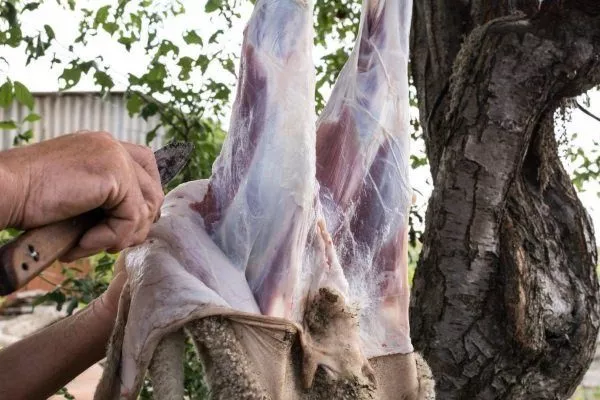
Preparation procedure:
- Make the first cut at the neck, across the belly, and toward the base of the tail. Then make circular cuts near the wrist and hock joints on the front and hind legs, respectively. Remove the skin with a knife, being careful not to leave any damage, such as tears or cuts.
- After removing large debris from the sheepskin, lay it down with the flesh side facing up.
- Carefully inspect the leather surface; if there are any remains of meat, fat, or tendons on the inside, scrape them off with a knife.
- After folding the sheepskin in half, leave it for a couple of hours to cool in a cool room.
- After two hours, they begin dressing. You can't wait more than two hours.
Fresh raw materials are easier to work with than preserved ones. However, if it's not possible to work on the hides immediately, they are preserved.
Tools and equipment
For the fleshing stage of hide processing, specialized equipment is required. Hides are fleshed by hand or using specialized machines—these are used in dressing yards and on large livestock farms.
What you will need for fleshing:
- Deck – a solid board on which the hides are spread. It should have a convex and smooth surface.
- Pallet - the flesh side is collected in it.
- Mezdryak – a curved, sharp knife with two handles. It is used to trim away any remaining fat and meat.
- Fleshing machine – It effectively removes grease. Machines come with one or two blade shafts. The blade shaft is controlled hydraulically or pneumatically.
A whole range of sharp cutting tools is also available for manual fleshing. Hides are processed using fleshers of various designs:
- fleshing knife;
- straight flesher;
- serrated flesher;
- disassemblable fleshing knife;
- hare - for breaking up;
- braid;
- gouging knife.
Dressing hides also requires large containers that can accommodate the fully straightened hides. In production facilities where dressing is carried out on a regular basis, in addition to fleshing machines, special centrifuges are used for drying the hides.
Preservation of skins
To prevent spoilage, the raw material is preserved. Preservation involves dehydrating the hides and infusing them with salt. The raw material is considered preserved if it contains at least 12% salt and no more than 48% water.
Salting kills most microorganisms in fresh hides. Preservation does not cause any noticeable changes to the collagen that provides the elasticity of leather and fur. Freezing or drying the raw material cannot be used to preserve it; it will inevitably spoil.
Helpful tips:
- To prevent the skins from losing their strength, do not stretch them.
- When scattering salt, distribute it evenly over the entire surface.
- Store salted sheepskins in a dark place to prevent them from becoming hardened and cracking.
- Check the condition of the skins periodically – air them out, tug at the fur.
If the preserved sheepskin starts to shed fur, it will soon spoil – the salting process must be repeated.
Wet-salted method
This preservation method is used only during the cold season. Salting is done without subsequent drying. The salting procedure is as follows:
- In a dry, shaded and cool place, lay the skin out with the flesh side up.
- After straightening the sheepskin, sprinkle it with salt. The amount of salt is 30-40% of the weight of the raw material being salted. Typically, 800 g of salt is needed per hide.
- Salting lasts 7-8 days.
Before rolling the preserved sheepskins, they are folded with the flesh side inward:
- fold the top part in a quarter;
- fold the side parts towards the center – by a quarter;
- fold the skin along the ridge;
- roll up starting from the neck;
- tie the bundle with twine.
Dry-salted method
The first stage of preservation is almost identical to the wet-salting method—the hide is salted in exactly the same way. However, slightly less salt is used, as the salt's effect is enhanced by the addition of naphthalene, which is used to repel pests. The recommended naphthalene concentration is 0.8% of the hide's weight.
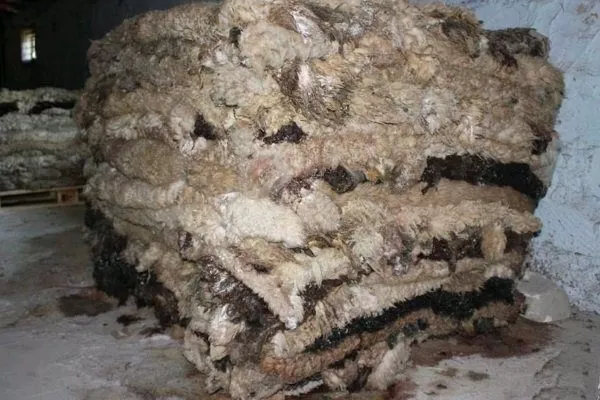
Salting sheep skins
The salt-sprinkled hides are stacked in piles. After 2-3 days, they begin to dry, hanging them straightened on poles. The hides are hung bent along the spine.
Dry the sheepskins on both sides, first with the flesh side facing up, then with the fur side facing up. When the drying process is complete, the temperature should be at 30°C.
Drying skins in direct sunlight is prohibited. In summer, they are dried in the shade, and in winter, indoors.
Acid-salt method
This is the best method for dressing sheepskins. Ingredients for the preservative mixture:
- table salt – 85%;
- aluminum-potassium alum - 7.5%;
- ammonium chloride – 7.5%.
To ensure uniform preservation, mix the ingredients thoroughly. One sheepskin will require approximately 1.5 kg of the mixture. Rub the mixture into the flesh side and then sprinkle generously over the entire surface. Store the salted sheepskins for 5-7 days, just as with wet-salt canning.
During preservation, a reaction occurs that produces sulfuric acid, which effectively dehydrates the raw material and inhibits microorganisms. The resulting aluminum sulfate ensures tanning. Thanks to acid-salt preservation, sheepskins can be preserved for six cold months or two warm months.
Fresh and dry canning
This method is used in the summer, if for some reason access to salt is unavailable. The hides are simply dried in a shaded area. This preservation method cannot ensure high-quality products.
Stages of dressing – step-by-step instructions
Sheepskins undergo the same stages of tanning as any other skin. It's best to begin processing the hides immediately after they're removed. Every minute lost will negatively impact the quality of the finished product.
Soaking
For soaking, you'll need a container large enough to comfortably accommodate the sheepskin. The solution is prepared from:
- table salt;
- furatsilin or formalin;
- acetic acid.
- ✓ The temperature of the water for soaking should be no lower than 20°C and no higher than 25°C for optimal softening of the skin.
- ✓ The concentration of salt in the pickling solution must be strictly 5-6% to prevent damage to the skin.
How to prepare a soaking solution:
- Furacilin is dissolved in water - 2 tablets are taken per 1 liter, or 0.1 ml of formalin;
- add 30 to 50 g of salt per 1 liter;
- vinegar is added for an antiseptic effect, 5 g per 1 l;
- Experienced furriers add oak, birch, or willow infusions to the solution—they're made from the leaves of these trees. Add no more than 0.5 liters of infusion to 10 liters of water.
After soaking, the hides are soaked in the prepared solution for at least 12 hours. If half a day is not enough to soften the hide, the procedure is repeated. To determine if the hide is ready for the next step, scrape the flesh side with a fingernail. If it comes off easily, proceed to fleshing.
Fleshing
The purpose of fleshing is to remove residual fat and grease, as well as excess skin, from the inside surface of the hide. The fleshing procedure is as follows:
- stretched on a special machine, and if there is none, then simply on a flat surface;
- scrape from the inside with a blunt knife or a special iron scraper.
- First, process the back part, then move towards the head part.
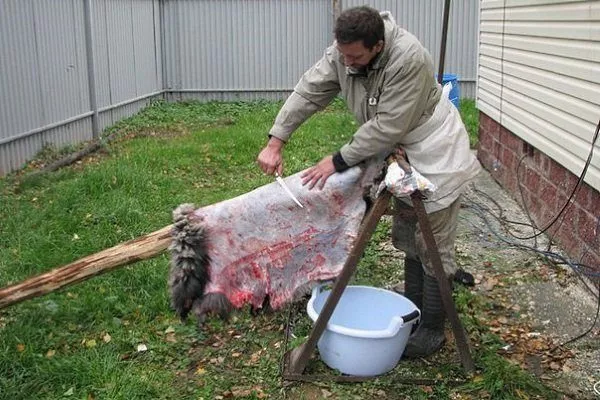
Fleshing the skin of a smooth-wool sheep
The skins are fleshed only with a blunt instrument; sharpness is not allowed, so as not to cut the material.
Degreasing
After fleshing, the skin is washed by immersing it in a solution prepared from:
- table salt – 20 g;
- washing powder – 3 g.
The dosages given are for 1 liter of water. After washing, remove the sheepskin and wring it out. You can proceed to the next step.
Pickling
The purpose of this stage is to improve the properties of the raw material. Pickling softens the sheepskin and makes it more elastic.
How to prepare pickling brine:
- water at room temperature – 2 l;
- salt – 100-120 g;
- vinegar 9% – 1 l.
Instead of vinegar, you can take acetic acid - 30 g, or formic acid - 10 g.
The hide is left to soak in the vinegar-salt solution for the same amount of time as it would have been soaked—12 hours. To test the hide's elasticity, it is pressed while folded in half. If the process is successful, a crease line will be clearly visible on the straightened surface.
If the hide is to be used for clothing or items that will come into direct contact with humans, the pickling solution must be neutralized. To do this, soak the hide in a baking soda solution for 1 hour (1 gram of baking soda per 1 liter of water). Neutralization reduces the strength of the sheepskin, but it becomes hypoallergenic. Pickling is completed by washing the hide again under running water.
Tanning
The purpose of tanning is to increase the strength of sheepskin. For 1 liter of water, take:
- table salt – 50 g;
- chrome tanning agent – 6 g.
Place the hide in the container, ensuring the solution completely covers it. Leave it for 48 hours. Warm the solution occasionally to keep it warm.
After examining the cut, evaluate the tanning results with a magnifying glass. If the coloring is uniform, the process is complete. To enhance the tanning effect, add a decoction of horse sorrel root to the solution.
Sheepskin has an unpleasant odor, which must be eliminated. To achieve this, add alum to the tanning solution at a rate of 7 g per liter. Alum eliminates the odor, makes the sheepskin supple, disinfects, and accelerates drying.
Utility bill
The purpose of greasing is to make the leather shiny. A solution is prepared from:
- table salt – 100 g;
- glycerin – 25 g;
- ammonia – 20 g;
- egg yolk – 70 g.
- Check the uniformity of the color of the skin cut under a magnifying glass before fatliquoring.
- Apply the fat solution to the flesh side in a thin layer, avoiding excessive accumulation.
- Dry the skin at a temperature not exceeding 40°C, periodically kneading it to make it soft.
The flesh side is smeared with this solution, and then the sheepskin is folded so that the inner sides touch each other.
Drying
Before drying, the hide is thoroughly wrung out, for example, using a centrifuge. Then the sheepskin is dried in heat chambers at 40°C, or outdoors. As it dries, the hide is kneaded and stretched to soften it. The flesh side is cleaned with pumice. Drying usually takes three days.
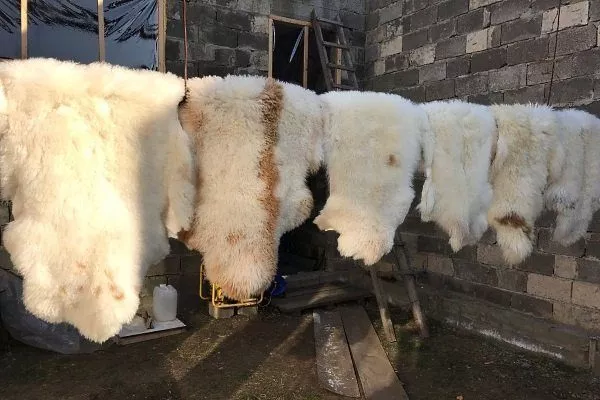
Drying the skins of smooth-wool sheep
Final processing
The final step in the tanning process is cleaning the hair. The sheepskin is beaten with a stick, then the nap is smoothed with a clothes brush. The fur is then rubbed with sawdust from deciduous trees. The sawdust is heated on a baking sheet and then combined with a solvent such as turpentine, gasoline, acetone, etc.
Hot sawdust soaked in solvent is rubbed into the fur. The hide is then beaten with a stick. The finished hide is hung to dry, which takes 1-2 days. It can then be stored indefinitely as raw material for fur products.
Once you learn how to tan sheepskins, you'll be able to do the same with any animal hide. Now you won't have to throw away hides or go to a tanner just for one or two—you can do it all yourself.