
Keeping nutria, whether at home or on a farm, requires certain conditions. It's important to consider the diet based on the rodents' intended purpose and the time of year. Only after reviewing this information can you confidently begin breeding water rats.
Keeping nutria as a pet
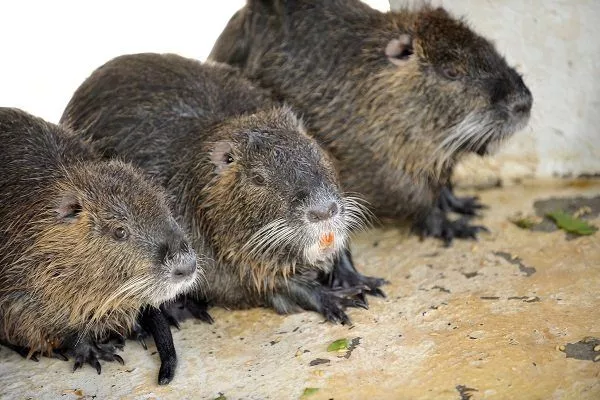
Nutria's behavior and skills are very similar to those of cats and dogs, as they also respond to their owners' names, remember their voices and appearance, ask to be picked up, cuddle, and even sleep under a blanket, creating a "nest" for themselves there.
Keeping rodents in an apartment isn't that difficult, but there's a major drawback: their urine is extremely foul-smelling. Despite this, nutria lovers have learned to train them to use a litter box, so the problem is considered solved.
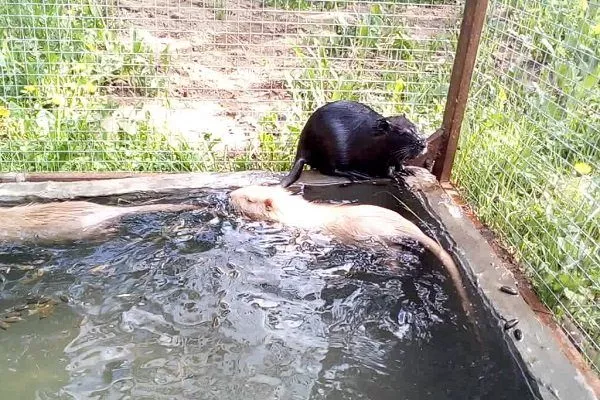
- ✓ The temperature of the water for bathing should not be lower than +15°C and not higher than +25°C.
- ✓ The depth of the pond or bathing container should allow the nutria to be completely immersed, but should not exceed 40 cm for safety.
Content Features:
- Cell. For home conditions, it is enough to buy a cage with the following dimensions: 50x65x80 cm.
- A place for walking. This is a must, as the animal won't be able to remain confined to a cage for long periods of time. It's acceptable to let it out in the apartment. To prevent it from gnawing on wooden furniture, simply place tree or bush branches or bark in the cage.
- Water treatments. This is also part of the nutria's life cycle. They use water to clean their fur and get rid of dirt (water rats are very clean).
For bathing, you can put out a trough or a large basin, but many breeders prefer to fill the bathtub with water and let the animals in there for a certain amount of time. - Feed. For feeding at home, you can buy specialized dry pelleted food for nutria/pigs. If this is not available, the following will work:
- crushed and steamed in boiling water cereals (oatmeal, wheat, corn, rice);
- vegetables – carrots, boiled potatoes and pumpkin, beets, etc.;
- fruits – apples, pears, grapes;
- milk porridges (not sweet);
- cottage cheese;
- boiled milk;
- boiled and lean fish;
- croutons, but without flavorings and spices;
- lettuce, parsley, dill.
Avoid drafts in the room—the nutrias will catch a cold. If you're unsure which one to get, keep in mind that females are more aggressive and capricious, while males are kind and patient.
Conditions for keeping nutria on a farm
On farms raising nutria (for meat, fur, fat, and live sale), breeders create special conditions. These require maintaining a consistent temperature, providing the rodents with water, a house, and an outdoor run.
Basic requirements
To ensure rapid growth, healthy litters, and proper fur, water rats need to feel comfortable. They are timid animals, so dogs should be kept away from their mini-farm. Sudden and excessively loud noises should be avoided.
But the most important thing is to observe the following conditions:
- Water. It's used for bathing and drinking. It should always be clean, so change it twice a day (animals can become infected if it's dirty). Use special drinking bowls for drinking, and there are several options for bathing:
- dig an artificial reservoir (provided that groundwater is close to the surface of the earth);
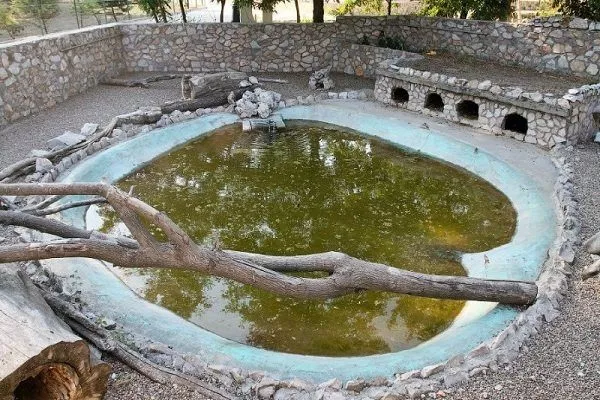
- make a pool by filling it with concrete mix;
- Place and secure the bathtub and trough (to prevent the animals from tipping the container over).
- Temperature conditions. In winter, a temperature reading of +8-10°C is acceptable; in other periods, maintain a temperature of +15 to +20°C. Avoid higher readings, as nutrias have fairly thick fur (they will overheat).
- Sun. The animals should not be exposed to direct sunlight; create artificial shade.
- House and enclosure. These are essential items, as they sleep and eat in the former, and walk in the latter. It's not recommended to make them out of wood, as nutrias love to chew on wood. Preference should be given to concrete or metal structures.
A mandatory requirement is that one head requires at least 0.5 square meters of space in the house and 1.5 square meters of space in the walking area. - Disinfection. This is done at least 2-3 times a year. Enclosures and cages, exercise areas, feeders, water bowls, equipment, and tools are treated with antiseptics.
To prevent the farmer from bringing infection into the premises, it is advisable to lay a mat soaked in disinfectant before the entrance.
Equipment
Breeding nutria, like other animals, requires the use of specialized equipment, which accelerates the rate of development and prevents diseases.
What you will need:
- Feeders, drinkers. You need enough so that a maximum of 2-3 individuals can use one container. They are sold in pet stores. The main requirement is that they slide out like drawers.
If you can't buy them, use plastic bottles at first. Features:- After emptying, be sure to rinse;
- place them at the level of the nutria's neck - otherwise the animals will climb into them with their paws, filling them with dirt;
- Close the openings during winter.

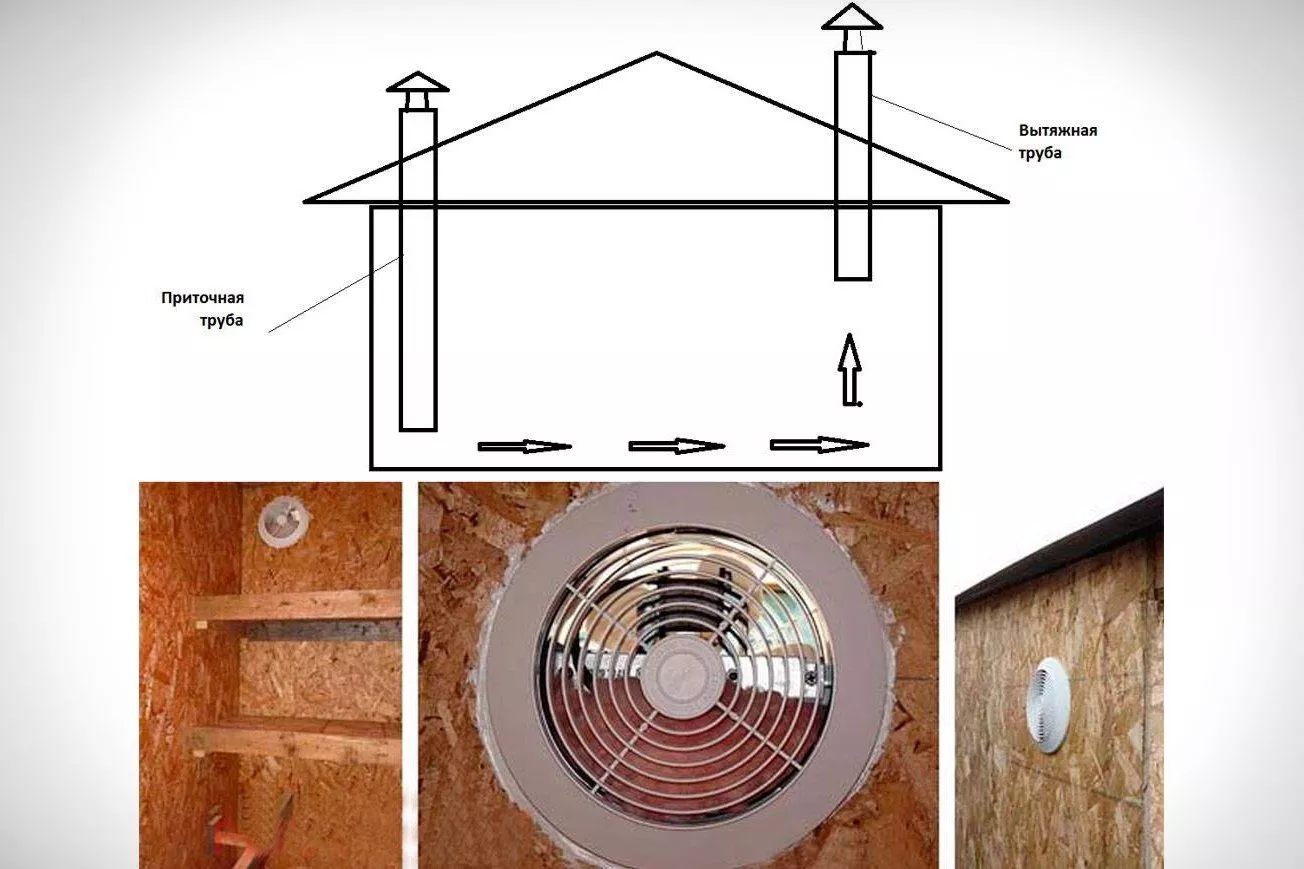
- Ventilation system. The animals need oxygen, and the room needs to be free of unpleasant odors. It also acts as an air conditioner in the summer.
If the indoor farm space is small, a standard fan can be installed, but if the farm is housing large numbers of animals, a permanent device is better. Artificial ventilation can also be installed. To do this, you need:- In the room just under the roof, make 2 holes in the wall.
- Install two pipes—one higher, one lower. The first will exhaust heated and stale air, while the second will draw in fresh air.
- Heating. Without it, frostbite can occur in winter, and the nutria will become ill and die. It's not recommended to use heaters that dry out the air; oil-based options are better.
- Pool. Use a trough or bathtub instead. There are special requirements (the more individuals, the higher the indicators):
- container depth - from 30 cm;
- width – from 60 cm;
- length – from 1.5-2 m.

Arrangement of the house
Nutria spend a lot of time in their house—even 24 hours a day in winter—so it needs to be as comfortable as possible. What materials are best for making or buying:
- Tree. It's an excellent thermal insulation material, but you'll have to protect it from nutria (cover it with metal sheets to prevent the animals from gnawing holes).
- Metal. The optimal option, distinguished by its durability, is usually prefabricated and easy to move. However, they do have a drawback: they can get cold in the winter.
- Concrete, brick, stone, cinder block. An excellent solution for placing a playhouse directly on the ground. Pros: it's not cold in winter and not hot in summer. Cons: it's not portable.
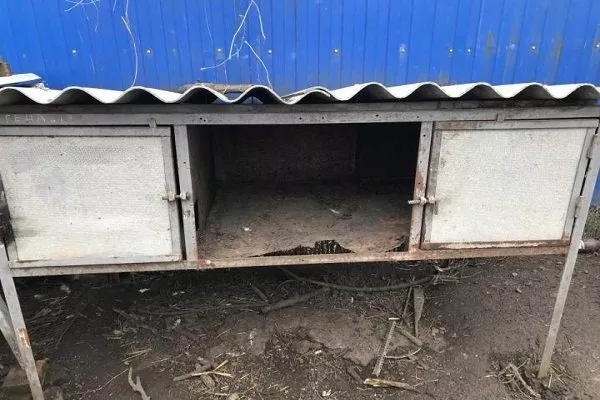
- Slate. It is most often used as a temporary shelter, as the sheets quickly burst.
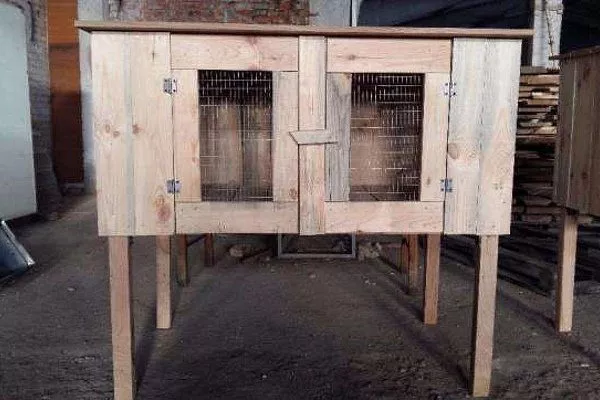
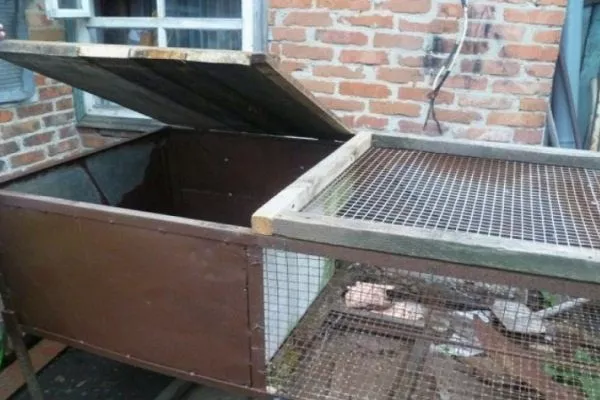
What needs to be done inside:
- If the house is stationary, its walls are covered with plaster;
- In all options, sawdust is spread on the floor, which simplifies the cleaning process and keeps the animals warm;
- The roof should be hinged so that the sun's heat can be let in in the spring, and it will be easier for the owner to care for the water rats. Be sure to make a mesh cover under the roof - this will prevent predatory birds from stealing the nutria;
- fence off the walking area with a chain-link fence - no one except people will enter the pen, and the animals will not escape; it is also recommended to make a mesh roof over this area;
- If the house is intended for wintering, equip it with insulating lining;
- It is advisable to cover the roof of the house with roofing felt or other moisture-proofing material – dampness is unacceptable in houses, as this promotes the development of bacteria.
House options:
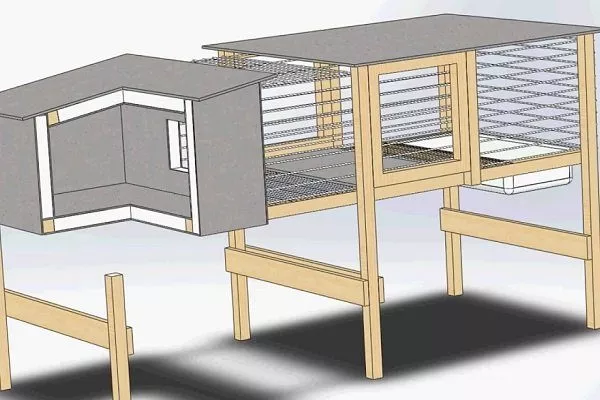
- single-chamber – there is only one room inside for the nutria, so they are forced to sleep and eat in one place;
- two-chamber – consists of 2 compartments, which is very convenient for animals.
Cellular content
Nutria are kept in cages if they are housed in a large room; in summer, they can be placed outside. The cage should have the following compartments:
- house with 1 or 2 compartments;
- walking area;
- swimming area;
- channels (pipes, hoses) for supplying clean water and pumping out dirty water.
In larger farms, it's common to build 2- or 3-tiered structures, which take up less space in the common area. In this case, inclined trays should be installed on the upper floors to collect feces and urine.
The size of the cells depends on the number of individuals:
- group enclosure – 100x80x70 cm;
- single – 50x80x50 cm.
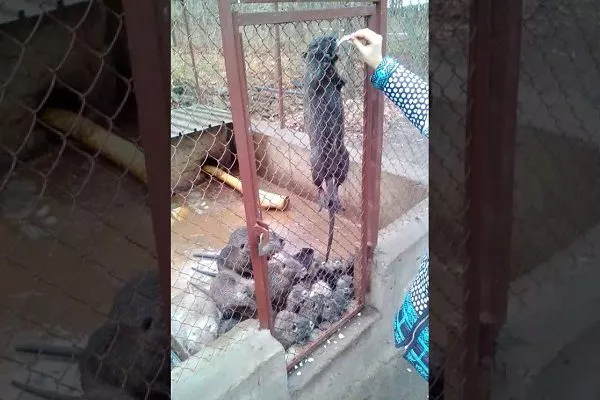
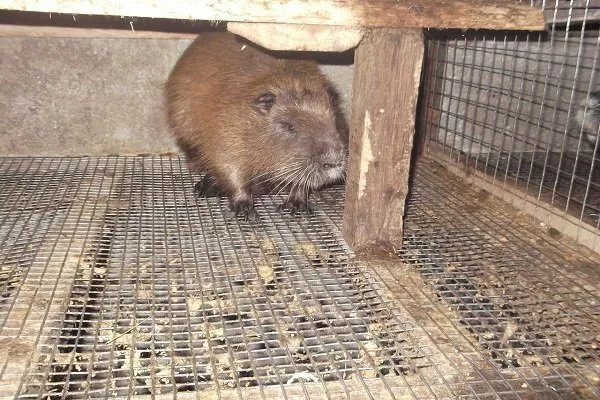
If several families/single nutrias live in a large cage, there should be doors between them to prevent the animals from coming into contact.
Hygiene
Compliance with sanitary and hygienic standards is a must. This will ensure that animals are less likely to get sick, and that their meat, fat, and fur are of high quality.
What you need to do:
- Remove feces and discard urine 1-2 times a day;
- periodically disinfect the premises;
- constantly wash feeders and waterers;
- treat swimming pools with antiseptics;
- exterminate other rodents (mice, rats) that are carriers of infections;
- To prevent infestation, do not allow insect pests into the premises.
Nutria family and reproduction
Nutria can be bred starting at 6-7 months, although sexual maturity occurs at 3-4 months. The gestation period is 130 days, and immediately after birth, the cubs are able to see, move around, etc., but they continue to nurse until they are 2 months old.
During these periods, it is important to strictly adhere to special maintenance rules:
- Do not allow the female to become anxious or frightened. During pregnancy and breastfeeding, she is very susceptible to fears, and if the female cannot cope with them, the death or freezing of the embryo, followed by a miscarriage, may occur.
- When the female is giving birth, do not enter under any circumstances. But watch her from a distance - in case she fails to give birth (this is provided that the female is not tamed to hands, in other cases you can stay nearby).
- In the last 2-4 weeks, separate the female from the rest of the individuals. Keep her like this until she stops feeding the babies.
- Pay special attention to hygiene and temperature. Even the slightest draft should not be allowed, as puppies are very susceptible to colds.
- Keep the young animals separately. Up until two years old, until it matures. Unless, of course, you slaughter it earlier.
- Change the queens. This needs to be done after 3, maximum 4 years.
What to feed nutria?
In the wild, nutrias feed on vegetation, so their diet without it is considered incomplete. At home or on a farm, the animals are fed various types of supplementary feed. Their favorite foods include reeds, matting, seaweed, and other plants growing near bodies of water.
In summer
In the summer, give preference to plant-based foods—they're good for the nutria and profitable for the farmer. The daily requirement for herbs is approximately 1 kg, depending on age. This includes:
- weeds;
- branches of bushes and trees;
- seaweed;
- reeds, cattails;
- clover, alfalfa;
- cereal, legume tops;
- sweet clover;
- grape vine;
- cane;
- salads and greens;
- sorrel;
- buckwheat;
- cinquefoil;
- plantain;
- sow thistle;
- coltsfoot;
- Ivan tea;
- dandelions;
- pemphigus.
In addition, you can give the following:
- up to 100 g of grain feed (a mixture of barley, oats, millet, rye, wheat);
- fruits – grapes, pears, apples (150-200 g each);
- vegetables – zucchini, tomatoes, cabbage, watermelons and melons, turnips (the same amount);
- ground corn;
- sunflower.
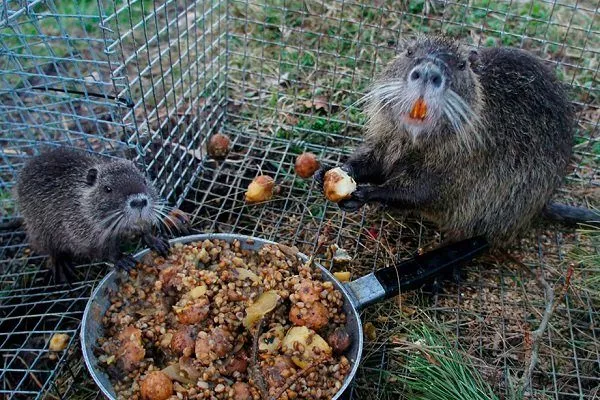
In winter
In winter, fresh greens are scarce, so nutria are fed hay and straw, but this is not enough to provide them with the necessary nutrients. The following foods are also mandatory:
- Fruits and vegetables. They should be fed 300 grams per head. Suitable foods include apples, beets, carrots, boiled potatoes, and pumpkin prepared in the same way. The best root vegetable for nutria is Jerusalem artichoke, so prepare it in the fall.
- Steamed grain (corn, barley, oats). Minimum – 150 g, maximum – 250 g. Pour boiling water over the chopped grains, let it steep for 3-4 hours, then add 1 g of salt, 0.7-1 g of chalk, 10 g of cake, 1.5-2 g of fish oil per serving.
- Sprouted grain crops. Feed a maximum of 30 g per day. Chopped hay is very rich in vitamins. For this purpose, the hay is chopped (4-5 cm pieces) and fed in a dosage of 50-60 g.
- Prepared food. It's sold in pet stores or specialized retailers. It's suitable for nutria, pigs, and rabbits. No other product should be used.
Essential vitamins and minerals
In the wild, nutria obtain most of their vitamins and minerals from the roots of grasses growing near water bodies. This is impossible in captivity, so farmers are required to provide supplemental feeding.
Water rats need the following elements most of all:
- vitamins – A, D, B, E;
- phosphorus;
- calcium.
What experienced nutria breeders use to replenish these and other substances:
- standard premixes or protein-mineral-vitamin supplements (the dosage is indicated in the instructions and depends on the type of feed and the manufacturer);
- fodder yeast (5 to 10 g per head, depending on age);
- table salt (1 g for an adult, 0.5 g for a baby);
- hydroponic greens (50-100 g per day);
- fortified fish oil (0.5-1 g);
- pharmaceutical carotene (for adults – 3 g, teenagers – 2 g, puppies – 1 g);
- multivitamins (maximum 1 g).
Mix supplements thoroughly when diluting them with food; otherwise, one individual will receive an excessive amount of vitamins, while another will receive too little.
Features of content depending on the purpose
Many farmers prefer to raise swamp beavers solely for meat and fat, or solely for their valuable fur. In these cases, it's crucial to select the right breed—meat, fur, or meat-and-wool. Specific features:
- If the main emphasis is on the quality of the wool, then the presence and cleanliness of water in the pool are monitored with particular care, since it is this factor that affects the performance and value of the fur;
- To obtain the maximum amount of fur of the same color, use a uniform breeding method, that is, mate females and males of the same breed; if it is for meat, there is no difference;
- If the nutria is raised for meat, then it is necessary to achieve the pet's maximum growth - for this purpose, it is permissible to feed it not 2, but 3 times a day.
Otherwise, the conditions are identical. However, experienced breeders recommend paying attention to the diet, depending on the purpose of raising water rats:
| Type of food | For fur (percentage of products for daily diet) | For meat (percentage of products for daily diet) |
| Alfalfa grass meal | 25% | 15% |
| Barley and corn | 15% | 47-50% |
| Oats | 10% | 15% |
| Bran | 15% | 7-8% |
| Sunflower cake | 10% | 10% |
| Pea flour | 3-4% | 5% |
| Nutritional yeast | 2% | 2% |
| Chalk | 0.5% | 0.7% |
| Salt | 0.4% | 0.4% |
| Fish meal | 3% | 0% |
Nutria diseases, their symptoms and treatment
If nutrias are properly cared for and fed, their premises are regularly disinfected, etc., then they are practically not susceptible to diseases, since their immune system is strong.
However, there are infectious pathologies that arise due to poor cleanliness, the transfer of bacteria by insects and other rodents, and feeding low-quality food.
What are these diseases:
| Name of the infectious disease | Symptoms – how to recognize them | Treatment methods |
| Salmonellosis | The animal becomes lethargic, exhibits tearfulness, diarrhea, abdominal distension, and refusal to eat. The final symptom before death is a sharp drop in body temperature. | Medications: Furazolidone, Biomycin, Levomycetin. The dosage is indicated in the instructions, but you should consult a veterinarian. |
| Helminthiasis | Lack of appetite and sudden weight loss, depressed state, when examining feces - the presence of worms. | Anthelmintics. The choice depends on the type of helminth. |
| Ringworm | Inflamed areas in the form of round, grey-white spots are found on the neck, head, sides and back, which subsequently transform first into blisters, then scales and scabs. | Tools used:
|
| Pasteurellosis | Symptoms include increased drowsiness, loss of appetite, unsteadiness of gait, and difficulty breathing. In the final stages of the disease, mucus mixed with blood is released from the nose and mouth. | The following medications are prescribed:
The dosage for all products is the same: 30,000-50,000 units per 1 kg of weight. For intramuscular administration. |
| Tuberculosis | The nutria lies down constantly, moves slowly, does not respond to external stimuli, does not eat, and loses weight. If the respiratory system is affected, coughing and shortness of breath are observed. | It is not treatable. |
| Colibacillosis | Diarrhea occurs, characterized by a foul odor. | Anti-colibacillosis serum for calves is administered in a volume of 10 ml per adult (for a baby, half as much is required). |
| Streptococcosis | Apathy, purulent nasal discharge, and loss of appetite. Later, joint damage occurs, causing the animal to stop walking. | Antibacterial therapy is used - a specific drug and dosage are selected by a veterinarian after examination and identification of a specific strain. |
| Listeriosis | Body temperature rises, gait changes, loss of appetite and lethargy appear. | It is impossible to cure. |
To prevent all these diseases, follow the basic preventive rules:
- Observe sanitary and hygienic requirements. 1-2 times a day, clean cages, houses, and enclosures from feces and other debris, and wash away urine with water (it is advisable to make a light pink solution of potassium permanganate).
- Change the water in the pool twice a day. And give us fresh drinking water every time.
- If you give milk, be sure to boil it. Since cow's or goat's milk is a common carrier of infection, boiling it for 10 minutes is sufficient.
- Vaccinate animals. Vaccinations can help protect animals from many diseases.
You can also learn about preventative measures in the following video:
Keeping nutria at home or on a farm isn't as difficult as it initially seems—just follow the basic rules for cleanliness and diet. But the most important thing is to love your pets and care for them constantly.