
Breeding swamp beavers is not difficult, as they are unfussy eaters. Nutria don't require any special food; they can be fed the same feed as pigs, calves, and rabbits. The key is to provide a complete and balanced diet; this will ensure the animals gain weight quickly, and their pelts meet quality standards.
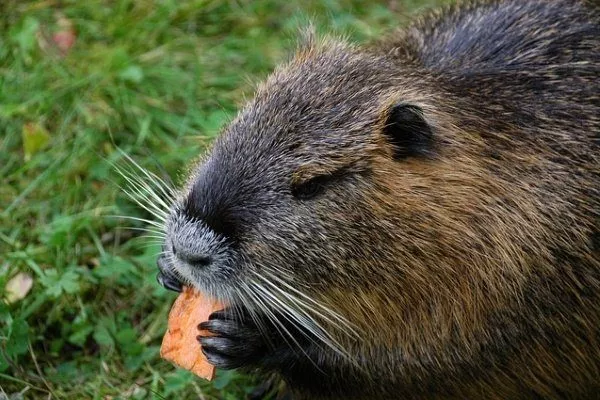
What can you feed animals?
There's no strict diet for nutrias; each breeder chooses their own feeding schedule and food selection. Nutrias thrive on a monotonous diet. These animals consume about 200 kg of food per year and don't like their diet to change drastically.
There are 4 different feeding options for nutria:
- Dry. Commercial dry food. Water is provided separately.
- Semi-moist. Grain or compound feed is combined with fruits and root vegetables, green or coarse dry food.
- Mixed. In the morning the livestock is fed dry food, and during the second feeding they are given plant food.
- Separate. Different types of food are given separately.
- ✓ The water temperature for soaking grains should be at least 20°C for optimal swelling.
- ✓ The grain soaking time before feeding should be at least 2 hours to improve digestibility.
Taking advantage of nutrias' omnivorous nature, they can be fed anything they can chew. And given their voracious appetite and the strength of their incisors, they can chew anything. Along with root vegetables, vegetables, and weeds, the animals can be fed grain mixtures, corn stalks, and even young branches to sharpen their teeth. Let's take a closer look at the foods that can be included in the diet of captive-bred swamp beavers.
Green fodder
| Name | Protein content, % | Fat content, % | Fiber content, % |
|---|---|---|---|
| Green parts of legumes and cereal plants | 18 | 3 | 25 |
| Quinoa | 15 | 2 | 20 |
| Cattail | 12 | 1 | 30 |
| Water rice | 10 | 0.5 | 35 |
| Sweet clover | 16 | 2.5 | 22 |
| Cane | 11 | 1.5 | 28 |
| Plantain | 14 | 2 | 24 |
| Coltsfoot | 13 | 1.8 | 26 |
| Sow thistle | 17 | 2.2 | 23 |
| Pemphigus | 9 | 0.8 | 32 |
| Ivan tea | 19 | 3.5 | 18 |
| Sedge | 8 | 0.7 | 34 |
| Dandelion | 20 | 4 | 15 |
| Clover | 21 | 4.5 | 12 |
| Marsh cinquefoil | 7 | 0.6 | 36 |
| Buckwheat | 22 | 5 | 10 |
| Seaweed | 6 | 0.5 | 38 |
| Salad | 23 | 5.5 | 8 |
| Sorrel | 24 | 6 | 5 |
The most nutritious grass is the one that has flowered and developed ears; it contains the most vitamins, calcium, phosphorus, proteins, and carbohydrates. Nutria can be fed:
- green parts of legumes and cereal plants;
- quinoa;
- cattail;
- water rice;
- sweet clover;
- reed;
- plantain;
- coltsfoot;
- sow thistle;
- pemphigus;
- Ivan tea;
- sedge;
- dandelion;
- clover;
- cinquefoil;
- buckwheat;
- algae;
- salad;
- sorrel.
- Collect green fodder in the morning hours when it has the highest nutrient content.
- Rinse the greens under running water to remove dust and any chemicals.
- Chop the greens to a size of 3-5 cm to make them easier for the nutria to eat.
In summer, adult nutria should receive 800-1000 grams of green feed daily. To prevent bloat in nutria, green feed should be washed before feeding.
Cereal crops
| Name | Protein content, % | Fat content, % | Fiber content, % |
|---|---|---|---|
| Barley | 12 | 2 | 5 |
| Millet | 11 | 3 | 8 |
| Rye | 10 | 1.5 | 9 |
| Oats | 13 | 4 | 10 |
| Wheat and wheat bran | 14 | 2.5 | 12 |
| Corn | 9 | 4.5 | 2 |
Three-quarters of nutria's diet consists of grains. These aquatic rodents readily consume grains, which are ground and soaked for a couple of hours to make them easier to eat. Nutria can be fed:
- barley;
- millet;
- rye;
- oats;
- wheat and wheat bran;
- corn (except for pregnant females and females preparing for mating).
For better growth and development, nutrias are fed sprouted grain, pre-soaked for two days. The daily grain requirement for an adult nutria is 100-150 g.
Dry and rough food
| Name | Protein content, % | Fat content, % | Fiber content, % |
|---|---|---|---|
| Bark | 5 | 1 | 40 |
| Branches | 6 | 1.2 | 38 |
| Needles | 4 | 0.8 | 42 |
| Hay | 8 | 1.5 | 35 |
| Straw | 7 | 1.3 | 37 |
| Dry cake and pulp | 9 | 2 | 30 |
| Crushed meal from soybeans, hemp, sunflower, flax | 10 | 2.5 | 25 |
Dry and coarse feed serves as a source of fiber. The feeding rate depends on the season and ranges from 50 to 150 g. The following can be used as coarse and dry feed:
- bark;
- branches;
- pine needles;
- hay;
- straw;
- dry cake and pomace – waste from wine and sugar production;
- crushed meal from soybeans, hemp, sunflower, flax.
These types of feed are given to nutria only in winter. They are harvested in late spring or early summer, when plants contain the most nutrients. The feed prepared for winter is dried in the sun. Grass meal is considered a valuable feed; it is recommended to mix it with other feeds.
Vegetables, fruits
| Name | Protein content, % | Fat content, % | Fiber content, % |
|---|---|---|---|
| Boiled potatoes | 2 | 0.1 | 1.5 |
| Raw carrots and beets | 1.2 | 0.2 | 2 |
| Tomatoes | 1 | 0.3 | 1 |
| Cabbage | 1.5 | 0.2 | 1.8 |
| Zucchini | 1.3 | 0.1 | 1.2 |
| Boiled pumpkin | 1.1 | 0.2 | 1.5 |
| Jerusalem artichoke | 1.4 | 0.3 | 1.7 |
| Turnip | 1.6 | 0.2 | 1.9 |
| Watermelons | 0.8 | 0.1 | 0.5 |
| Melons | 0.9 | 0.1 | 0.6 |
| Apples | 0.7 | 0.2 | 1 |
Nutria are fed approximately 200 grams of root vegetables, fruits, and vegetables daily. They can be fed:
- boiled potatoes;
- raw carrots and beets;
- tomatoes;
- cabbage;
- zucchini;
- boiled pumpkin;
- Jerusalem artichoke;
- turnips;
- watermelons;
- melons;
- apples.
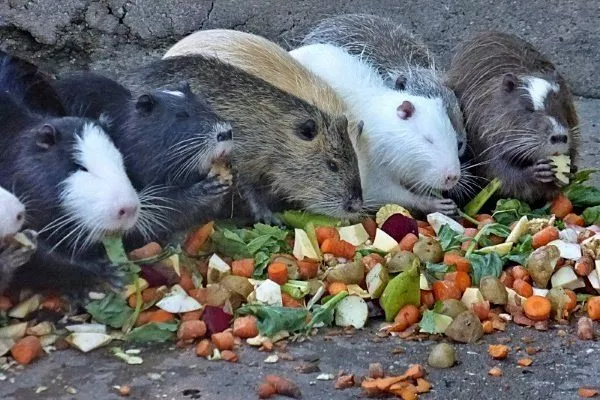
Industrial compound feed
Industrially produced compound feed is a feed mixture and an excellent grain substitute. It contains all the nutrients necessary for nutria. Fur farms use only pelleted compound feed—it's ideal for feeding aquatic rodents. 100 grams of compound feed contains 290 kcal, 16 g of protein, calcium, phosphorus, and other beneficial substances.
The industry produces special compound feed for nutria, but compound feeds produced for other livestock, such as rabbits, pigs, and calves, can also be used. Compound feeds must be diluted with water before feeding.
Advantages of industrial compound feed:
- saves time on preparing feed;
- balanced composition;
- have a longer shelf life than home-made compound feed.
Nutria should not be fed poultry feed, as it contains crushed shells and chalk. Cattle feed is contraindicated due to the presence of urea.
Never feed a feed that raises doubts without testing it on several nutria. Control animals are removed from the herd and fed for two weeks. If any symptoms or behavioral changes occur, the feed being tested is discarded.
The industry produces pelleted feed with a diameter of 3-6 mm. The pellet length is up to 1.2 cm. The pellet size is designed to prevent nutria from picking and choosing their favorite ingredients, ensuring they consume the entire feed evenly. The composition of nutria feed is listed in Table 1.
Table 1
| Composition of compound feed | % of total mass |
| No. 1 | |
| Herbal flour | 10-20 |
| Corn and barley | 33-43 |
| Wheat and oats | 15 |
| Wheat bran | 12 |
| Sunflower meal | 8 |
| Pea flour | 5 |
| Fish meal | 3 |
| Feed yeast | 2.2 |
| Bone meal | 0.5 |
| Feed chalk | 0.5 |
| Table salt | 0.3-0.5 |
| Multivitamins | 0.3-0.5 |
| No. 2 | |
| Herbal flour | 20 |
| Flaxseed meal | 18 |
| Wheat bran | 17 |
| Crushed barley | 15 |
| Dry beet pulp | 15 |
| Malt sprouts | 5 |
| Protein hydrolysate | 5 |
| Crushed corn | 2 |
| Fish meal | 2 |
| Calcium phosphate | 0.4 |
| Multivitamins | 0.2 |
| Fodder chalk | 0.3 |
| Table salt | 0.1 |
Compared to other types of compound feed, granulated feed has the following advantages:
- granules retain their beneficial properties for a long time;
- no delamination during transportation;
- homogeneity of granules;
- the possibility of automating the feeding process.
100 g of compound feed contains 96-104 feed units, as well as:
- crude protein – 16-18 g;
- digestible protein – 13-14.5 g;
- crude fat – 3-3.3 g;
- crude fiber – 7.5-10.5 g;
- phosphorus – 0.6-0.78 mg;
- calcium – 0.84-1.0 mg.
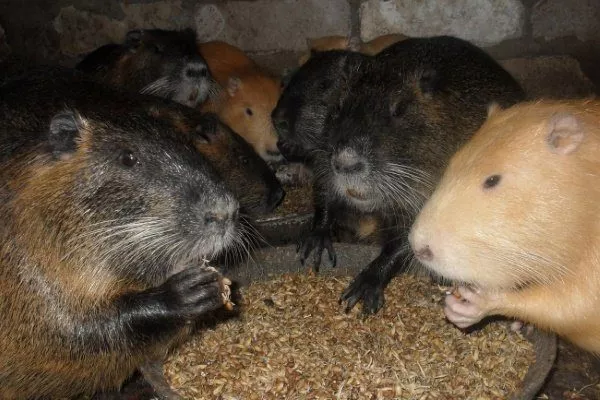
Homemade compound feed
You can prepare your own nutria feed. For example, like this:
- put equal parts barley (wheat) and oats (corn);
- add meal – 1/10 of the mixture;
- add flour - bone, meat or fish, or feed yeast - 1/5 of the resulting mixture;
- add salt and chalk.
Homemade feed, like commercially prepared feed, should only be fed after soaking. An example of the percentage of ingredients in homemade feed is shown in Table 2.
Table 2
| Ingredients | % content of total mass |
| Wheat | 45 |
| Corn | 40 |
| Sunflower meal | 8 |
| Yeast | 6 |
| Chalk | 0.5 |
| Salt | 0.5 |
| Vitamins | at the discretion of the farmer |
Supplementary feed
There are periods when vitamins and mineral supplements are crucial for nutria. Deficiencies can occur at the end of winter and with monotonous feeding. Primarily, the animals lack vitamins A and D. Vitamin deficiency weakens their immunity, and nutrias become ill. Pregnant and lactating females are particularly vulnerable, as vitamin deficiency can lead not only to illness but also to abortion and cannibalism.
To avoid vitamin deficiency and other health problems, nutrias are recommended to be given the following daily:
- Fish oil with vitamins – up to 1 g.
- Multivitamins – up to 1 g.
- Vitamins A, D, and E, prepared in an oil base, are mixed with milk or fat and given to the animals.
- carotene – 1 g for puppies and 3 g for adults;
- retinol acetate – 0.34 mg.
Animals can be provided with carotene by feeding them raw carrots. Sprouted carrots are rich in vitamin E, and 20 grams of them are given daily.
- Calcium and phosphorus. They are abundant in meat and bone meal, fish meal, chalk, limestone, travertine, feed precipitate, and tricalcium phosphate.
In summer and winter, nutria need salt – 1 g per individual.
When adding vitamin and mineral supplements to concentrated feed, the mixture must be thoroughly mixed. Otherwise, the animals will receive the nutrients unevenly – they will eat more of some ingredients than others.
Water
Nutria must have constant access to clean drinking water; water bowls are installed in their cages for this purpose. This is especially important if the nutria are fed dry food. Water should not be a source of infections, bacteria, or intestinal parasites, so it should not be taken from ponds or other questionable sources.
Water is added to the drinking bowls twice a day. Nutria can receive some of their water with their grain mixture, or they can dispense with drinking bowls entirely by adding water to the grain feeders. This way, the animals will consume both the food and water, and the bedding will remain dry.
What is prohibited to feed nutria?
Nutria's omnivorous diet is related to the type of food they eat, not its quality. Feeding them low-quality or toxic foods can cause death. There are also certain foods and plants that are contraindicated for nutria.
It is strictly forbidden to feed swamp beavers:
- sprouted and green potatoes;
- green potato and carrot tops;
- rotten, moldy or fermented food;
- viscous porridges;
- compound feed for poultry and cattle;
- raw meat and fish;
- cottonseed cake;
- oats (can be given from 4 months of age);
- green fodder treated with chemicals.
Nutria are not allowed to be given hot water - it is dangerous for their body.
When feeding nutria, you need to understand botany. You'll need to study herb descriptions to avoid accidentally feeding them celandine, foxglove, datura, hemlock, water hemlock, aconite, sleepy grass, hellebore, milkweed, comfrey, hemlock, and buttercup. However, dried herbs make them safe for rodents.
Nutria love acorns, but they should be fed with caution as they can cause constipation. The maximum dose of legumes per individual is 25 g. There are also specific contraindications for pregnant females and females preparing for breeding. They should not be fed corn. Sugar beets are not recommended for lactating females. Beet tops are also undesirable as they can cause digestive upset.
Kalanchoe, a popular medicinal plant, is deadly to nutria, causing paralysis in the animals.
Feeding by seasons
The nutria's diet is adjusted depending on the season. Since water beavers are eager for a variety of foods, seasonal feeds can be introduced into their diet. Their summer diet is rich in green fodder, vegetables, and fruits. In winter, they rely on preserved root vegetables and other vitamin-rich foods.
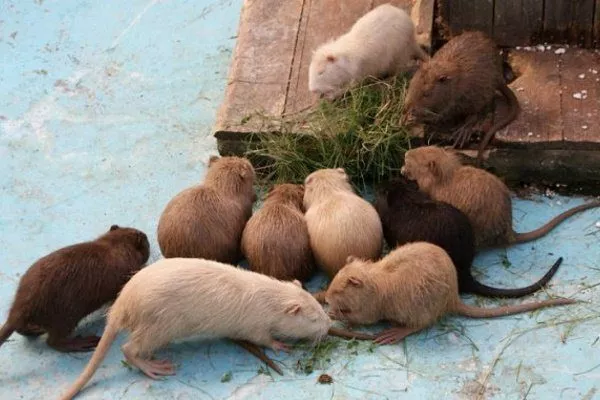
Spring-summer
During the warm season, breeders make the most of summer's bounty—it provides both free food (such as grass or weeds from the garden) and a source of vitamins. In the summer, nutrias are fed all permitted plant species, from cattails to dandelions.
While nutrias rely heavily on grass in the spring, with the onset of summer, their diet expands to include fresh vegetables and fruits. They can be fed cabbage, cucumbers, tomatoes, and other garden produce. Even the peelings of vegetables, berries, and fruits can be used as food. Summer diets for individuals of different ages are listed in Table 3.
Table 3
| Feed in summer | Daily intake for adult nutria, g | For young animals, g | |
| up to 2 months | 2-6 months | ||
| Green fodder | 800-1000 | 150-400 | up to 800 |
| Cereals | 100-150 | 35 | 80-100 |
| Salt | 0.5-1 | 0.2 | 0.5 |
| Chalk | 1.5 | 0.5 | 1 |
| Whole milk | 15-20 | 10-15 | 10-15 |
| Meat-fish | 7-10 | 5-8 | 5-8 |
Composition of green fodder in % ratio:
- willow leaves – 10%;
- meadow grass – 30%;
- vetch grass – 30%;
- green fodder beans – 15%;
- cattail roots – 10%.
If possible, in summer, grass can be replaced or combined with vegetables and fruits.
Autumn-Winter
In winter, when there's no grass or other greenery, feeding nutria is more difficult and expensive. Their winter diet should consist of dry and succulent foods. Dry food for winter:
- straw-grass flour;
- hay;
- brooms made from sedge and water rice, prepared in summer.
Hay is given every 2-3 days. Some of the hay is used for bedding. Branches are given occasionally for the animals to nibble on.
The main succulent foods and sources of vitamins during the winter are carrots and beets. It's best to feed nutrias both, mixed in roughly equal parts. The daily requirement for root vegetables is 0.5 kg. However, even feeding the animals a carrot-beet mixture every day won't provide them with all the necessary nutrients. It's also recommended to include the following in their winter diet:
- Potato. It is boiled and added to the mash.
- Pumpkin. It's also served boiled. This vegetable has a unique composition and can replace root vegetables. Just be sure not to feed spoiled pumpkin—mold or rot can cause serious illnesses.
In winter, when fresh vegetables, fruits, and green grass are unavailable, animals should be fed grain-based mash. Liquid waste, such as borscht, soups, dairy products, and porridge, can be added to mash made from ground corn, wheat, bran, or mixed feed. Boiled potatoes, peelings, and boiled pumpkin can also be added. Grass meal should make up no more than 10-20% of the mash.
The mash should be fairly thick. The nutria will only be able to eat it if it can form a ball out of it that it can hold with its paws.
Winter diet for individuals of different ages is shown in Table 4.
Table 4
| Feed in winter | Daily intake for adult nutria, g | For young animals, g | |
| up to 2 months | 2-6 months | ||
| Roots | 400-500 | 150 | 300 |
| Cereals | 100-150 | 35 | 80-100 |
| Hay | 100 | 50 | 100 |
| Branches | 150 | 50 | 150 |
| Salt | 0.5-1 | 0.2 | 0.5 |
| Chalk | 1.5 | 0.5 | 1 |
| Fish oil | 0.5 | 0.3 | 0.5 |
Root crops fed to nutria, in % ratio:
- carrots – 20%;
- beetroot – 25%;
- rutabaga – 10%;
- cabbage – 25%;
- raw potatoes – 15%;
- cabbage and carrot silage – 5%.
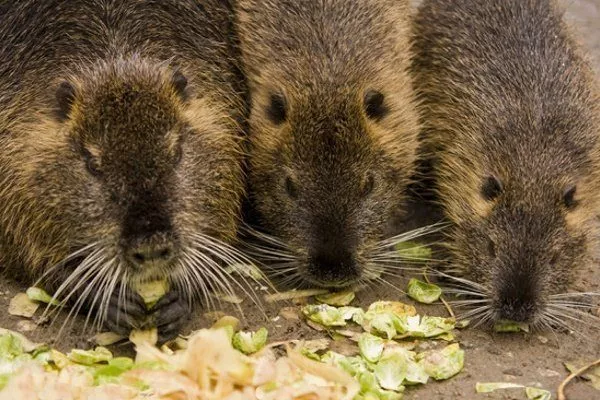
Features of feeding nutria
The diet of nutrias depends on their age, physiology, and the purpose for which they are bred. Feeding standards for nutrias depending on their condition are presented in Table 5.
Table 5
| Physiological state | Grass or root vegetables | Concentrates | Hay or grass meal |
| Adults | 200-300 | 150-200 | 30-40 |
| Preparing for mating | 180-270 | 120-200 | 20-40 |
| Mating and the first half of pregnancy | 200-300 | 150-240 | 25-40 |
For fattening
Animals raised for meat are fed a dry diet. The diet should be balanced in energy, protein, fiber, and minerals. Nutria gain weight well on a 1:4 ratio of concentrates and succulent feed. Alternatively, they can be fed concentrates with up to 15% protein and 7% animal protein. The diet should contain 3.5-5.5% fat, which is given at 5-10 g per day. The diet must also include B vitamins, as well as A, C, E, D, and K.
Recommendations for feeding nutria:
- In summer, grain feed is soaked, and in winter, it is steamed. Sprouted grain can also be fed during the winter season.
- It is better to give root crops at midday, green fodder in the afternoon, and roughage (hay) before bedtime.
If feeding practices are followed, slaughter yield reaches 50-53% of live weight. An adult nutria weighs 2.2-2.3 kg.
Pregnant nutria
Pregnant females require increased nutrition during the second half of pregnancy. Towards the end of the first half, females are housed in smaller cages to avoid energy waste. Feed volume is initially increased by 10% and then gradually increased to 35% of the initial amount. During the second half, the female should consume:
- root vegetables – 330 g;
- compound feed or grain – 250 g;
- hay or grass meal – 45 g;
- protein foods and vitamins.
A pregnant female should not weigh more than 3 kg, and there should be no fat deposits on her body. If the female gains excessive weight, her food intake should be reduced by a third.
Lactating females
For several days after the birth of the puppies, the female eats nothing—she has no appetite. When the female begins to eat, she must be provided with food that will ensure her milk is rich and nutritious. If the milk is of poor quality, the puppies may die. A nursing female receives double the food ration of adult nutrias.
The menu for lactating females must include the following components:
- grain or compound feed;
- roots;
- legumes;
- fish meal;
- fresh grass, hay or grass meal;
- table salt.
Grains and root vegetables form the basis of a nursing sow's diet. Grass should make up 20% of the total.
During the lactation period, the female should not lose more than 10% of her weight.
Young animals
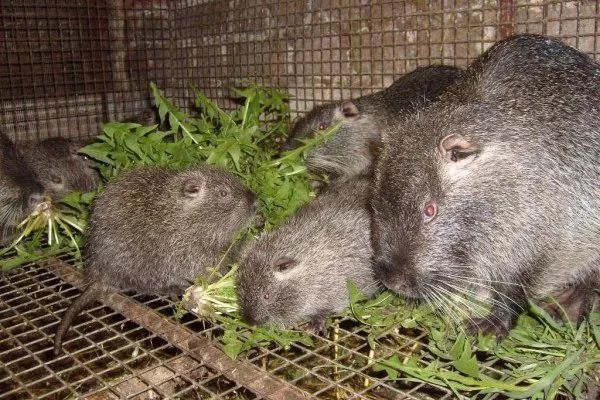
Newborn cubs initially drink only milk. But as early as the second day of life, they can be given a mixture of root vegetables and mixed feed. After two weeks, the cubs eat the same food as the mother, the only difference being the amount.
When the puppies reach 1.5 months of age, the feeding volume is calculated as follows: six puppies are given the same amount of food as one female. Water should be clean and freely accessible. The young puppies' diet should include:
- soaked grain;
- roots;
- hay or fresh grass.
If the female refuses to nurse her offspring or dies, the young are given warm cow's milk with added glucose. They are fed with a pipette. Feedings are given every three hours, from 6 a.m. to 9 p.m. After seven days, semolina, grated apples, and carrots are added to the cow's milk. After another two weeks, the young are fed porridge and soaked compound feed.
Feed amount for young animals:
- 1st week – 1 g of milk at a time.
- 2nd week – 5 g of milk at a time.
Weak puppies are given supplemental feeding. After 45 days, the young are separated from their mother and gradually transitioned to an adult diet. By 4 months, the young are eating the full adult diet.
What do nutrias prefer to eat in the natural environment?
If breeders have the opportunity, they can introduce natural food sources into the nutria's diet. In the wild, these animals live in bodies of water, feeding on whatever they can find on the shore or catch in the water. Nutria are practically omnivorous, but their diet primarily consists of reeds and cattails, their stems, leaves, and rhizomes. They can also eat:
- reed;
- tree branches;
- water lilies;
- pondweed (aquatic plant);
- water chestnut.
If there is not enough plant food, swamp beavers can eat animal food - mollusks or leeches.
Feedback on feeding
Nutria are voracious eaters and will eat a wide variety of foods. It's no surprise that breeders experiment to find the optimal feed and feeding options. Let's see what nutria breeders have to say about feeding nutria.
Thanks to nutria's omnivorous nature, creating a complete diet for them is not at all difficult. The main thing is to follow feeding guidelines, sanitary standards, and avoid feeding them low-quality food.