
When breeding horses, every horse farmer must have specialized tools to help manage the animal, protect it from adverse conditions and situations, and ensure its comfort. Feeding equipment and grooming equipment are also essential.
Types of equestrian equipment
Horse tack is divided into several groups. They are as follows:
- control accessories;
- means for the safety of the horse and rider;
- items for comfort.
Much also depends on the purpose of breeding horses. For example, showing thoroughbred mares will require additional equipment. Each type of necessary equipment is equipped with an impressive set of components.
There are also other types of equipment, depending on the purpose of keeping horses:
- transport – a team usually consists of 2 or more horses, so horse harness has its own characteristics;
- agricultural – a special harness is required;
- visiting - there is no harness, but it is necessary saddle, horse blanket etc.;
- army – today it exists as a species, but is not used anywhere (it can be seen in museums).
Additionally, equipment is divided into training and riding equipment. Training requires the horse to be calmed, which is why auxiliary harnesses are used. For broken-in horses, a different type of harness is used.
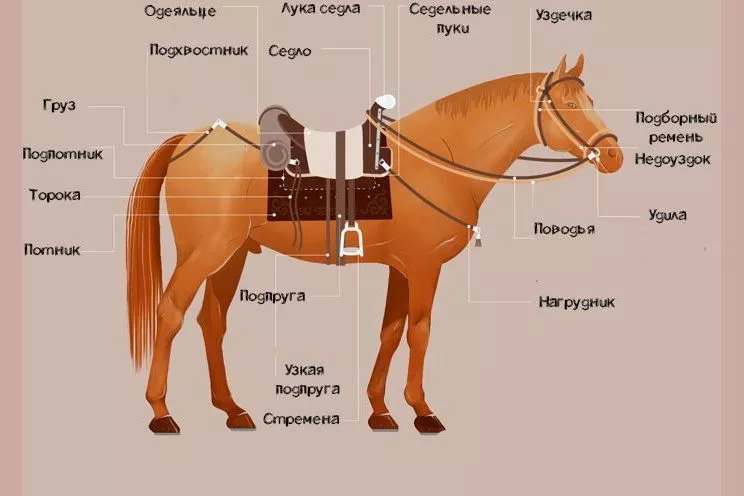
Horse control tools
To keep a horse moving in the right direction, it needs to be coordinated. This is accomplished with a control harness. This also helps teach the horse to follow the rider's commands and tame unruly four-legged friends.
| Name | Material | Length | Purpose |
|---|---|---|---|
| Bits | Copper, iron, steel, rubber | 12-14 cm | Front Body Control |
| Headband | Leather | Various | Transmission of command signals |
| Reins | Leather, braid | Short | Setting the direction of movement |
| Halter | Braid, leather | Various | Leading out horses, tying them up |
| Martingale | Leather | Various | Preventing head tilt |
| Chambon | Leather, braid | Various | Command training |
| Saddle | Wood, plastic, fiberglass | Various | Spinal protection |
| Stirrups | Steel, aluminum, plastic | Various | Rider comfort and balance |
| Whip | Plastic, rubber, gel | 75-125 cm | Horse control |
| Beach | Wood, plastic, nylon, leather | 2-3 m | Taming wild horses |
| Spurs | Iron | Various | Horse control |
Bits
The bit is designed for horseback riding. It allows the rider to control the front part of the animal's body. The bit consists of a mouthpiece (rod) and rings on the sides. The device is inserted into the mouth from the edges, where the teeth are missing.
To slow down or stop a horse, the rider must apply tension, which compresses the horse's jaw, tongue and lips, causing it to obey.
Various materials are used for production – copper, iron, steel and other metals, but ultra-modern models can be made of high-strength rubber.
The rod also has another name - the snaffle bit. It is attached to bridle and belts. Please note the requirements for the bits:
- the distance between the rings should be from 12 to 14 cm;
- It is important to select harness based on the size of the horse's head, otherwise it will be uncomfortable;
- The taste of the bit is an important factor, as horses chew the bit, which relaxes the lingual-pectoral muscles;
- Never buy a tool based on external features - functionality is what matters.
- ✓ Take into account the physiological characteristics of the horse: head size, sensitivity of the lips and tongue.
- ✓ Materials that do not cause allergic reactions in the animal, such as rubber or special alloys, are preferred.
But the most important thing is comfort for the animal, as even-toed ungulates experience pain with every pull, and if the bit is too small, even just walking. A rubber bit is the best option—the horse won't suffer.
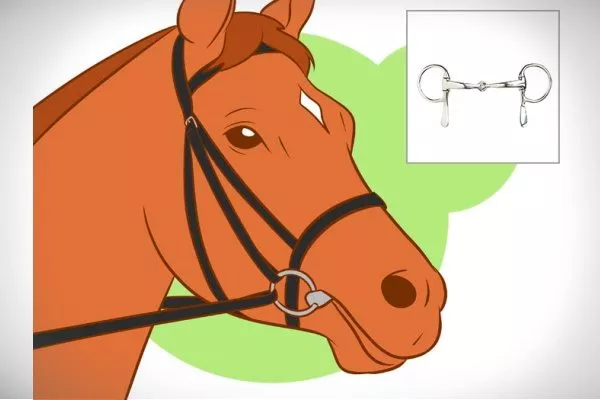
Headband
A bridle is a bridle made of leather straps used to hold the bit. It is used by the rider to convey commands to the horse. Bridles come in different types:
- Snaffle bits. They are considered universal, as they can be used for both training and regular riding. A key feature is that a bit is required, but a carrying strap is not required.
- Mouthpiece. Designed exclusively for dressage, this bridle allows the horse to follow commands more precisely. It is used with both types of bits and reins.
- Running. It combines a classic bridle and halter and is used exclusively for long rides. Its distinctive feature is the easy-to-detach cheek straps and reins, making it easy to attach to carrying straps.
- Hackamore. The bridle is bitless, so it fits directly over the horse's chin, nape, and nose. A huge advantage is that there's no need to use metal parts on the horse's mouth.
This also belongs to the universal variety, but has a wider range of applications – for horseback riding, training, long hikes, young horses, and most importantly – when it is not possible to put a bit on the horse, for example, in case of a mouth injury.
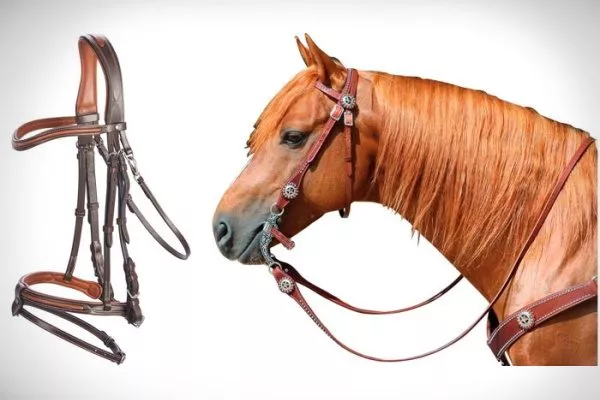
Reins
An essential component of the harness. Made from leather straps and webbing, it is attached to rings located on the bit using special buckles. The purpose of the reins is to set the direction of travel, change speed, and stop the horse.
There's also a tool called reins, but they're used with harnesses. They're designed to transmit impulses to the horse by shaking it vigorously. Unlike reins, reins are shorter and therefore not used with harnesses.
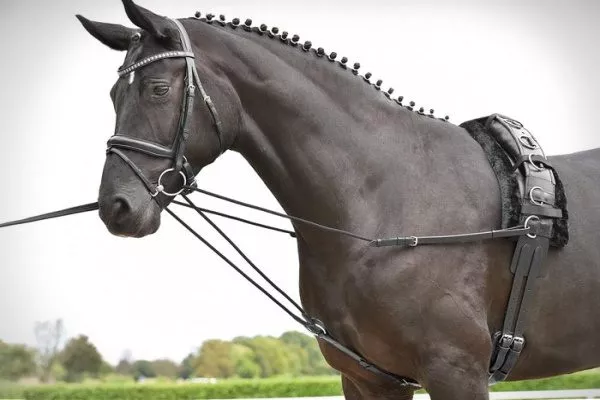
Halter
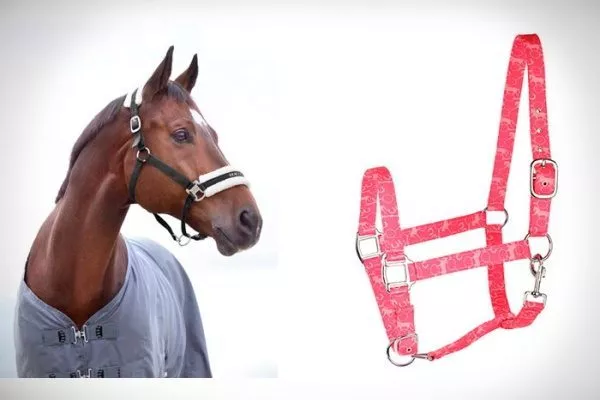
In appearance, it resembles a bridle used without a bit, or a hackamore. It is used only for leading horses out of paddocks, tying them up in stalls, and saddling. To secure the horse in the stable, tie-down straps are used.
The halter is placed on the head. A lead rope is also required. The halter is made from reinforced webbing or leather.
Martingale
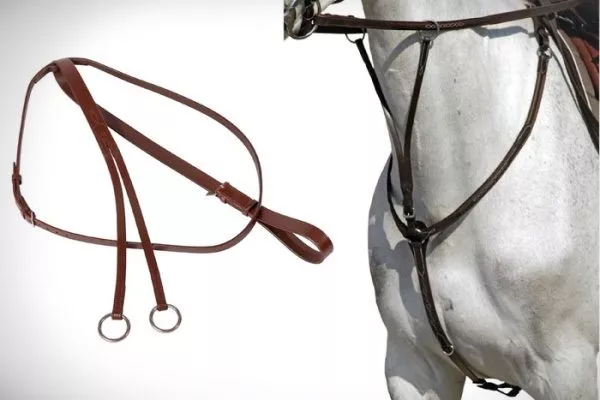
A piece of horse tack known by the "foreign" name of a martingale prevents the horse from throwing its head back, which poses a risk of injury to the rider. The problem is that throwing the head back means losing control of the horse.
One side is attached to any type of girth, and the other to the sternum (for this purpose, the martingale has two leather straps running from a single strap). The martingale is also equipped with rings for reins.
The martingale works as follows:
- The horse raises its head.
- The martingale is being pulled tight.
- This results in a lot of tension on the bit.
- The animal feels discomfort and lowers its mane.
The design of the instrument is quite varied, and they are intended for experienced racehorses, unbroken young horses, etc. Experienced horse breeders recommend choosing a martingale with the help of specialists, as the condition of the horse's teeth, its intended use, and other parameters are taken into account.
Chambon
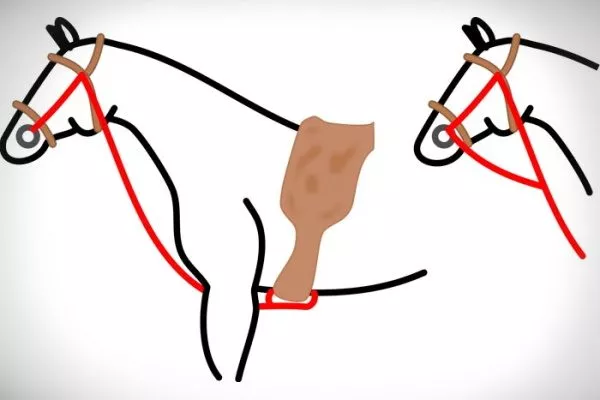
A chambon refers to a special strap used for training a horse. It helps train horsemen to perform commands such as lowering their heads and stretching their necks and backs. This is why the tool is used on the lunge line during dressage.
The chambon consists of rings connected to the bridle strap located at the poll. The second part is attached to the girth and divided into two cords. These cords pass across the entire poll and along the cheek area, after which they are secured to the bit.
How it works:
- When the horse assumes an incorrect body position, the chambon applies slight pressure to the occipital region.
- As a result, the animal stretches out parts of its body.
- Along with this, relaxation occurs.
Saddle
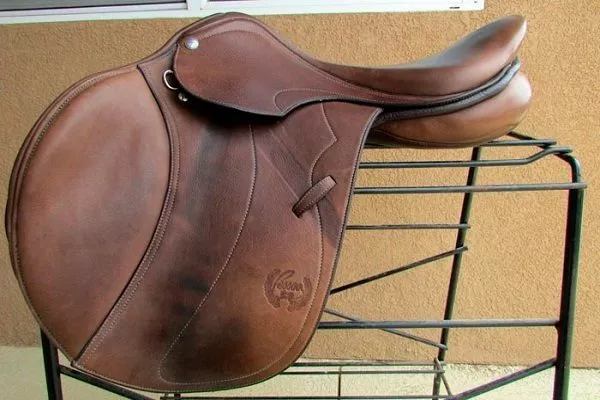
Many people mistakenly believe that a saddle is designed solely for the rider's comfort. In fact, this piece of equipment serves more for the horse's comfort—it protects the animal's back. This element reduces pressure and distributes the rider's body weight evenly across the horse's body.
The saddle comes in the following varieties:
- By driving style - Spanish, arena, English, vaulting, western, Asian, ladies', drill, racing, Cossack, Hungarian.
- By appointment - pack, riding, pack-riding.
In fact, there are so many different saddles that it's simply impossible to describe them in just a few words. Much more important is the saddle's components:
- Archak or Lenchik. This is a rigid frame. It is made from various materials, including fiberglass, laminated wood, and plastic.
- Seat. It is located slightly lower than the front and back bow.
- Luke. It is located in front and behind the saddle and has raised edges.
- Wing. There are two types: the standard extended type, used for dressage, and the fender (shortened and set forward). The latter is designed for Western riding and show jumping.
- Schneller. Closes the putlischa.
- Saddle cushions. They are installed so that there is space between the saddle and the horse's spine. They are usually made of natural wool or synthetic materials.
Today, universal, multifunctional options are also being produced. Some experts advise against purchasing them, as they don't fully meet the requirements for use in a given situation (walking, jumping, etc.).
Stirrups
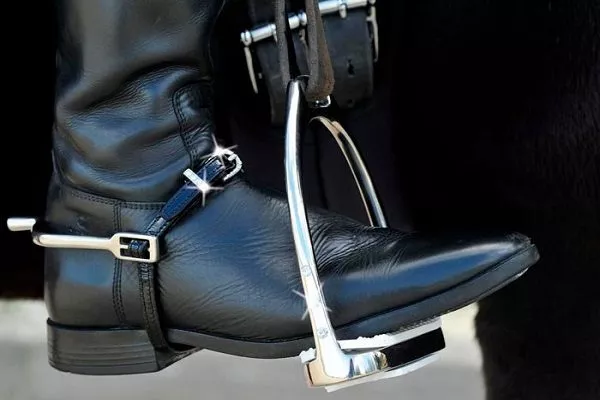
Stirrups deserve special attention, as not all saddles are equipped with them. They are designed for comfort, balance, and stability for the rider. They are attached using the stirrup and stirrup leather. They come in a wide variety of shapes and configurations, and are selected solely to fit the rider's legs.
Steel, aluminum and plastic materials are used for production, often with rubber segments.
Whip
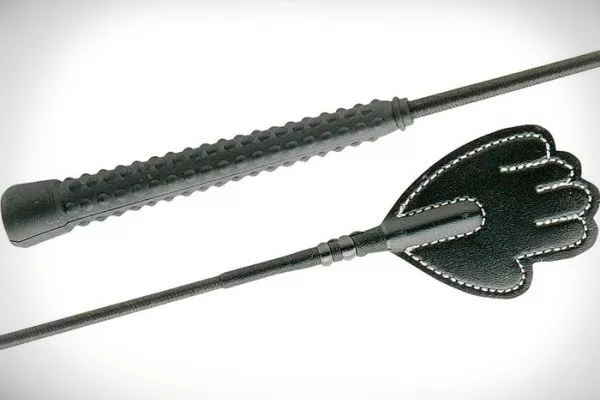
This is an auxiliary piece of equipment, also known as a whip. Its primary purpose is to control the horse by whipping it. To prevent the force of the blow from being too strong, whips are equipped with special crackers at the very tip. The standard length of a whip is 75-125 cm.
To prevent the product from slipping off the rider's hand, loops are installed. The handle is usually made of plastic, rubber, or hard gel. There are different types – for racing, dressage, training, etc.
Beach
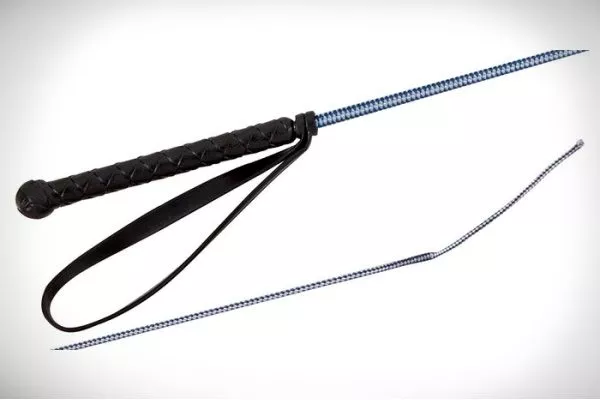
The main purpose is to tame unruly and unruly horses. Inexperienced horse breeders believe that the whip is used to punish the animal, but in reality, it is used to teach the animal proper movements. What does the design consist of?
- plastic or wooden handle;
- bowstring;
- a knot at the end of a bowstring.
The average length is 2 to 3 meters. The bowstring is woven from nylon or leather elements. A good indicator of a good whip is a click when struck.
Spurs
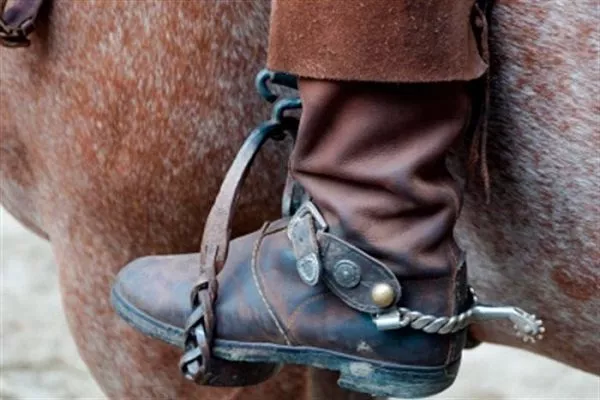
This is an additional tool worn on the back of the rider's boots. Its primary purpose is to control the horse by applying pressure to the sides of the body with the legs. The spurs consist of a small iron arch, a small wheel, and a burdock.
Horse protection equipment
Horses are often subject to injuries, bruises, falls, and other stress. But these aren't the only things that negatively impact their well-being and overall health. Exposure to cold and hypothermia in inclement weather, especially in autumn and winter, is also a significant risk. Therefore, horse tack was developed to protect horses.
| Name | Material | Type | Purpose |
|---|---|---|---|
| Blankets | Wool, synthetics | Levandnaya, nocturnal, New Zealand, gladiator, waggon, stable, melton | Weather protection |
| Bandages | Fleece, jersey, cotton | Elastic | Joint protection |
| Legs | Leather | With gel, extended | Bandage protection |
| Rubber holsters | Rubber | Closed, open, anatomical | Hoof protection |
Blankets
A blanket provides dryness and warmth. It's a covering used for transporting horses, during dressage training, and simply in uninsulated stables. It's made of natural wool or synthetic material—materials that provide warmth and retain heat.
There are models that absorb sweat, options made of lightweight fabrics, etc. This is necessary for different conditions, climates, and weather.
To prevent the blanket from slipping off the horse's body, it is secured with fasteners. Despite the vast variety of styles, experts recommend three basic options: "winter," "home" (for the stall), and "demo-modified" (for sweating).
The most common types are:
- Left-hand blanket. It dries the animal's body of sweat and prevents water from penetrating the fabric. This keeps the horse dry and warm without overheating. Synthetic fabrics are usually used for this purpose.
- Night. This is a thickened model with a lining that prevents the undercoat from growing through. It usually forms in the fall to keep the horse warm during the winter. This is physiologically necessary, but only for horses living in the wild.
For domesticated cats, this is undesirable, as excessively thick fur makes grooming difficult. Modern materials are used for their production, which don't require frequent cleaning and washing. - New Zealand LevandayaA very heavy blanket made of canvas. It is used primarily in stables.
- Gladiator and Vag. Both options are synthetic and designed to protect not only the torso but also the neck area from the elements.
- Stables. Used exclusively in stall to keep dirt and dust from penetrating the skin.
- Melton. This is a woolen stole that accumulates heat. It is extremely heavy, making it necessary for harsh climates.
In addition to the above models, there are many others – waterproof, fly-proof, fully closed (when only the eyes and ears are visible), etc.
Bandages
Bandages perform 3 main functions. Namely:
- prevent injury;
- warm the joints;
- immobilize the horse's legs after an injury.
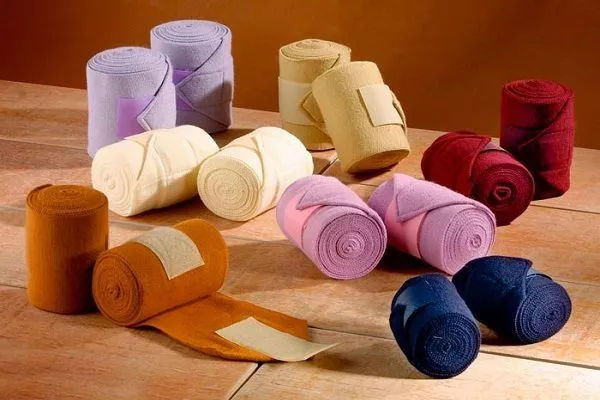
These are elastic devices that fit over the metacarpus. Some models are primarily applied to specialized pads secured with Velcro, etc.
Various materials are used, but fleece, knit, and cotton bandages are the most popular. The average width is 8 cm.
Legs
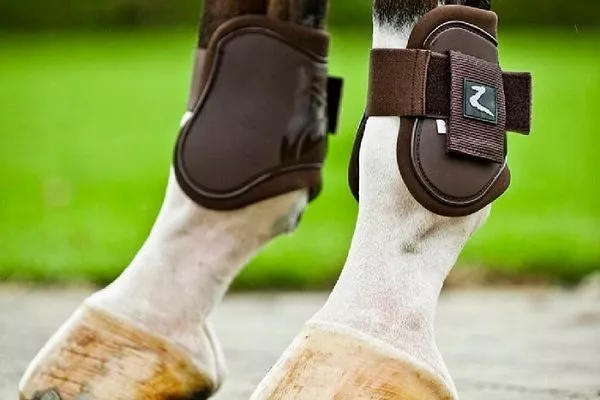
These are designed to protect bandages and are therefore placed directly over them. These shin guards are usually made of leather and secured with laces, buckles, or Velcro. The shin guards are pulled tightly to help prevent bruising.
There are different models – with gel filling, extended (for transportation), etc.
Rubber holsters
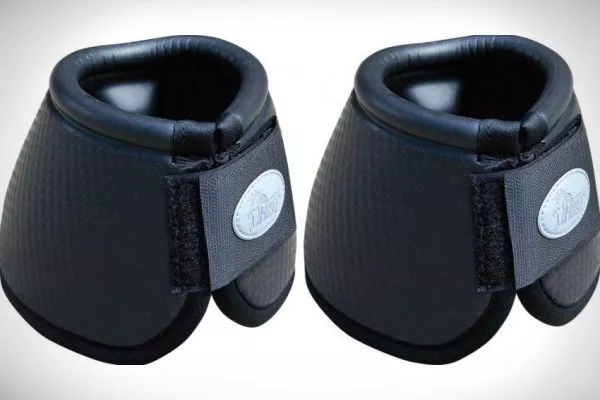
When a horse runs, its legs brush against each other, causing abrasions, wounds, and nicks. To prevent this, rubber hooves are used. They are used in the following cases:
- during the races;
- for transportation;
- if there is a risk of losing horseshoes.
There are 2 types of holster applications:
- only on the front legs;
- on all hooves (when a horse is prone to developing nicks not only on the front legs, but also on the back legs).
The products are available in 3 sizes. Are there any models like these?
- Closed. These are options that don't have fastenings, so when putting them on, they need to be pulled sideways (like putting on socks). They stay in place very securely (until the fabric stretches).
- Open. It's quite easy to put on, as the product has fasteners, but the downside is that they often slip on the leg, come off, or the horse steps on the fasteners.
In this case, it is recommended to purchase more expensive models that have a reinforced structure on the back. - Anatomical. They imitate open holsters, but are made in such a way that they do not turn over on the leg, as they are individually adjusted to the heel area.
What does a rider need?
Not only does a horse need equipment, but the rider needs it too, as it provides comfort and protection. What a rider needs is basic equipment:
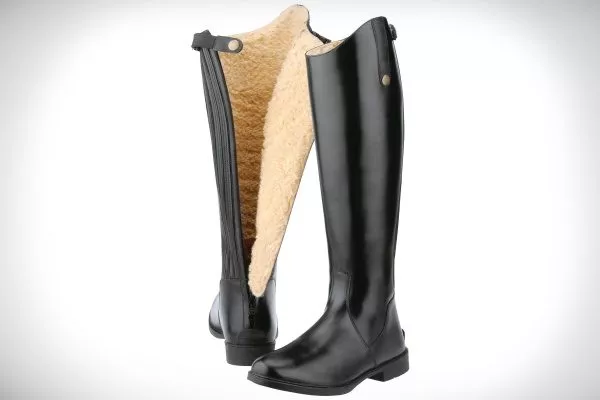
- Shoes. There are many different models available, but pay attention to the following requirements: boots should slide easily into and out of stirrups. Otherwise, your foot will get stuck in the stirrup if you fall. Other features:
- there should be a small heel that will prevent your foot from slipping out of the stirrups while riding;
- the sole is only thick;
- The outsole is grooved.

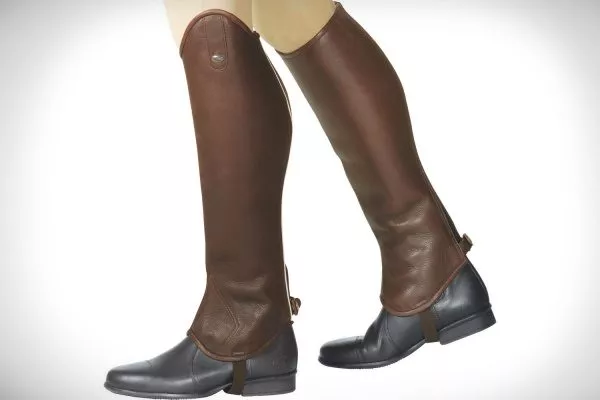
- Leggings. Designed for horseback riding when boots are not available, they are made of suede or leather and are secured with laces, clasps, or zippers.
- Chaps. These are form-fitting trousers with no rough seams, preventing chafing. They resemble tights/stockings but are made of leather or suede. They also provide additional protection from mosquitoes, thorns, and other insects.
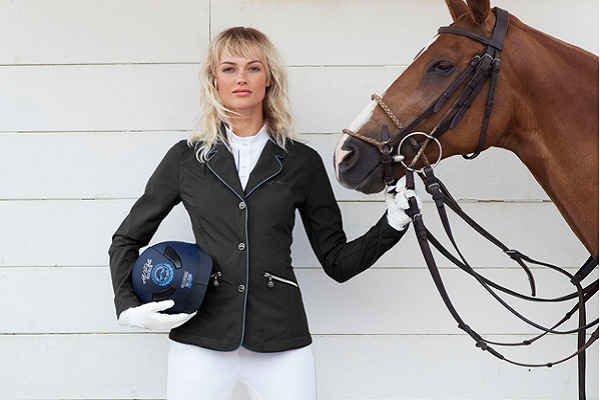
- Jacket, vestA mandatory requirement is waist-length, which prevents the rider from getting caught on the horse's tack. Style and requirements vary depending on the sport.
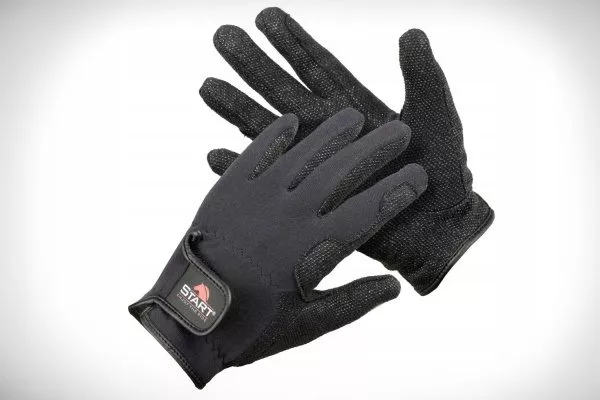
- Gloves. Store-bought reins aren't suitable for horseback riding, so you'll need to purchase them from specialized equestrian shops. They're made to ensure the rider can hold the reins without them slipping.
An additional benefit is protection against skin injury.
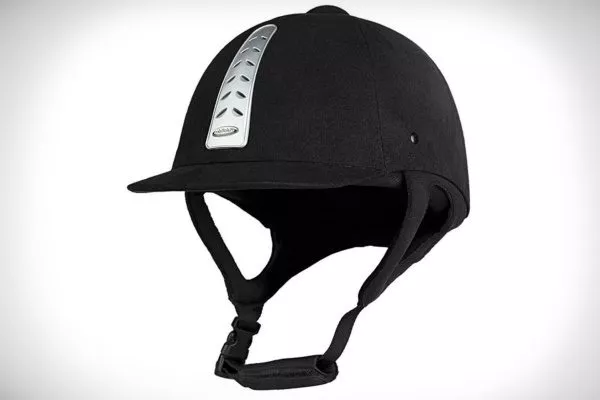
- Helmet. Designed to protect the head from injury during a fall from a horse, this harness is mandatory and is not suitable for mounting a horse. Key requirements: choose one that fits your head precisely and securely fastens with all fasteners.
Harness equipment
In our country, two types of harnesses are used. They are as follows:
- European. It does not have a belly pan and a saddle pad, but it does have the following elements:
- bridle and reins;
- blinders worn on the sternum through the neck (consist of rings, connecting straps - chest, retaining and connecting);
- saddle - with rings for reins;
- girth – secures the saddle;
- harness – secures the harness with back, side and bypass straps, and an undertail strap;
- traces - attached to the carriage and the harness.
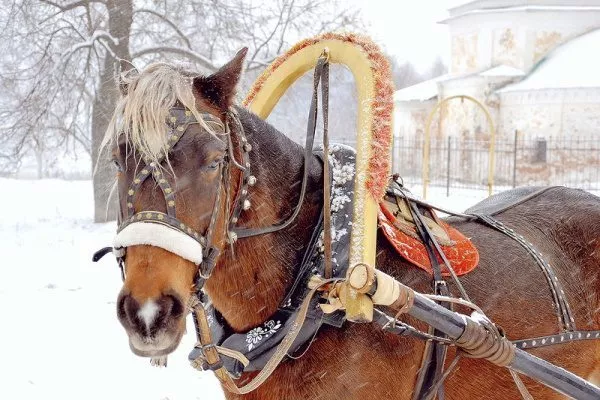
- Russian. The equipment is impressive, as it consists of the following parts:
- bridle and reins;
- saddle – secures the harness, located on the withers;
- girth – secures the saddle to the animal’s back;
- harness – holds the collar and fixes the movement of the harness;
- saddle strap - a special thin belt that is passed through the saddle rings and attached to the shaft (as a result, the harness is held in place);
- collar - needed to provide traction from the horse to the vehicle (has pincers, felt padding, collar, rings, and tires);
- belly strap – a belt placed under the animal’s belly and secured to the shaft and girth using a belt loop;
- arc – is considered a connecting element, softens impacts and jerks.
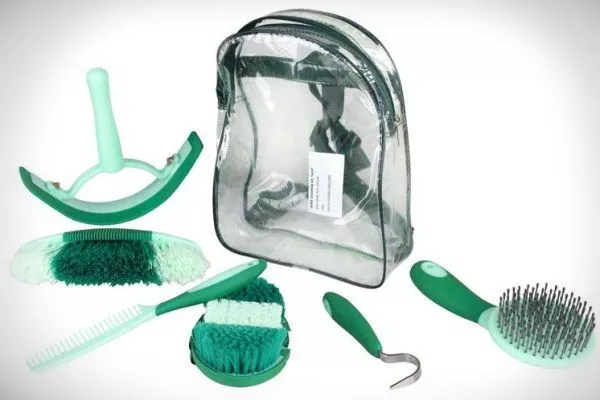
Grooming equipment
Horses need to be kept completely clean, as they are very clean creatures, and often become sick and die from contamination. This requires:
- soft brush – designed for cleaning the entire body and muzzle after rough cleaning;
- tail and mane brush – usually plastic, classified as a curry comb;
- comb – combs the mane and tail;
- metal scraper – cleans soft brush;
- rubber currycomb – cleans the brush, removes stickies and other dirt from the body (except for the legs and muzzle);
- Hoof pick – cleans hooves;
- tourniquet - hay twisted into a tight bundle (for massage);
- 2 sponges – for washing the muzzle and head;
- Sukonka – a cloth fabric designed to neutralize sweat and other moisture from the horse’s body.
There are many other devices – brushes for the muzzle, legs, scrapers for massage, etc., but they are not considered essential equipment.
Feeding equipment
Horses are fed a variety of feeds, so the equipment selected for this purpose is appropriate:
- a hay feeder must be a lattice one;
- a container for the wet mixture – made so that there are no cracks through which liquid will leak;
- Containers for grain feed and concentrates can be of a conventional suspended or bunker type.
There are universal models that combine compartments for different types of food.
The equipment comes in the following types:
- individual – designed for one individual, has parameters of 5-40 liters in volume;
- group – installed along the stalls, they hold from 50 to 300 liters, which corresponds to a herd of 2 to 12 horses.
Additionally feeders are divided as follows:
- stationary option - they cannot be moved or folded;
- mobile – can be easily moved from one place to another, which is also convenient when transporting horses;
- Folding – usually hung on the wall, opened for feeding, and then folded (significantly saving space in the stall).
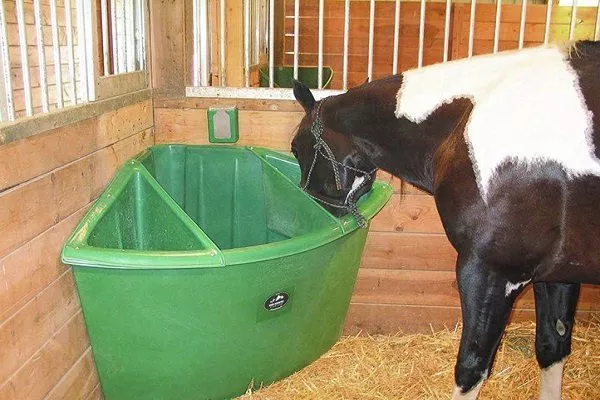
The form can be any, but it is important to adhere to the following criteria:
- the height of the feeder when hanging is 90-110 cm from the floor surface;
- material – natural, without chemical-synthetic coatings (varnishes, paints);
- purpose - for example, if it is hay, then grates are needed, otherwise the product will rot;
- food preservation – food should not spill from the tray onto the floor (this is an unnecessary expense);
- design - it is best to buy a simple one, so it will be easier for the horse to feed.
Before getting horses, carefully review the list of essential tools. Consider the horses' intended purpose—their tack will depend on it. If possible, make some yourself.